Original Odaily Planet Daily (@OdailyChina)

On December 1, Strategy announced the establishment of a $1.44 billion dividend reserve fund, primarily to support preferred stock dividends and debt interest payments. This fund comes from the proceeds of the company's sale of Class A common stock through an "at-the-market" (ATM) program, expected to cover at least 12 months of related expenses, with plans to further extend it to 24 months to enhance financial buffer capacity.
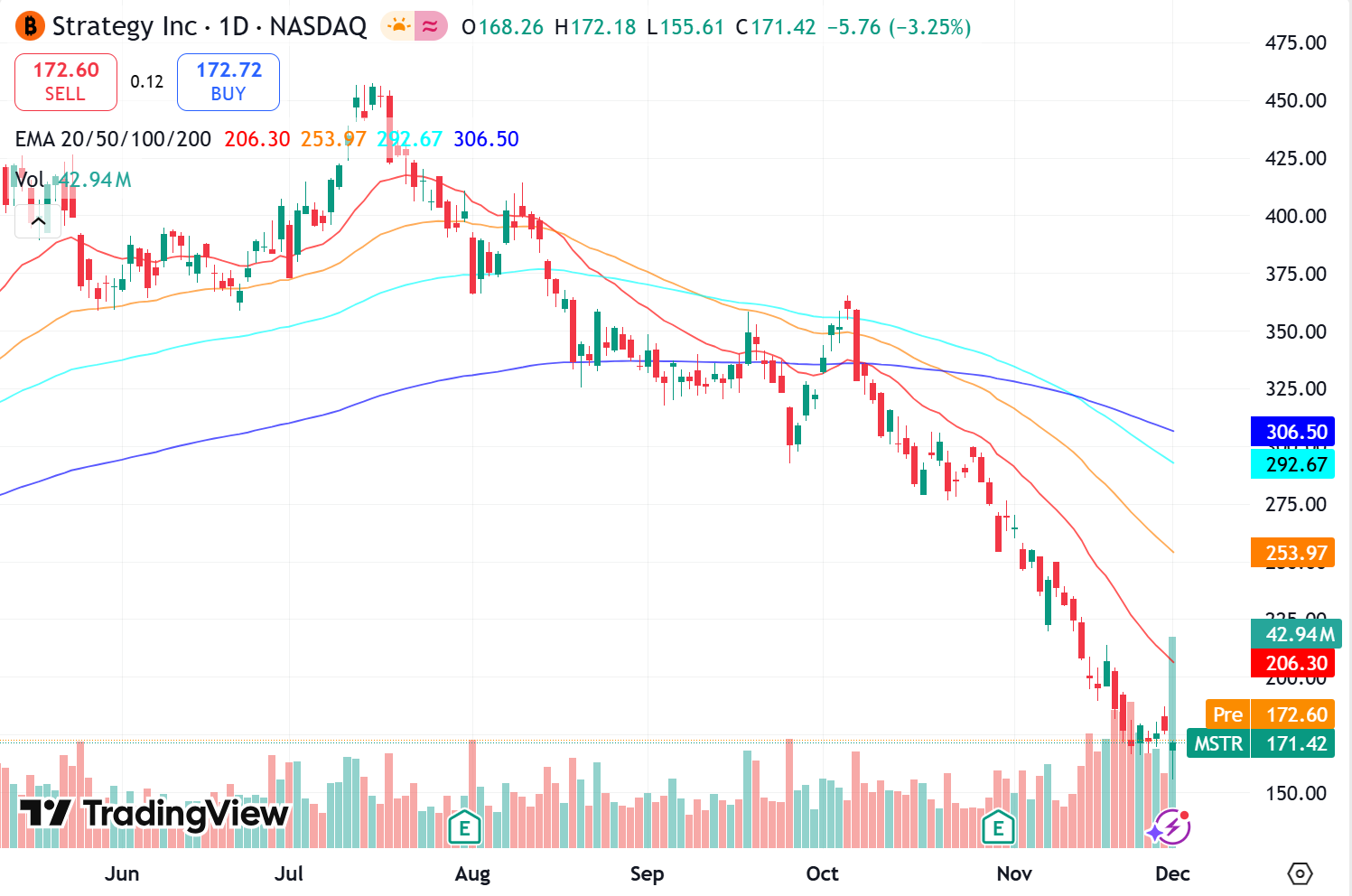
However, the market's reaction has not been friendly. Following the announcement, Strategy's stock price fell by about 5-10%, reflecting growing concerns in the market about its liquidity situation and long-term sustainability.
Currently, pessimism surrounding Strategy is rapidly fermenting in communities and media.
Some viewpoints liken Strategy to a "Bitcoin central bank," suggesting it is caught in a struggle between the traditional financial system (Federal Reserve, Wall Street, JPMorgan) and the emerging system (Treasury, stablecoins, Bitcoin collateral financing). The article points out that JPMorgan has recently intensified its short-selling efforts against Strategy, including delaying stock settlements, suppressing the Bitcoin derivatives market, and "crashing" through the options market to create panic. This has led to a continuous decline in Strategy's stock price, which has dropped over 60% since its peak in July 2025, and it faces the risk of being removed from the MSCI index. (Recommended reading: Federal Reserve vs. Treasury: The Currency War Behind Bitcoin's Plunge)
These pressures amplify Strategy's inherent vulnerabilities, raising market concerns about its "death spiral."
Reserve Fund: Short-term "Stopgap," but Cannot Change the Underlying Business Model
According to data from bitcointreasuries.net, Strategy currently holds approximately 650,000 Bitcoins, valued at about $56.5 billion, making it the publicly traded company with the largest Bitcoin holdings globally. Its average holding cost is around $74,431, and as Bitcoin has fallen from a high of $126,000 to the current $93,000, its unrealized gains have quickly shrunk to 25%, with asset volatility becoming more pronounced.
More critically, the company's market capitalization / Bitcoin net asset value (mNAV) has fallen below 1, currently at 0.87. This means the market values Strategy's stock lower than its Bitcoin holdings. A more straightforward explanation is that the market can buy MSTR stock containing $1 worth of Bitcoin for less than $1.
The core of Strategy's current predicament is a liquidity crisis. The high dividends on its preferred stock (such as STRC, with an annual yield of 10.75%) and over $4 billion in debt constitute rigid expenses, requiring hundreds of millions in payments each quarter. These expenses amplify leverage costs during a bear market. From this perspective, the reserve fund acts more like a financial "firewall" built for the next year. It can prevent defaults on preferred stock or debt, avoid triggering credit downgrades, and temporarily stabilize expectations for external financing. However, it remains a buffer measure, not a structural fix.
Nonetheless, the limitations of this initiative are evident. First, this money comes from the sale of common stock, meaning the risk has shifted from debt and preferred stock investors to common stock shareholders. Second, while the reserve fund can cushion short-term issues, it cannot address the root problems. If Bitcoin continues to decline or financing channels cool off, this reserve fund may deplete faster than expected. The market's reaction confirms this: the drop in stock price following the announcement reflects investors' concerns that the reserve fund is merely a "delay tactic," not a fundamental solution.
Despite this, Strategy's founder and executive chairman Michael Saylor emphasized that this move aims to "enhance the stability of the Bitcoin holding strategy," rather than being a panic measure. At the same time, the company has lowered its profit target for 2025 (downgraded from $1 billion) and its Bitcoin yield expectations (from 20% to 15%).
Overall, the reserve fund is intended to stabilize preferred stock investors and alleviate credit pressure in the short term. But the key remains: Can Bitcoin see a decent rebound in the coming months? Otherwise, the negative effects of leverage amplification will be hard to reverse.
Notably, Strategy's CEO Phong Le stated in a recent interview that when the company's stock price falls below net asset value and it cannot secure new funding, it will consider selling Bitcoin. This is the first time Strategy has signaled to the market the "possibility of selling coins," and if it sells Bitcoin, it could trigger a more severe chain reaction.
Today, Michael Saylor emphasized at Binance Blockchain Week that Strategy's current enterprise value is $68 billion, with reserve Bitcoin valued at $59 billion, and the LTV (Loan to Value) is only 11%. Based on current financial data, the dividend guarantee margin is sufficient to cover the next 73 years.
The Predicament Did Not Arise Suddenly, but Is Embedded in Strategy's DNA
Strategy's situation is indeed tense, but it must be pointed out that this is not a problem that arose from Bitcoin's decline this year, but rather a structural risk that has existed since the shift to a Bitcoin strategy in 2020. This is because its business model has been based on a "three high model" of high volatility, high leverage, and high financing dependence from day one.
Specifically, first, Bitcoin's volatility means the company's asset side swings dramatically with market conditions: when BTC rises, the company's assets expand, and the stock price is magnified; when BTC falls, the same leverage effect works in reverse, and asset shrinkage occurs at a rate far exceeding the market average. Second, high leverage involves using low-interest bonds (some with rates below 1%) to buy Bitcoin, which is quite effective in a bull market; however, in a bear market, while debt may not trigger margin calls, it can lead to increased cash payment pressure due to the conversion price mechanism. Finally, financing dependence makes the company highly sensitive to market sentiment; the "at-the-market" program, while flexible, can quickly turn into "high-cost financing" during market downturns, even facing the risk of financing exhaustion.
Because of this, Strategy experiences completely opposite narratives in different cycles. For instance, during the bull markets of 2021 and 2024, the market referred to it as "financial alchemy" or "the Bitcoin version of treasury bonds." However, during the downturns of 2022 and the current period, it has been relabeled as a "high-leverage time bomb" or "Ponzi structure." This model can amplify the benefits of a bull market while also magnifying the pain of a bear market. Moreover, as its Bitcoin holdings gradually expand, both the gains and pains will become more pronounced.
Of course, these narratives often gain rapid traction only when prices are continuously rising or falling; their diffusion speed is part of market sentiment, not an "objective fact" independent of price fluctuations.
Narratives Do Not Change Because Logic Changes, but Because Prices Change
Risks do not appear suddenly, but market prices can make them seem like they have suddenly erupted. When stock prices fall by 60%, the term "death spiral" will naturally be frequently mentioned; when stock prices multiply in a bull market, the same structure is praised as "strategic genius."
Prices amplify market noise. The pressures on Strategy are real, specific, and need attention, but they are far from reaching the level of "losing control" or "ending the model."
Understanding this is crucial: this is not a sudden problem with the model, but a long-standing risk that has been rapidly amplified during price declines.
免责声明:本文章仅代表作者个人观点,不代表本平台的立场和观点。本文章仅供信息分享,不构成对任何人的任何投资建议。用户与作者之间的任何争议,与本平台无关。如网页中刊载的文章或图片涉及侵权,请提供相关的权利证明和身份证明发送邮件到support@aicoin.com,本平台相关工作人员将会进行核查。