Introduction
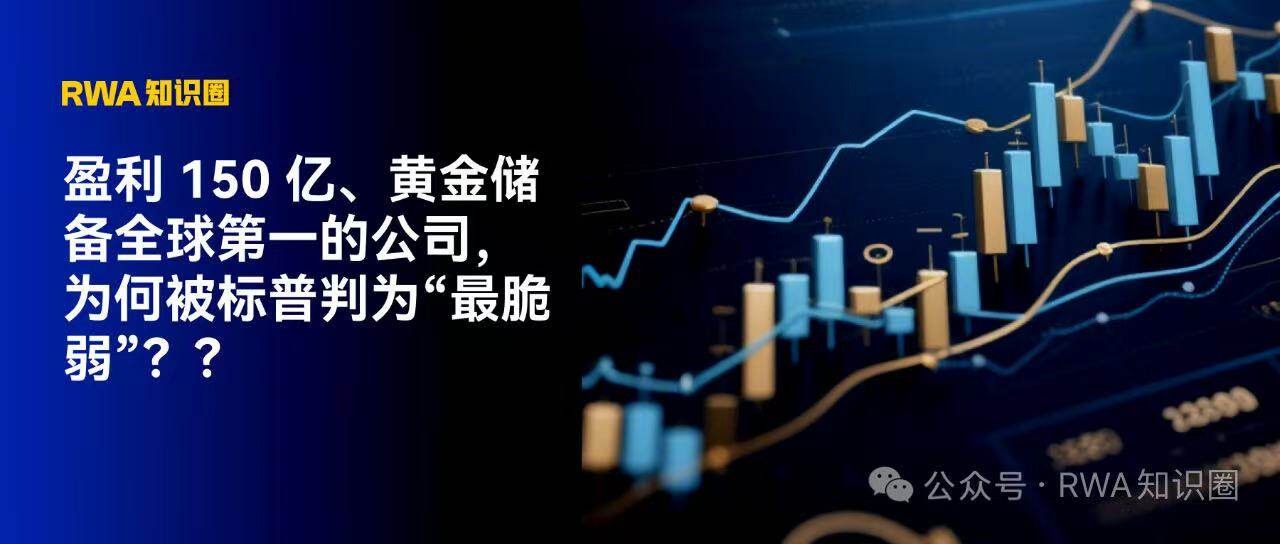
In the past, we introduced Tether, the number one issuer of stablecoins. On November 26, a Jefferies analysis report revealed: Tether currently holds 116 tons of physical gold, becoming “the largest holder of gold in the world outside of central banks”, with reserves nearing those of central banks in countries like South Korea, Hungary, and Greece. The company plans to increase its holdings by another 100 tons by 2025 and has invested over $300 million in precious metal producers through RWA, with the market capitalization of its gold-backed stablecoin Tether Gold (XAUt) surpassing $2.1 billion, doubling its issuance in six months; annual profits are expected to reach an astonishing $15 billion.
However, on the same day, this highly profitable company with substantial reserves was downgraded to the lowest rating (5 - weak) in the stablecoin system by S&P Global. Why such a stark contrast?
1. Why did S&P downgrade Tether to the lowest rating?
S&P's asset quality scoring for stablecoins ranges from 1 to 5 (very strong to weak). In this assessment, Tether was further downgraded from “4” (restricted) to “5” (weak).
S&P's core concern centers on the risk level of the reserve structure and insufficient transparency.
Specific concerns include:
- Increased proportion of high-risk assets: Tether's Bitcoin reserves now account for 5.6% of USDT's circulation, exceeding the 3.9% over-collateralization rate of USDT. If the prices of BTC or gold decline, the reserve coverage may be insufficient.
- Limited information disclosure: Tether has long failed to provide sufficiently transparent disclosures regarding custodians, counterparties, bank accounts, and other key details.
- Lack of a sound regulatory framework and asset segregation: Currently, USDT lacks strict bankruptcy isolation and regulatory filing.
- Redemption mechanism limitations: There are still questions about whether there is sufficient liquidity during large redemptions.
S&P also stated that if Tether can reduce its exposure to high-risk assets and improve the quality of information disclosure, its rating could potentially improve.
2. USDC receives a high rating, but the market is skeptical
The second-largest stablecoin, USDC, issued by Circle, received a “2 - strong” rating in this assessment, which is significantly more recognized by S&P compared to Tether.
It is evident that S&P has an overall preference for:
- Highly transparent centralized stablecoins (like USDC)
- Simple collateral structures, high over-collateralization rates, and a high proportion of safe assets
- Complete information disclosure and clear regulatory pathways
Conversely, S&P is cautious about decentralized stablecoins (like USDe, USDS) because their collateral assets mostly belong to “high-risk digital assets.” However, the market's attitude differs from S&P's. Circle's stock price has plummeted from a high of $298 in June 2025 to $72, a drop of 75%, and the company remains in a loss-making state. The capital market values revenue capacity, growth rate, and business model more than the regulatory rating itself.
3. Tether is moving towards Circle's “regulatory path”
Despite Tether's lowest rating, it seems to have recognized the importance of regulation.
Tether has announced that it will launch a stablecoin USAT aimed at the U.S. market in December, with the new framework fully integrated into the GENIUS Act regulatory system. The regulatory requirements regarding reserve structure, disclosure mechanisms, redemption terms, and risk segregation almost correspond one-to-one with S&P's rating standards.
This means that the future competition among stablecoins will no longer be about “who has the largest market share,” but rather “who better complies with the regulatory system.”
4. The value of RWA is becoming apparent
From Tether to Circle, from asset exposure to disclosure mechanisms, and the implementation of regulatory and rating systems, this series of events points in one direction — digital assets are moving towards institutionalization, with RWA at the center of this transformation.
The value of RWA lies not only in enhancing transparency and credibility but also in transferring the risk control logic of traditional finance onto the blockchain, allowing for clearer identification and verification of asset structures, risk sources, and liquidity. Financial products thus escape the black box, presenting the market with clearer rules and more robust structures.
For all those concerned with the long-term trends in digital finance, RWA is an important entry point for understanding the essence of assets, assessing risks, and discerning industry directions. It is not an asset but a language for understanding the future financial order.
As the industry shifts from extensive expansion to systemic competition, mastering the knowledge system of RWA is a key tool for seizing the new cycle.
免责声明:本文章仅代表作者个人观点,不代表本平台的立场和观点。本文章仅供信息分享,不构成对任何人的任何投资建议。用户与作者之间的任何争议,与本平台无关。如网页中刊载的文章或图片涉及侵权,请提供相关的权利证明和身份证明发送邮件到support@aicoin.com,本平台相关工作人员将会进行核查。