On December 2, multiple Coinbase shareholders filed a lawsuit against the company's executives, accusing them of insider trading worth billions of dollars over the years. The core of the lawsuit centers on allegations of a series of "dishonest" actions by Coinbase's executives and early investors.
According to publicly available court documents, the plaintiffs have raised two critical accusations:
Concealment of Significant Negative Information: The lawsuit claims that Coinbase's management concealed several pieces of negative information during 2023 that could severely impact the company's stock price. This includes significant failures in the company's "Know Your Customer" (KYC) and anti-money laundering (AML) compliance, risks of data breaches, and the fact that the company was under investigation by regulatory authorities at the time. These pieces of information are alleged to have not been disclosed in a timely manner as required, leading to a severe distortion in the market's perception of the company's risks.
Massive Insider Trading: During the period of concealing the above information and artificially maintaining the stock price at a "high level," a group of insiders, represented by CEO Brian Armstrong and board member Marc Andreessen, massively sold off their holdings of Coinbase stock, with total sales reaching an astonishing $4.2 billion. Shareholders believe this constitutes insider trading for profit using significant non-public information.
It is noteworthy that the presiding judge in this case has preliminarily determined that the shareholders "have presented sufficient evidence," and the case is entering the substantive hearing phase. Just before the lawsuit was exposed, Coinbase had announced plans to relocate its corporate registration from Delaware to Texas, citing one of the reasons as the belief that Delaware court rulings are "unstable" and "unpredictable."
The "Domino Effect" Under a Crisis of Trust
Following the news, the market quickly reacted negatively. The lawsuit not only impacted Coinbase itself but also sent ripples throughout the entire cryptocurrency market.
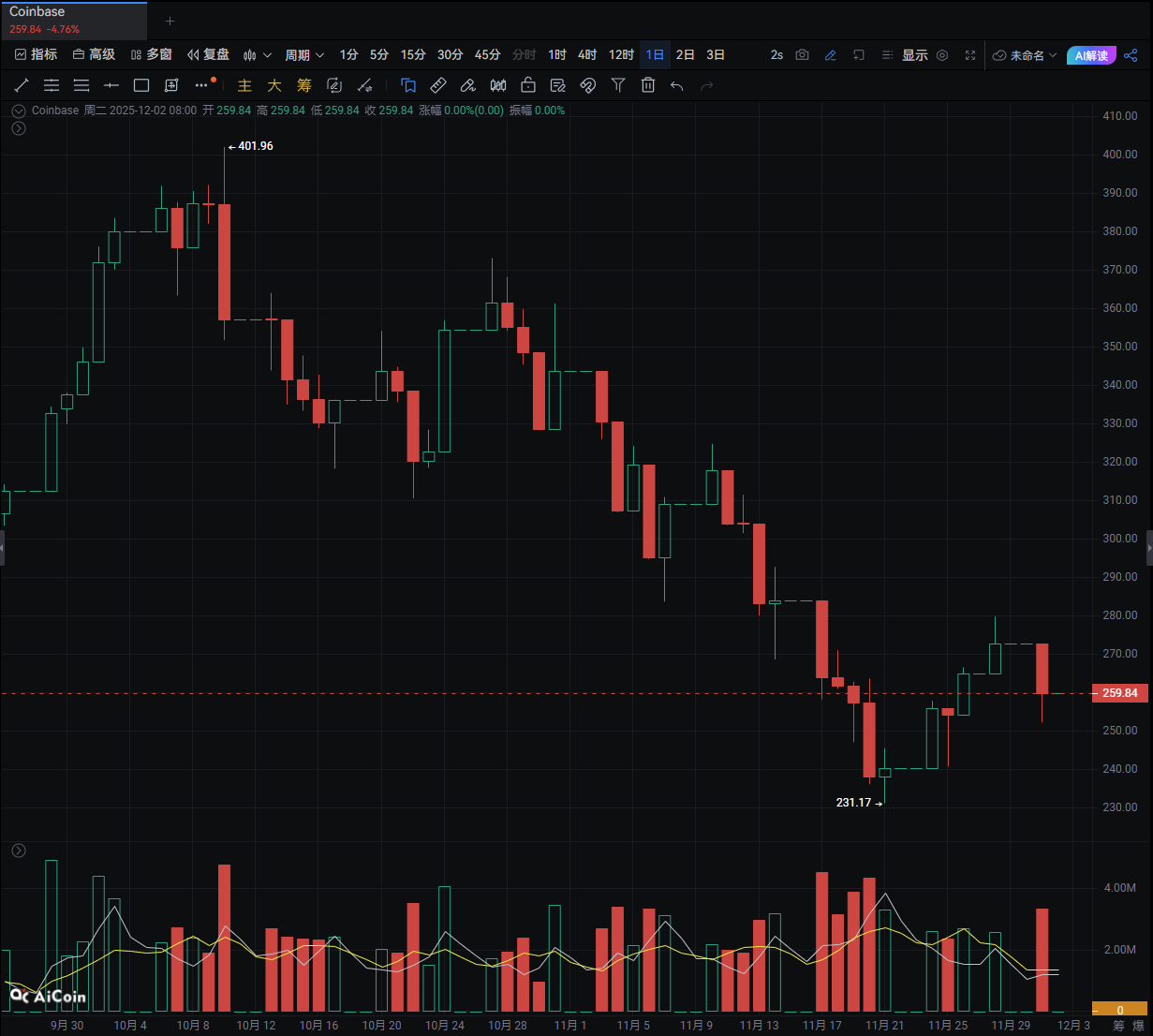
- Stock Price Drops, Confidence Shaken: Coinbase's stock price came under pressure immediately after the news broke. Data shows that its stock price fell nearly 5% at one point. This decline reflects investors' concerns about the company's governance structure and legal risks. Investment analysis platform AInvest pointed out that this lawsuit "will amplify legal and financial risks" and may "weaken the platform's long-term competitiveness."
- Impact on the Cryptocurrency Market, Industry Reputation Tarnished: As the most important bridge connecting traditional finance and the crypto world, Coinbase's negative news inevitably shook the confidence of some market participants. Cryptocurrency market analysis bot Cryptheus Bot believes that such scandals "easily trigger a crisis of trust, similar to past exchange collapse cases, potentially leading to capital outflows." Although mainstream cryptocurrencies like Bitcoin did not experience a collapse-like drop, market sentiment was undoubtedly suppressed, adding new variables to the already complex regulatory environment of the industry.
- Hurdles for Institutional Entry: The more profound impact lies at the level of institutional investors. For years, Coinbase has attracted traditional large capital such as sovereign funds and pensions with its image as "the most compliant U.S. exchange." This lawsuit severely damages that core brand value. Cryptocurrency trading strategy analyst CryptoforniaX warned that this incident "will lead to a repricing of sovereign capital," potentially forcing the most cautious funds to pause or even reassess their crypto asset allocation plans.
Intense Debate from "Legal Extortion" to "Governance Failure"
Market observers and analysts have differing opinions on the nature and impact of this lawsuit, reflecting the complex public opinion environment facing the current cryptocurrency industry.
"Extortion Lawsuit" Camp: Jeff Roberts, an editor at Fortune magazine, believes that such class-action lawsuits are often tools of "extortion" by plaintiff lawyers, lacking substantive evidence. He pointed out that the notion of Armstrong and Andreessen, as billionaires, colluding to sell stocks is "far-fetched." He views this case as a common legal interference in the U.S. capital markets and believes its impact on Coinbase's fundamentals should not be overinterpreted.
"Governance Crisis" Camp: Analyst Cryptofornia emphasizes that the concealment of KYC/AML loopholes and data breach risks revealed by the lawsuit is key. This is not merely a legal dispute but a nonlinear rise in corporate governance risks, compounded by SEC regulatory pressure, which will amplify uncertainty.
"Bearish Trigger" Camp: Market analysis tools like Cryptheus Bot hold a strong bearish view, believing that allegations of fraud and insider trading will severely damage investor confidence, potentially triggering capital outflows and leading to sustained pressure on stock prices.
Despite the differences, there is a consensus: regardless of the final judgment, both Coinbase and the entire industry will incur significant reputational costs and legal resources.
The Storm is Far from Over
This $4.2 billion lawsuit is by no means an isolated legal event; it may open Pandora's box, triggering a series of chain reactions.
Two major potential risks that investors need to pay attention to:
Dual Risk of Legal and Regulatory Backlash: The case itself could lead to exorbitant damages. More dangerously, it could become a "perfect entry point" for regulatory bodies like the U.S. Securities and Exchange Commission (SEC) to intervene. The "compliance failures" and "concealment of investigations" detailed in the lawsuit are precisely the issues that regulators are most concerned about. The industry may face a new wave of stricter scrutiny.
Risk of Capital and Trust "Flight": The core accusations undermine the foundation of Coinbase's business—trust. If platform users (especially institutional clients) begin to transfer funds to other platforms or turn to decentralized wallets due to concerns about asset safety or compliance flaws, it will directly impact Coinbase's trading revenue, custodial asset scale, and other core performance indicators.
Two core dynamics that need to be closely monitored moving forward:
Coinbase's Counterattack (within the next week): The market is closely watching whether Coinbase's management will issue a strong formal statement or submit a robust legal motion to dismiss the charges. The strength and credibility of their response will be the first line of defense in stabilizing market sentiment. At the same time, whether its stock price can stop falling and stabilize will be the most direct barometer of market confidence.
Silence or Statements from Regulatory Bodies (within the next 1-2 weeks): The stance of regulatory bodies like the SEC on this matter is crucial. If they remain silent, it may indicate that they view it as a typical corporate lawsuit; if any regulatory officials publicly comment or announce the initiation of related investigations, it would indicate that risks are spreading to the entire industry, which would be an extremely negative signal.
An Industry "Stress Test"
Coinbase's $4.2 billion insider trading lawsuit serves as a mirror, reflecting the shadows in corporate governance, compliance transparency, and conflict of interest management within centralized cryptocurrency institutions amid their rapid development. It is not just a crisis for one company but a high-pressure "stress test" for the entire industry.
In the short term, legal lawsuits, stock price volatility, and public opinion questioning will constitute a continuous "open fire." In the long term, the event may force Coinbase and other exchanges to rebuild their internal control and information disclosure systems to higher standards, while also potentially accelerating the "undercurrents" of capital and users migrating to more transparent decentralized solutions.
Join our community to discuss and become stronger together!
Official Telegram community: https://t.me/aicoincn
AiCoin Chinese Twitter: https://x.com/AiCoinzh
OKX benefits group: https://aicoin.com/link/chat?cid=l61eM4owQ
Binance benefits group: https://aicoin.com/link/chat?cid=ynr7d1P6Z
免责声明:本文章仅代表作者个人观点,不代表本平台的立场和观点。本文章仅供信息分享,不构成对任何人的任何投资建议。用户与作者之间的任何争议,与本平台无关。如网页中刊载的文章或图片涉及侵权,请提供相关的权利证明和身份证明发送邮件到support@aicoin.com,本平台相关工作人员将会进行核查。