Author: YQ
Translation: Yangz, Techub News
From Philosophy to Infrastructure Shift
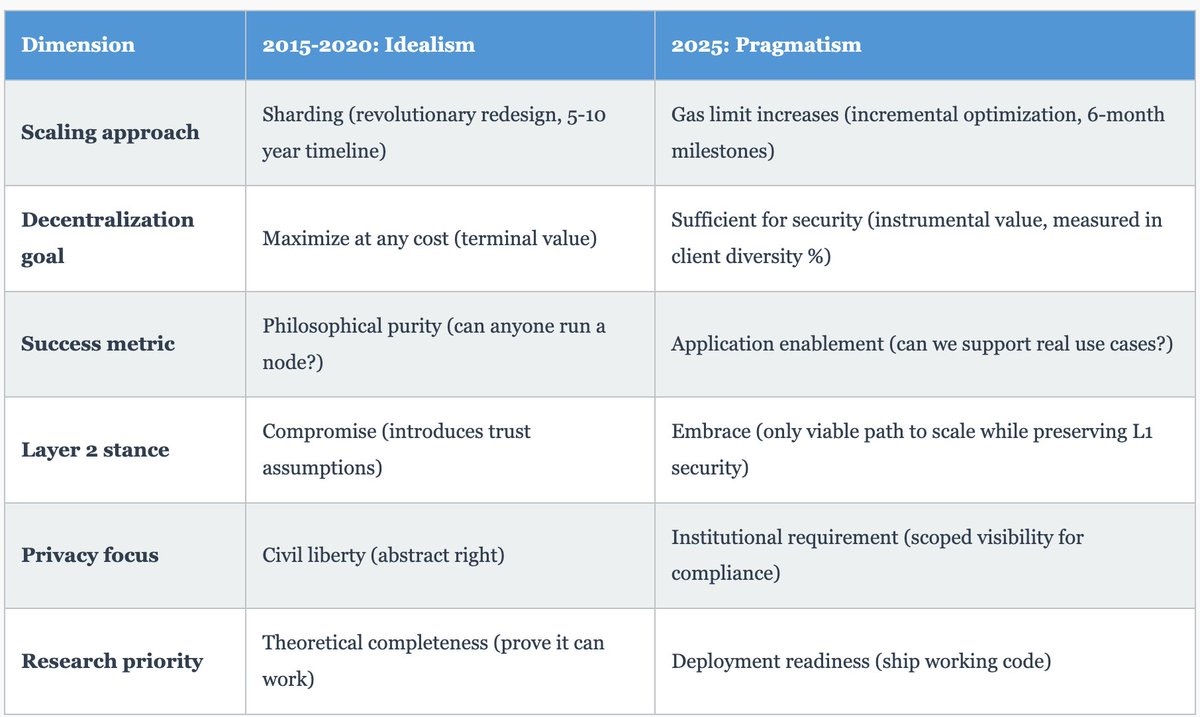
Fundamental Shift: In 2015, Ethereum embraced decentralization, censorship resistance, and trustlessness as its ultimate values (the goal itself, rooted in the cypherpunk ideology). By 2025, these characteristics have shifted to serve instrumental value (as means to achieve practical goals, such as eliminating counterparty risk, achieving global financial inclusion, and reducing operational costs). This shift is crucial: idealism asks, "How decentralized can we make this?", while pragmatism asks, "How decentralized do we need to be to solve this problem?" The Devconnect conference in Buenos Aires in 2025 revealed that the Ethereum Foundation has decisively chosen to pursue the latter question.
When Ethereum launched in July 2015, its founders articulated a vision rooted in the 1990s cypherpunk movement. Like the 2,000 mathematicians, cryptographers, and software engineers who resisted government attempts to ban encryption, the early Ethereum community pursued decentralization and censorship resistance as ultimate values. The project was to operate as a "world computer," where smart contracts executed with mathematical certainty, free from corporate or governmental interference. This philosophical commitment supported the project through its early years, attracting developers more for ideological reasons than for commercial interests.
A decade later, a fundamentally different Ethereum was presented at the five-day Devconnect 2025 technical conference in Buenos Aires. Presentations by Ethereum Foundation researchers and application builders revealed a decisive shift: from pursuing abstract protocol perfection to pragmatically improving infrastructure for practical applications. This transformation became evident in the structure of the event itself. Ethereum Day kicked off on November 17, where Tomasz Stanczak, Hsiao-Wei Wang, Ansgar Dietrichs, Barnabé Monnot, and Vitalik Buterin introduced the Ethereum Foundation's strategic restructuring around three specific priorities established in April 2025: scaling Layer 1 by increasing the Gas limit, expanding Blob data availability through the deployment of PeerDAS, and improving user experience through cross-chain interoperability. Specific achievements delivered in 2025 were then detailed: the Gas limit doubled from 30 million to 60 million in December (via the Fusaka upgrade), the number of validators exceeded 1.1 million, and $70 billion worth of staked ETH was used to secure the network. The following days focused on specific application areas rather than abstract protocol theory. Stani Kulechov elaborated on decentralized credit markets, and Santiago Palladino detailed Ethereum's interoperability layer. On November 19 (Trustless Agent Day), the ERC-8004 portable reputation protocol and the x402 micropayment protocol for autonomous AI agent economies were introduced. The Privacy Summit and ZK Day showcased that zero-knowledge proofs achieved an average block verification speed of under 10 seconds. Throughout, speakers emphasized solving concrete problems for actual users, such as cross-chain fragmentation, DeFi privacy needs, institutional settlement requirements, and autonomous agent payment infrastructure.
We witnessed Ethereum's evolution from idealism to pragmatism across five key infrastructure areas, where the ultimate philosophical goals have yielded to instrumental engineering objectives: Layer 1 scaling achieved through incremental optimization rather than architectural revolution, cross-layer interoperability addressing Layer 2 fragmentation, DeFi primitives empowering a $300 trillion credit market, autonomous agent infrastructure aimed at a machine-native economy, and institutional adoption frameworks prioritizing privacy over transparency.
L1 Scaling: Incremental Optimization Replaces Architectural Revolution
Strategic Restructuring and 3x Annual Goals
Ansgar Dietrichs and Barnabé Monnot detailed the Ethereum Foundation's restructuring in their opening speech at Ethereum Day. This marked a shift from years of research on sharding technology to a pragmatic path for throughput improvements achievable in the near term. The Foundation is no longer pursuing major architectural changes that could take 5 to 10 years but is committed to achieving a 3x annual throughput increase through systematic client optimizations and targeted protocol adjustments. This approach reflects the hard-earned lessons about the cost of complexity in distributed systems: coordinating between four independent execution clients (Geth, Nethermind, Besu, Erigon) and five consensus clients (Prysm, Lighthouse, Teku, Nimbus, Lodestar) makes significant protocol changes costly in terms of both development time and deployment risk.
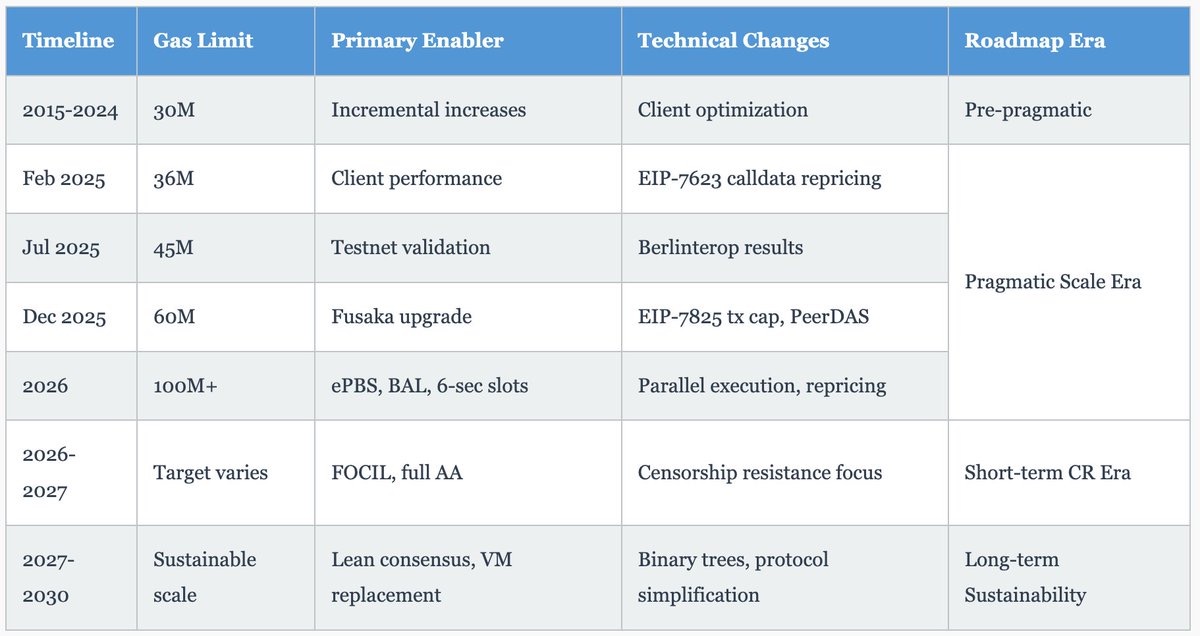
The strategy for increasing the Gas limit will advance during the "Pragmatic Scaling Era" (2025-2026), addressing bottlenecks through incremental optimization rather than architectural revolution. The increase from 30 million to 60 million is achieved through client performance optimizations and EIP-7623, which re-prices call data (charging 40 gas per byte for L2 Rollups with a high proportion of call data, while standard transactions are charged 16 gas per byte), along with EIP-7825, which limits the transaction Gas limit (to 16.78 million per transaction). The entire process occurs in three steps: increasing from 30 million to 36 million (February 2025), from 36 million to 45 million (July 2025), and from 45 million to 60 million (November 2025), with the default value officially set to 60 million in the Fusaka upgrade on December 3.
This change, combined with the introduction of EIP-4844 dedicated Blob transactions through the Dencun upgrade in March 2024, provides Rollups with an independent data availability layer while freeing up block space for L1 execution. Recent scaling focuses on: enhanced proposer-builder separation (ePBS), block-level access lists supporting parallel execution (BAL), targeted repricing to align Gas costs with actual computation costs, and a doubled block rate with a 6-second block interval. Longer-term sustainability planning (2027-2030) looks at streamlining consensus mechanisms, virtual machine replacement, binary tree state structures, and protocol simplification, rather than the previously planned Verkle tree scheme (which was abandoned due to quantum computing vulnerabilities in polynomial commitment schemes).
Client Performance Benchmarks and Engineering Constraints
The Fusaka upgrade has obtained precise benchmark data on the Sepolia testnet and the mainnet shadow fork. The Geth client, serving about 60% of the validator set, takes 3.0 seconds to process blocks at the full 60 million Gas limit, achieving a throughput of 20 million Gas per second. Nethermind is the fastest, at 2.4 seconds (25 million Gas per second), while Besu takes 3.3 seconds (18 million Gas per second), and Erigon completes block processing in 2.7 seconds (22 million Gas per second). All implementations perform well below the critical threshold of 4 seconds, ensuring that 90% of validators can receive and process blocks within the first quarter of a 12-second slot, thus maintaining consensus security margins. Network propagation analysis shows that 90% of validators receive blocks within 0.7 to 1.0 seconds via the Gossip protocol, but the remaining 10% may experience delays of 2 to 3 seconds due to geographical differences. These engineering realities prompt a conservative incremental increase in the Gas limit rather than a sudden leap that could jeopardize network stability.
Currently, the bottleneck has shifted from raw execution speed to state access patterns, disk I/O, and cumulative state growth. Measurements indicate that for complex transactions, accessing state accounts and storage slots now dominates execution time. At a 60 million Gas limit, the annual growth rate of state data is approximately 60 GB. If expanded to 300 million Gas without mitigation, the annual growth rate would reach 300 GB, and the state size could reach several TB within a few years. This reality was originally a driving force behind Verkle tree research, but advancements in quantum computing have forced a shift to pragmatic near-term management strategies (active state pruning, state rental economic mechanisms), while developing quantum-resistant binary tree alternatives for the 2027-2030 period.
PeerDAS and Blob Expansion for L2 Rollups
The second strategic priority is expanding Blob data availability, directly addressing the needs of L2 Rollups. The current infrastructure supports 3 to 6 Blobs (each 128 kilobytes) per block, providing a capacity of 384 to 768 kilobytes in each 12-second slot. The PeerDAS (Peer-to-Peer Data Availability Sampling) deployed through the Fusaka upgrade, utilizing erasure coding mathematics, can scale to 16 Blobs in the short term and potentially to 64 Blobs in the long term.
Each Blob is divided into multiple data fragments using Reed-Solomon coding, allowing any 50% of the fragments to reconstruct the complete data. Validators download random subsets rather than the entire Blob, with the network ensuring data availability through collective cooperation, requiring no single validator to store all content. This sampling method can expand the number of Blobs by 10 times or more while reducing the bandwidth required for each validator from O(n) to O(log n).
Deployment Timeline: Development network testing in Q3 2025, testnet in early 2026, and mainnet activation in mid-2026 (subject to security review). Once operational, PeerDAS can increase Rollup data availability by 10 times while lowering the Gas price of Blobs through expanded capacity.
ZK-EVM Proofs: From Theory to Production Timeline
Vitalik Buterin's discussion on agent infrastructure and Ansgar's protocol updates both highlighted significant breakthroughs in zero-knowledge Ethereum Virtual Machine (ZK-EVM) proof times. Multiple ZK-EVM teams achieved average proof times of under 10 seconds in 2025, a substantial reduction from the 5 to 10 minutes seen in 2024. This marks a critical step for Ethereum towards achieving real-time proofs (under 12 seconds to match slot times).
Deployment will follow an incremental path: the first phase will experimentally introduce validity proofs, allowing validators to choose to verify ZK proofs instead of re-executing parts of blocks; the second phase will implement a hybrid model where key blocks require ZK proofs while most blocks continue normal execution; the third phase will transition to a proof-mandatory model where all blocks must have ZK proofs; the fourth phase will realize a complete ZK-EVM, allowing stateless clients to operate without storing state, providing full security for mobile and browser nodes. As for the implementation timeline, production deployment is expected to be completed between 2027 and 2030.
Cross-Layer Interoperability: Addressing L2 Fragmentation
Fragmentation Issues
In his "Ethereum Everywhere" presentation, Santiago Palladino revealed a fundamental contradiction in Ethereum's development roadmap centered around Rollups. Despite over 50 L2s achieving a combined throughput of over 100,000 transactions per second, fragmentation has led to severe user experience issues and liquidity segmentation, threatening the value proposition of a unified Ethereum ecosystem. A user holding assets on Arbitrum cannot purchase an NFT on zkSync without bridging funds through L1, which requires a 7-day waiting period (the fraud proof window for optimistic Rollups) and a $35 gas fee. Liquidity is fragmented across different chains, and the trading price of the same token varies on different L2s. Applications must be deployed separately on each chain, dispersing developers' focus and user bases.
Ethereum Interoperability Layer: Single Signature for Multi-Chain Operations
The Ethereum Interoperability Layer (EIL) is collaboratively developed by teams from Arbitrum, Optimism, Polygon, zkSync, and Base, built on ERC-4337 account abstraction, aiming to achieve cross-chain operations through a single signature. Its technical innovation lies in Merkle tree batch authorization. Users construct an operation tree spanning multiple chains, sign the Merkle tree root, and submit branches to each target chain. Smart contract accounts on each chain verify the Merkle proof based on the signed tree root, enabling atomic multi-chain execution without complex cross-chain messaging protocols.
The mechanism demonstrated by Palladino at the conference showcased specific efficiency improvements: a user holding 10,000 USDC on Arbitrum wishing to purchase an NFT for 5,000 USDC on zkSync only needs to sign a single Merkle tree root, simultaneously authorizing the deduction on Arbitrum and the purchase on zkSync. Cross-chain liquidity providers (XLPs) can "pre-run" the settlement by immediately providing 5,000 USDC on zkSync, then requesting the user's funds from Arbitrum after the withdrawal delay period. XLPs charge about $5 for this service (0.1%), allowing the transaction to be completed within 1 minute from the user's perspective, compared to the traditional bridging method which takes over 7 days and incurs $35 in fees.
Based on Account Abstraction
ERC-4337 enables the EIL by replacing externally owned accounts (controlled by ECDSA private keys) with programmable smart contract accounts. Traditional Ethereum addresses can authorize only one operation per signature. Smart contract accounts can implement any verification logic, including verifying Merkle proofs that can authorize multiple operations simultaneously. This capability has theoretically existed since Ethereum's inception, but ERC-4337 has standardized its implementation and created the alternative mempool infrastructure necessary for production deployment.
The conference on November 18 revealed commitments from mainstream wallets: MetaMask, Argent, and Safe have all deployed smart account infrastructure, with Safe reporting over 100,000 active accounts as of November 2025. Additionally, user experience improvements are not limited to cross-chain operations but also include using ERC-20 tokens to pay gas fees (via payment managers), social recovery mechanisms, and programmable spending limits.
Fast Finality and 6-Second Slots
Barnabé Monnot, in his talk about enhancing Ethereum's service quality as a "confirmation engine" for the entire ecosystem, emphasized two metrics: inclusion time (currently averaging 12 seconds) and final confirmation time (currently 13 minutes). Fast confirmation rules, set to be deployed in Q1 2026, can provide 95% certainty within 1 to 2 blocks (12 to 24 seconds) without waiting for the 13-minute economic finality. This looser security assumption (based on probability rather than economic finality) is sufficient for many use cases: L2 can use confirmed L1 states more quickly (benefiting Base Rollup), cross-chain bridge protocols can achieve faster cross-chain messaging, and centralized exchanges can reduce deposit and withdrawal delays.
Long-term plans include reducing the slot time from 12 seconds to 6 seconds, effectively doubling the network's block rate. Current client performance (processing 60 million gas blocks in 2.4 to 3.3 seconds) indicates that a 6-second slot is feasible under the premise of raising the gas limit to 100 million or higher, with ongoing client optimizations. When combined with fast confirmation rules, a 6-second slot could achieve effective finality within 6 to 12 seconds, making it comparable to centralized payment networks.
DeFi Infrastructure: $300 Trillion Credit Opportunity
Stani Kulechov's Renaissance Finance Thesis
In his presentation "The New Architecture of Credit," Stani Kulechov drew historical parallels between financial innovations of the Renaissance and modern DeFi primitives, positioning decentralized credit markets as a $300 trillion opportunity aimed at unleashing global capital flows. In Florence in 1252, the florin became the first widely trusted base currency due to its standardized weight and predictable purity, enabling the expansion of credit across Europe. DeFi replicates this function through stablecoins (USDC, DAI, USDT providing $150 billion in on-chain liquidity at the base layer); Venice's commercial intelligence network collected business information from Mediterranean ports, functionally equivalent to oracle infrastructure (Chainlink providing price feeds and off-chain data verification); commercial networks like the Hanseatic League created liquidity layers connecting local markets, similar to automated market makers (Uniswap, Curve enabling instant token swaps across liquidity pools); and Renaissance commenda contracts allowed passive investors to fund merchant voyages with agreed profit-sharing, serving as precursors to smart contracts that automatically allocate capital based on programmed conditions.
Kulechov's core argument is that the $300 trillion global credit market remains out of reach for DeFi because traditional credit relies on local information (borrower reputation, legal enforceability, collateral assessment), which cannot be directly put on-chain. His proposed solution—the Aave Horizon protocol—tokenizes local credit to enable global DeFi liquidity participation. Local credit analysts use traditional methods (credit history, cash flow analysis, collateral assessment) to evaluate borrowers, then package loans into tokenized tranches for on-chain trading. DeFi liquidity providers purchase these tranches, earning returns from local credit markets, while the protocol handles compliance, collections, and default management.
Kulechov specifically chose Argentina as a case study for the conference. Argentina's credit market exhibits extreme inefficiencies: credit card annual interest rates exceed 100%, and despite valuable real estate, the availability of mortgages remains limited, with capital controls hindering cross-border investment. Furthermore, while institutional investors seek returns in emerging markets, local businesses with strong cash flows struggle to obtain growth capital at reasonable rates. The Aave Horizon pilot project announced during Devconnect aims to bridge this gap by tokenizing accounts receivable from Argentine SMEs and offering them to global DeFi investors at annualized rates of 15% to 25% (attractive to investors and transformative for borrowers accustomed to rates above 100%).
Atomic Settlements and Programmable Compositions
Danny Ryan, in his talk on institutional adoption, emphasized the operational improvements brought by blockchain infrastructure through cryptographic settlements (rather than legal enforcement). In traditional finance, stock trades settle on T+1 (one business day), corporate bonds on T+2, and private equity transactions take 90 to 180 days. Each settlement involves multiple intermediaries (transfer agents, custodians, clearinghouses, payment processors), with corporate bond trades requiring about 20 manual steps, and 5% to 10% of transactions failing due to reconciliation errors. Ethereum simplifies this to atomic execution: smart contracts receive assets from both parties, either completing the exchange immediately or rolling back the entire transaction. On L2, settlements can be completed within 12 seconds at a cost of under $5, achieving a 99.9% improvement in both time and cost metrics.
More importantly, atomic compositions enable financial products that are not feasible in traditional systems. Morpho's presentation showcased cross-collateralized loan products. When an institutional client deposits $100 million in tokenized U.S. Treasuries and immediately borrows $90 million in USDC, the loan terms automatically adjust based on Treasury yields, and if the collateral ratio falls below a safe threshold, programmatic liquidation is automatically executed. The entire process requires no legal contracts, no credit checks, and no settlement delays.
Privacy Infrastructure and Scoped Visibility
The Privacy Summit on November 19 clearly stated that privacy has become a major barrier to institutional adoption, surpassing regulatory issues in importance. Europe's MiCA provides a clear regulatory framework. The U.S. approval of Bitcoin and Ethereum ETFs also demonstrates that regulators recognize cryptocurrencies as an asset class. However, the development of privacy infrastructure has lagged behind regulatory clarity.
What institutions need, as described by the speakers, is "scoped visibility": different stakeholders see different subsets of data based on their roles and permissions. Fund managers must see complete holdings to make asset allocation decisions. Regulators must be able to verify compliance without accessing strategic trading information. Clients must be able to view their own positions without knowing about others'. The transparency of public chains makes all information visible to everyone, failing to meet these requirements.
In response, the proposed technical solutions layer various cryptographic techniques. Private L2s like Aztec default to encrypting state, with decryption keys distributed according to access policies defined in smart contracts. Zero-knowledge proofs enable selective disclosure: proving to regulators that KYC checks have been passed without revealing identity, or demonstrating that transactions remain within approved limits without exposing actual positions and counterparties. Multi-party computation allows parties to collaborate on analysis without knowing the original input data of others.
BlackRock's BUIDL fund (with assets reaching $500 million as of November 2025) operates on Ethereum but requires permissioned access and off-chain reporting to maintain privacy. The structure of the fund not only demonstrates market demand for blockchain settlement (atomic, programmable, available 24/7) but also exposes the current inadequacies of privacy infrastructure. Multiple presentations indicated that once native privacy features enter production in 2026, they will unlock larger-scale institutional deployments, with tokenized asset volumes potentially reaching $100 billion by 2027.
Autonomous Agent Economy: ERC-8004 and x402
Portable Reputation Infrastructure
The "Agents Day" on November 19 showcased a complete infrastructure for AI agent economies, predicated on the assumption that agents will become major economic participants in the next decade. The shift from human-centered to agent-native design became evident in two complementary protocols: ERC-8004 for agent identity and reputation, and x402 for machine-native payments. ERC-8004 extends the ERC-721 non-fungible token standard with reputation tracking features.
Each agent receives a unique token ID to accumulate performance metrics: number of tasks, success rate expressed in basis points, total transaction value, and the Merkle root of detailed performance proofs stored on IPFS or Arweave. Consequently, on-chain reputation can be ported across platforms, addressing the fragmentation issue of reputation silos that plague traditional service platforms (e.g., Upwork's reputation cannot be transferred to Fiverr).
The technical specification defines on-chain and off-chain components to balance verifiability with storage costs. On-chain, the contract stores a compact reputation vector (number of tasks as uint256, success rate in basis points, total value as uint256, and Merkle root for performance proof). The off-chain infrastructure indexes complete performance data. An agent claiming a 95% success rate over 1,000 tasks must provide a Merkle proof linking to verifiable task completion records (encrypted signatures from task requesters, timestamps, result descriptions) to prevent reputation inflation through false claims.
x402: Payment as an Alternative to Authentication
The x402 protocol aims to address the authentication issues of autonomous agents operating without supervision. Traditional API access requires developers to manually register accounts, handle OAuth processes, and manage API keys, all of which presuppose human interaction. Autonomous agents cannot complete CAPTCHA verifications and cannot securely store long-lived keys without introducing centralized key management (which contradicts the goal of decentralization).
The solution provided by x402 is to replace authentication with payment: to access a resource, an agent simply pays a specified amount of cryptocurrency. The protocol flow is straightforward: the agent requests a resource, the server returns HTTP status code 402 (Payment Required), along with payment details (amount, token type typically USDC, recipient address, and a unique nonce to prevent replay attacks). The agent constructs a transaction transferring the requested amount to the recipient address, submits it to Ethereum L2 (such as Arbitrum or Base, providing sub-second finality) for quick confirmation, and then retries the request with the transaction hash as proof of payment. The server verifies the transaction on-chain, checking that the amount is correct, the recipient address is accurate, and the nonce has not been used before, then provides the requested resource.
Institutional Adoption: Counterparty Risk and Crypto Economic Security
Wall Street's Demand for Decentralization
In his talk on institutional adoption of Ethereum on November 17, Danny Ryan challenged traditional notions of blockchain value propositions. The evidence Ryan provided indicated that Wall Street is not begrudgingly tolerating decentralization for the sake of blockchain advantages but is actively demanding it, viewing it as a solution to counterparty risk, operational inefficiencies, and regulatory burdens. This argument is based on a year of institutional interactions by the Ethereum Foundation's institutional expansion team, representing a significant restructuring of Ethereum's market positioning.
Financial institutions analyze each system through the lens of counterparty risk: who might fail, deceive, or disappear, and the probability and extent of loss. Traditional finance mitigates this risk through legal contracts, insurance, and regulatory oversight. Each layer of mitigation introduces its own counterparty dependencies: trades settled through DTCC depend on DTCC's solvency and operational capacity; credit default swaps depend on the payment capacity of insurance companies; third-party custody arrangements depend on the integrity of custodial agents.
Ethereum's atomic settlement eliminates these dependencies through cryptography rather than legal enforcement. Smart contracts simultaneously verify that both parties have provided the agreed-upon assets and execute the exchange, or roll back the transaction if one party fails to fulfill its obligations. The counterparty is the code itself, which anyone can verify. The $70 billion staked ETH securing the network represents an economic security that cannot be easily replicated. Disrupting consensus requires not only attacking the code but also obtaining 51% of the staked share, which, considering the penalties for slashing and the need to maintain the value of the stake, is an expensive and economically irrational act.
Ryan's data quantified the improvements in operational metrics. Traditional corporate bond settlements involve backend costs of $50 to $200 per transaction, with a failure rate of 5% to 10%, requiring manual reconciliation. Ethereum's settlement costs on L2 are under $5, with a zero failure rate (deterministic execution). The capital occupation time is reduced by 99.99% when comparing T+2 settlements to 12-second atomic execution. For a $100 million transaction, this saves approximately $20,000 in opportunity costs at a 5% annual return rate.
In addition to cost savings, atomic compositions enable risk management that is impossible in traditional systems: flash loans used for liquidation eliminate the capital requirements of liquidators, cross-collateralized positions across multiple protocols can achieve atomic updates, and programmable circuit breakers can automatically halt activities when risk parameters exceed thresholds.
Achieving 100% Uptime Through Client Diversity
Tomasz Stanczak's ecological update emphasized that a trillion-dollar market requires infrastructure that never stops running. Ethereum achieves this through client diversity rather than redundancy. Four independent execution clients (Geth using Go, Nethermind using C#, Besu using Java, Erigon using Go) and five consensus clients (Prysm, Lighthouse, Teku, Nimbus, Lodestar) ensure that vulnerabilities in a single implementation affect at most 60% of validators (currently Geth's market share). While developers patch the affected code, the network can continue to operate on a minority of clients.
This architecture sharply contrasts with traditional exchanges, which, despite having complex redundancy designs, still experience periodic outages. The New York Stock Exchange experienced a 226-minute outage in 2015. The Tokyo Stock Exchange suspended trading for an entire day in 2020 due to hardware failure. Robinhood experienced multiple outages during high volatility in 2021. Since Ethereum's merge in September 2022, it has maintained 100% uptime, processing over 1 million transactions daily without interruption. For institutions considering adopting blockchain infrastructure, this reliability record surpasses traditional financial market standards while maintaining the decentralized characteristic of eliminating single points of failure.

From Idealism to Pragmatism: What Has Changed
The contrast between Ethereum's founding vision in 2015 and its development direction in 2025 reveals a fundamental philosophical shift in the community regarding decentralization, censorship resistance, and minimizing trust assumptions. The original white paper viewed these characteristics as ultimate goals pursued for their intrinsic value, rooted in the cypherpunk tradition (where cryptographic technology aims to achieve human freedom rather than commercial profit). By 2025, these same characteristics serve instrumental goals in the strategic planning of the Ethereum Foundation rather than ultimate objectives. Censorship resistance is important because it enables 1.4 billion unbanked individuals to achieve global financial inclusion and prevents systemic infrastructure from having single points of failure; trusted neutrality is important because it allows competitors to coexist on shared infrastructure, creating network effects that proprietary platforms cannot achieve; minimizing trust assumptions is important because they reduce counterparty risk and operational dependencies that lead to costs and failures in traditional finance.
This shift from idealism to pragmatism permeated the technical content of Devconnect 2025, manifesting both subtly and explicitly. The presentations emphasized performance benchmarks (client throughput of 20-25 million gas per second), deployment timelines (Fusaka in Q4 2025, Lump Sadam in 2026), and user experience improvements (1-minute cross-chain transfers via EIL, 12-second confirmations), rather than abstract philosophical discussions about decentralization. The increase in gas limits from 30 million to 60 million was noteworthy because it doubles throughput and supports more complex applications, rather than maintaining a specific level of decentralization (which it does, but this is achieved through client optimization rather than increased hardware requirements, which has now become a constraint to be met rather than a goal to be optimized). The importance of privacy infrastructure lies in meeting the regulatory and competitive requirements for scoped visibility needed for institutional adoption, rather than as an abstract civil liberty (though this benefit still exists as a positive externality).
The L2 ecosystem most clearly illustrates this pragmatic turn. Pure idealism would reject L2 solutions, viewing them as introducing additional trust assumptions (sequencer liveness, data availability guarantees, fraud proof submission windows), thereby undermining decentralization. Pragmatism accepts them as the only viable path to scalability while maintaining L1 security, with the Ethereum Foundation actively coordinating the entire ecosystem through infrastructures like EIL and PeerDAS.
Some critics interpret this shift as a departure from Ethereum's original vision, pointing out issues such as validator centralization (Lido controls 29% of the staked share), MEV extraction centralization (95% of blocks are built by five relayers), and application layer compromises (most DeFi frontends use centralized RPC providers like Infura or Alchemy). A more accurate assessment recognizes that this vision has matured from abstract principles into concrete implementations with measurable attributes. Decentralization now means metrics of client diversity (Geth's share is 60%, down from 95% in 2021), geographical distribution of validators (validators running in over 60 countries), and economic analyses of centralization vectors (the agency problems generated by Lido's liquid staking derivatives), rather than just the number of nodes. Censorship resistance means adopting game-theoretic mechanisms, such as inclusion lists and proposer-builder separation, which make censorship economically unfeasible, rather than relying solely on social consensus. Trustlessness means quantifying security assumptions (how much staked share is needed to reverse finality), providing users with cryptographic proofs of state validity, and designing systems where verification costs are lower than trust costs, rather than resorting to philosophical arguments that treat decentralization itself as an intrinsic value.
Conclusion: Infrastructure is in Place, Awaiting Application Takeoff
Devconnect Argentina 2025 indicates that the Ethereum Foundation has decisively shifted towards application infrastructure rather than treating protocol research itself as the ultimate goal. The five-day technical presentations focused on solving specific problems and provided clear timelines: deploying EIL to address cross-chain liquidity fragmentation by mid-2026; meeting DeFi privacy needs with zkRollup encrypted state in production by 2026; enabling agent payment infrastructure through x402 and ERC-8004 launched in Q1 2026; satisfying institutional settlement needs through privacy features and throughput expansion; expanding Blob data availability through PeerDAS in the Fusaka upgrade (December 3, 2025); managing state growth through pragmatic optimizations (client state pruning, witness data compression) while developing quantum-resistant binary tree alternatives for the sustainability era from 2027 to 2030. Each solution targets deployable improvements with measurable success criteria, rather than uncertain theoretical progress over time.
This approach reflects hard-won lessons from a decade of operations: early Ethereum pursued ambitious protocol changes that consumed years of research and engineering time: sharding technology spanned from 2016 to 2020, after which the focus shifted to a Rollup-centric roadmap; Verkle trees lasted from 2018 to 2025, ultimately abandoned due to quantum computing vulnerabilities; proof of stake extended from 2014 to 2022, only completing with the "merge" in September 2022. These efforts achieved technical success (or revealed fundamental limitations), but delivery was slower than expected, while application layer innovations like the DeFi summer of 2020 and NFT adoption in 2021 demonstrated that significant value could be created on existing infrastructure through careful smart contract design. The current strategy has reversed this priority order.
Protocol changes like ePBS and BAL serve specific application needs (parallel execution, mitigating MEV) rather than theoretical improvements for their own sake. Privacy features address institutional needs (compliance with scoped visibility) rather than abstract privacy rights. Cross-chain infrastructure resolves user experience issues (liquidity fragmentation across over 50 L2s) rather than achieving architectural completeness. The willingness to abandon Verkle trees after years of investment exemplifies this pragmatic shift: timely termination of designs with quantum computing vulnerabilities to avoid losses is preferable to deploying infrastructure that would need replacement within a decade.
Looking ahead, if applications built on this infrastructure can create significant value for users, this pragmatic foundation will prepare Ethereum for mainstream adoption. Achieving 300 million gas throughput by 2028, deploying privacy-preserving smart contracts in 2026-2027, enabling seamless cross-chain operations through EIL by mid-2026, and ensuring institutional-grade reliability (100% uptime since September 2022) — the combination of these capabilities creates an infrastructure capable of supporting trillions of dollars in economic activity. Whether this potential is realized depends on factors beyond the Ethereum Foundation's control: regulatory evolution in major jurisdictions, competitive dynamics with other public chains offering different trade-offs, and most critically, whether applications built on this infrastructure address real problems faced by users rather than issues that engineers find interesting. However, from a purely infrastructural perspective, the decade-long evolution from idealism to pragmatism has created a platform ready for serious economic activity. It has traded philosophical purity for deployable solutions, abstract decentralization for measurable security attributes, and revolutionary ambition for incremental compound growth.
免责声明:本文章仅代表作者个人观点,不代表本平台的立场和观点。本文章仅供信息分享,不构成对任何人的任何投资建议。用户与作者之间的任何争议,与本平台无关。如网页中刊载的文章或图片涉及侵权,请提供相关的权利证明和身份证明发送邮件到support@aicoin.com,本平台相关工作人员将会进行核查。