Author: Lawyer Liu Zhengyao
Today, as Lawyer Liu writes this article, a significant piece of news has once again stirred up waves in the domestic cryptocurrency and even financial circles.
This afternoon, the People's Bank of China published an article titled “Meeting on Coordinating Work to Combat Speculation in Virtual Currency Trading”, stating that "we will continue to adhere to the prohibitive policy on virtual currencies and persist in cracking down on illegal financial activities related to virtual currencies." This means that in the short term, there is no possibility of "policy loosening" regarding virtual currencies in China; instead, the high-pressure regulatory stance has further normalized and institutionalized.
As a lawyer who has long been engaged in criminal defense and compliance in the cryptocurrency space, my first reaction upon seeing this news was not surprise, but rather a sense of "groundedness" as if a certain shoe had dropped. Many friends in the cryptocurrency space often ask me, "Lawyer Liu, how is the cryptocurrency policy in Hong Kong? Is the mainland about to loosen up?" "Now that the enthusiasm for trading cryptocurrencies has decreased in the bear market, will regulation relax?"
The content of today's meeting provides the most powerful and coldest answer to these fantasies.
At this juncture, we need to calm down, set aside the ups and downs of candlestick charts, and discuss a fundamental question from the perspective of legal and regulatory underlying logic: Under the tone of "continuing to crack down," is there still a living soil for virtual currencies in China?
1. Understanding the Implications Behind "Continuing to Crack Down"
If many people only read the headlines of the news, then as legal professionals, we must delve deeper to understand the "specifications" and "wording" of the official article.
The theme of this meeting is "Coordinating Work to Combat Speculation in Virtual Currency Trading." It is important to note that the following ministries participated in this meeting: the Ministry of Public Security, the Central Cyberspace Affairs Commission, the Central Financial Office, the Supreme People's Court, the Supreme People's Procuratorate, the National Development and Reform Commission, the Ministry of Industry and Information Technology, the Ministry of Justice, the People's Bank of China, the State Administration for Market Regulation, the National Financial Regulatory Administration, the China Securities Regulatory Commission, and the State Administration of Foreign Exchange. Compared to the well-known "9.24 Notice" issued by ten ministries in 2021 (the "Notice on Further Preventing and Dealing with Risks of Speculation in Virtual Currency Trading"), this meeting involved thirteen ministries, including the Ministry of Justice, the Financial Office, and the Development and Reform Commission, indicating that this meeting is even more important than the "9.24 Notice."
This also means that cracking down on virtual currency speculation is not just a matter of "violations" at the financial regulatory level, but also constitutes "illegal" or even "criminal" activities at the levels of administrative law enforcement and criminal justice.
The meeting mentioned the need to "continue to crack down." In a legal context, the term "continuing" is significant; it is not merely a sudden "crackdown" campaign, but rather a long-term, normalized regulatory mechanism. Regardless of whether Bitcoin rises to $150,000 or falls to $10,000, the regulatory red lines will not shift with market fluctuations.
On the surface, the reason for this meeting is stated as: "Due to various factors, speculation in virtual currencies has risen, and related illegal activities occur from time to time, posing new risks and challenges for risk prevention"; but in reality, the People's Bank of China and the thirteen ministries are more concerned that virtual currencies, including stablecoins, due to their anonymity and decentralization, cannot be regulated in the mainland, cannot undergo KYC and AML (Know Your Customer and Anti-Money Laundering), and will be used as tools for money laundering, fundraising fraud, and other illegal activities, as well as a bridge for capital flight. This is the deeper reason for the ongoing crackdown.
2. The "Living Soil" for Virtual Currencies: A Salinized Trading Market
So, is there still a living soil for virtual currencies in mainland China?
If we define "living soil" as "an open, legal, and legally protected trading market," then the answer is clear: No, and it is completely dead.
From 2013, 2017, to 2021, the legal characterization of virtual currency trading by the state has been progressively upgraded. By the time of the "9.24 Notice," it was clearly stated: **Activities related to virtual currencies are considered illegal financial activities and must be *strictly prohibited and resolutely cracked down on*.
If you are still trying to set up an exchange, operate an ICO project, or organize a large-scale OTC (over-the-counter) trading team in the country, you are no longer facing regulatory interviews, but rather criminal sanctions. The specific analysis is as follows:
(1) Exchanges and Token Issuers: Due to the "territorial" and "personal" principles, there is no place for them in the country. Any overseas exchange providing virtual currency trading services to Chinese residents is also characterized as engaging in illegal financial activities. Domestic staff, including technical maintenance and marketing promotion, may face criminal risks of illegal business operations or operating a casino (when involving contract leverage trading).
(2) OTC Traders: A high-risk profession lingering at the entrance of detention centers. This is currently the group with the highest legal risks. Many friends involved in OTC trading consult me, saying they are just doing "arbitrage," so why were they arrested?
The reason is simple: You cannot control the source and destination of the funds. In the current regulatory environment, a large amount of telecom fraud and online gambling funds are laundered through USDT. Engaging in OTC trading easily violates the following three crimes:
First, the crime of assisting in information network criminal activities (assisting crime). If you know that others are using information networks to commit crimes (or even if you do not subjectively admit it, but your trading behavior is abnormal, such as buying USDT at high prices or evading risk control through chat software), and you still provide payment settlement assistance, you will constitute this crime.
Second, the crime of concealing or disguising criminal proceeds and the proceeds of crime (concealment crime). This is a more serious charge than assisting crime; if you receive obvious "dirty money" and assist in its transfer, once the upstream crime is verified, you will find it hard to escape responsibility.
Third, illegal business operations. Although there is still controversy in judicial practice regarding whether simply buying and selling USDT constitutes illegal business operations (I believe it does not), in cases involving wash trading (disguised buying and selling of foreign exchange), the logic of conviction is very straightforward.

3. The "Gray Area" for Individual Players and the "Frozen Card" Dilemma
Since there is no soil in the trading market, what about individual holdings and transactions? Currently, China's regulatory policy towards individuals (C2C) buying and selling virtual currencies adopts an attitude of "not encouraging, not protecting, and bearing the consequences themselves."
(1) Holding virtual currencies is not illegal. Simply holding Bitcoin and other virtual currencies does not constitute a crime under current Chinese law.
(2) Investment and trading are not protected. If you incur losses due to trading cryptocurrencies or encounter fraud, the court will likely deem such civil legal actions invalid, and you will have to bear your losses. However, as a victim involved in criminal cases related to virtual currencies, you can generally obtain the legal protection you deserve through criminal complaints and reporting.
For individuals, the greatest risk lies in the "withdrawal" phase. The recent meeting of the People's Bank of China emphasizes the crackdown, which is reflected in the execution level as an upgrade of the traditional "card disconnection operation." Previously, WeChat Pay had already begun to intensify its crackdown on virtual currency transactions; once identified by WeChat as engaging in virtual currency trading, the consequences could range from limits on transactions to outright account cancellation.
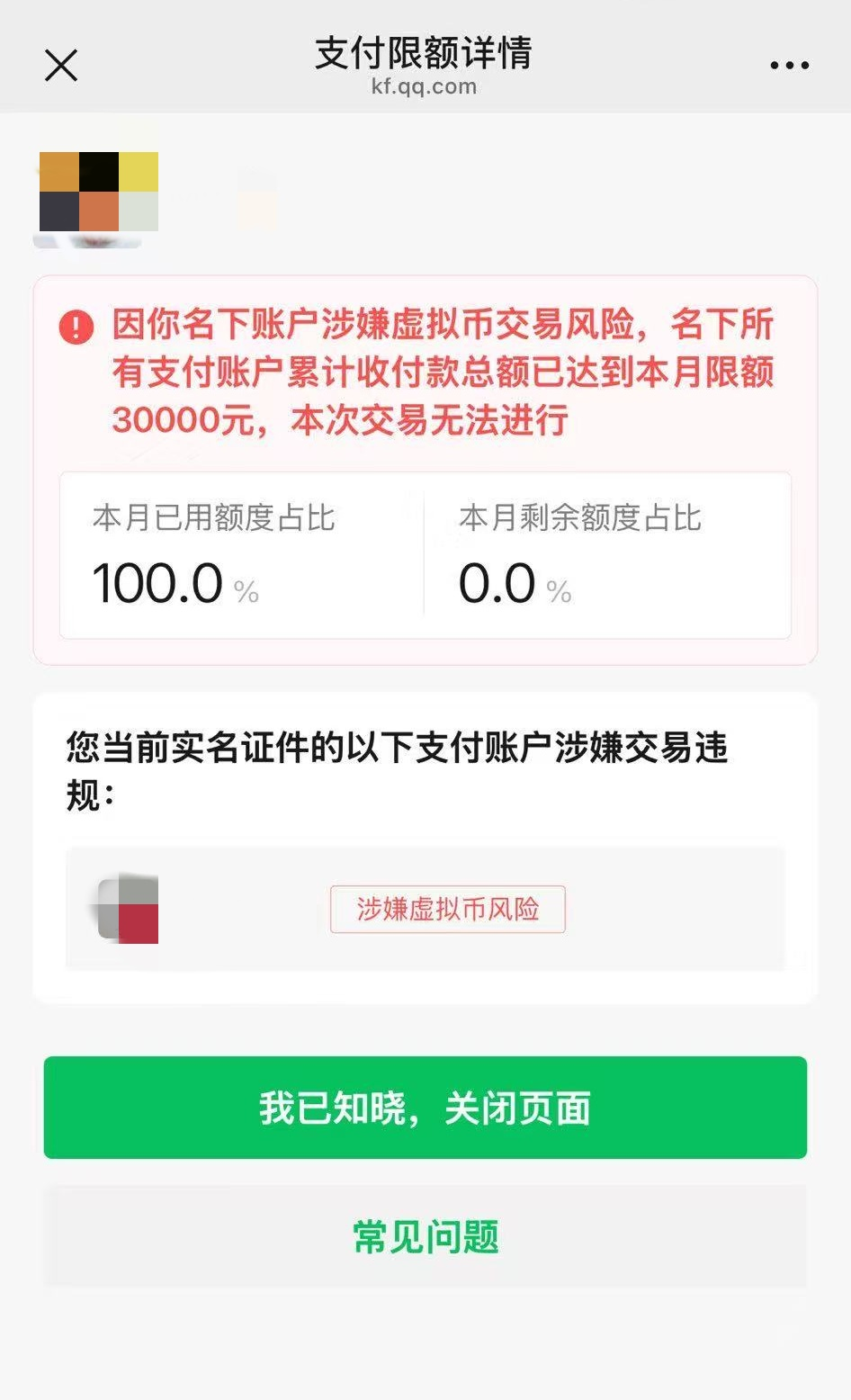
(Image source: internet, will be deleted upon request)
As a defense lawyer, the author has handled too many "frozen card" cases. Many ordinary players, merely trying to cash out, end up receiving involved funds (dirty money), and their bank cards are frozen by public security agencies in other locations. Once a card is frozen, whether applying for unfreezing or cooperating with investigations, the process is extremely long and painful. At best, the cards are stopped, and at worst, individuals may be summoned for questioning or even criminally detained. This is the price of forcibly growing in an environment lacking legal trading soil—you must face the ever-present sources of pollution (dirty money).
4. Final Thoughts
Since the People's Bank of China and other ministries have once again set the tone for "continuing to crack down," as a legal professional navigating this industry, the author has a few heartfelt words to offer to all "crypto circle" and even Web3 practitioners:
(1) Give up the fantasy of "compliance" for cryptocurrency-related projects. Within mainland China, there is currently no compliant path for businesses involving virtual currency trading. Do not be deceived by certain so-called "project parties" claiming to have obtained "certain licenses"; that is self-deception.
(2) Stay away from OTC lending and profit-sharing. If you are engaged in foreign trade or currency exchange, do not use USDT as a settlement tool for convenience or to profit from exchange rate differences. In the eyes of the police, this could often be seen as part of money laundering.
(3) Be wary of "going overseas" risks. Some teams physically go overseas, but their clients are still domestic residents, and funds continue to circulate within the country. This kind of "fake going overseas" not only cannot avoid risks but also, due to the convenience of cross-border evidence collection, is more likely to be swept up in a crackdown.
(4) Individual players, take care of yourselves. If you must participate, be sure to use spare money and be mentally prepared for your accounts to be frozen and your assets to be wiped out. Also, absolutely do not help others buy or sell virtual currencies, and do not easily trust the promotional claims of "crypto masters" or KOLs.
In China, virtual currencies, as a type of "virtual commodity" (partially recognized for their property attributes in criminal and civil judicial practice), may still have some space for private holding; but as a "financial asset" or "settlement tool," their living soil has been completely eradicated.
This meeting of the People's Bank of China’s coordinating mechanism is not a new beginning, but a reaffirmation of established policies. In this grand era, understanding the situation, respecting the law, and maintaining bottom lines are more important than seizing one or two "hundredfold coins." After all, freedom is the most valuable asset.**
免责声明:本文章仅代表作者个人观点,不代表本平台的立场和观点。本文章仅供信息分享,不构成对任何人的任何投资建议。用户与作者之间的任何争议,与本平台无关。如网页中刊载的文章或图片涉及侵权,请提供相关的权利证明和身份证明发送邮件到support@aicoin.com,本平台相关工作人员将会进行核查。


