Written by: Glendon, Techub News
The project issuer always faces a core challenge when building exchange liquidity: how to effectively reach real users with their tokens. Once, the "Initial Coin Offering" (ICO) craze swept through the cryptocurrency world, but it was severely hit by regulatory crackdowns in 2018 due to frequent fraud incidents. Since then, the threshold for retail investors wanting to participate in ICOs has been significantly raised. In response, Coinbase is breaking the mold, shifting its strategic focus to a broader group of retail investors.
Last night, Coinbase officially launched an end-to-end token sales platform aimed at providing projects with a more transparent and sustainable token distribution mechanism, while also opening a compliant investment channel for retail users in most parts of the world. This is undoubtedly a long-awaited feast for retail investors in the United States.
In fact, this move has been in the works for some time. On October 21, when Coinbase announced its acquisition of the crypto investment platform Echo for approximately $375 million, it indicated plans to integrate Echo's Sonar platform to help early crypto projects raise funds through self-hosted public token sales.
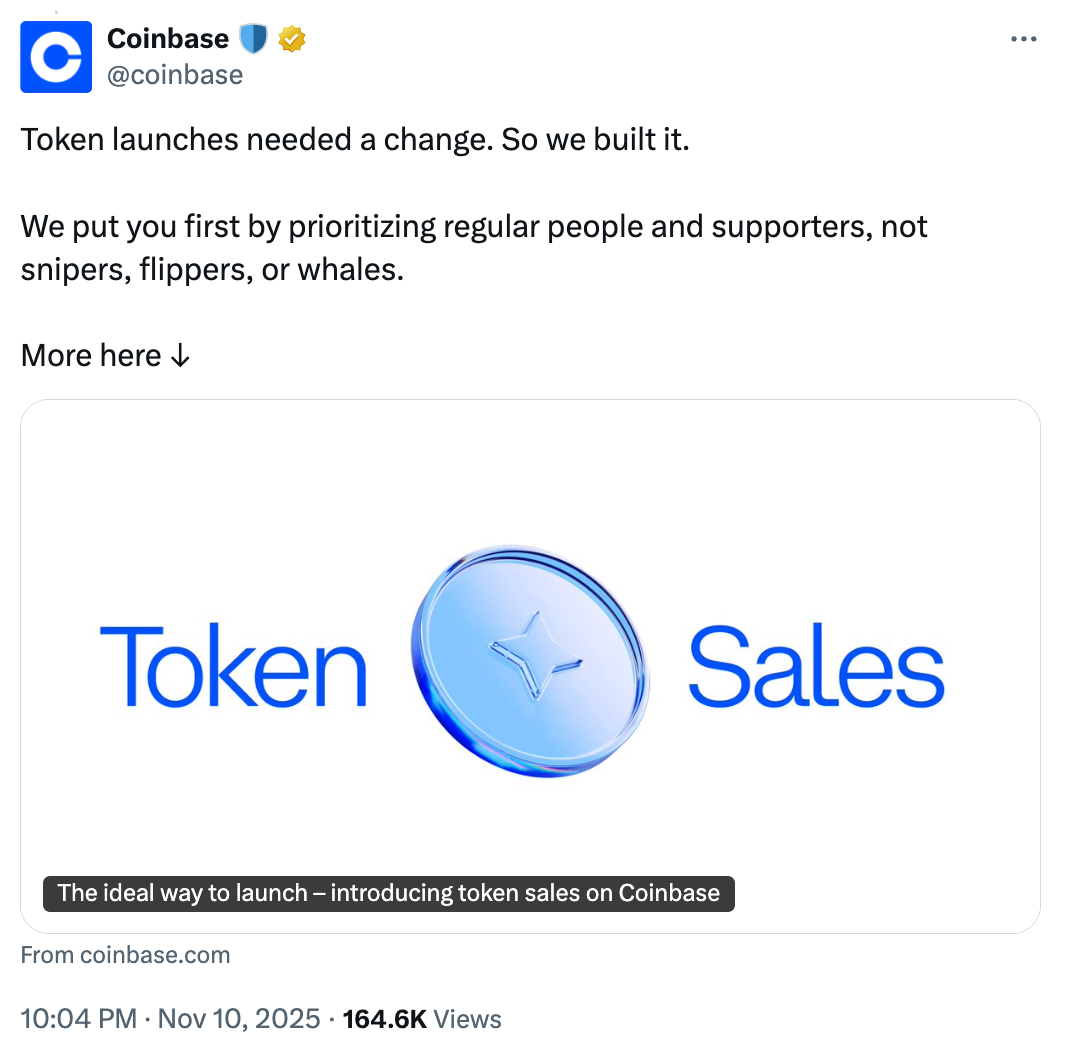
However, it should be noted that the "token issuance platform" is not a new track. Previously, mainstream exchanges such as Binance, Bybit, and OKX have launched issuance platforms like Binance Launchpad and Bybit IDO. As U.S. regulatory policies mature and become more open, the market has long anticipated fierce competition in the Launchpad space. What changes can Coinbase's latest move bring to this intensifying competition?
Core Mechanism of Coinbase's Token Sales Platform
Compared to other Launchpad platforms, the core competitiveness of Coinbase's token sales platform lies in its unique distribution mechanism. Unlike the "first-come, first-served" sales model commonly used by most platforms in the market, Coinbase's mechanism prioritizes the interests of the majority over the privileges of a few.
Specifically, the token sale period on Coinbase will last for a certain duration (e.g., one week), during which users can submit token purchase requests at any time. Once the window closes, Coinbase's algorithm will determine the final token distribution plan based on established rules.
Coinbase emphasizes that in the allocation of token sale quotas, it will follow the principle of "small amounts first," meaning that the needs of small buyers will be prioritized, followed by larger purchase requests, while algorithms will limit excessive concentration of assets among large buyers until the token supply is exhausted.
In addition, "zero-fee participation" is another significant advantage of this platform. Whether participating in token sales or applying for token listings, users and project parties do not incur any additional fees. Coinbase only charges the token issuer a certain percentage of USDC sales commission, and this commission is strictly limited to the token sale process itself. For users, participating in token sales only requires holding USDC, with no transaction fees throughout the process, thus breaking the constraints that often force users to purchase exchange platform tokens to participate in most token issuance activities.
If Coinbase can successfully implement its distribution mechanism, it will undoubtedly lower the investment threshold for retail investors, providing them with more opportunities to participate.
On this basis, Coinbase also has comprehensive considerations regarding price discovery and risk management. In addition to strictly requiring issuers to fully disclose key information to users (such as project details, token economic models, and team backgrounds), Coinbase stipulates that token issuers and their affiliates cannot sell any tokens in over-the-counter (OTC) or secondary markets within six months after the public sale on Coinbase. Moreover, any sale must be approved and publicly disclosed by Coinbase, and a lock-up period must be set, with tokens only unlockable after six months to maintain the project's stable operation.
At the same time, Coinbase has also established constraints on user behavior. If a user chooses to sell tokens shortly after they go live (within 30 days), their allocation in subsequent token sales may be reduced. Coinbase plans to use this restriction to ensure that projects genuinely support user participation, guide users toward long-term investment, and to some extent limit large sell-offs after token listings, providing a more stable development space for projects.
Another significant advantage of Coinbase is its "compliance" attribute. Unlike the Launchpad platforms of mainstream exchanges like Binance and Bybit, which are mostly established overseas, Coinbase is building a compliant token sales platform in the U.S., potentially becoming the first regulated global token release platform ecosystem and an important infrastructure for crypto projects' "launch layers."
Crypto KOL "Based Elnen" pointed out during the Coinbase acquisition of Echo that "Base is equivalent to the deployment layer, Echo is the issuance engine, and Coinbase is the liquidity and distribution platform, which will be a complete full-stack product release ecosystem." With the launch of Coinbase's token sales platform, this argument seems to be further validated, as it appears to be the final piece of the Coinbase ecosystem puzzle, making the entire strategic blueprint clearer and more complete.
For this reason, Coinbase's latest move may create a "catalyst effect," stimulating other platforms' competitive awareness and compliance consciousness while developing itself, prompting them to pay more attention to compliance construction and long-term development. This effect is expected to guide the entire industry into a more structured era, pushing this field from the previous "speculative hype" situation toward a more robust and orderly "compliance construction" direction.
Coinbase's Debut Project "Monad": A Star with Unlimited Potential
Why did Coinbase choose Monad as the debut project for its token sales platform?
Monad is a high-performance Layer-1 public chain aimed at solving Ethereum's performance bottlenecks. It employs parallel computing and the MonadBFT consensus algorithm, planning to achieve 10,000 transactions per second (TPS) and sub-second final confirmation, far exceeding the current performance of Ethereum and Solana. Additionally, it is fully compatible with EVM (Ethereum Virtual Machine) at the bytecode level, allowing Ethereum contracts to run directly without code modification. Its native token is MON, used for paying gas fees, securing the chain through staking, and promoting the development of the protocol by validators, developers, and users.
Coinbase's choice of Monad is likely based on multiple in-depth considerations. From a technical perspective, Monad's parallel EVM technology can address Ethereum's scalability issues, and its high performance and compatibility design align with Coinbase's positioning of a "sustainable, transparent" token distribution platform.
From a capital investment and ecosystem perspective, Monad has accumulated a massive $244 million in financing, with many well-known investment institutions such as Paradigm, Jump Trading, and Dragonfly expressing optimism and investing, making it a potential star project in the primary market. Although still in its early stages, Monad's ecosystem development momentum is rapid, attracting well-known projects like liquidity protocol Elixir and cross-chain bridge Wormhole, along with several emerging projects being built within its ecosystem, such as the DeFi trading platform Monday Trade, fully on-chain order book DEX Kuru, and social media betting platform Kizzy. This backing from capital and ecosystem also enhances its long-term value.
Notably, Monad's mainnet and its token MON will launch on November 24. Today, Monad also announced its token economics, with a total supply of 10 billion MON tokens, of which 7.5% will be sold at a fully diluted valuation (FDV) of $2.5 billion, and 3% of the tokens will be distributed through airdrops. The remaining allocation is 38.5% for ecosystem development; 27.0% for the team; 19.7% for investors; and 4.0% for the Category Labs treasury.
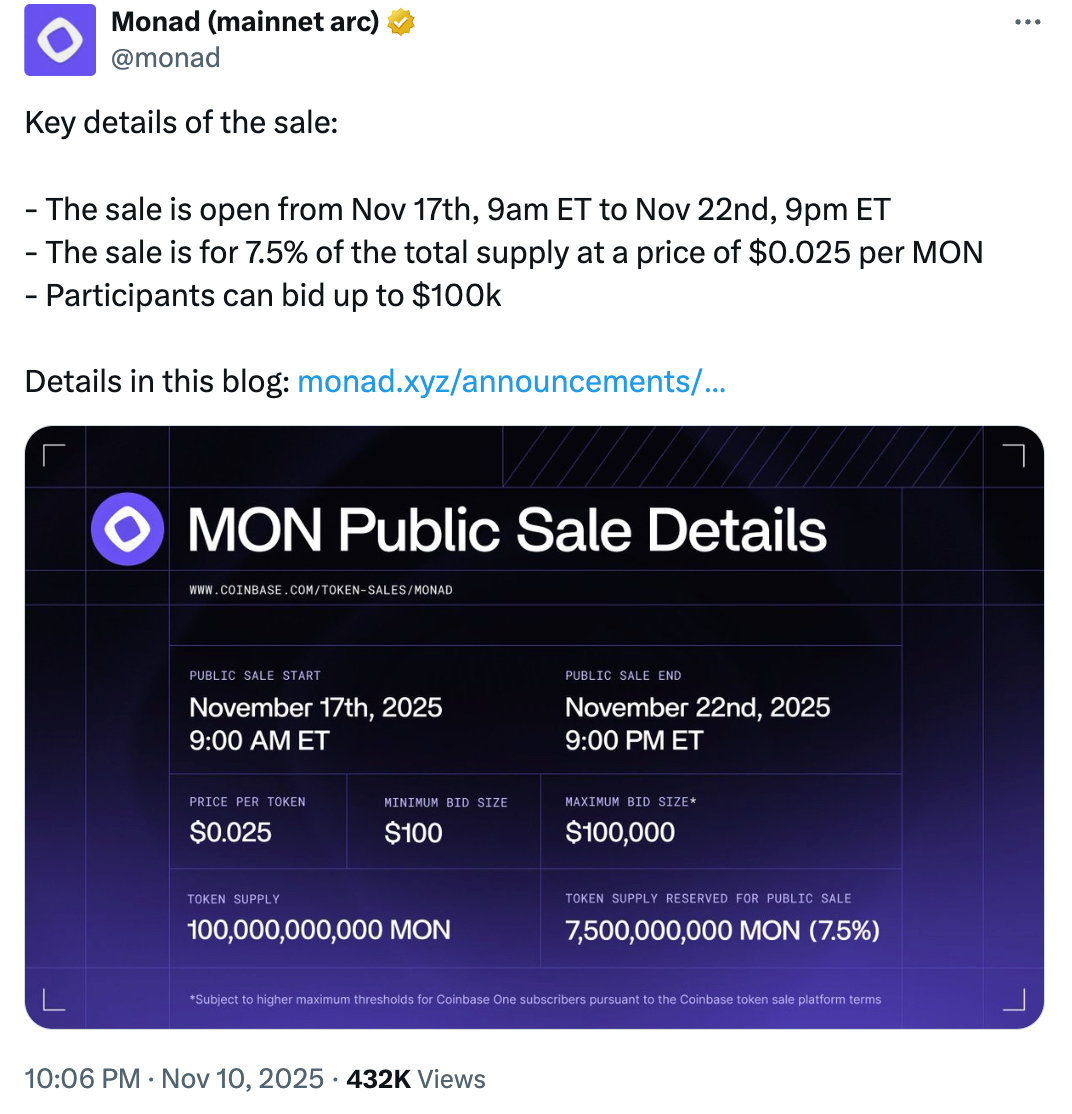
The public sale of Monad tokens is scheduled from November 17 at 22:00 to November 23 at 10:00. During this public sale, a maximum of 750 million MON will be sold at a price of $0.025 per token. The minimum purchase threshold is set at $100, with a maximum purchase limit of $100,000.
Despite the current market volatility, the inherent market attention surrounding Monad and its status as the debut project on Coinbase's token sales platform are expected to significantly enhance MON's liquidity in the initial market compared to similar projects. Based on this, its token price may have a promising upward potential.
Of course, from a medium to long-term perspective, Monad is still in the early stages of ecosystem development. Although the prospects are bright, its future performance will need to be closely monitored based on the actual situation of ecosystem construction after the mainnet launch.
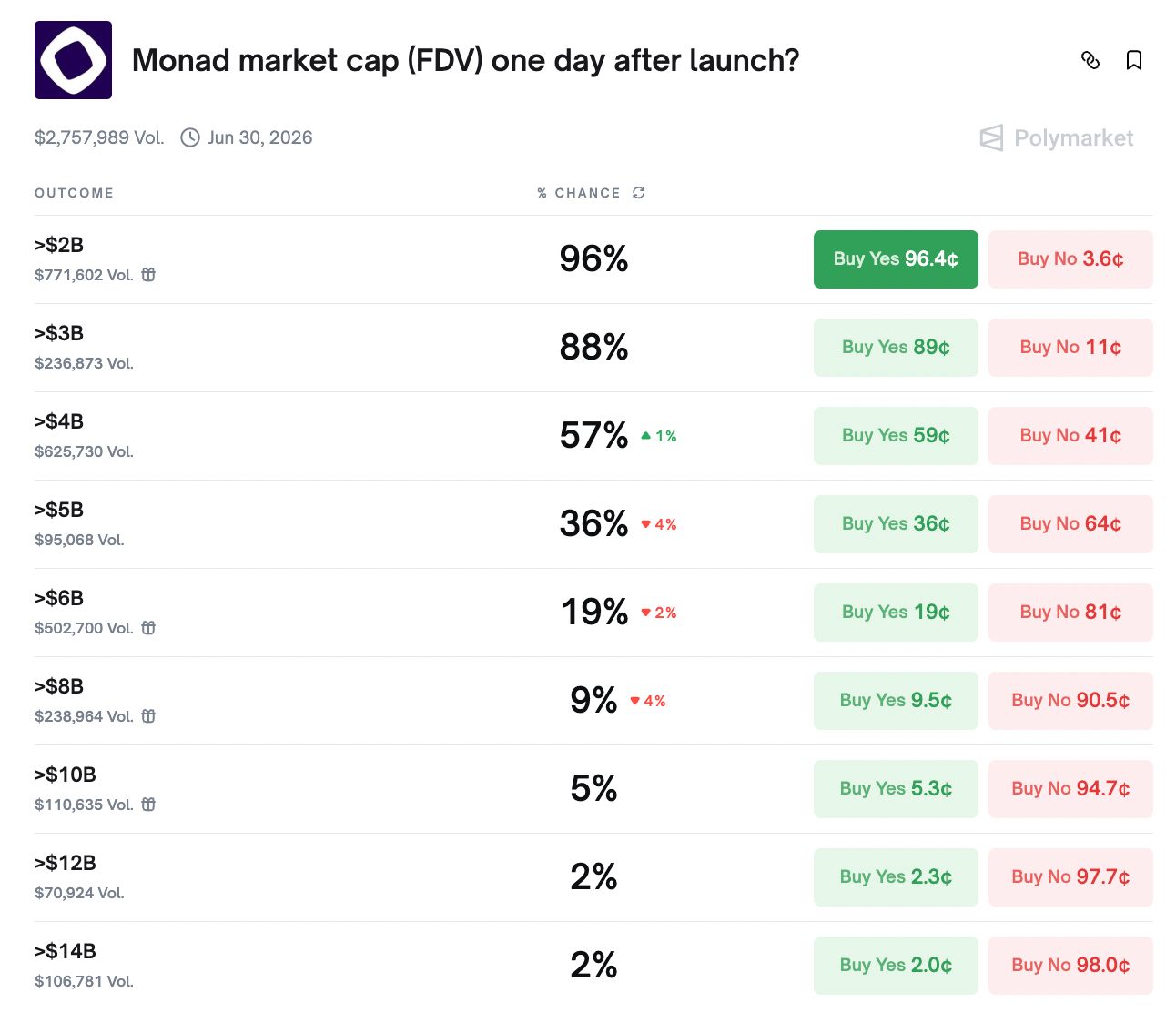
As of the time of writing, data from Polymarket provides a more intuitive market expectation. The data shows that the probability of Monad's token achieving an FDV of over $4 billion one day after its launch is 57%, the probability of exceeding $3 billion is 88%, and the probability of exceeding $2 billion is 96%. The trading volume in this prediction market is approaching $2.76 million.
Summary
The launch of Coinbase's token sales platform marks a key turning point in the token issuance ecosystem from speculative hype to standardized development. By ensuring fair participation for retail investors through an algorithmic distribution mechanism, this model not only provides a safer participation channel for compliant users and long-term investors but also opens a "front door" for quality projects to enter the mainstream market by reducing gray operational paths and rebuilding trust in the primary market. As a result, many in the community believe that Coinbase's move may usher in a new "ICO era."
However, we must recognize that Coinbase's innovative initiative is not an "industry savior." Currently, the token issuance market is already highly saturated, resembling a fiercely competitive red ocean. The core challenge facing Coinbase is how to filter out assets with genuine long-term value rather than simply relying on the issuance mechanism to attract traffic. Moreover, skepticism within the industry has never ceased, with many investors believing that most token issuances resemble "pump and dump" schemes, often lacking substantial product support, stagnating user growth, and seemingly existing solely to allow insiders to cash out at high prices, leaving retail investors to bear the losses.
Therefore, whether this token issuance platform can become a bridge connecting compliant users with quality projects remains to be seen over time.
Nonetheless, Coinbase's exploration provides a new perspective on the financing mechanisms for crypto projects: within a framework of fairness and compliance, the industry may move toward a more robust and sustainable development path. If this exploration can succeed, Coinbase will set a new precedent: truly opening up to retail investors, making financing no longer just a tool for venture capital firms to obtain liquidity upon exit.
免责声明:本文章仅代表作者个人观点,不代表本平台的立场和观点。本文章仅供信息分享,不构成对任何人的任何投资建议。用户与作者之间的任何争议,与本平台无关。如网页中刊载的文章或图片涉及侵权,请提供相关的权利证明和身份证明发送邮件到support@aicoin.com,本平台相关工作人员将会进行核查。


