If XAUT and other tokenized gold were placed in front of you alongside BTC, which one would you choose?
It is well known that in the TradFi world, gold symbolizes "hard currency," while in the Crypto world, Bitcoin is also regarded as "digital gold." Therefore, as gold accelerates its transition to the blockchain, the boundaries between the two are becoming increasingly blurred (for further reading, see “From Trustless BTC to Tokenized Gold, Who is the True 'Digital Gold'?”).
In this context, an interesting debate has reignited the topic—"Gold Father" Peter Schiff has officially challenged CZ, with the theme being "Bitcoin vs. Tokenized Gold." The clash of these two viewpoints actually reveals a larger question:
In the new era where RWA gradually integrates into Web3, can "trust" be completely replaced by code?
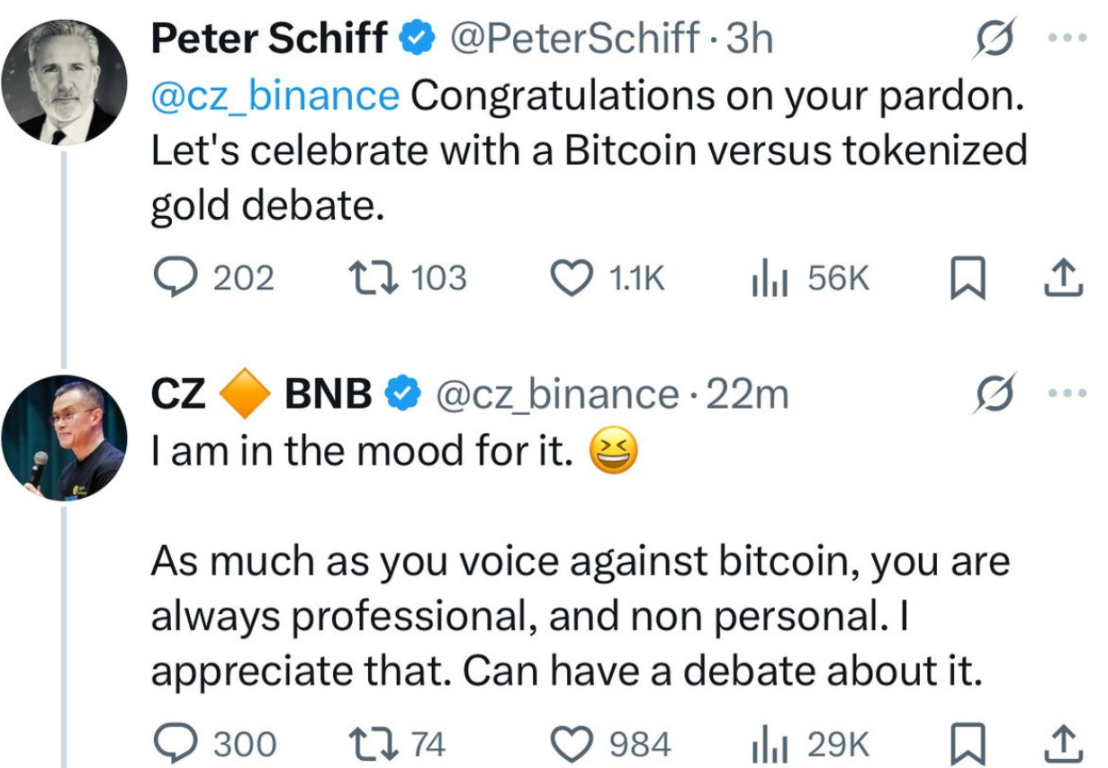
The Debate Between "Gold Father" and CZ
Looking back at historical statements, Peter Schiff is undoubtedly one of the most stubborn critics of Bitcoin.
In his view, Bitcoin is merely an illusion for speculators, while gold represents a return to currency, and "tokenized gold" serves as a bridge to further bring the gold standard into the digital age—possessing both the physical backing of gold and a series of advantages brought by blockchain.
This also means that Peter Schiff firmly stands on the side of "intrinsic value" and "physical reliability." CZ's response, however, is direct and sharp, pointing out the fundamental weakness of tokenized gold: "Tokenized gold is not truly on-chain gold; it still relies on trust. Users believe that the issuer will fulfill their obligations in the future, rather than code guaranteeing everything directly."
In simple terms, even projects like Tether Gold (XAUT), which have backing from Tether, still require users to rely on the continuation of traditional systems in extreme situations such as war, management changes, or regulatory conflicts.
Objectively speaking, CZ's statement is not wrong; projects like XAUT and other tokenized gold are essentially mapped assets based on institutional credit, unable to completely escape centralized dependence. However, Schiff's viewpoint is not entirely incorrect either, as he stands on the perspective of "intrinsic value and physical reliability."
Ultimately, the debate between Schiff and CZ is not a matter of right or wrong in value judgment; it is essentially a clash of two different "reliability models": the former is physical reliability (based on the scarcity of gold), while the latter is system reliability (based on code's trustlessness).
To deeply understand the positioning of tokenized gold as a mapped asset and its limitations in reliability, we must first review how traditional finance handles physical gold.
From Paper Gold to Tokenized Gold: Evolution and Compromise
In fact, even before the emergence of tokenized gold products like XAUT, TradFi had already begun to attempt to "certify" gold, with one of the most typical methods being "paper gold."
As the name suggests, paper gold is a type of bank gold savings book or a gold ETF without physical delivery, which can be simply understood as a credit certificate, meaning users no longer directly own gold but hold a "credit promise" from the bank, trading gold or other precious metals through a paper gold account without any physical delivery involved.
This solves the problems of physical gold being difficult to divide and inconvenient to carry, making gold lighter and more liquid. The "paper gold" products launched by various banks indeed provided many users with convenient opportunities for gold investment and holding.
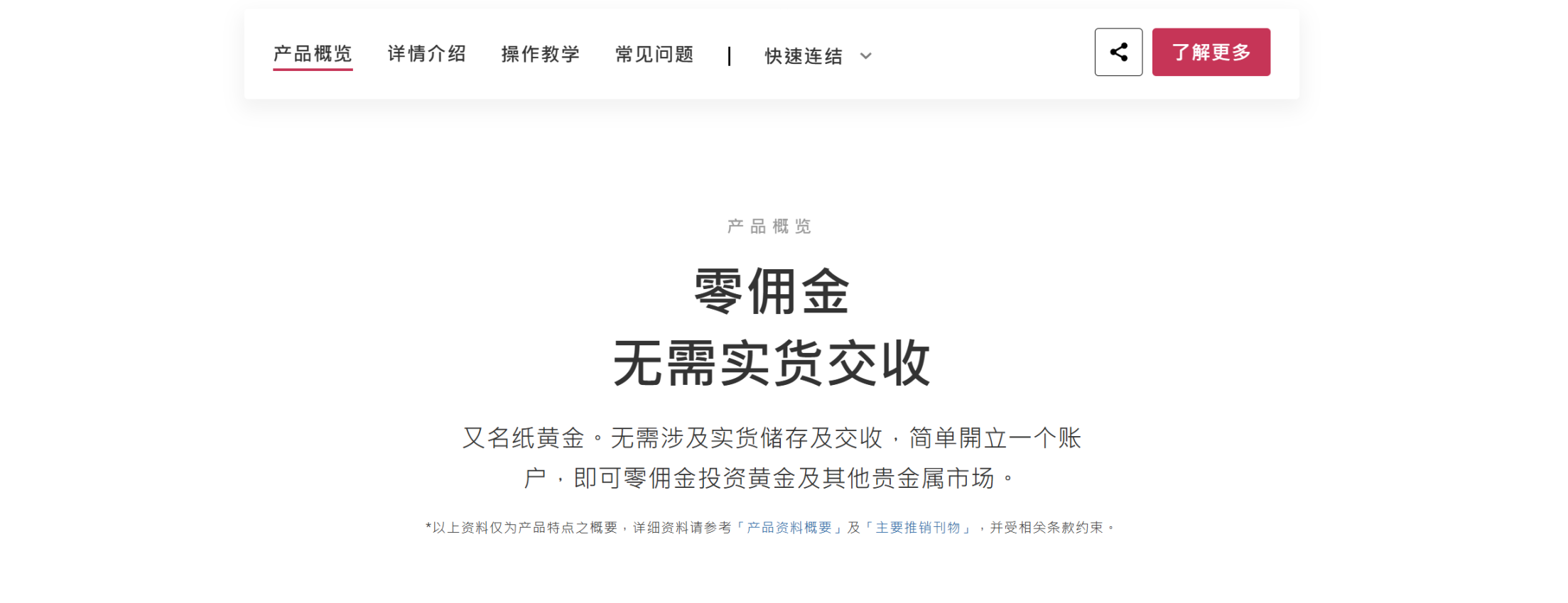
Source: Bank of China Hong Kong
However, fundamentally, the foundation of this model still relies on "centralized single-point trust," as it depends on the credit backing of financial institutions. Banks can issue certificates that exceed their actual gold reserves (i.e., over-issuance). In times of financial crises or large-scale runs, holders of paper gold may not be able to redeem physical gold in full, facing credit risk and redemption risk.
Only products backed by strong credit, such as large state-owned banks, can minimize this risk as much as possible. In other words, paper gold allows users to sacrifice certainty in exchange for liquidity and convenience.
The emergence of tokenized gold like XAUT can be seen as an upgraded blockchain version of "paper gold": it continues the mapping logic of "gold reserves + digital certificates," moving the certificates from bank ledgers to a public chain that anyone can view—taking Tether's XAUT as an example, each XAUT is said to represent one ounce of gold stored in a Swiss vault, allowing users to hold, transfer, or trade these tokens 24/7 through their wallets.
The biggest advantage of this model is that it provides gold with 24/7 global liquidity, while other dimensions are not much different from "paper gold," meaning users no longer have to bear the storage and transportation costs of gold bars; finally, small investors can also hold gold through fragmented tokens.
However, Tether Gold is not a "completely trustless" system; its security and stability still depend on Tether's own reserve disclosures, custody arrangements, and legal frameworks. Although Tether claims that each XAU₮ is backed by physical gold, it remains difficult for outsiders to independently verify the actual conditions of the vault, the independence of audits, and the redeemability in extreme environments.
In summary, XAUT is a disruptive upgrade to the paper gold model, combining direct ownership of physical gold (with a promise of full reserves) and the efficient transfer of Crypto (on-chain tokens), but it still retains the institutional credit risk brought by centralized issuance.
The Fate of RWA: An Inescapable Centralization Trade-off
The reliability dilemma of tokenized gold can actually be extended to the fundamental differences between all RWA/mapped assets and on-chain native assets, which centrally reflects the contradiction between efficiency and ideals in the development of Web3.
This includes stablecoins, especially the long-standing debate between "centralized stablecoins" and "decentralized stablecoins" that has been a main narrative in crypto for several years:
- Algorithmic stablecoins (like UST): Attempting to completely escape centralization by creating value through algorithms, but their rapid rise and collapse prove that pure code trust is extremely fragile without physical backing;
- Centralized stablecoins (like USDC): The 2023 Silicon Valley Bank crisis severely impacted USDC, exposing its excessive reliance on the traditional banking system and centralized regulation;
- Decentralized stablecoins (DAI/USDS): For a long time, they have tried to maintain decentralization through over-collateralization with crypto assets, but to enhance scale and stability, they have had to gradually introduce RWA assets as collateral, which itself is a compromise towards physical trust;
It can be said that except for BTC and ETH, whether it is stablecoins, XAUT, or other RWA assets, their fate is to be unable to escape centralization.
Because the essence of RWA is "mapping the value of off-chain assets to on-chain," this process inevitably requires issuing entities to promise 1:1 redemption, while regulated custodial institutions securely store physical assets, and the legal framework must ensure that token holders have legal recourse.
The final trade-off is also quite intuitive—XAUT is more conservative in asset value than BTC, with physical backing; but BTC is more censorship-resistant and decentralized in system architecture than XAU₮.
From this perspective, both Schiff and CZ are not wrong; they are merely defending two different future models:
- Schiff's future (RWA): "Digital efficiency + physical reliability," sacrificing decentralization but ensuring value backing;
- CZ's future (BTC): "Code trust + decentralization," sacrificing intrinsic value but ensuring system censorship resistance;
This also indicates that Web3 will not be a purely code-based world, but rather an ecosystem where code trust and physical trust coexist.
免责声明:本文章仅代表作者个人观点,不代表本平台的立场和观点。本文章仅供信息分享,不构成对任何人的任何投资建议。用户与作者之间的任何争议,与本平台无关。如网页中刊载的文章或图片涉及侵权,请提供相关的权利证明和身份证明发送邮件到support@aicoin.com,本平台相关工作人员将会进行核查。