After Trump took office in the White House, favorable policies for the cryptocurrency market have frequently emerged. On March 4, local time in the U.S., the Senate passed the repeal of the "DeFi Broker Rule" with a vote of 70 to 27. David Sacks, the White House AI and cryptocurrency director, announced on social media, "The White House is pleased to announce support for the Congressional Review Act (CRA) proposed by Senator Ted Cruz and Congressman Mike Carey to repeal the so-called 'DeFi Broker Rule'—an attack by the Biden administration on the crypto community at the last moment."
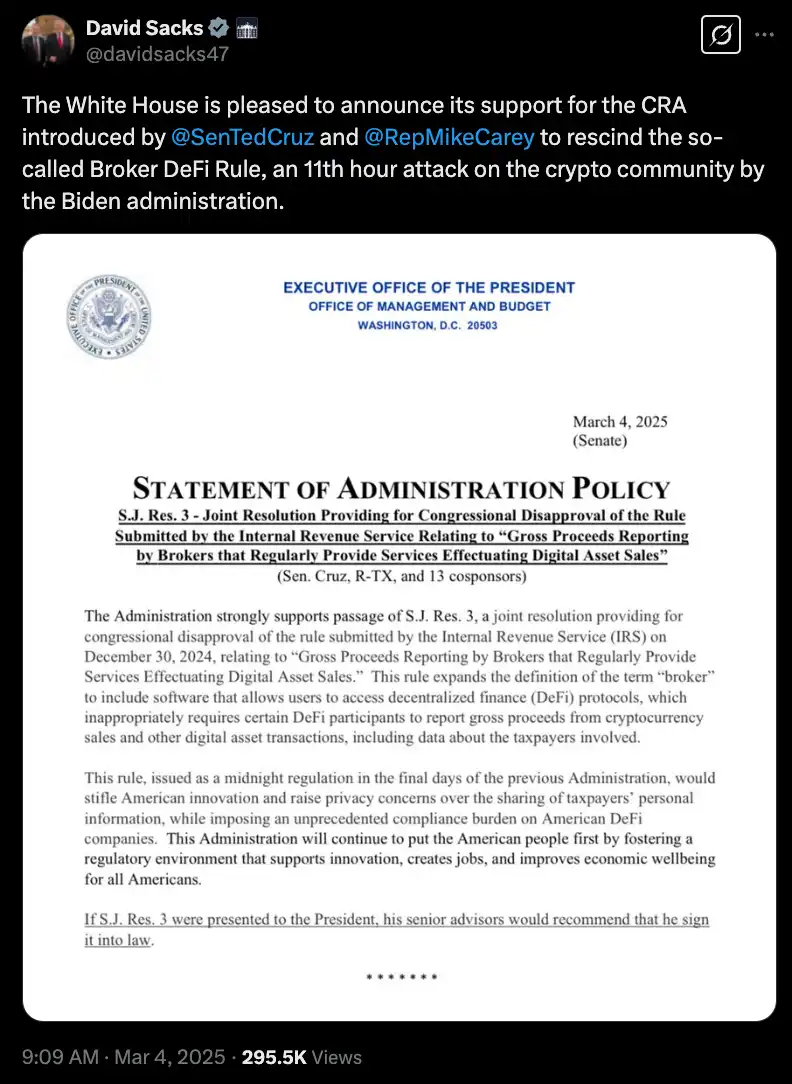
However, the resolution still awaits approval from the House of Representatives, after which President Trump can sign it into law. Once completed, not only will the rule be completely abolished, but the IRS will also be prohibited from implementing similar policies in the future. The White House stated that the president may sign this resolution quickly.
The Blockchain Association, representing well-known cryptocurrency companies such as Coinbase, Kraken, and Uniswap Labs, supports the repeal of the rule and stated that this will prevent unnecessary restrictions on DeFi innovation. The DeFi Education Fund stated that the Senate's vote is "the first of many historic milestones in U.S. digital asset regulation."
Why Repeal the "DeFi Broker Rule"?
The DeFi Broker Rule is a regulatory framework targeting decentralized finance (DeFi) intermediaries (such as trading platforms, lending protocols, etc.) that will take effect on January 1, 2025, aimed at ensuring compliance, user protection, and risk management. The core content includes anti-money laundering (AML), user identity verification (KYC), smart contract audits, fund security, and transparency requirements. According to TaxDAO's professional interpretation, this rule has certain positive effects on anti-money laundering, anti-terrorism, and anti-tax evasion.
In fact, the implementation of the DeFi Broker Rule had already sparked considerable controversy in the industry. Since decentralized platforms do not hold funds or store customer data like traditional financial institutions, many critics believe that the rule is impractical and constitutes "overregulation." The digital asset think tank Coin Center called the proposal "technically unfeasible."
Related Articles:
《U.S. Crypto Broker Rule: A Bitter Pill or a Deadly Poison?》
《Crypto Industry Calls on Congress to Repeal IRS's DeFi Broker Rule》
The main reason is that the DeFi Broker Rule attempts to regulate DeFi using traditional finance (TradFi) thinking, failing to align with the development logic and characteristics of crypto, and overlooking the decentralization and anonymity of DeFi, fundamentally misunderstanding the technology it seeks to regulate. The DeFi Broker Rule imposes higher compliance management requirements, mandating practitioners to strictly fulfill tax reporting obligations and enforce KYC mechanisms. For example, the requirement for reporting using the 1099-DA form explicitly requires brokers to submit information including investors' digital wallet addresses and transaction volumes, which would substantially change existing trading models: on one hand, the KYC mechanism would undermine the anonymity characteristic of DeFi, leading to a significant reduction in privacy protection levels; on the other hand, the collection, processing, and reporting of user data would greatly increase operational costs and compliance pressure.
This TradFi regulatory approach could have far-reaching impacts on the development of DeFi: first, the increase in manual review processes would disrupt the automated execution of smart contracts, affecting the operational efficiency of decentralized governance mechanisms; second, the obligation for information disclosure fundamentally conflicts with the core principles of the DeFi ecosystem. If regulation continues to strengthen transparency requirements while weakening anonymity features, it would not only change the trading behavior patterns of user groups but could also severely restrict the market competitiveness and innovative vitality of the distributed financial system.
Senator Ted Cruz, the initiator of the repeal of the DeFi Broker Rule, stated in his Senate speech before the vote that "DeFi is a microcosm of the cryptocurrency revolution." He described the rule as "incoherent" federal overreach. He argued that treating software developers as brokers (and forcing them to disclose user data and personal information) is meaningless, "as their software has never held or controlled user funds."
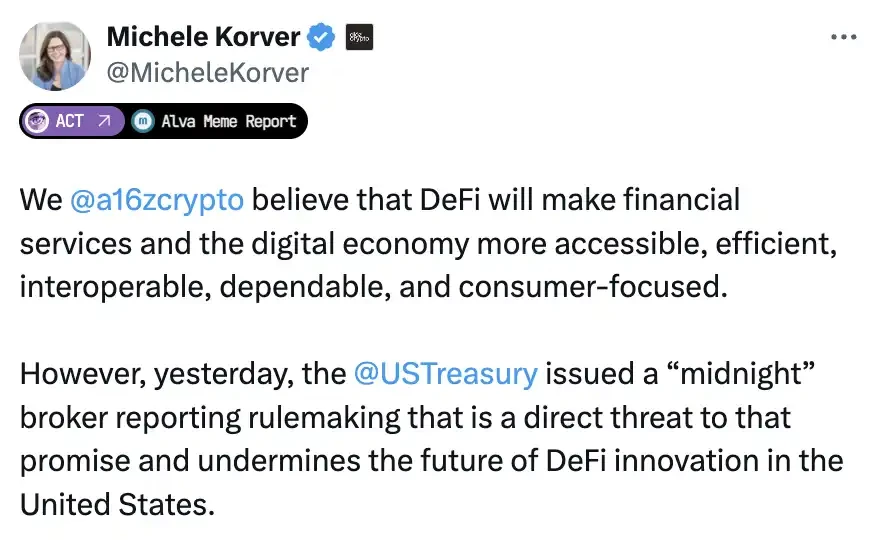
Michele Korver, head of regulatory affairs at a16z Crypto, also stated that the new broker reporting rule released by the U.S. Treasury yesterday poses a direct threat to the vision for the development of DeFi and could hinder the future of DeFi innovation in the U.S. To this end, a16z Crypto supports the Blockchain Association, DeFi Education Fund, and Texas Blockchain Council in filing a lawsuit, accusing the IRS and Treasury of exceeding their statutory authority, violating the Administrative Procedure Act (APA), and even being unconstitutional.
Trump's "De-Crypto Regulation," with DeFi at the Forefront
This proposal passed with an overwhelming victory of 70 votes to 27, indicating that not only Republicans but also many Democrats support the development of crypto. A similar situation occurred in the previous Congress when the SEC's cryptocurrency accounting rules were repealed, showing a continued bipartisan support for crypto development, which may bring favorable conditions for this year's stablecoin legislation and other crypto bills.
With Trump back in power, the most crypto-friendly U.S. Congress in history has emerged. Although the recent hype around "presidential coins," "first lady coins," and Trump's repeated emphasis on "cryptocurrency strategic reserves" has disappointed many, it is undeniable that the policy shift is indeed beneficial for the crypto market. On the third day after returning to the White House, on January 23, 2025, Trump signed an executive order to establish a cryptocurrency task force, tasked with proposing new regulatory recommendations for digital assets and exploring the establishment of a national cryptocurrency reserve. The order explicitly prohibits the creation of a central bank digital currency (CBDC) in the U.S., avoiding competition between government-issued digital currencies and existing cryptocurrencies.
As a core component of the crypto world, DeFi has also been the primary target of pressure and jurisdiction from regulatory agencies like the SEC in the early years. However, recently, various positive signals regarding regulation in the DeFi sector have emerged, indicating a shift in the attitude of regulatory agencies. From the SEC announcing the withdrawal of the Kraken lawsuit; closing the investigation into Gemini; terminating the three-year investigation into Uniswap Labs without taking any enforcement action; to major market makers Wintermute and Citadel Securities entering the U.S. market; and Tornado Cash founder Alexey Pertsev receiving temporary release…
Related Articles:
《Regulatory Easing Frequent, Is the Crypto Spring Coming to the U.S. Market?》
《Regulatory Easing Continues, Are U.S. Crypto Market Makers Back?》

In addition, the SEC has rescinded the accounting guidance requiring listed companies to record third-party crypto assets as both assets and liabilities, announced the establishment of a crypto task force to develop a comprehensive and clear regulatory framework, and stated that it will reduce the intensity of crypto enforcement, reallocating over 50 dedicated lawyers and staff to alleviate regulatory pressure on the industry. Furthermore, last month, the SEC confirmed several crypto ETF applications from traditional U.S. giants and concentrated on withdrawing lawsuits and investigations against crypto projects like Coinbase, Robinhood, and Uniswap. These actions indicate that the SEC's attitude towards crypto assets is shifting from "strict regulation" to a "friendly approach."
In the future, under the regulatory easing environment represented by the repeal of the "DeFi Broker Rule," the crypto market may not only welcome favorable conditions. In a relaxed regulatory environment, how to combat illegal activities such as money laundering, and how to ensure tax fairness and market order? Against the backdrop of the rapid development of the crypto industry, how to find a balance between encouraging innovation and strengthening regulation? How will this "crypto president" fulfill the promise of making the U.S. the world's crypto capital? All of these questions still need to be answered through continuous exploration and adjustment between the crypto market and regulatory policies.
免责声明:本文章仅代表作者个人观点,不代表本平台的立场和观点。本文章仅供信息分享,不构成对任何人的任何投资建议。用户与作者之间的任何争议,与本平台无关。如网页中刊载的文章或图片涉及侵权,请提供相关的权利证明和身份证明发送邮件到support@aicoin.com,本平台相关工作人员将会进行核查。