The information, opinions, and judgments regarding the market, projects, and cryptocurrencies mentioned in this report are for reference only and do not constitute any investment advice.
In the December 2024 report, EMC Labs pointed out that the world is still in a rate-cutting cycle, and the current cooling is merely a temporary setback. As liquidity gradually recovers, BTC will once again challenge the $100,000 mark after a high-level adjustment.
In January 2025, the Federal Reserve paused rate cuts as expected, but BTC still managed to rise to the $100,000 mark, driven by medium- to long-term liquidity and optimistic sentiment, closing at $102,411.26, and reaching a new high of $109,358.01 in mid-month.
With Trump's inauguration on January 20, the world welcomed the most crypto-friendly U.S. president. He announced a series of crypto-friendly measures and unexpectedly issued a personal MEME coin. Meanwhile, the "BTC Strategic Reserve" proposal is being actively pursued in several states across the U.S. and is making continuous progress.
These measures and developments greatly stimulated market sentiment, leading to over $16.4 billion flowing into the crypto market in January, resulting in a remarkable 9.7% increase in BTC during the first month of 2025, far exceeding the performance of the Nasdaq and gold during the same period.
From the perspective of BTC's four-year halving cycle and global monetary macro liquidity, BTC is still in the rising phase of EMC Labs' large cycle model (i.e., a bull market).
The market has completed the adjustment of the 2025 Federal Reserve rate cut expectations from "4 to 2" and priced in the yen's interest rate hike, maintaining a relatively intact trend. Starting in February, the factors influencing short- to medium-term price performance will shift to whether Trump's economic policies will lead to rising inflation, which could further lower the Fed's rate cut expectations or even lead to rate hikes. However, the market has not adequately priced in the volatility that Trump's tariff policies may trigger, and the high stock market and BTC are likely to experience price fluctuations in the short term.
Macroeconomic Finance: Crypto Assets Officially Accepted by the U.S. Government
With the sequential release of December's CPI and non-farm employment data in January, the judgment of the U.S. economy as "not landing" has become increasingly clear.
The December CPI rose 2.9% year-on-year, in line with market expectations, with a previous value of 2.7%; the core CPI rose 3.2% year-on-year, slightly below the market expectation of 3.3%, with a previous value of 3.3%. The December PCE increased by 2.5% year-on-year, up from 2.4% previously; the core PCE rose 2.8%, unchanged from the previous value. Non-farm employment increased by 256,000 in December, far exceeding the market expectation of 165,000; the unemployment rate fell to 4.1%, below the expected 4.2%.
The inflation data remains sticky, while employment data remains strong, making it inevitable for the Federal Reserve to stop rate cuts at the end of January.
Since this result had already been priced in by the market, although the stock market, gold, and BTC experienced significant fluctuations in the middle of the month, they ultimately recorded gains. The Nasdaq, Dow Jones, and S&P 500 recorded monthly increases of 1.64%, 4.7%, and 2.7%, respectively. London gold closed at $2,801 per ounce, reaching a new high. BTC rose 9.7% for the month, hitting a historical high of $109,358.01 during trading.
After three consecutive months of significant increases, the rise of the U.S. dollar index finally slowed, with a monthly increase of 0.3363%, still at a high of 108.5160, putting continued pressure on non-dollar-denominated assets. Both long-term and short-term U.S. Treasury yields slowed their increases, consolidating at high levels, with yields slightly rising to 4.543% and 4.155%.
Currently, major asset classes have completed the pricing adjustment for rate cut expectations after necessary turmoil, and the next trading focus will revolve around Trump's economic policies, with tariffs being the most crucial aspect.
On February 1, the U.S. imposed a 25% tariff on its two major trading partners, Canada and Mexico, and a 10% tariff on China, stating that it would also take action against the European Union. After this news was clarified, the three major stock indices and BTC recorded significant declines on the last trading day of January.
After Trump's inauguration, he began to fulfill his promises to the crypto community. On the 23rd, he established a Digital Asset Market Working Group, which will submit a report to the president within 180 days after the issuance of an executive order. The report will include: a federal regulatory framework for the issuance and operation of U.S. digital assets, including stablecoins, considering regulations on market structure, oversight, consumer protection, and risk management, and assessing the feasibility and standards for establishing and maintaining a national digital asset reserve.
The establishment of this working group marks the formal acceptance of crypto assets at the highest level in the U.S., and the specific policies released thereafter will have a profound impact on the digital asset market in the U.S. and globally.
Additionally, regarding BTC, there is a more specific long-term benefit at the policy level, namely the "BTC Reserve Bill." Fifteen U.S. states, including Pennsylvania, Oklahoma, and Ohio, are discussing or advancing the "Bitcoin Reserve Bill," aimed at incorporating Bitcoin into state-level strategic reserves to hedge against inflation and promote fiscal stability. Among them, the plans in Arizona and Utah have entered the approval stage by the White House and senators, just a step away from becoming law.
The advancement of the Reserve Bill will undoubtedly provide strong confidence support for BTC holders and bring new long-term buying power to the market.
Crypto Assets: Waiting for a Breakthrough in a New Range
In January, BTC opened at $93,347.59 and closed at $102,411.26, with a 9.7% increase and a volatility of 21.78%, reaching a historical high of $109,358.01 during trading, with trading volume slightly shrinking compared to the previous month.
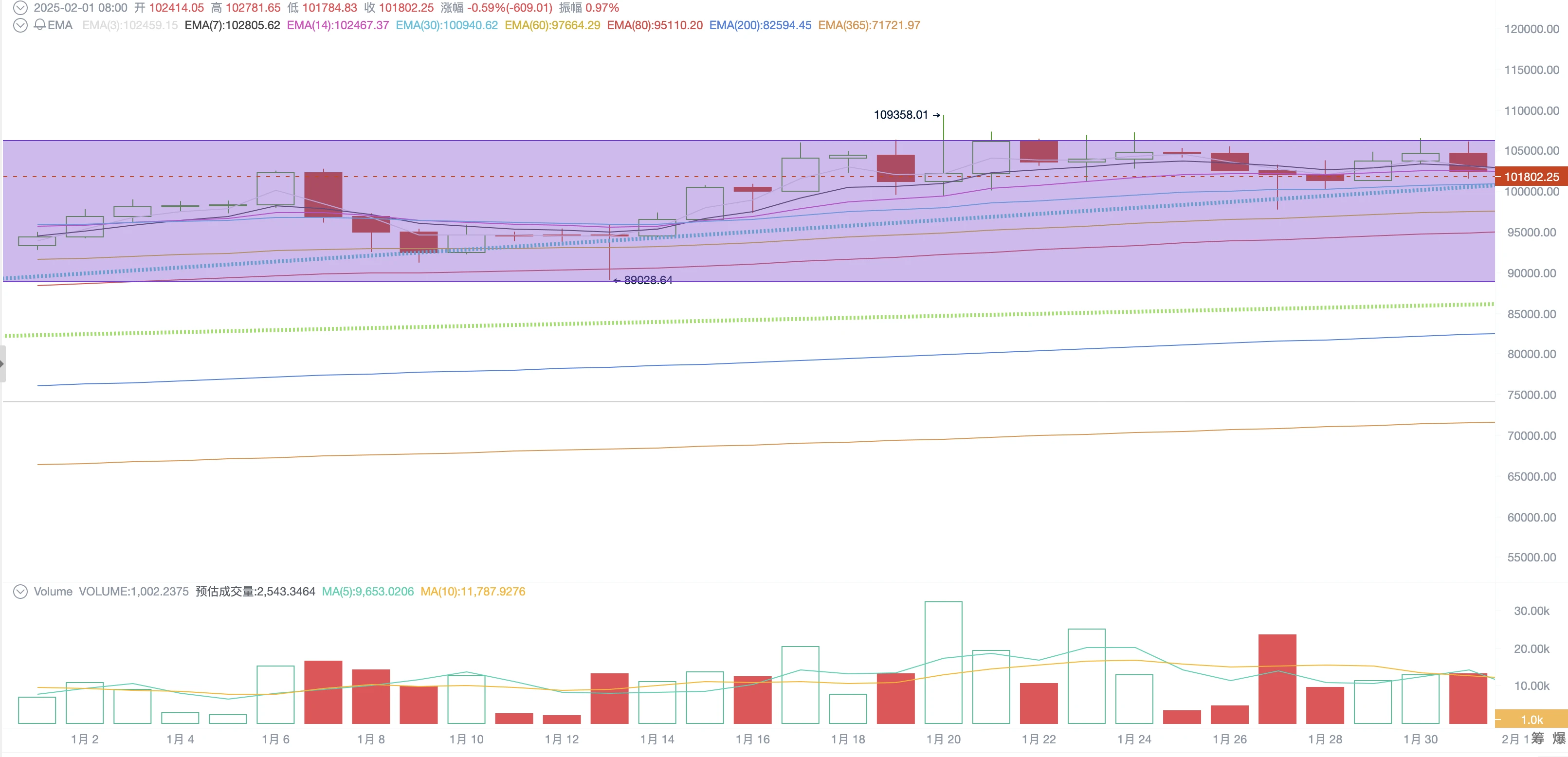
BTC Price Trend (Daily)
Technically, since early November, BTC's price has formed a box structure ranging from $89,000 to $110,000 (the purple range in the above image), which can be referred to as the "Trump Bottom." This range was established around Trump's inauguration and can be seen as the market's pricing range for Trump's crypto-friendly policies.
At the same time, based on the second upward trend line established by the expectations of Trump's victory and the announcement of the victory results (the blue dotted line in the above image), this month it has provided support for BTC prices on January 13 and 27. The second upward trend line is about to intersect with the upper edge of the $89,000 to $110,000 box, forcing the market to make a directional choice in the short term.
In terms of trading volume, after reaching a peak on January 20, the day of Trump's inauguration, it gradually declined, indicating that the market has adopted a cautious attitude towards BTC at high levels. The reduction in liquidity is likely to weaken BTC's short-term performance.
From a technical indicator perspective, the short-term outlook is not optimistic, with a significant possibility of downward pricing. However, the market structure has been changing during this cycle, with upward pricing increasingly driven by large funds behind Microstrategy and BTC ETFs. Therefore, tracking the dynamics and medium- to long-term actions of this portion of funds is more effective for mid- to long-term observations.
Funds: Inflows Reaching $16.4 Billion
Since the launch of the Trump rally in November, the continuous inflow of new funds into the market has become a key force supporting BTC prices against selling pressure.
This month's fund inflow continued the trend since November, exceeding December's scale, reaching $16.406 billion.
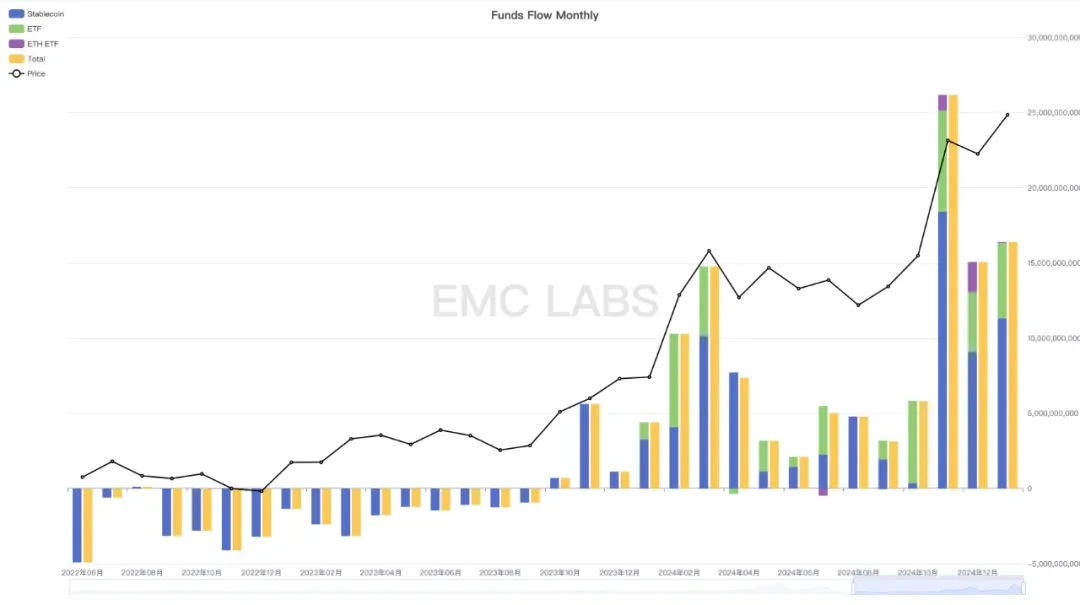
eMerge Engine Crypto Market Fund Inflow Statistics (Monthly)
In 31 trading days, only 9 days recorded net outflows, which is comparable to the number of days BTC experienced declines this month (11 days down). This reflects that after entering a rate-cutting cycle globally, ample liquidity has led to an increase in investors' risk appetite, and the long-term trend of risk assets being favored, driven by U.S. policies, is gradually increasing BTC adoption.
However, it is important to be cautious that after a strong inflow, accompanied by uncertainties from tariffs, if the inflow slows down, BTC prices may face a sharp short-term adjustment.
Secondary Sell-off: New Range Sell-off Gradually Slowing
Since BTC broke through the "new high consolidation range" in October, long-term investors have initiated the second wave of sell-offs in this cycle. According to historical patterns, as liquidity is injected and prices rise, the second wave of sell-offs by long-term holders will continue until liquidity is drained, leading to the end of the bull market, at which point prices will cyclically decline again.
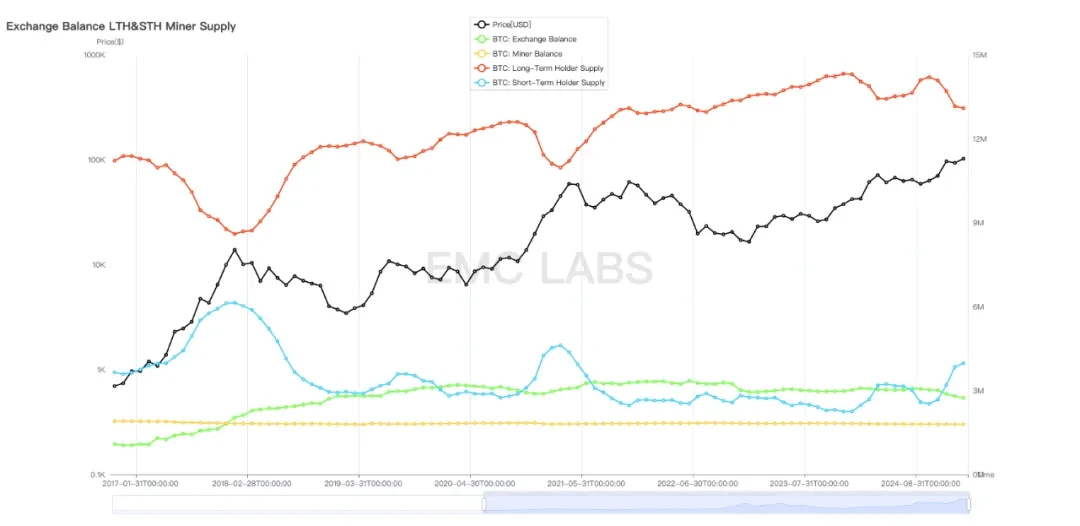
BTC Long-term Holders, Short-term Holders, Miners, and Exchange Inventory Statistics (Monthly)
The sell-off is still ongoing, and although the scale of the sell-off is considerable, it has not yet reached the point of draining liquidity. In fact, since November, the sell-off volume has been decreasing month by month, and exchange inventories have also been continuously declining.
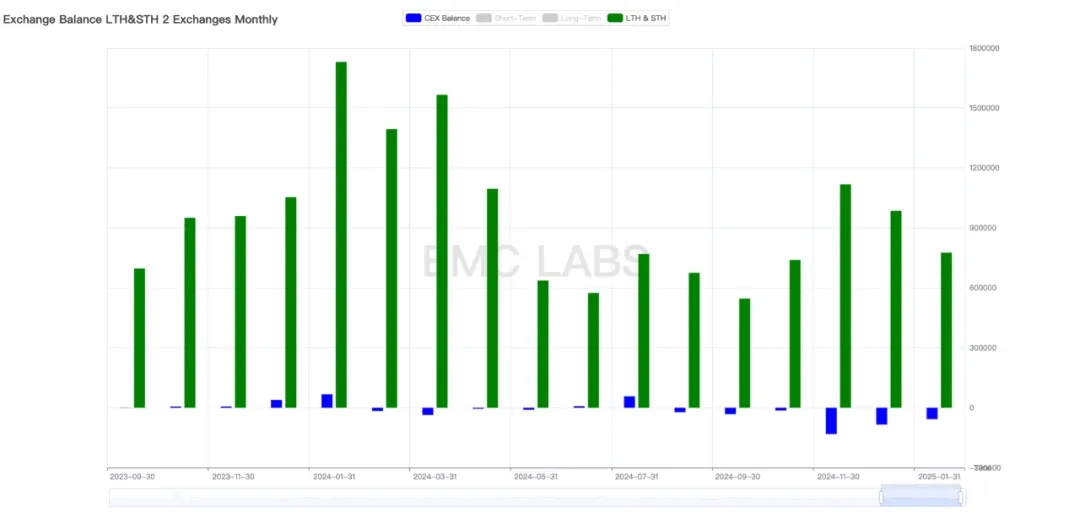
BTC Sell-off and Exchange Inventory Change Statistics (Monthly)
So far, most of the sell-offs have occurred above $90,000, specifically after November. This has resulted in the scale of BTC distributed in the $89,000 to $110,000 range reaching 4,138,554.23 coins, accounting for 24.22% of the total issuance.
This portion of chips has formed a new level of support, which can be referred to as the "Trump Bottom." The core buying volume during this phase comes from institutional investors entering through Microstrategy and BlackRock's BTC ETF channel after Trump's election victory.
EMC Labs judges that the "Trump Bottom" is solid enough, and as the long-term holders' reduction in holdings within the $89,000 to $110,000 range slows down, the medium- to long-term upward momentum for BTC far exceeds the downward pull. However, in the short term, it may face significant pressure from panic sentiment triggered by tariffs, with a small probability of breaking below, depending on liquidity.
Conclusion
With the introduction and gradual implementation of crypto-friendly policies in the U.S., crypto assets represented by BTC are moving from the margins to the center stage, entering a new phase of development.
New holders are flooding into the BTC market, exchanging original holders' chips at higher purchase prices or losses triggered by market chaos. The motivation for new investors comes from the new use case scenarios that BTC is unfolding (large company allocations, state government reserves, and even federal government reserves). These new use cases allow BTC's value and price to be reassessed in new scenarios, and the control over prices may undergo fundamental changes.
In the medium term, from the perspectives of internal holding structure, external fund supply, and investor sentiment, BTC has basically completed the formation of the "Trump Bottom" and is ready to break through to the next price range.
The greatest external uncertainty comes from the chain reaction formed by the implementation of Trump's economic policies on rate cut expectations and fund supply. Once liquidity is constrained, volatility will significantly increase.
EMC Labs was established in April 2023 by crypto asset investors and data scientists. It focuses on blockchain industry research and investments in the crypto secondary market, with industry foresight, insights, and data mining as core competencies, aiming to participate in the thriving blockchain industry through research and investment, promoting the benefits of blockchain and crypto assets for humanity.
For more information, please visit: https://www.emc.fund
免责声明:本文章仅代表作者个人观点,不代表本平台的立场和观点。本文章仅供信息分享,不构成对任何人的任何投资建议。用户与作者之间的任何争议,与本平台无关。如网页中刊载的文章或图片涉及侵权,请提供相关的权利证明和身份证明发送邮件到support@aicoin.com,本平台相关工作人员将会进行核查。