
I. Introduction: The Rise of Decentralized Trading
On January 18, 2025, just two days before his inauguration, a social media post by U.S. President-elect Trump triggered the most remarkable on-chain trading surge in crypto market history. Within just 24 hours, the token named TRUMP saw its market cap exceed $24 billion, with over 115,000 new users flooding into the Solana ecosystem, equivalent to half of Arbitrum's daily active users. This phenomenal event not only set a new record for single-day on-chain trading but dramatically revealed the immense potential of decentralized trading.
As Bybit CEO Ben Zhou commented on Twitter on January 19: "Yesterday, all centralized exchanges witnessed a massive flow of SOL and USDC onto the chain. Just through DEXs like Moonshoot and Jupiter, a Meme token created a market cap of over $30 billion in less than 10 hours, without any CEX involvement…" He also stated plans to invest heavily in on-chain infrastructure to become a key entry point for users into web3.
This statement highlights a key trend: decentralized trading is becoming the choice of an increasing number of investors.
From Margins to Mainstream Consensus
Over the past seven years, decentralized exchanges (DEXs) have gradually moved from the margins to the mainstream. Platforms like Pump.fun, which simplify token issuance, have stimulated investor interest in low-market-cap virtual assets. These assets typically trade on DEXs first after their launch. Major centralized exchanges like Binance, Coinbase, and Kraken are slower to list new coins, often taking weeks or months to add them in limited batches. As people place more emphasis on privacy, security, and the frequency of new coin trading, more users are entering the realm of on-chain trading.
From "CEX Dominance" to the Revolution of "On-Chain Trading"
In the early days of the industry, CEXs like Binance and Coinbase dominated the market with their high liquidity and user-friendly interfaces. However, this centralized model also brought risks of asset custody and lack of transparency. With technological advancements, users began seeking safer and more autonomous trading methods, driving the development of DEXs.
The Emergence of New On-Chain Aggregated Trading Platforms
In this context, facing a new market landscape, different platforms have chosen their own transformation paths, leading to the emergence of new on-chain aggregated trading platforms.
Bitget has innovatively launched on-chain trading tools such as fast trading and smart market analysis by acquiring BitKeep and upgrading it to Bitget Wallet, showcasing a strong Web3 ecosystem layout.
OKX's OKX Web3 Wallet supports multiple chains and DApp protocols, providing native cross-chain trading and other features, demonstrating a comprehensive transformation from traditional exchanges to Web3.
Ave.ai takes a different approach by integrating data analysis from multiple blockchains, smart contract risk detection, and smart money flow monitoring to provide users with comprehensive one-stop trading support.
The innovative practices of various platforms confirm the strong market demand for one-stop on-chain trading services.
II. Evolution of Different Types of Exchanges and Analysis of Their Advantages and Disadvantages
1. The Prosperity and Dilemmas of the CEX Era
Prosperity: The Pinnacle of Efficiency and Liquidity
CEXs have dominated the cryptocurrency market over the past decade. Taking Binance as an example, at its peak, it accounted for a significant portion of global cryptocurrency trading volume, with an average daily trading volume exceeding $76 billion by the end of 2024, capturing over 60% of the global market share. CEXs attracted a large number of users with their efficiency, strong liquidity, and fiat currency support, allowing novice investors to easily enter the market.
Dilemmas: Centralization Risks and Lack of Transparency
However, CEXs also face numerous challenges:
Asset custody risks: User assets are concentrated on the platform, leading to significant losses in the event of a hacker attack. For example, in 2019, Binance suffered a theft of 7,000 BTC.
Lack of transparency: Internal operations of the platform are opaque, which can lead to trust crises.
Regulatory pressure: As global regulations tighten, many CEXs face compliance challenges, such as the FTX bankruptcy incident in 2022.
When we examine the market data from early 2025, Binance, while still leading the industry with a daily trading volume of $29.25 billion, shows that the underlying logic of the market is quietly changing. Notably, the proportion of altcoin trading on the Binance platform has risen to 78%, an increase of 11 percentage points since May 2024. This data reveals that the cryptocurrency market is evolving towards a more diversified ecosystem. This shift is reflected not only in the variety of trading products but also in the innovation of trading methods. As technology advances, users are seeking safer and more autonomous trading methods, driving the development of DEXs.
2. Exploration of Traditional DEXs
Innovation: The Rise of the Swap Model
The development trajectory of decentralized trading reflects, to some extent, the maturation process of the entire cryptocurrency market. Since the pivotal moment in September 2020 when CEXs first lost half of their on-chain trading volume, decentralized trading has shown strong momentum. DEXs like Uniswap, which utilize the automated market maker (AMM) mechanism, have addressed the liquidity issues inherent in order book models. By June 2021, Uniswap achieved an 80% market share in on-chain trading, indicating that decentralized trading was gradually being accepted by users. In January 2025, data from The Block and DefiLlama showed that the spot trading volume of decentralized exchanges surpassed 20% of centralized platform trading volume for the first time in cryptocurrency history. Analysts believe this may reflect a growing interest in decentralized platforms.
Platforms like Pump.fun, which simplify token issuance, have stimulated investor interest in low-market-cap virtual assets. These assets typically trade on DEXs first after their launch. Major centralized exchanges like Binance, Coinbase, and Kraken provide web2-style access to digital assets. However, these exchanges are slow to list new coins, often taking weeks or months to add them in limited batches. Decentralized platforms like Uniswap will continue to play a significant role in cryptocurrency trading. DEXs align more closely with the spirit of decentralization, supporting the unrestricted launch of new tokens. On-chain data shows that since the beginning of this year, decentralized exchanges have generated nearly $10 billion in trading volume.
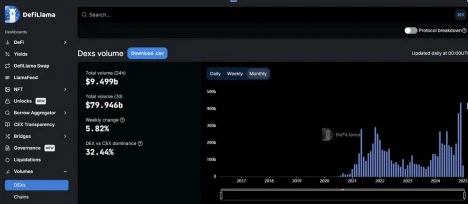
Market research indicates that the rapid development of DEXs is attributed to several key factors:
Users' pursuit of asset autonomy
Continuous maturation of smart contract technology
Prosperous development of the DeFi ecosystem
Breakthrough advancements in cross-chain technology
Limitations: Technical Bottlenecks and User Barriers
However, traditional DEXs also face numerous challenges:
Fragmented liquidity: Assets across different chains are difficult to interoperate.
High gas fees: Congestion in blockchain networks leads to high transaction costs.
Complex user experience: The operational threshold is high for non-technical users.
3. New Species: The Rise of On-Chain Aggregated Trading Platforms
On-chain aggregated exchanges combine the advantages of CEXs and traditional DEXs, providing users with a new decentralized trading method by integrating multi-chain asset analysis, on-chain order placement, and a user experience close to CEX levels. The emergence of these new exchanges marks a new development stage in cryptocurrency trading.
Core Features and Advantages
- Multi-Chain Asset Integration Capability:
Supports cross-chain asset management and trading, allowing users to operate assets across multiple blockchains from a single interface.
Provides comprehensive asset analysis tools to help users make more informed investment decisions.
- CEX-Level Experience:
Achieves real-time order books and efficient matching mechanisms, addressing liquidity issues in traditional DEXs.
Optimizes the user interface, making it easy for non-technical users to get started.
- Coexistence of Decentralization and Autonomy:
Users still control their private keys, achieving true autonomy.
All transactions are executed through smart contracts, eliminating the need to trust third parties.
- Expanding Market Share in Spot and Derivatives:
- Supports not only spot trading but also gradually expands into the derivatives market, such as options and leveraged products.
III. Competitive Analysis of On-Chain Aggregated Trading Platforms
1. Bitget Wallet: A Global Web3 User Entry Point
Global Market Advantages:
Over 60 million global users in 2024, with a 300% annual growth rate.
Emerging markets: 1000% growth in Africa, 400% growth in Central and Eastern Europe.
Becomes the largest multi-chain wallet on Telegram.
Function Integration:
Supports access to 90 mainnet networks.
Connects to over 20,000 DApps.
Provides fast trading and smart market tools.
2. OKX Web3 Wallet: A One-Stop DApp Interaction Platform
Multi-Ecosystem Coverage Advantages:
Supports over 80 blockchain networks.
Connects to over 1000 DApp protocols.
Provides access to NFT markets.
Trading Functions:
Token Swap cross-chain trading.
Batch transfer tool support.
Real-time gas fee tracking.
3. Ave.ai: An AI-Driven One-Stop Trading Analysis Platform
Data Coverage Advantages:
Connects to data from over 60 blockchains, linking over 4 million crypto wallets.
Supports over 300 DEX markets and more than 130 networks.
Provides multi-dimensional security ratings and risk detection for tokens.
AI Trading Signals:
Intelligent money flow monitoring.
Tracking of whale behavior and developer activities.
On-chain trading data analysis.
In the current competitive landscape, Ave.ai stands out as a one-stop trading analysis platform with unique advantages:
First, the platform achieves a seamless connection from data analysis to trade execution, allowing users to complete all operations in one place, greatly enhancing efficiency. The platform supports importing existing wallets or creating new ones, simplifying the asset management process for users. The platform excels in empowering investment decisions by providing detailed dashboards that include capital flow, token holding distribution, and real-time monitoring of whale behavior and capital movements, helping investors seize market opportunities.
Characteristics of other major competitors:
Trading function coverage: Mainstream platforms generally support 80-130 public chain networks, as well as thousands to tens of thousands of DApps.
User growth: Various platforms are rapidly expanding globally, especially performing well in emerging markets.
Differentiation strategies: Some focus on global layout, while others emphasize integration with Web2 services.
Looking ahead, competition among on-chain aggregated trading platforms will become more intense, with user experience and data analysis capabilities becoming key. As the boundaries between CeFi and DeFi continue to blur, the comprehensive service capabilities of platforms will become increasingly important.
IV. Future Outlook: A New Paradigm for Decentralized Trading
1. Trends in Market Structure Evolution
In the coming years, DEXs and CEXs may form a new model of symbiotic development. Institutional investors are gradually participating in decentralized finance, which will further drive the development of on-chain aggregated platforms. As the industry evolves, we expect to see more innovative projects emerge in the next five years to meet the changing market demands.
2. Directions for Technological Development
On the technical level, the industry will present multi-dimensional breakthroughs. Enhancements in cross-chain interoperability will break down barriers to asset circulation, achieving broader value exchange. At the same time, the deep integration of AI technology and blockchain will provide users with a more intelligent service experience. Additionally, as the demand for complex financial products grows, the security of smart contracts will continue to be optimized and strengthened.
V. Conclusion: Redefining Digital Asset Trading
In this grand financial revolution, on-chain aggregated trading platforms are redefining the foundational paradigm of digital asset trading. From the transformation paths of major CEX platforms to the practices of the one-stop on-chain platform Ave.ai, we see the emergence of a new trading form: one that retains the essential characteristics of decentralization while achieving significant breakthroughs in efficiency and user experience.
Standing at the 2025 time point, we have reason to believe that with continuous technological advancements and the ongoing maturation of the market, decentralized trading will ultimately break through existing barriers and play an increasingly important role in the new era of the digital economy. In this transformation, platforms that can accurately grasp technological trends and deeply understand market demands will gain a competitive edge in the future. For the entire cryptocurrency market, this may very well mark the beginning of a new era.
免责声明:本文章仅代表作者个人观点,不代表本平台的立场和观点。本文章仅供信息分享,不构成对任何人的任何投资建议。用户与作者之间的任何争议,与本平台无关。如网页中刊载的文章或图片涉及侵权,请提供相关的权利证明和身份证明发送邮件到support@aicoin.com,本平台相关工作人员将会进行核查。


