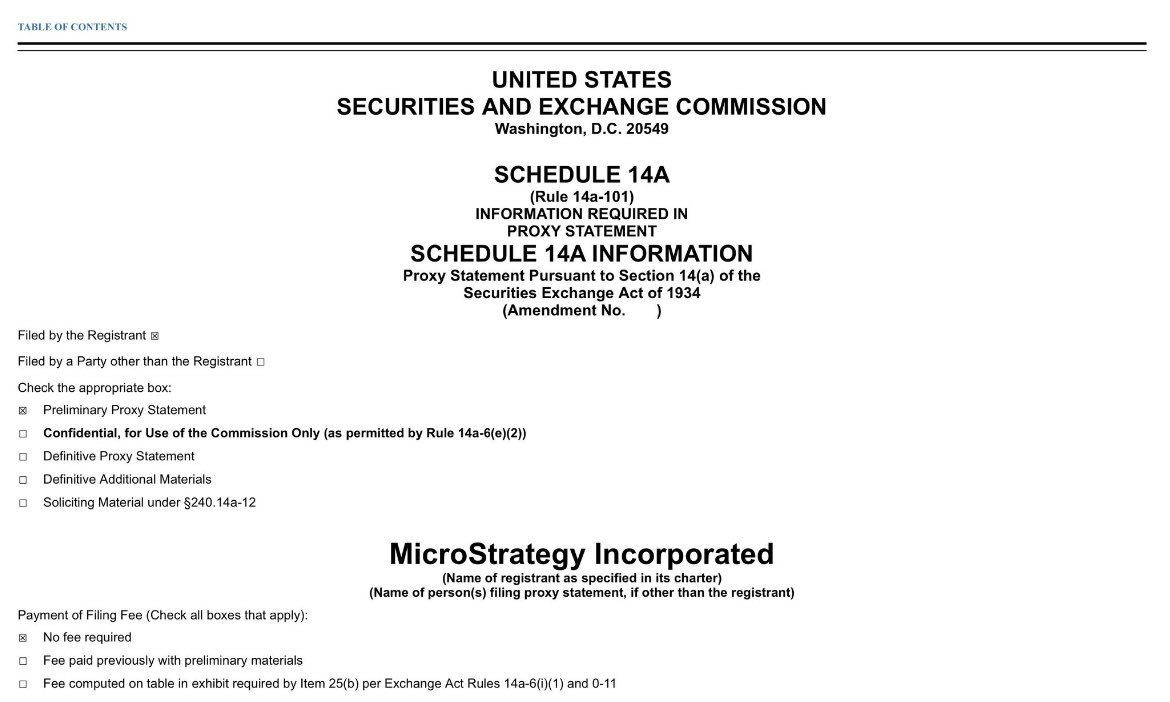
Today, many friends are asking whether MicroStrategy's proposal to increase the authorized number of common and preferred shares is a good or bad thing.
I think this can be discussed from three perspectives:
- From the perspective of #BTC price trends.
This time, MSTR is raising funds to support the "21/21 plan."
[The plan is to raise $42 billion over three years through equity (stocks) and debt (such as convertible bonds and preferred shares) to support its investment strategy, especially the purchase of #Bitcoin.]
Increasing the authorized number of common shares (from 330 million to 10.33 billion)
By increasing the authorized common shares, MicroStrategy can have greater fundraising capacity in the future, for example, by obtaining cash through equity dilution. (This will also dilute shareholders' ownership percentage.)
Increasing the authorized number of preferred shares (from 500,000 to 1.005 billion)
Preferred shares provide fixed income returns and are generally safer than common shares. This can attract risk-averse investors and provide MicroStrategy with more fundraising channels.
So, in fact, we can see that this proposal is beneficial for MicroStrategy's financing plan, and the majority of the funds in this plan are used to buy #BTC. Therefore, from this perspective, it is favorable for the price trend of BTC, although many friends say they only see MicroStrategy buying BTC but not the price of BTC rising. This is because the purchase of BTC is mostly done through OTC channels, so the impact on the secondary market is not significant.
However, for MicroStrategy at present, buying BTC is not for short-term selling, so it effectively locks in some BTC liquidity. For example, currently holding 444,000 BTC, these BTC will not circulate in the market, reducing the potential price pressure. Therefore, from any reasoning, MicroStrategy's purchase of BTC is beneficial for the price of BTC.
Not to mention that more and more CopyCats have started to learn from MicroStrategy's strategy of holding BTC to increase their market value premium. And the market is still paying for it.
- From the perspective of $MSTR price trends.
In the short term, it is definitely not a good thing. After all, if the proposal is approved, it will issue more shares, thereby diluting the value of each share, and the funds raised through the issuance will not all be used to purchase #Bitcoin; some will also be used to pay off debts and meet other company needs.
Although MicroStrategy believes this will not dilute the stock price because the funds raised from issuing more shares will be used to purchase #BTC. If the value of BTC rises, the overall value of the company may grow faster than the number of newly issued shares, thus benefiting shareholders in the long term. (Similar to the ATM issuance method.)
So, even MicroStrategy itself believes this may be a good thing in the long term, while in the short term, if the price of BTC does not rise rapidly, the earnings per share of MSTR will inevitably be diluted. Of course, MicroStrategy cannot issue all the shares at once; it is likely to issue them as needed later. However, the public nature of this proposal is not very friendly to MSTR holders.
Therefore, it cannot be ruled out that MSTR may decline in the short term, but if BTC can indeed experience a decade-long upward trend like gold, then the possibility of MSTR's price increase is still high. For example, if BTC rises to $200,000, MSTR could potentially reach $600 (this is just an example).
- From the perspective of holding both #BTC and $MSTR.
MicroStrategy's approach is to buy more BTC, which is undoubtedly beneficial for BTC from any angle. It is completely incorrect to describe MicroStrategy using LUNA as an analogy, and MicroStrategy does not face the risk of a short-term collapse; even if there is, it will be after the end of this BTC bull market. Therefore, from all aspects, as long as the price of BTC is above the cost price before the debt matures, there is nothing to worry about.
Thus, as long as #Bitcoin remains in a bull market, do not easily short it. MSTR may not necessarily drive BTC up, but in the interplay, it will definitely reduce the potential sell-off chips in the market, which means lowering the possibility of a significant price drop.
Buying MSTR is equivalent to going long on BTC, but this leverage is relatively low, and MSTR remains the only investment target in the U.S. stock market that can benchmark BTC. To take a step back, as long as BTC is rising, MSTR's performance will not be too poor, especially as the market value premium of BTC shrinks, MSTR's "BTC content" will also increase.
However, it must be said that as long as there is an issuance, it will dilute the price of MSTR. Therefore, from any perspective, the short term is unfavorable for MSTR.
Conclusion
Simply put, if #BTC can maintain an upward trend, the long-term benefits for MSTR outweigh the drawbacks, although in the short term, there is a possibility that investors may leave due to concerns about dilution. If BTC remains merely a cyclical product and experiences a significant correction due to the end of the bull market, then shorting MSTR would be a very meaningful action.
This post is sponsored by @ApeXProtocolCN | Dex With ApeX
免责声明:本文章仅代表作者个人观点,不代表本平台的立场和观点。本文章仅供信息分享,不构成对任何人的任何投资建议。用户与作者之间的任何争议,与本平台无关。如网页中刊载的文章或图片涉及侵权,请提供相关的权利证明和身份证明发送邮件到support@aicoin.com,本平台相关工作人员将会进行核查。


