On Wednesday afternoon local time, the Federal Reserve announced a 25 basis point reduction in the benchmark interest rate to a target range of 4.25%-4.5%, marking the third consecutive rate cut. Chairman Powell emphasized in a press conference that this adjustment pushes monetary policy toward a "more neutral" stance. Although this sounds like a cautious monetary policy signal, the market's reaction was unexpectedly negative.
Both the U.S. stock market and the cryptocurrency market fell, with the Dow Jones Industrial Average setting a record for the longest single-day losing streak in 50 years. Meanwhile, cryptocurrencies like Bitcoin followed suit, unable to escape the "avalanche" of market sentiment.
For investors, this rate cut seems to have failed to provide the expected "breather," instead intensifying market anxiety about the economic outlook. Players in the crypto market are also forced to reassess the deeper implications behind this policy.
Powell's "Rejection Statement": Is the Federal Reserve Out of Touch with Bitcoin?
"We are not allowed to hold Bitcoin, nor do we intend to change that." This was Powell's clear response during the press conference to questions about whether the Federal Reserve might hold Bitcoin. He further explained that the Federal Reserve Act strictly limits the categories of assets that the Fed can hold, and cryptocurrencies are clearly not on the list.

Powell's statement is not only a defense of the legal framework but also serves as a declaration of attitude toward Bitcoin: the Federal Reserve will not easily cross this line. This statement clearly responds to speculation about whether the Federal Reserve would venture into the cryptocurrency space, while also indirectly "slapping" Trump's Bitcoin strategic reserve plan.
Despite Powell's calm tone, his position is firm. This "cold rejection" not only dampens enthusiasm in the crypto market but also makes the United States' leadership position in the global cryptocurrency field more ambiguous.
Trump's "Bitcoin Dream": Ambition and Dilemma of Strategic Reserves
In stark contrast to Powell's cold attitude is Trump's ambitious vision. The former president has long been attempting to incorporate cryptocurrencies into the United States' strategic reserve system. He publicly stated in a CNBC interview, "We will achieve great things in the cryptocurrency space because we do not want any other country to be the leader; we must take the lead."
This statement is not mere rhetoric. Wyoming Senator Cynthia Lummis is drafting a bill that plans to purchase 1 million Bitcoins over five years, with funding sourced from the Federal Reserve's bank deposits and gold reserves. Similarly, Pennsylvania has proposed a comparable plan.
Trump's plan appears ambitious but faces numerous challenges. First, this proposal requires Congressional approval, which is undoubtedly a significant obstacle given the current severe partisan divisions. Second, even if the bill passes, it remains uncertain whether the Federal Reserve will cooperate in its execution. Finally, from a technical perspective, such a large-scale Bitcoin purchase could directly disrupt market conditions and even trigger greater price volatility.
Nevertheless, Trump's initiative undoubtedly injects new momentum into the United States' competition in the global cryptocurrency arena. However, whether this strategic reserve plan is a "shortcut" for the U.S. in the cryptocurrency field or a high-risk gamble remains to be seen.
The "Eye of the Storm" in the Bitcoin Market: A New Landscape of Bull vs. Bear
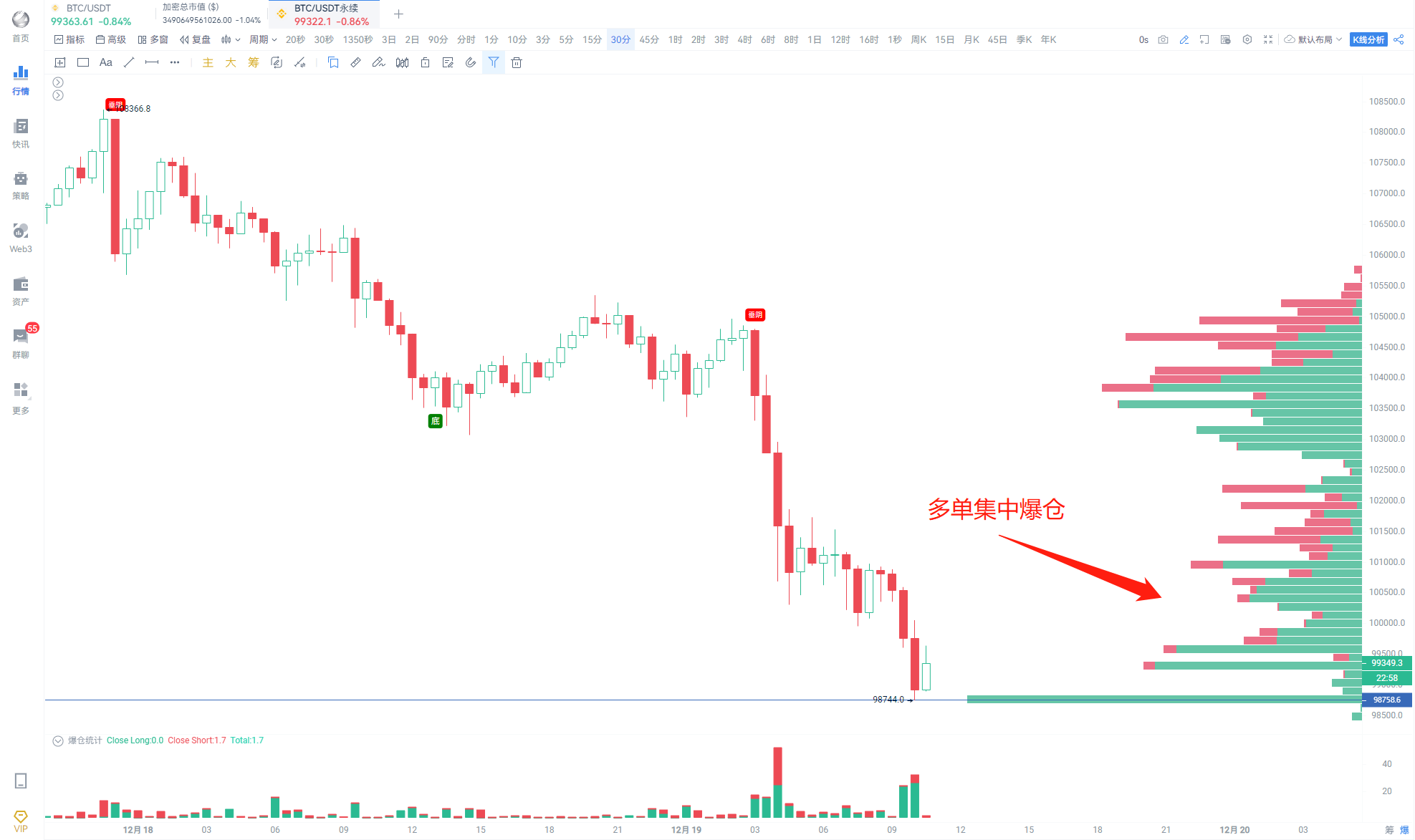
The news of the Federal Reserve's rate cut and Powell's statements directly triggered a downturn in the Bitcoin market. Following the announcement, Bitcoin plummeted by 5%, and by the time of writing, it had fallen below the $100,000 mark. Meanwhile, the declines in popular mainstream coins were even more severe, with ETH dropping nearly 10%, and prices of XRP, LTC, and other coins retreating over 12%. The total market capitalization of cryptocurrencies evaporated by more than $260 billion. According to AICoin statistics, in the past 24 hours, a total of $662 million in positions were liquidated in the futures market, primarily from long positions, with BTC contracts leading the way, amounting to $135 million, accounting for 20.44%.
Market analysts have varied opinions on this. Zach Pandl, head of research at Grayscale, believes that investors may be overly focused on the U.S. Bitcoin reserve plan while overlooking the potential power of other countries and regions. He pointed out that sovereign wealth funds in Asia and the Middle East might be the next wave of market drivers.
Meanwhile, Andre Dragosch, head of European research at Bitwise, analyzed Bitcoin's pressures from a macroeconomic perspective. He stated that although rate cuts are typically seen as positive factors, the continued strength of the dollar and the contraction of global money supply pose structural risks to Bitcoin. In this context, Bitcoin must contend not only with internal capital flow pressures but also with the impacts of external macroeconomic changes.
Uncertain Future: Is Bitcoin's Future an "Opportunity" or a "Trap"?
The Federal Reserve's latest policies and Powell's remarks undoubtedly inject new uncertainty into the cryptocurrency market. While Trump's Bitcoin strategic reserve plan has sparked heated discussions, its feasibility remains questionable under multiple legal, market, and technical constraints.
More importantly, the global macroeconomic environment is rapidly changing. From the strengthening of the dollar to the potential influence of other sovereign wealth funds, Bitcoin's future trajectory will be shaped by multiple factors. For investors, this is not only a moment to reassess risks but also an opportunity to seek new prospects.
In this complex game, is Bitcoin's future an opportunity or a trap? Perhaps only time will reveal the answer.
免责声明:本文章仅代表作者个人观点,不代表本平台的立场和观点。本文章仅供信息分享,不构成对任何人的任何投资建议。用户与作者之间的任何争议,与本平台无关。如网页中刊载的文章或图片涉及侵权,请提供相关的权利证明和身份证明发送邮件到support@aicoin.com,本平台相关工作人员将会进行核查。


