Original Author: IOSG Ventures
As we look back at the year 2023 so far, the GameFi-related projects that have received significant funding and performed well (currently, GambleFi is also classified under the GameFi sector) have primarily focused on infrastructure development in the GameFi track, such as gaming platforms and game Layer 3. The most notable among them are the pump.fun casino, which has attracted countless participants since the beginning of the year, and the booming mini-game ecosystems of Not and Telegram. This article will analyze the defensive investment logic behind such investment phenomena and our attitude towards this investment logic.
1. GameFi Market Financing Overview
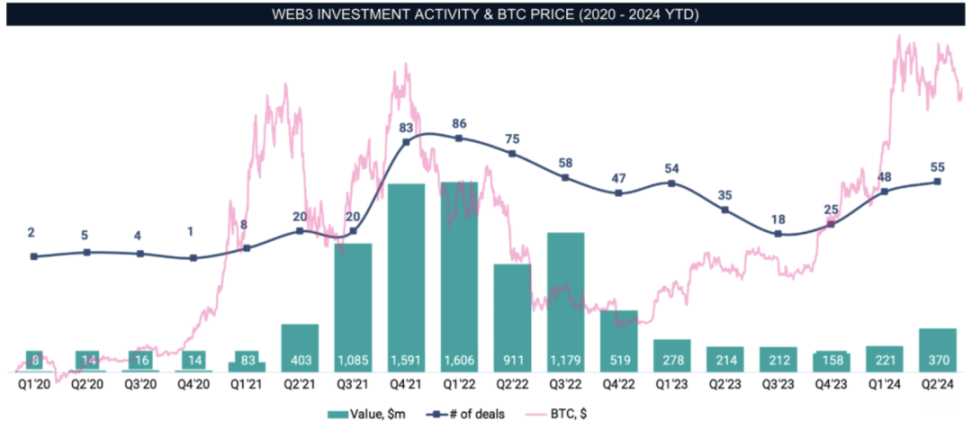
Source: InvestGame Weekly News Digest #35: Web3 Gaming Investments in 2020-2024
Looking at the investment volume and number of projects in the GameFi sector from 2020 to 2024, even though Bitcoin has surpassed its previous high from 2021 this year, the data from the past year appears relatively sluggish and conservative in both total volume and number of projects. In comparison to the high of Q4 2021, where a total of 83 projects received investments amounting to $1,591M, with an average investment of $19.2M per project, this year’s Q1, which broke the previous high, saw only 48 projects with a total investment of $221M, averaging $4.6M per project, a 76% decrease year-on-year. In terms of figures, overall investment behavior shows a conservative defensive posture.
2. Analyzing Three Market Phenomena from the Past Year: Underlying Logic, Shifts, and Doubts
2.1 Phenomenon One: Gaming Platforms Evolving from Pure Platforms to User Acquisition Channels
"The reason why gaming infrastructure is favored by VCs, aside from its strong survival capability and long lifecycle, is its gradual evolution into a channel for user acquisition."
Among the 34 GameFi-related projects that received over $10M from June 2023 to August 2024, 9 were gaming platforms and 4 were game Layer 3s. From BSC to Solana, from Base to Polygon, and even self-built Layer 2 and Layer 3s, gaming platforms are flourishing everywhere. Even with a significant decrease in total funding amounts, 38% of high-investment projects are still concentrated in gaming infrastructure, which has strong survival capabilities and long lifecycles. Platforms are narratives that cannot be disproven by trends and are a low-risk defensive investment choice to remain in the market.
Source: PANTERA
In addition, for leading gaming ecosystems, there are multiple funds, like Pantera, heavily investing in top gaming platforms such as Ton's ecosystem token. Ronin is also a secondary favorite among several VCs. The reason Ton's ecosystem and Ronin are so favored by VCs may be attributed to the gradual evolution of platform roles. Nearly a billion users on Telegram are being attracted to Web3 by mini-games like Not, Catizen, and Hamster (Not has 30M users, Catizen has 20M users with 1M paying users, and Hamster has 0.3B users), or the new user groups flowing to exchanges after tokens are listed on Ton. This has brought new blood to the entire crypto world. Since March of this year, Ton announced over $100M in ecosystem incentives and multiple league prize pools, but later on-chain data shows that $Ton's TVL does not seem to have significantly increased with the explosion of mini-games; more users are primarily being converted directly into exchanges through pre-recharge activities. On Telegram, the CPC (Cost-Per-Click) is as low as $0.015, while the average customer acquisition cost for a new account on an exchange is $5-10, and the cost for each paying user can exceed $200, averaging $350. The customer acquisition and conversion costs on Ton are far lower than those of the exchanges themselves. This indirectly confirms why exchanges are racing to list various Ton mini-game tokens and memecoins.
Moreover, Ronin's existing user base provides many more customer acquisition opportunities for individual games. The migration of high-quality games like Lumiterra and Tatsumeeko to the Ronin chain also reflects this. The user increment and acquisition capabilities that gaming platforms can bring seem to have become a new angle of favor.
2.2 Phenomenon Two: Short-Term Projects Dominating the Market Become New Favorites, but User Retention Ability is Questionable
"In a secondary market with poor liquidity, many games' flywheel and profit-making effects are directly castrated, turning perpetual games into one-time games. In the current unfavorable macro environment, these short-term projects are more aligned with VCs' risk aversion as a defensive investment choice, but we still have doubts about whether users' long-term retention capabilities match VCs' expectations."
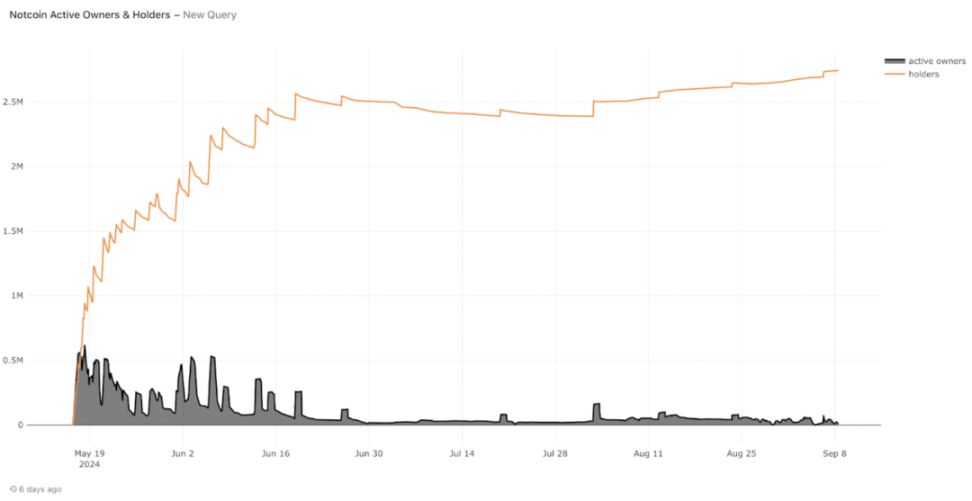
Let’s take a look at the economic model of Not (a short-term project).
Source: PANTERA
The active users of Not have been declining since the token launch, dropping from an initial 500,000 to 200,000 five days after TGE, and stabilizing at around 30,000. The user decline reached 94%. If we refer to user data, Not is indeed a short-term project. Recently launched projects on Binance like Dogs, Hamster Kombat, and Catizen, which are fully circulating short-term projects, have garnered significant attention from the market and VCs.
Source: Starli
From the previous P2E (Play-to-Earn) model of earning money through gaming, with simple game level setups, auto-chess modes, and Pixel's farming and logging for coins, to Not's explosive click-to-earn model, these projects branded as GameFi are gradually simplifying or even shedding the gaming layer. When the market is willing to pay, is it because everyone's acceptance is increasing, or are they becoming impatient and restless? Accepting that the essence of most GameFi is merely a way to replace mining machines with interactions to mine, why bother with those cumbersome game steps and modeling costs? It would be better to use the costs originally needed for game development as the initial cake for this Ponzi mining factory, benefiting both parties.
The economic model of Not differs from the previous GameFi flywheel model, with fully circulating one-time unlocks and no upfront cost investment. Users can exit as soon as they receive airdropped tokens, and VCs no longer have to endure the pain of locking up for two to three years. The model has shifted from a sustainable mining game to a more memecoin-like short-term version. Additionally, similar to the value added by platforms in user acquisition, the simple monetization game mechanics attract new Web2 users to participate in Web3, with new users cashing out their airdrops and moving to exchanges. The user traffic brought to ecosystems and exchanges may also be another reason VCs are optimistic about such projects.
The essence of the flywheel cycle and the reasons why short-term projects align more closely with the current market raise doubts about mid-to-late stage investment returns.
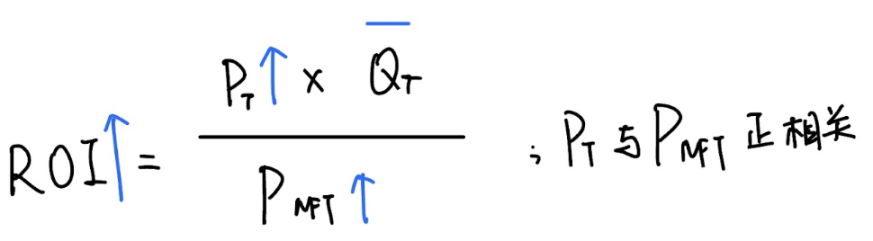
Previously, P2E games had a complete economic cycle, and whether this economic cycle's flywheel can run depends on whether players can calculate an acceptable ROI (Return on Investment). In P2E games, ROI = Net Profit / Net Spend translates to future expected returns (the value of mined resources) / NFT costs (mining machine costs). Therefore, in P2E games, the formula for participants' earnings is:
ROI = Value of Future Rewards / Acquisition Cost of NFT
Ignoring wear and electricity costs, the larger the calculated ROI, the stronger the players' incentives. How can we maximize ROI? Let’s break down the formula.
Source: Starli, IOSG Ventures
- Path 1: Increase the Value of Future Rewards
Value of Future Rewards = Quantity of Future Rewards * Price of Future Rewards
V = P * Q
When the value of future rewards increases, either the quantity of rewards increases (i.e., token rewards increase), or the price of rewards rises (i.e., token prices increase).
In the context of the Web3 economy, the output settings for almost all tokens show a converging trend, similar to Bitcoin's halving cycle. As time goes on, token output becomes scarcer, and mining difficulty increases. Perhaps more expensive mining machines or rarer NFTs yield higher rewards, but they also add extra costs. Therefore, without changing the quality of mining machines, increasing the quantity of rewards does not make sense.
The most likely scenario is that the price of future rewards increases, meaning that the value of the coins players mine continues to grow steadily. In a secondary market with ample buying volume, there won't be a situation of oversupply; buy orders will consume all sell orders while still showing an upward trend. This way, the numerator in the ROI calculation increases.
- Path 2: Lowering NFT Costs
When the denominator in the ROI calculation decreases, the ROI naturally increases, which means that the acquisition cost of NFTs as mining machines becomes lower. If the price of NFTs traded with project tokens decreases, it could be due to either a decrease in demand for those NFTs and an increase in supply, or a decline in the price of the token acting as a medium of exchange and standard of measure, leading to a drop in NFT prices from external factors.
A decrease in demand is naturally because the profit-making attributes of the game weaken, prompting players to seek opportunities in other games with higher ROIs. When settled in other fiat currencies like Ethereum or Solana, the market influences will cause mainstream coin prices to drop, and altcoins will not fare well either. Thus, NFT prices and token prices are bound to show a positive correlation. Therefore, the simultaneous increase of the numerator and decrease of the denominator cannot coexist; their changes are synchronous and may even have a certain proportional interaction.
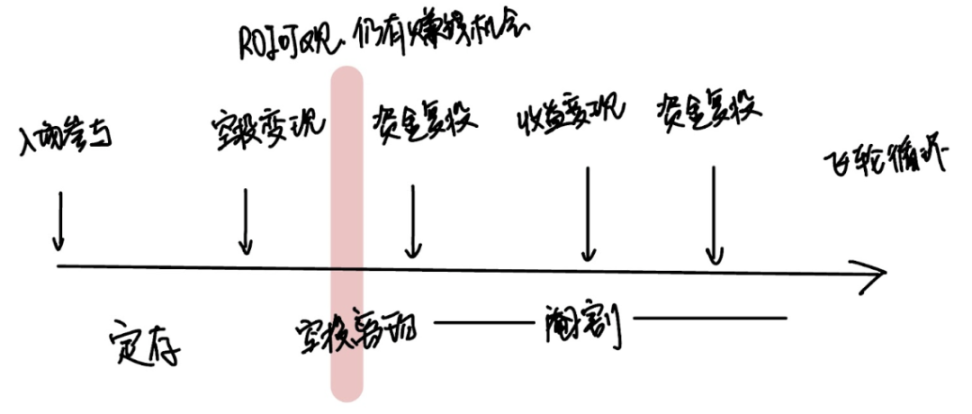
This implies that the most likely way to achieve an increase in ROI is through the anticipated rise in the price of rewards, with NFTs rising in sync but by an amount less than or equal to the increase in token prices, allowing ROI to stabilize or slowly rise, continuously incentivizing players. In this scenario, new funds entering the Ponzi scheme act as an amplifier, and only in a bull market, when token prices rise, can the P2E game's flywheel start to run. When ROI stabilizes or gradually increases, players will reinvest their earnings, creating a snowball effect, where injection exceeds withdrawal. Axie is the most successful example of this flywheel cycle.
Source: Starli, IOSG Ventures
Source: Starli, IOSG Ventures
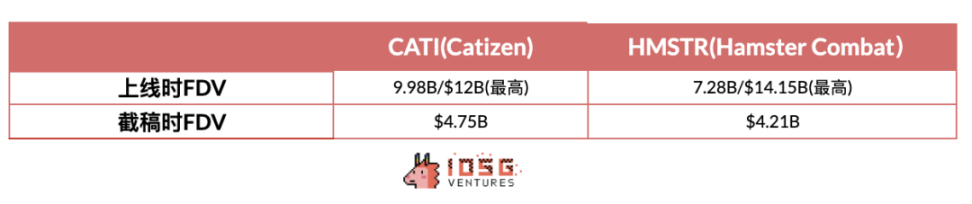
Looking back at the games in this cycle, it seems that most experienced a brief FOMO in the market before launch, only to plummet overnight after the FG, with all tokens unlocked through airdrops becoming sell pressure. After cashing out, players move on to find the next opportunity. Without subsequent ROI, reinvestment of funds, and the flywheel cycle, it has become a short-term burden for diamond hands. P2E has become less popular, while P2A has quietly gained traction; "play to airdrop" is a frightening concept, as this title seems to label the game as a one-time event. The goal of farming is merely to sell the airdrop upon listing and cash out, rather than continuously seeking to earn within this game ecosystem. Despite the changing times, the act of selling coins remains consistent, but in the current weak secondary market, where altcoins are struggling, the secondary token prices cannot sustain the flywheel. Without strong market makers to support the price, many games' flywheels and profit-making effects have been forcibly castrated, shifting from loops to short-term plays, with perpetual games becoming one-time games. From this perspective, the performance of Catizen and Hamster after their TGE further corroborates that the economic model was designed for the short term, and there is no need to run the subsequent flywheel, making price manipulation unnecessary. For such projects, whether mid-to-late stage Token Funding is a lucrative deal remains questionable.
The flywheel cycle requires a more sophisticated economic model and cost investment, while the short term only needs the expectation of airdrops, as the task is accomplished upon listing, and the subsequent economic model can be curtailed. The expectation of airdrops is merely about earning the price difference in liquidity between the primary and secondary markets. We can understand these short-term projects as a form of fixed deposit until reinvestment into the economic system, where players invest the costs of NFTs or pass cards as principal, allowing for a time cost of capital retention, waiting to earn airdrop profits upon token listing.
Such projects do not require cross-cycle operating time and uncertain economic cycles, nor do they rely heavily on market conditions and FOMO emotions. Their brief yet brilliant lifecycle, along with the fully circulating unlock model, alleviates VCs from the troubles of lock-up periods, allowing for quicker exit times. In the current unfavorable macro environment, these short-term projects align more closely with VCs' risk aversion as a defensive investment choice.
User Long-Term Retention Ability is Questionable
Whether it’s Not, Catizen, Hamster, or Dogs, they have brought a significant wave of new user growth to exchanges like Binance. However, how many of these new users actually remain in the ecosystem or exchanges in the long term? Does the value of these new users match VCs' expectations and investments?
Source: IOSG Ventures
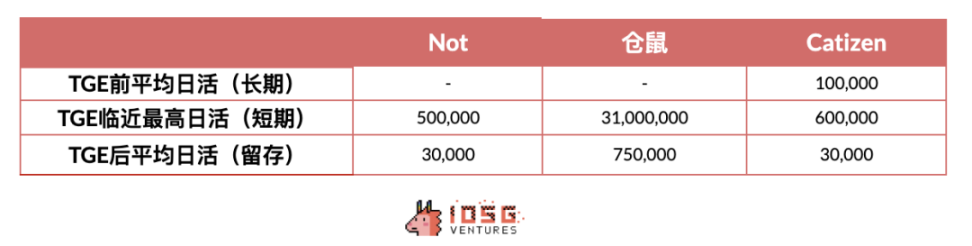
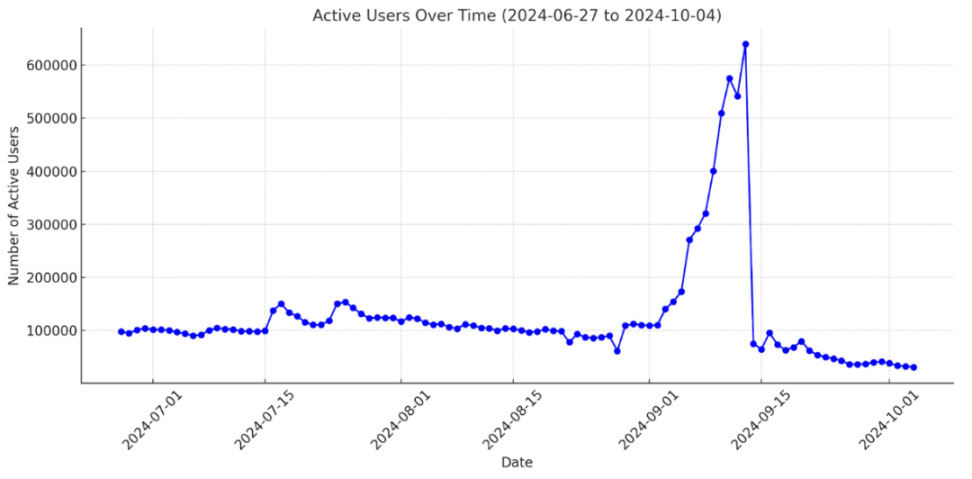
Let’s take a look at Catizen, one of the hottest mini-games in the Ton ecosystem. Its active users dropped from 640,000 before the token launch to just 70,000 in a single day, with subsequent user retention data appearing even more dismal. From a long-term user perspective, even if the game content remains unchanged, once the expectation of airdrops disappears, over 90% of users immediately withdraw, leaving only about 30,000 users retained. Does this level of user retention meet investors' expectations and achieve the goal of user acquisition? Even if users who received airdrops turn to exchanges, bringing a wave of immediate user growth, will these users abandon Catizen after cashing out their airdrops? When the product itself transforms into a viral campaign, aimed at user acquisition, even if it brings a wave of incremental growth to the ecosystem in the short term, can the truly retained users meet the expectations of the ecosystem and exchanges, justifying this investment? We still have doubts.
2.3 Phenomenon Three: Top VCs Positioning Casinos for Profit, but Lacking Token Issuance Expectations and Value Capture
"Infrastructure projects and secondary trading are closely related to the macro market. When the market trend is strong, funds are more willing to stay in the market to capitalize on the gains of various hotspots. In an environment where there is no strong buying or selling desire in the secondary market, relying on casinos and pump.fun's PVP to earn fees and kill rates has become a more prudent defensive choice for VCs. However, where does customer acquisition come from? Platforms and tools lack token issuance expectations, and the fees earned may underperform compared to GameFi project investments."
Multiple casino projects have begun to emerge, accounting for 15% of the high financing in GameFi related to 2024. In this fast-paced crypto world, since memes and pump.fun can be reasonably accepted, large-scale gambling games no longer need to disguise themselves under the GameFi label, appearing openly before everyone.
On February 12 of this year, Monkey Tilt, led by Polychain Capital with follow-on investments from Hack VC, Folius Ventures, and others, provided a betting aggregation site and online casino backed by large funds. Myprize, which announced on March 24 that it had raised $13 million led by Dragonfly Capital with participation from major VCs like a16z, is even bolder, featuring sexy dealers dealing cards and live options on its homepage.
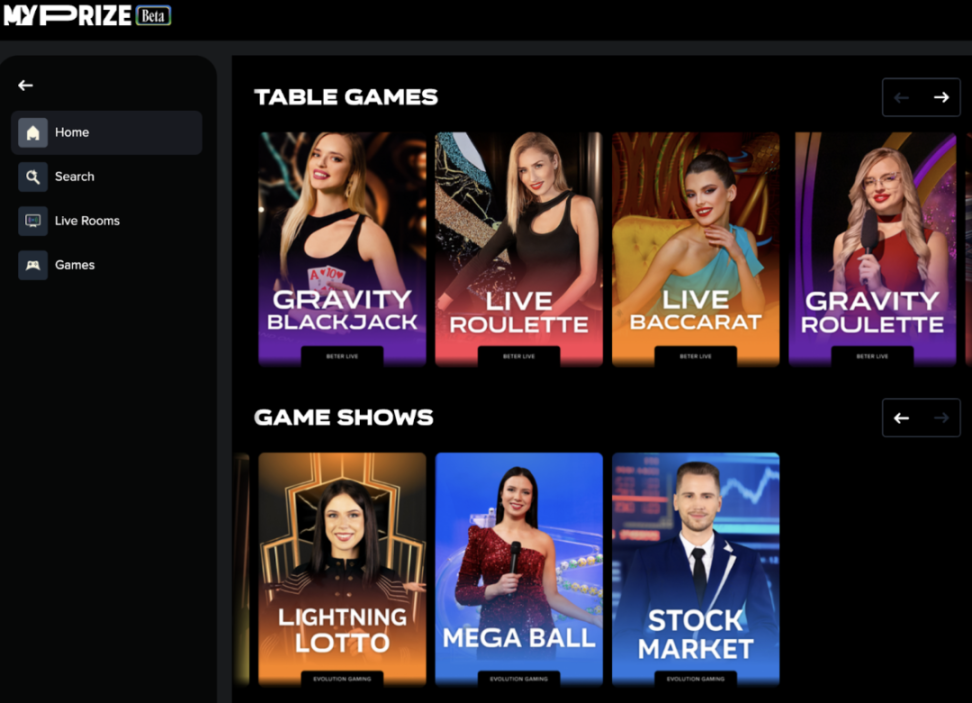
Source: Myprize
The logic of pump.fun, a casino platform earning fees and cash flow
When the market cools and becomes unstable, with the election outcome uncertain and the U.S. interest rate cuts dragging on, this garbage time, combined with the emergence of coins like BOME (Book of MEME) and other hundredfold or thousandfold coins, greatly stimulates people's gambling instincts, leading more money to flow onto the chain and into pump.fun in search of the next "golden dog." The timing of pump.fun's emergence coincided with the sustained fluctuations after Solana's rise.
What is the biggest casino in Web3? Many may already have the answer in their minds. Binance, OKX, and other top exchanges offer perpetual futures contracts with leverage of 125X, while smaller exchanges offer 200X or even 300X leverage. In contrast, the A-share market has a maximum daily fluctuation of 10%, and the ChiNext has a fluctuation of 20%. Tokens, which are already T+0 and have no price limits, combined with 100X leverage, mean that less than 1% price fluctuation can wipe out all your principal.
Whether the price of coins rises or falls, contracts can participate in either direction through long or short positions. Essentially, ultra-short-term contracts are just betting on the size of the market during the entry and exit period, with odds ranging from 5X to 300X. Exchanges profit handsomely from transaction fees, holding costs, and forced liquidation fees. The logic is similar for casinos, which typically earn from fees or the house edge.
If infrastructure projects and secondary trading are closely tied to the macro market environment, when the broader environment is clear and the market is rising, funds are more willing to stay in the market to capitalize on significant gains from various hotspots, yielding considerable returns with lower risk. However, in the current unstable market, funds seem to be flowing into casinos and PVP, leveraging high margins to seek returns that cannot be reached in the present. High leverage amplifies gains, but it also magnifies losses. In a market that oscillates back and forth, the fees earned by exchanges and platforms may be more objective than during a one-sided market.
In a time of market instability, with users' gambling instincts heightened, funds and interest seem to be flowing into casinos and PVP. The fees earned by casinos and tool-type products have become a stable income with demand and growth, aligning with the defensive investment logic of earning fees. However, the revenue from casinos or platform-type fee structures also faces certain issues.
Lack of Token Issuance Expectations and Value Capture.
For platform projects like pump, even if they become phenomenally successful and generate substantial trading volume, they still lack the expectation of token issuance. Whether from the perspective of the token itself, its necessity and utility within the ecosystem, or from a regulatory standpoint, as long as no tokens are issued, there is no risk of being flagged by the SEC for securities violations. Similar casinos or platforms also lack a genuine expectation of token issuance.
On the other hand, without the expectation of token issuance, the logic of earning fees and operating casinos is more applicable during sideways market fluctuations and cannot predict future hotspots. Earning fees relies on the popularity and activity of on-chain memes or gambling, serving as an intermediary tool to meet demand rather than being the demand itself, lacking true value capture based on its own merits. The recent actions of pump.fun in selling Solana tokens for cash (as of September 29, it has sold approximately $60 million worth of Solana tokens, accounting for about half of its total revenue) illustrate this; in the absence of token issuance expectations and value capture, pump.fun, while benefiting from the prosperity of $SOL, also exerts significant selling pressure on the market.
Although pump.fun will undoubtedly bring many positive effects to the entire Solana ecosystem, such as increased trading activity, attracting new users to the Solana ecosystem during the meme summer, stable demand and buying pressure for $SOL, and the purchasing power of those who buy in after seeing $SOL's price rise, the issues remain. It takes from the people and sells back to them, collecting $SOL as fees while dumping these sell orders into the market. The closer the total sales approach the total revenue, the more neutral pump.fun's impact on Solana's price becomes, resembling a stabilizer, and there may even be negative premiums (only sell orders without buy orders). During the growth phase, pump.fun has a very strong positive impact on the Solana ecosystem, potentially exhibiting geometric growth; however, once it matures into a platform phase, the relatively fixed selling pressure (as fee income) minus the diminishing positive impact may result in greater selling pressure.
In summary, similar gambling platforms are likely to lag behind GameFi projects that have genuine value capture. Additionally, most VC investment returns come from fee distributions, and under the logic of unrealistic equity exits and lack of token issuance expectations, they can only wait for the next round of mergers or acquisitions to exit, leading to a long and difficult exit cycle.
### 3. Conclusion: Casinos and Platforms May Underperform GameFi, Short-Term Project Retention Declines, and a Cautious Attitude Towards Past Defensive Investments
Whether pulling retained users towards new games or leveraging the user base to convert new Web3 user increments, one of the main roles and value directions of gaming platforms seems to have evolved into a channel for user acquisition. However, for projects relying on such platforms to convert users through short-term projects as true value, the long-term retention rate of users has yet to be proven by time and data. In the absence of token issuance expectations and value capture, gambling platforms seem to underperform compared to GameFi projects that genuinely capture value and have product-market fit (PMF) during bull markets. We remain cautious about past defensive investments in the market and are eager to find products and high-quality games that have yet to form a consensus and attract few investors. Such games can convert future willing buyers into higher retention rates, increased in-game spending, and on-chain activity due to their quality. Ultimately, this will translate into a higher value for the tokens.
免责声明:本文章仅代表作者个人观点,不代表本平台的立场和观点。本文章仅供信息分享,不构成对任何人的任何投资建议。用户与作者之间的任何争议,与本平台无关。如网页中刊载的文章或图片涉及侵权,请提供相关的权利证明和身份证明发送邮件到support@aicoin.com,本平台相关工作人员将会进行核查。


