This article reviews the current state of stablecoins, including the characteristics of major stablecoins such as USDT, USDC, and DAI, as well as regulatory discussions in Singapore, the European Union, and Japan.
Written by: DeSpread Research
1. Introduction
Stablecoins play a crucial role in the cryptocurrency market due to their low volatility and high universality, being widely used in P2P remittances, exchanges, and DeFi applications. In addition to their importance in the cryptocurrency market, the potential impact of stablecoins on traditional financial markets such as banking, securities, payments, international remittances, and trade has also garnered significant attention.
The stablecoin market is rapidly evolving, with a growing number of users. Consequently, the demand for clear definitions of stablecoins from various countries is also increasing, ranging from establishing management frameworks and implementing relevant policies to preventing potential issues. Following the Monetary Authority of Singapore's announcement of a stablecoin regulatory framework in 2023, it is expected that countries will release and implement their stablecoin regulations in 2024.
- European Union (MiCA): The EU's Markets in Crypto-Assets Regulation (MiCA) was announced in March 2022, passed with overwhelming support in April 2023, and will take effect in December 2024. Additionally, the EU has drafted technical standards for stablecoins backed by multiple fiat currencies or assets, which will take effect in the summer of 2024.
- Hong Kong: A stablecoin regulatory proposal is expected to be released in early 2024, with preparations for a stablecoin sandbox currently underway.
- United States: Federal Reserve Chairman Jerome Powell emphasized the necessity of stablecoin legislation to House Democrats, while Congresswoman Maxine Waters stated in an interview that "the passage of the stablecoin bill is very close," raising market expectations for stablecoin regulation.
- United Kingdom: UK Treasury Minister Bim Afolami announced at a Coinbase-hosted event in February 2024 that plans are in place to pass a stablecoin bill within six months, with related legislation expected in 2024.
Issuing stablecoins pegged to different national currencies not only facilitates new capital inflows but also indicates the potential to create an on-chain foreign exchange market for exchanging stablecoins of different national currencies, similar to traditional foreign exchange markets. This article will explore the current state of the stablecoin market, the characteristics of several major stablecoins, and ongoing regulatory developments. In the second part, we will delve into the status of various countries' stablecoin regulations and examine the characteristics of emerging stablecoins.
2. Current State of the Stablecoin Market
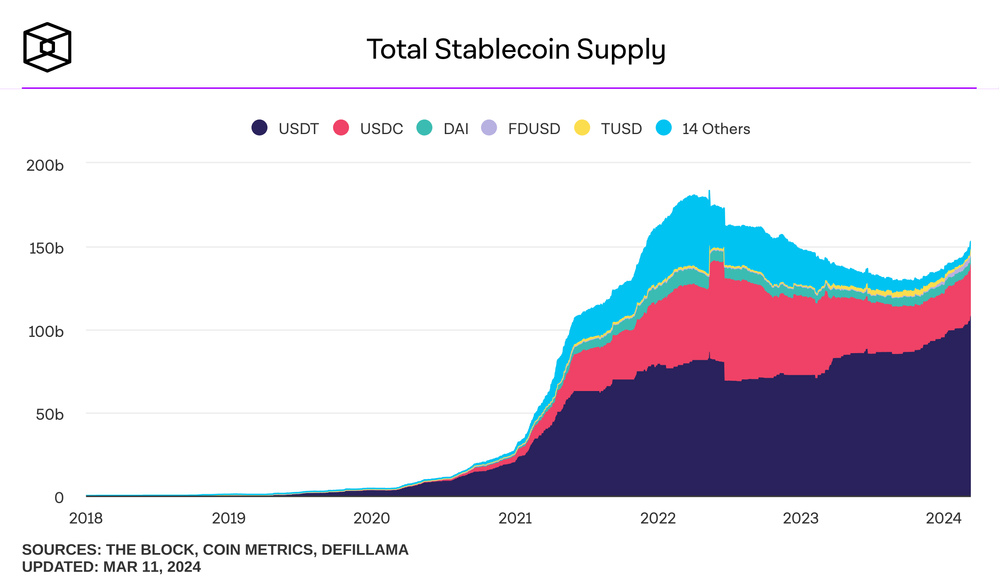
_Stablecoin supply, source: _The Block
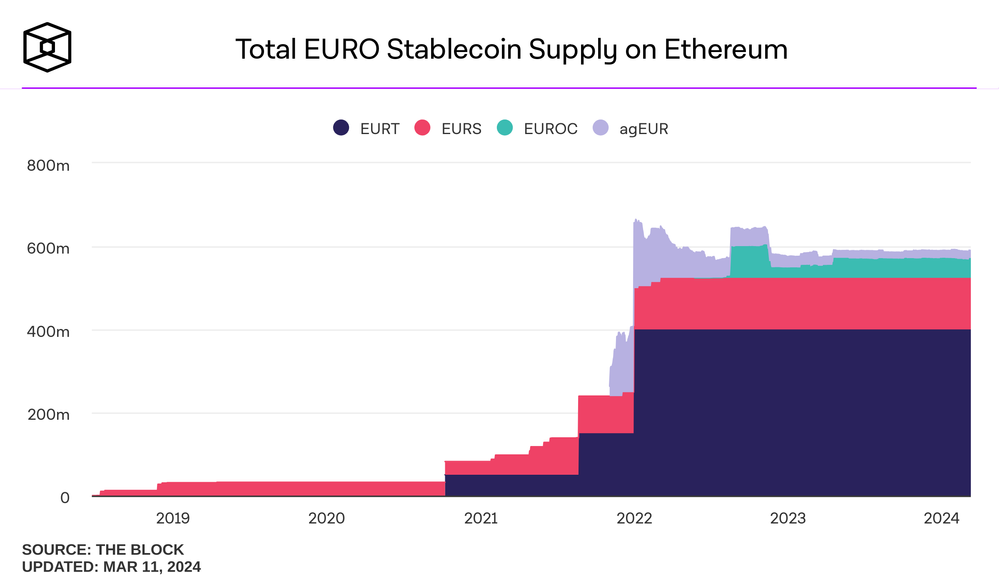
_Euro-pegged stablecoin supply, source: _The Block
- Market Trends: According to data from The Block, the total supply of stablecoins has been steadily increasing since 2020, peaking at $180.4 billion on March 30, 2022. Although the supply decreased due to a downturn in the cryptocurrency market, it began to rise again starting in September 2023. As of March 12, 2024, the total supply of stablecoins is approximately $153.6 billion.
- Market Share of Dollar-Pegged Stablecoins: The supply of USDT is $108.13 billion, accounting for 70.5% of the market share; the supply of USDC is $31.38 billion, accounting for 20.5%. Together, these two stablecoins account for 91% of the total supply of dollar-pegged stablecoins, approximately $153 billion. The total supply of euro-pegged stablecoins is about $60 million, indicating that dollar-pegged stablecoins dominate 99% of the stablecoin market. This dominant position suggests that the market size has the potential to exceed that of traditional foreign exchange markets.
3. Status of Major Projects
3.1. USDT
- Issuer: Tether Limited
- Pegging Mechanism: Pegged 1:1 to fiat currency, fully backed by Tether reserves
- Collateral Breakdown:
- Cash and Cash Equivalents: 84.58%
- U.S. Treasury Bills: 76.87%
- Overnight Reverse Repurchase Agreements: 11.4%
- Institutional Reverse Repurchase Agreements: 0.99%
- Money Market Funds: 10.16%
- Cash and Bank Deposits: 0.48%
- Non-U.S. Government Bonds: 0.08%
- Corporate Bonds: 0.05%
- Precious Metals: 3.62%
- Bitcoin: 2.91%
- Other Investments: 3.89%
- Secured Loans: 4.95%
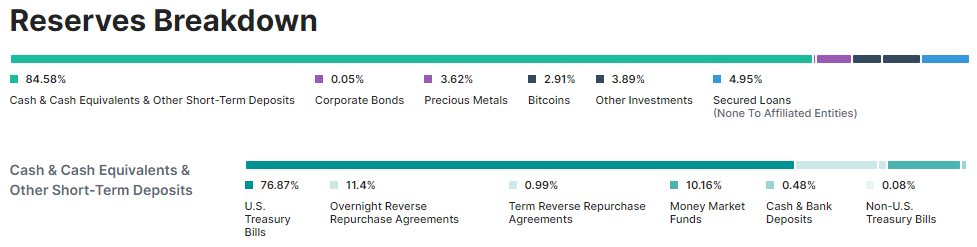
_USDT collateral composition, source: _Tether
- Verification Method: Audit reports from accounting firms (BDO Italia has been providing quarterly audit reports since Q2 2022)
- Fees and Deposit/Withdrawal Policies:
- Minimum Deposit/Withdrawal Amount: $100,000
- Fiat Deposit Fee: 0.1%
- Withdrawal Fee: $1,000 or 0.1%
- Issuance Eligibility: Limited to verified members
3.1.1. Recent Updates
- Revenue Status:
- According to BDO's Q4 2023 report, Tether's net profit is approximately $2.9 billion, with operating profit around $1 billion. The main sources of income are interest income from holding U.S. Treasury Bills and profits from the appreciation of Bitcoin and gold. During the same period, U.S. Bank reported a net profit of $3.1 billion, highlighting the scale of Tether's profits.
- Trust Issues:
- Tether has faced audit demands since 2017, initially leading to market skepticism about the company's issuance of USDT without sufficient dollar reserves and manipulation of Bitcoin prices. After being subpoenaed by the Commodity Futures Trading Commission (CFTC), Tether indirectly proved its reserves through legal and bank balance confirmations in mid-2018, but the lack of a formal audit process has limited the restoration of market trust in Tether.
- Implementation of Formal Audits:
- In March 2021, after three and a half years, Tether began providing quarterly audit reports through accounting firms, which somewhat alleviated investor concerns. However, unlike its competitor Circle (the issuer of USDC), which releases monthly audit reports, Tether's quarterly reports carry regulatory risks. The EU MiCA and the New York Department of Financial Services both require monthly asset disclosures.
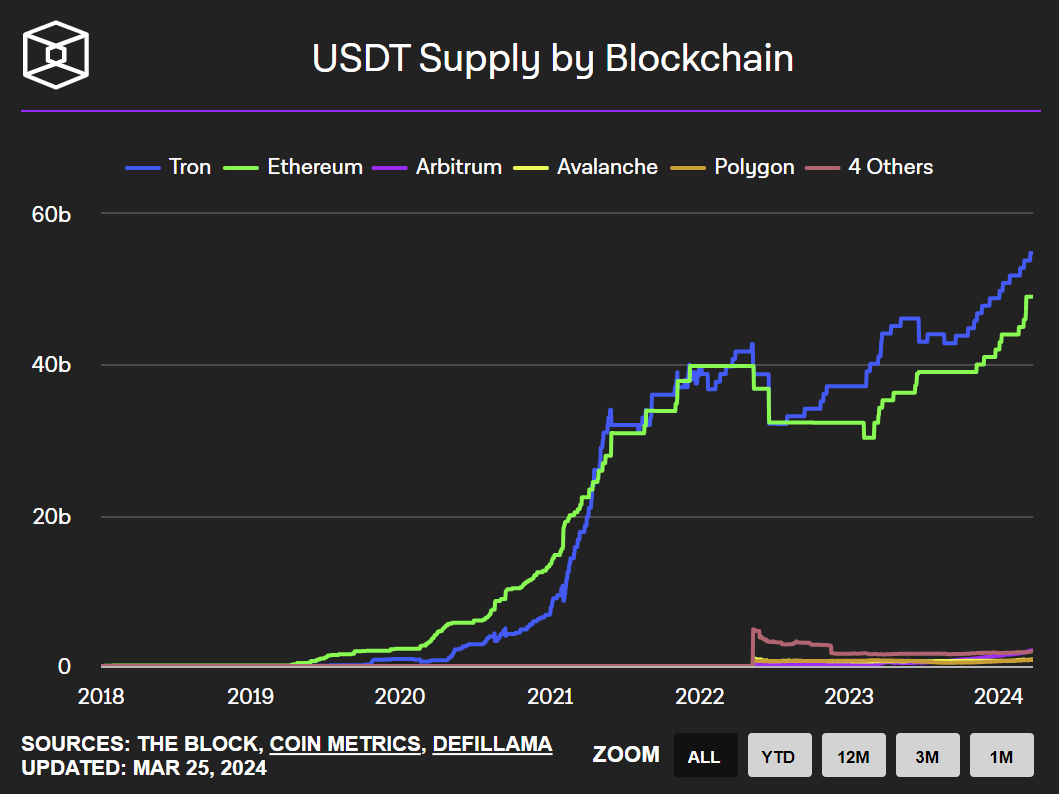
_USDT supply by blockchain, source: _The Block
- USDT Issued by Blockchain:
- USDT is primarily used as a trading currency pair on centralized exchanges, and due to its low transaction fees, the transfer volume on the Tron blockchain is substantial. Consequently, the issuance of USDT on Tron has rapidly increased, surpassing the previously leading issuance platform, Ethereum. Currently, approximately 50% of USDT is issued on Tron, while about 44.79% is issued on Ethereum.
3.2. USDC
- Issuer: Circle
- Pegging Mechanism: Pegged 1:1 to fiat currency, fully backed by Circle reserves
- Collateral Composition (as of March 7, 2024): Cash 12.28%, Circle Reserve Fund 87.72%
- The Circle Reserve Fund (code: USDXX): held at Bank of New York Mellon, managed by BlackRock, includes 58.01% U.S. Treasury repurchase agreements and 41.99% U.S. Treasury Bills (as of March 11, 2024).
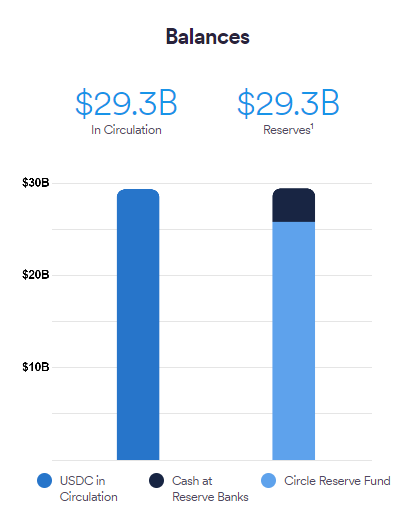
_USDC collateral composition, source: _Circle
- Verification Method: Monthly audit reports from one of the Big Four accounting firms (currently Deloitte)
- Compared to USDT, the monthly reports issued by a reputable accounting firm and transparent fund management give USDC higher reliability.
- Fee Policy: Free
- Issuance Eligibility: Limited to verified members
3.2.1. Recent Updates
- Revenue Status:
- Circle's revenue for the first half of 2023 was approximately $779 million. To expand its market share, Circle implemented a zero-fee policy, resulting in lower revenue compared to USDT. However, its conservative fund management and compliance efforts are expected to attract more institutional demand.
- Decoupling Incident:
- In March 2023, following the collapse of Silicon Valley Bank (SVB), it was revealed that $3.3 billion (about 8-9%) of Circle's $40 billion reserves were held at SVB, causing the price of USDC to drop to $0.86. The U.S. government's full guarantee of SVB deposits resolved the incident without causing any loss of reserves.
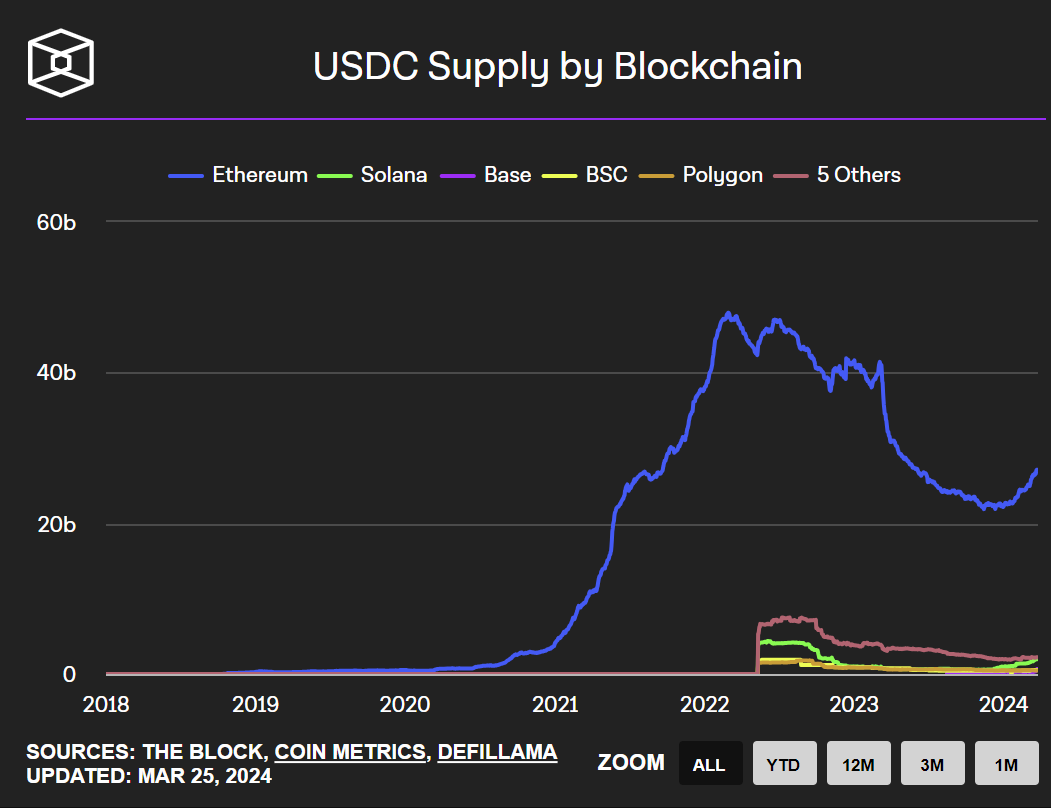
_USDC supply by blockchain, source: _The Block
- Issuance Status:
- USDC is primarily issued on the Ethereum blockchain, accounting for 80% of the total supply. Unlike USDT, Circle has not issued USDC on the Tron blockchain. In February 2024, Circle decided to stop supporting Tron according to its risk management framework, allowing customers to transfer Tron-based USDC to other chains until February 2025.
- Compared to centralized exchanges, USDC has a broader application in the DeFi ecosystem. With the growth of DeFi on Solana, the issuance of USDC on the Solana chain is also increasing.
3.3. DAI
- Issuer: MakerDAO
- Pegging Mechanism: Collateralized through Maker Vault in an over-collateralized manner.
- Collateral Composition: Cryptocurrencies and Real-World Assets (RWA)
- Spark dApp Collateral: $1.19 billion (approximately 26%)
- USDC: $757 million (approximately 16.55%)
- ETH: $676 million (approximately 14.77%)
- WSTETH: $515 million (approximately 11.25%)
- RWA007 (Real-World Assets): $446 million (approximately 9.75%)
- Others: $990 million (approximately 21.64%)
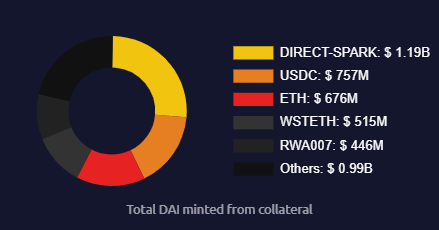
_DAI Collateral, source: _Makerburn
- Verification Method: On-chain data
- Fee Policy: Varies due to treasury liquidity
- Issuance Eligibility: Anyone can participate
3.3.1. Recent Updates
- Revenue Status:
- MakerDAO's revenue for 2023 was $75.5 million, with a net profit of $21.7 million, representing a 15.6% increase compared to 2022. The proportion of RWA assets in its collateral increased by 281.5%, indicating a change in the collateral composition.
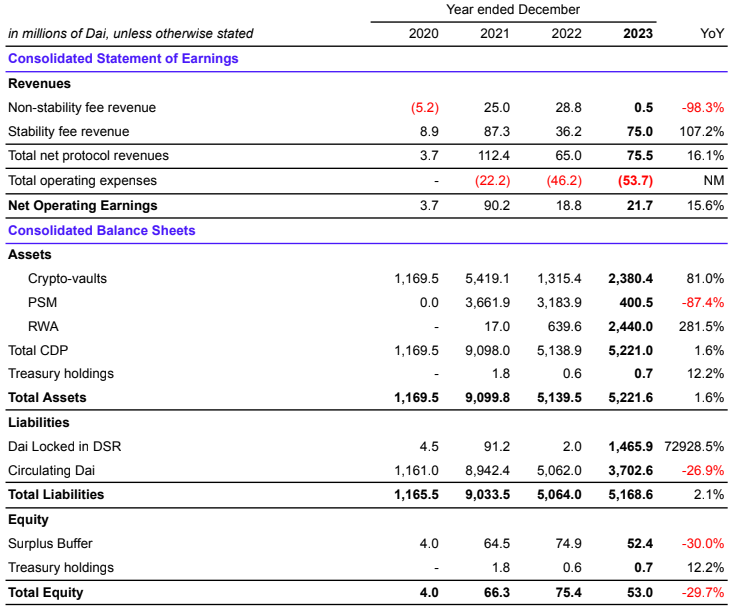
_MakerDAO 2023 Financial Report, source: _MakerDAO
- Issuance Status:
- DAI is used across various blockchains, with 90% of its issuance concentrated on Ethereum. This concentration is due to the fact that the main dApp for generating DAI, Spark, currently only supports Ethereum and Gnosis chains.
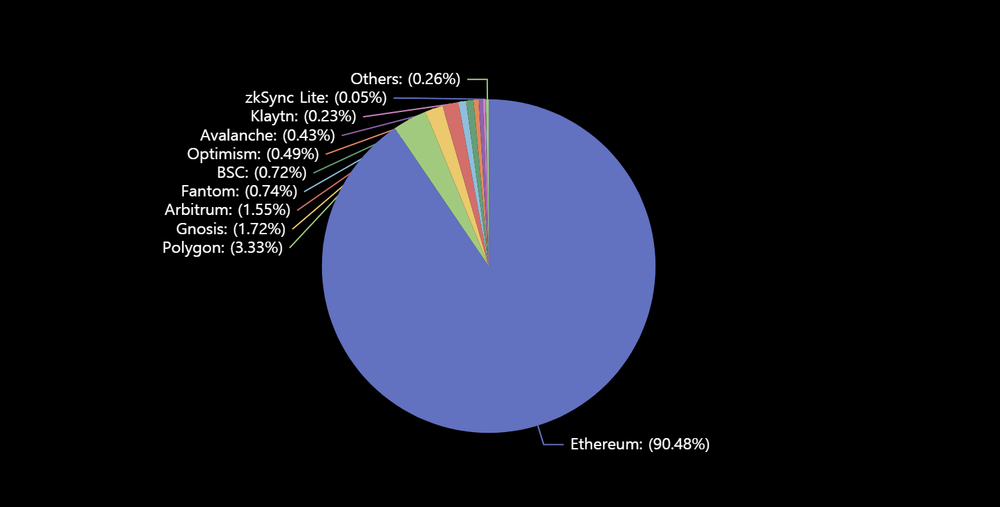
_DAI supply by blockchain, source: _Defillama
- Characteristics:
- Centralized stablecoins like USDT and USDC are pegged to fiat currencies and supported by regular audit reports, while decentralized DAI is transparently supported by on-chain collateral, allowing anyone to participate in its issuance.
- However, DAI also faces challenges such as reduced efficiency due to over-collateralization, difficulty in managing collateral value fluctuations, and variable fees.
4. Failures of Stablecoins
Due to the inherent capital efficiency reduction and lack of scalability in the over-collateralization model, existing stablecoins (like DAI) struggle to achieve widespread adoption. To address these issues, many projects have received significant investments to attempt innovative approaches, but ultimately failed due to regulatory ambiguities and structural limitations.
Notable failure cases include Basis, Terra, and Diem (formerly Libra). Despite raising $133 million, the Basis project was halted due to regulatory concerns. Terra suffered a decoupling attack, resulting in losses of approximately 59 trillion won. Similarly, the Diem project, led by Facebook, was indefinitely postponed and ultimately terminated due to opposition from regulators.
These failures highlight the necessity for a clear regulatory framework and the need for technological solutions that can ensure the success of stablecoins. Below is a detailed explanation of these failure cases:
Basis
Objective: Basis aimed to address the capital efficiency issues of stablecoins.
Funding: In 2018, it raised $133 million from major investors such as Andreessen Horowitz, Polychain Capital, and Meta Stable.
Failure: Regulatory concerns indicated that the token could be subject to U.S. securities regulation, significantly reducing its liquidity and ability to withstand scrutiny. As a result, Basis returned capital to investors and terminated the project.
Terra
Objective: Terra attempted to solve capital efficiency issues using an algorithmic stablecoin model.
Mechanism: It utilized a dual-token system of LUNA and UST, pegging UST to the U.S. dollar through LUNA.
Failure: In May 2022, a large-scale decoupling attack caused UST to lose its peg to the dollar, leading to hyperinflation of LUNA and a system collapse. Estimated losses were around 59 trillion won, causing widespread market impact.
Diem (formerly Libra)
Objective: Diem, led by Facebook, aimed to launch a global stablecoin backed by multiple currencies, including the U.S. dollar and the euro.
Participation: 28 companies were involved, including Mastercard, Visa, and Uber, with plans to expand to 100 companies.
Failure: Facing strong regulatory resistance from the EU and G7 countries, the project was indefinitely postponed, and partners withdrew. The project was renamed Diem and scaled down to a U.S. dollar-pegged stablecoin, but ultimately failed to resolve regulatory ambiguities and was terminated.
These cases underscore global concerns about the impact of stablecoins on monetary policy and the large-scale losses caused by events like Terra, prompting the need for sound stablecoin regulations and guidelines. The success of stablecoin projects requires not only technological solutions but also the establishment of clear regulatory standards.
5. Definitions and Regulatory Status of Stablecoins in Various Countries
5.1. Singapore (Monetary Authority of Singapore)
- Definition of Stablecoins:
- Digital payment tokens pegged to the value of one or more specific fiat currencies.
- Applicability:
- Applicable to single-currency stablecoins (SCS) pegged to the Singapore dollar or G10 currencies issued in Singapore.
- Key Requirements:
- Value Stability: Must meet requirements for the composition, valuation, custody, and auditing of reserve assets.
- Capital Requirements: Must maintain minimum base capital and liquid assets.
- Par Redemption: Must redeem at par within five business days upon request.
- Disclosure Obligations: Must disclose information such as value stabilization mechanisms, holder rights, and audit results.
- Certification of Stablecoins Regulated by the Monetary Authority of Singapore:
- If the above requirements are met, issuers can apply for certification as "Monetary Authority of Singapore Regulated Stablecoins," and only certified stablecoins can carry this label.
5.2. Europe (MiCA)
- Definition of Stablecoins:
- In Europe, stablecoins are categorized based on their support mechanisms:
- Electronic Money Tokens: Issued at a 1:1 ratio with fiat currency, providing holders with redemption rights.
- Asset-Referenced Tokens: Stabilized by a basket of assets, including fiat currencies, commodities, cryptocurrencies, etc.
- Utility Tokens: Not considered stablecoins as they stabilize value through algorithms.
- Only electronic money tokens and asset-referenced tokens fall under the category of stablecoins, with different regulations based on their issuance purpose and supporting assets.
- Types of Regulation for Stablecoins:
- The regulations for issuing and operating electronic money tokens and asset-referenced tokens differ significantly.
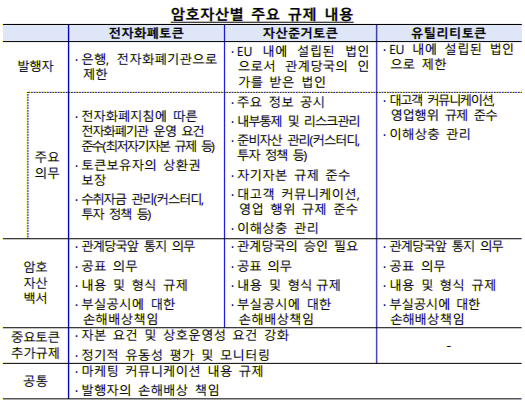
- Regulations on the Issuance and Operation of Electronic Money Tokens:
- Issuer Qualifications:
- Limited to banks and electronic money institutions, which must obtain a license under the Electronic Money Institutions Business Directive (Directive 2009/110/EC).
- Main Obligations:
- Comply with operational requirements for electronic money institutions, including minimum capital requirements.
- Ensure that token holders can redeem tokens at par value at any time, with minimal fees.
- Prohibit the payment of interest on tokens held.
- Secure fund management, ensuring that funds are invested in assets of the same currency to avoid exchange rate risks, and manage funds securely through custodial services.
- Impact:
- Strict qualifications and obligations promote the robustness of electronic money token issuance and operation, but there are criticisms that the core role of traditional financial institutions limits innovation.
- Regulations on the Issuance and Operation of Asset-Referenced Tokens:
- Approval and Refusal Rules:
- Issuance requires prior approval from EU authorities, which have the right to refuse approval if the business model poses a serious threat to financial stability, monetary policy, or monetary sovereignty. Consultation with European regulatory authorities is required before approval or refusal.
- Investor Protection Regulations:
- Issuers must provide clear, fair, and non-misleading information to holders, including detailed information in the white paper regarding value stabilization mechanisms, reserve asset policies, and holder rights. A conflict of interest management policy must be established and disclosed. Monthly disclosures of the value and composition of circulating and reserve assets are required, along with mandatory disclosure of significant events and the provision of redemption rights to holders.
- Reserve Asset Management Regulations:
- Issuers must continuously maintain and conservatively manage reserve assets, including policies on composition, allocation, risk assessment, creation and destruction procedures, and appropriate custody policies to protect reserve assets. Reserve assets must be held in authorized credit institutions, professional investment firms, or licensed crypto asset service providers, and issuers are liable for any loss of reserve assets. Prohibition on the payment of interest on tokens held.
- Potential for Stablecoin Use:
- The MiCA regulations clarify the definitions and issuance requirements for stablecoins, increasing the likelihood of stablecoin issuance and use in Europe.
- Major companies such as Galaxy Digital, DWS, and Flow Traders are issuing euro-based stablecoins, while fintech companies like Monetae in Spain are experimenting under bank supervision.
- Given the high proportion of the euro in the foreign exchange market, it is expected that under MiCA regulation, the euro-based stablecoin market will see more diverse and proactive attempts, thereby enhancing the potential for stablecoin use.
5.3. Japan (PSA)
Japan established a definition and system for stablecoins through the third amendment to the Payment Services Act (PSA) in June 2022, which regulates remittances and payments.
- Definition of Stablecoins:
- The Japanese Financial Services Agency (JFSA) defines them as "digital currency-type" stablecoins pegged 1:1 to fiat currencies and "crypto asset-type" stablecoins pegged to cryptocurrencies, the latter of which is further classified as crypto assets or securities in the PSA.
- Regulations on Digital Currency-Type Stablecoins:
- Classified as electronic payment instruments, with three basic characteristics:
- Transferable to unspecified persons for goods/services.
- Transferable through electronic payment systems.
- Exchangeable for property value with unspecified persons.
- Four categories of electronic payment instruments:
- Property value of goods/services transferable to unspecified persons.
- Exchangeable property value similar to Category 1.
- Beneficial rights to specific currency trusts.
- Designated by the Financial Services Agency (FSA).
- Banks and digital currency issuers fall under Category 1, while digital currency issuers belong to Category 3 designated by the FSA.
- Crypto asset types can fall into Category 4.
Categories 1 and 2 require a bank or remittance business license, making entry difficult. Category 3 only requires a trust company license, making entry relatively easier.
The PSA amendment also includes regulations for intermediaries of electronic payment instruments, divided into dealers and processing business licenses.
- Dealer Business License
- Required when engaging in the following activities:
- Trading or exchanging electronic payment instruments.
- Intermediating electronic payment instrument transactions.
- Managing electronic payment instruments on behalf of others.
- Managing funds received from users on behalf of remittance businesses.
- If the following conditions are met, the dealer business license allows handling of both domestically issued and foreign-issued electronic payment instruments:
- Issued by entities licensed under laws equivalent to the Public Service Agreement or Banking Act.
- Thoroughly audited reserve assets by a reliable organization.
- Appropriate actions taken if electronic payment instruments involve criminal activities.
- Processing Business License:
- Required for intermediaries providing services for bank-issued electronic payment instruments, involving the management of funds related to bank accounts and foreign exchange transactions.
In summary, intermediaries must obtain a processing business license for bank-issued notes and a dealer business license for notes issued by remittance businesses or trust companies. Both types of notes require these two licenses for intermediaries.
- Potential for Stablecoin Use:
- After the PSA amendment, major companies such as DeCurret, ENF, Jasmy, and GMO Group are actively issuing yen-based stablecoins.
- Notable progress includes MUFG's collaboration with Ginko on corporate cryptocurrency payment systems and trade financing, as well as JPYC's collaboration with Promat on trust-type JPYC issuance.
- MUFG expects that the use of stablecoins will accelerate after obtaining a dealer business license in June 2024.
- The regulatory foundation is expected to promote the issuance and use of stablecoins in Japan, marking 2024 as a key year for the Japanese stablecoin market.
5.4. New York Department of Financial Services (NYDFS)
In June 2022, New York became the first state in the U.S. to issue "Virtual Currency Guidance," which includes specific regulations regarding stablecoins.
- Stablecoin Guidance
- Redemption of Stablecoins: At the end of each business day, reserves equivalent to the value of stablecoins issued in the market must be maintained.
- These reserves must be separated from the issuer's own assets and held in state or federally chartered institutions insured by the Federal Deposit Insurance Corporation (FDIC), or in custodial institutions approved in writing by the DFS.
- Stablecoin Reserves: Reserves must consist of the following assets:
- U.S. Treasury securities purchased by the issuing institution with a maturity of three months or less.
- Reverse repurchase agreements collateralized by U.S. Treasury securities, notes, or certain long-term government bonds, but must meet DFS-approved over-collateralization conditions.
- These reverse repurchase agreements must be either tri-party agreements or bilateral agreements, with the creditworthiness of the counterparties verifiable. Information regarding the identity and credit rating of the counterparties must be submitted to the Department of Financial Services at least 14 days prior to entering into the agreement.
- Government money market funds (MMFs) with a minimum allocation to direct U.S. government debt, subject to asset ratio limits and fund constraints approved by the DFS.
- Deposit accounts at state or federally chartered institutions, but must comply with reserve ratio or absolute value limits approved by the Department of Financial Services, based on the risk characteristics of the institution.
- These deposit accounts should also contain a reasonable amount necessary to meet expected redemption demands.
- Audit of Stablecoin Reserves
- Issuers must have their reserve disclosures audited at least monthly by an independent certified public accountant (CPA) licensed in the U.S., in accordance with the guidance.
- These audits must comply with the auditing standards of the American Institute of Certified Public Accountants (AICPA), and the information and audit agreements of the CPA must be pre-approved in writing by the DFS.
- During each month's audit period, the CPA must randomly select at least one business day from the audited period and the last business day of that period to verify the issuer's reserve disclosures.
Currently, the issuance of stablecoins such as Circle's USDC and PAXOS's PYUSD, USDP, and BUSD complies with the guidance of the New York Department of Financial Services (DFS). Therefore, these guidelines are expected to have a significant impact on future U.S. stablecoin regulations.
If this impact materializes, Tether's USDT may require significant modifications to comply with regulatory requirements. In comparison to Circle, which publishes audit reports monthly, Tether releases reports quarterly and holds collateral such as Bitcoin that does not meet reserve asset requirements. These differences may pose challenges for new regulations and could lead to significant changes in the stablecoin market. Therefore, it is crucial to pay attention to the regulatory environment for stablecoins in the largest stablecoin market, the U.S.
6. Conclusion
This article reviews the current state of stablecoins, including the characteristics of major stablecoins such as USDT, USDC, and DAI, as well as regulatory discussions in Singapore, the EU, and Japan. As stablecoin regulation becomes clearer, various attempts continue to emerge, while projects facing operational difficulties may also increase, highlighting the significant influence of regulation. Monitoring the progress of regulatory implementation is essential for understanding market trends.
In the next article, we will examine the progress of countries preparing to introduce stablecoin regulations, compare existing regulatory policies, and explore new stablecoin projects to understand the diversification development potential of the stablecoin market. Finally, we will compare the stablecoin market with the traditional foreign exchange market to discuss its future development potential.
References>
Transparency & Stability, Circle
MAS Finalises Stablecoin Regulatory Framework
Examining Japan's Stablecoin Regulations, Declan Kim
CBDC and Stablecoins: Insights from the Bank of Korea, Circle, and Paxos, Hashed Open Research
免责声明:本文章仅代表作者个人观点,不代表本平台的立场和观点。本文章仅供信息分享,不构成对任何人的任何投资建议。用户与作者之间的任何争议,与本平台无关。如网页中刊载的文章或图片涉及侵权,请提供相关的权利证明和身份证明发送邮件到support@aicoin.com,本平台相关工作人员将会进行核查。


