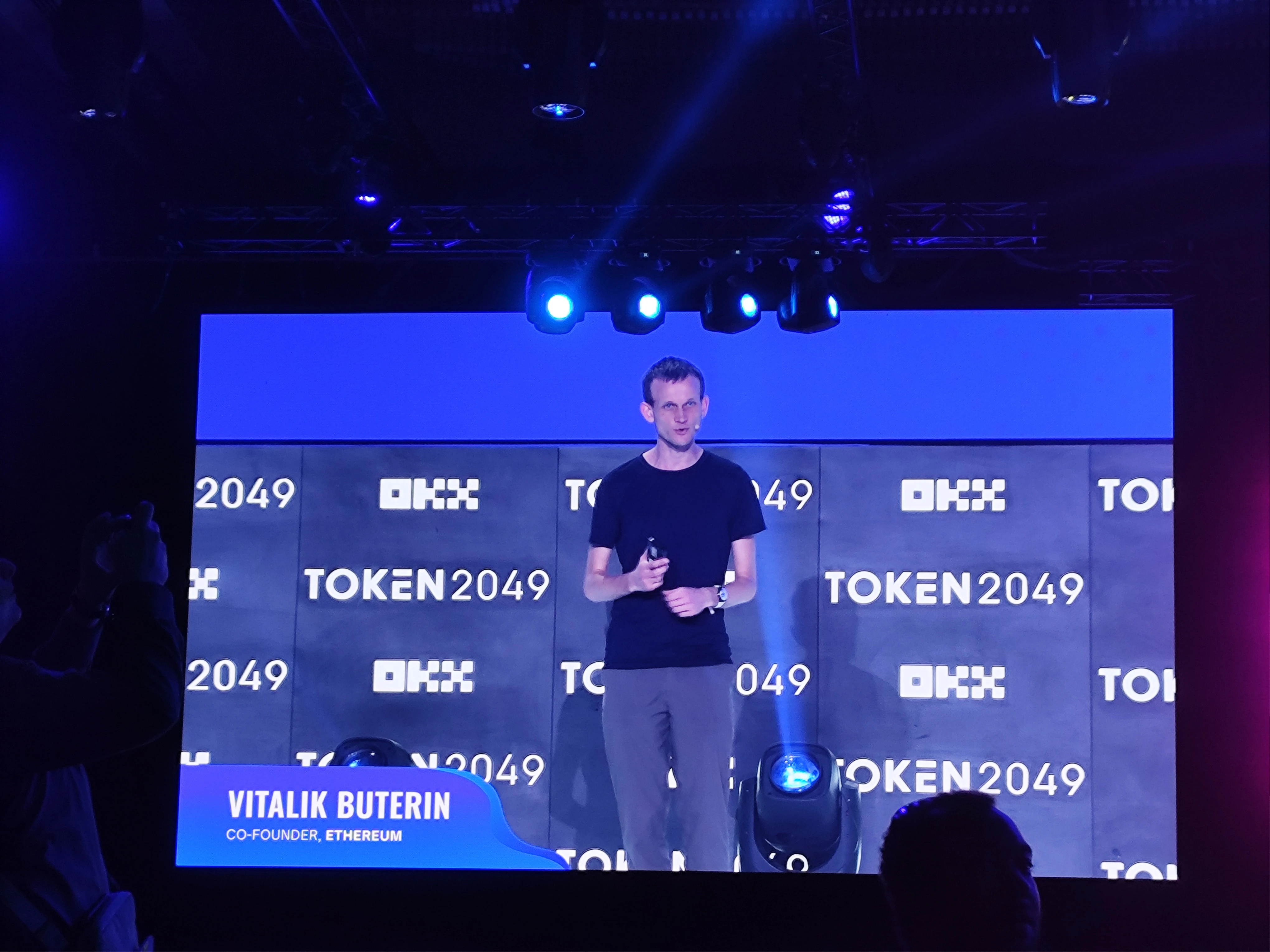
Ethereum co-founder Vitalik Buterin delivered a keynote speech titled "What Excites Me About the Next Decade" at TOKEN2049, where he believes that the current cryptocurrency industry is no longer in its early stages, but is still in its early stages in terms of "practical usability," and Ethereum needs to meet the demands of mainstream adoption. Below is the original text of Vitalik's speech, compiled and summarized by Odaily Star Daily, enjoy~
The Cryptocurrency Industry is No Longer in its Early Stages
Many times, when people talk to me about some of the challenges we are facing now, they tend to say, "You know, we are still in the early stages, we are still building the basic infrastructure, look at how long it took for the internet to take off." Since the launch of Bitcoin, people have been saying this, but I think it's time to focus on the products, and cryptocurrency is no longer in its early stages.
Bitcoin has been around for 15 years, and Ethereum has been around for over 10 years. We have seen things like ChatGPT go from non-existent to suddenly emerging, completely changing everyone's understanding of artificial intelligence.
So we have to ask ourselves a question, how should we view all of this? I think the answer to this question is that we are not in the early stages of the cryptocurrency industry, but we are still very early in terms of "practical usability" in the cryptocurrency industry. So let me explain what I mean by reviewing history.
I remember in 2013, our team, at that time we were all excited about Bitcoin, thinking that Bitcoin was the next major revolution in the payment field, and builders made amazing and serious efforts to get ordinary merchants around the world to start accepting Bitcoin. Who still remembers Room 77 in Berlin? There was a restaurant that accepted Bitcoin payments, and it was actually the first Bitcoin restaurant I went to. In 2013, you could proudly say that you were a restaurant that accepted Bitcoin, and people were very excited about it.
So what happened next? We can delve a little deeper, I remember the first time I went to Argentina in 2021, the first thing I noticed was that people across the country were not only very excited about cryptocurrencies, but were also actively using them on a large scale.
One Christmas, as I was walking around, I entered a coffee shop that was open, and the owner knew who I was and allowed me to pay with cryptocurrency. Although they could use cryptocurrency, they were not actively using decentralized technology.
What technology were they using? It turns out that locals in Argentina were using financial transfers. Because financial transfers are instant and free. I think this ultimately comes down to the same issue—fees, at least it stifled the wave of digital currencies: "getting everyone to accept Bitcoin as a currency."
If you remember the initial marketing of cryptocurrencies, it talked a lot about the fees of Western Union money transfers, PayPal, and credit cards, which charged customers very high fees. But later, the fees of Bitcoin itself rose to $50.
And the fees of Ethereum also rose, the highest fee I paid on Ethereum was actually for a privacy service transaction. But it is undeniable that gas prices have risen, and there were many comments on Twitter every time I made a transaction. So privacy protocols have a very good product-market fit, but some transaction fees were around $800. So high fees are basically the reason for the failure of many things.
Ethereum Becomes Faster and Cheaper
So, what new changes are there in 2024? This is a chart of Ethereum fees, which have dropped from between 10 to 50 cents to less than 1 cent, basically close to zero. At the same time, the two major Ethereum Layer 2 solutions, Optimism and Arbitrum, have reached an important security milestone called Phase 1, and multiple ZK-based Rollups have told me that they plan to reach Phase 1 soon. Therefore, Rollups will soon become more secure as well.
The issue of fees has actually been resolved, but that's not the only important thing.
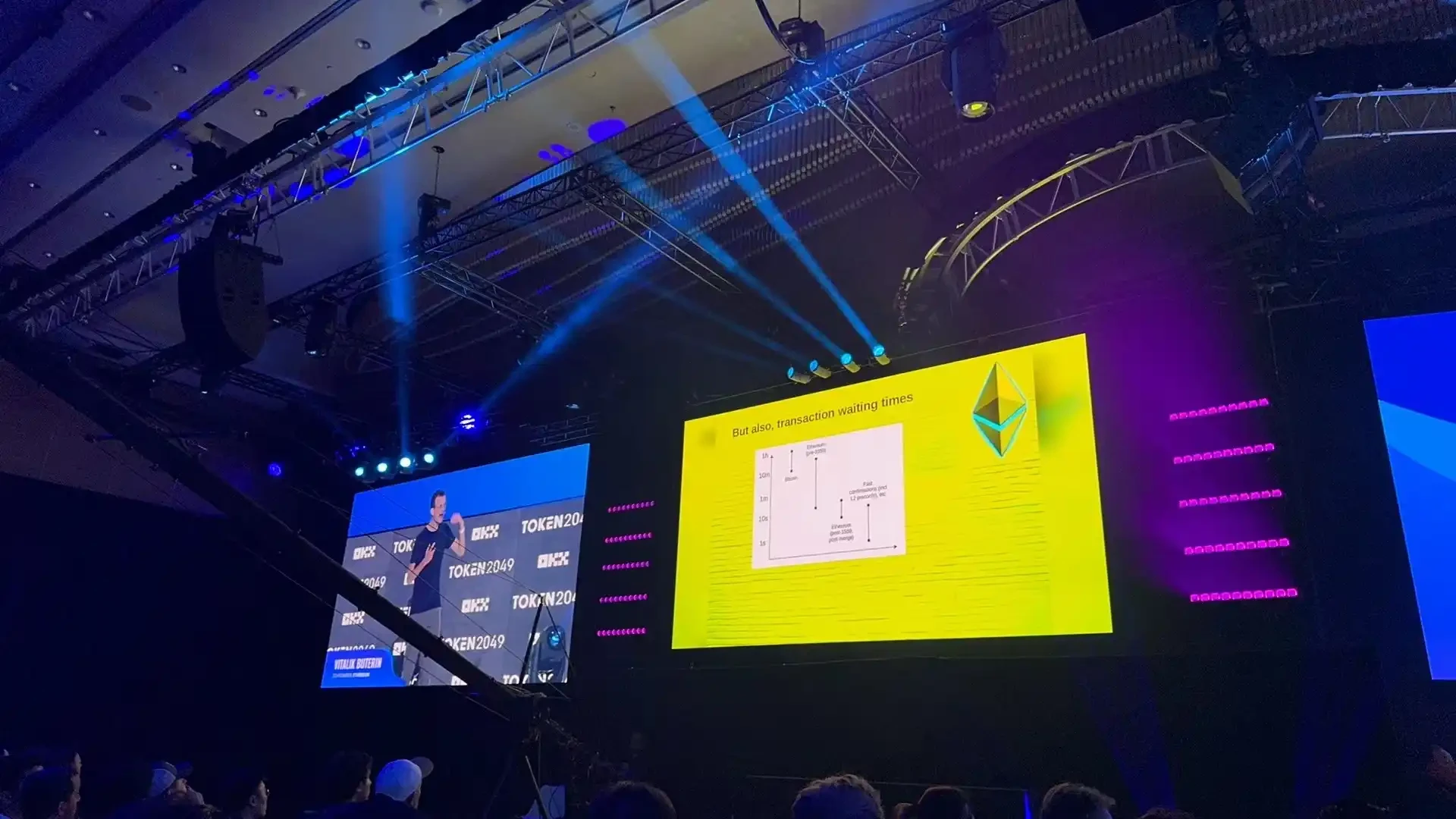
I vividly remember another annoyance I encountered while traveling in Argentina, when I tried to transfer money to someone on the Ethereum mainnet, the transaction fee was about $4, and the transaction confirmation took about 5 minutes. Although EIP-1559 was already live at that time, the wallet I was using had not actually been upgraded.
Bitcoin blocks are mined every 10 minutes. So you have to wait 10 minutes, or even possibly an hour for the transaction to be confirmed. In theory, Ethereum's block confirmation time is 13 seconds, but due to gas, the market may experience inefficient situations, and sometimes you have to wait for completely random block confirmation times, which could be 5 minutes, or even longer to include our transactions.
But EIP-1559 actually basically solved this problem. If you add the merge feature, what the merge feature does is shorten the average waiting time for the next transaction by half.
With these two upgrades, our transaction confirmation time is now between 5 to 15 seconds. If using a Layer 2 solution with fast and free confirmation, it can usually be shortened to one second. So basically, these two major issues are the biggest factors that led to the centralized user experience being far superior to the decentralized user experience in 2021.
Cryptocurrency is Not Just an Efficiency Technology
But we can also look at the general user experience quality of applications. If you look at my tweet from 2015, it was about a hackathon, and it mentioned Firefly, which is a client for Farcaster and Twitter, Lens. If you look at the quality of the user interface, it doesn't seem much different from the quality of Web2 products, but it is a decentralized application.
This year, we also saw progress in account abstraction. We see more and more people using secure protocols. We saw EIP-7702. We started to see mainstream applications of ZK-snarks, various different applications, and we have new and better privacy protocols. There are also zero-knowledge proofs, I can prove that this is your knowledge, you can have a passport and fully use it, and it can even be used for usability improvements between existing Layer 2 solutions.
Two years ago, everyone was complaining about having to manually switch networks. Today, I think at least in the past year, I haven't actually manually switched networks. So the limitations of the technology used to be a hindrance. I even remember that moment, when CryptoKitties looked like it might become a real breakout application, but what happened later? CryptoKitties' success pushed Ethereum's gas prices to $50.
Ethereum became basically unusable, which really limited its growth. But now this won't happen, which basically means there is no longer a reason not to use cryptocurrency. So, what other reasons are there to use cryptocurrency? I think one mistake people sometimes make is to always talk about cryptocurrency SDKs and to see cryptocurrency as an efficiency technology. This is something that many people talked about 10 years ago.
What were the benefits of Bitcoin that were promoted in 2013? Making payments easy, secure control of your funds, zero or lower fees, protecting personal identity, and so on. Of these four, two are features of cryptocurrencies that I think are very unique. Are the other two still unique to cryptocurrencies? Today we have Venmo, and there are some better payment methods, such as WeChat Pay.
Centralized system solutions are getting better, but in some areas, accessing payment and financing channels is still very difficult. Why is it difficult? This is not because of technological issues, but mainly due to global political restrictions. So I think it's important to remember that the benefits that cryptocurrencies bring to the world are not tied to similar technological advancements. This is similar to the transition from regular jet planes to supersonic jet planes, although they are both airplanes, it's a different type of technology.
So, what specific technology is this? One perspective is to refer to a blog post written by Josh Stark at the Ethereum Foundation about two years ago. The article is titled "Atoms, Institutions, Blockchains." The argument is that blockchains allow us to create a digital robustness that enables us to create enduring digital structures that are difficult to change.
These structures are robust and cannot be destroyed, just like physical structures made of concrete. What is the difference between blockchains and previous network technologies? In previous networks, if your file-sharing network crashed, it didn't matter, you just switched to another network, and everyone would forget in a week. But in a blockchain, if one locking mechanism crashes and you switch to another, everyone loses all their money. This is a fundamental difference.
Blockchains not only compensate for the weaknesses of the overall structure of the internet, but can actually better build alternative solutions that can address similar problems.
Blockchain is the digital concrete that can be used to build a virtual sky city. So, has anyone seen the movie "Castle in the Sky"?
I think this movie is really great, I think it's definitely one of the best works of Studio Ghibli, I've seen it at least five times. But it turns out that this movie has also unexpectedly become an inspiration for Ethereum to some extent, although I didn't realize it myself.
In 2013, while browsing the list of fictional elements on Wikipedia, I discovered Ethereum. The name was really great, it reminded me of a scientific theory from the 19th century. Two months later, a former designer of the Ethereum Foundation decided to use this diamond as the symbol of Ethereum. At the time, I thought it was a really cool diamond, I liked the logo, it was beautiful.
Seven years later, when I saw this movie for the first time, I found that they also had an Ethereum crystal. The Ethereum crystal is actually like a diamond. Ethereum looks like a digital castle in the sky, I think the serious and fun aspects of cryptocurrency are combined, and this is what I hope people remember. A castle can protect you, your family, and your community. A castle can also be the castle in Disneyland, making your community happy; a castle can also be a museum, preserving the thousand-year history of your culture. A castle can be all of these things, and various types of digital castles can be built on Ethereum.
Blockchain Needs to Meet Mainstream Adoption Demands—Using Wallet Security as an Example
So, after building all of this, we need to meet the demands of mainstream adoption, while also adhering to open-source and decentralized values. What does this mean? For example, wallet security.
Historically, there are basically two ways to safeguard your funds:
The first method is a somewhat crazy form of self-preservation. You write down a mnemonic, and all your operations are done offline. You engrave the mnemonic on a piece of titanium, then put the titanium in a stronger titanium lockbox, and bury the lockbox 10 meters underground, and your coins are safe. This is one method.
The other method is to entrust your coins to a trusted person. You know there's this good person, his name is Sam. He attended events with Clinton, so he must be trustworthy. But two years later, it turns out that your judgment of who is trustworthy and who is not is a bit wrong.
I don't think these are the only two choices. If you want to protect yourself from centralized harm, then you can do traditional self-custody, such as putting the mnemonic in titanium and burying it 10 meters underground. If you want to have both, then what do you do?
This is the importance of secure smart wallets with multi-signature security. Multi-signature security means you have multiple keys, for example, you might have 6 keys, and 4 are required to send a transaction. You can even set a rule that only one key is required for small transactions. These keys can be any combination you can control, including friends and family.
Now, you can actually create a simple real account, which is a smart contract wallet, and you can only send transactions from it when you generate proof that you control a specific email address. So, you can basically introduce Web2's social recovery feature into the Web3 world. In the Web3 world, you can even diversify your trust.
Therefore, you can wrap your Gmail account with zk by a US company, then combine it with CK wrapping, and at the same time, you can make three keys with a hardware wallet made by a Chinese company. This way, you can even get the benefits of institutional-level trust without many weaknesses. Forecast is a Web2 application in terms of user experience, but users can set a recovery address, and in the future, it may be possible to control their accounts through multi-signature. I personally trust my multi-signature account far more than any centralized account.
**Balancing Decentralization and Usability
**
There is a demonstration wallet based on Ethereum, but its user experience is the same as Venmo. Through some mechanism, users can prove that their withdrawals come from some deposits without revealing which one, but can prove that their deposits are not from bad actors. Therefore, this is a way for ordinary users to have very high privacy and meet many important needs, but there are actually no backdoors.
For example, for ZK social media, a similar super account can be used. We can prove that you are a member of the community, provide proof or solve reputation problems for people in need, while still protecting your privacy. This doesn't require the user to be present, doesn't require anyone to believe you, or require KYC to verify you. We can have both privacy and trust at the same time.
On the Ethereum mainnet, many technological improvements are happening, reducing final confirmation times, increasing capacity, and making it more decentralized and easy to verify at Layer1. These things are already happening. These are the directions in which the Ethereum ecosystem and I believe cryptocurrency will develop in the next 10 years.
Now we basically have two wrong paths, one is sacrificing usability for decentralization, and always being an ecosystem that is only attractive to oneself. It only has 695 users. The other bad path is sacrificing decentralization for usability, and then trying to convince oneself that this is the only choice.
So, do we have to log in with a "pretty" Gmail account for the next great crypto application? We don't have to make a decision between these two dark options, we can have both decentralization and usability at the same time.
免责声明:本文章仅代表作者个人观点,不代表本平台的立场和观点。本文章仅供信息分享,不构成对任何人的任何投资建议。用户与作者之间的任何争议,与本平台无关。如网页中刊载的文章或图片涉及侵权,请提供相关的权利证明和身份证明发送邮件到support@aicoin.com,本平台相关工作人员将会进行核查。