Author: Pavel Paramonov
Translated by: Alex Liu, Foresight News
Is everything really moving towards AppChains?
Yes, and no.
The main reason dApps are turning to building their own sovereign chains is because they feel they are being exploited. This is not far from the truth, as most dApps indeed have not made money.
You can consider the recent example of @zkxprotocol ceasing operations, as well as many other past applications such as @utopialabs_, @yield, @FujiFinance, and so on.
But is this because their business model is bad, or are the protocols really being exploited?
The main source of income for dApps (usually the only source) is fees. Users pay fees because they directly benefit from them.
However, users are not the only beneficiaries of the increasing usage of dApps.
In the transaction supply chain, there are several roles that can profit from it, with the most important being the block proposers, even though they are the last to see the transactions. In the case of L2, it's the sequencers.
MEV (Maximal Extractable Value) is heavily extracted, which is not always a bad thing, but the value created by dApps is taken away, so they do not receive all the value they provide.
Currently, there are three ways to solve this problem:
Become an Appchain.
Choose an L1/L2 that can return value.
Implement application-specific sequencing.
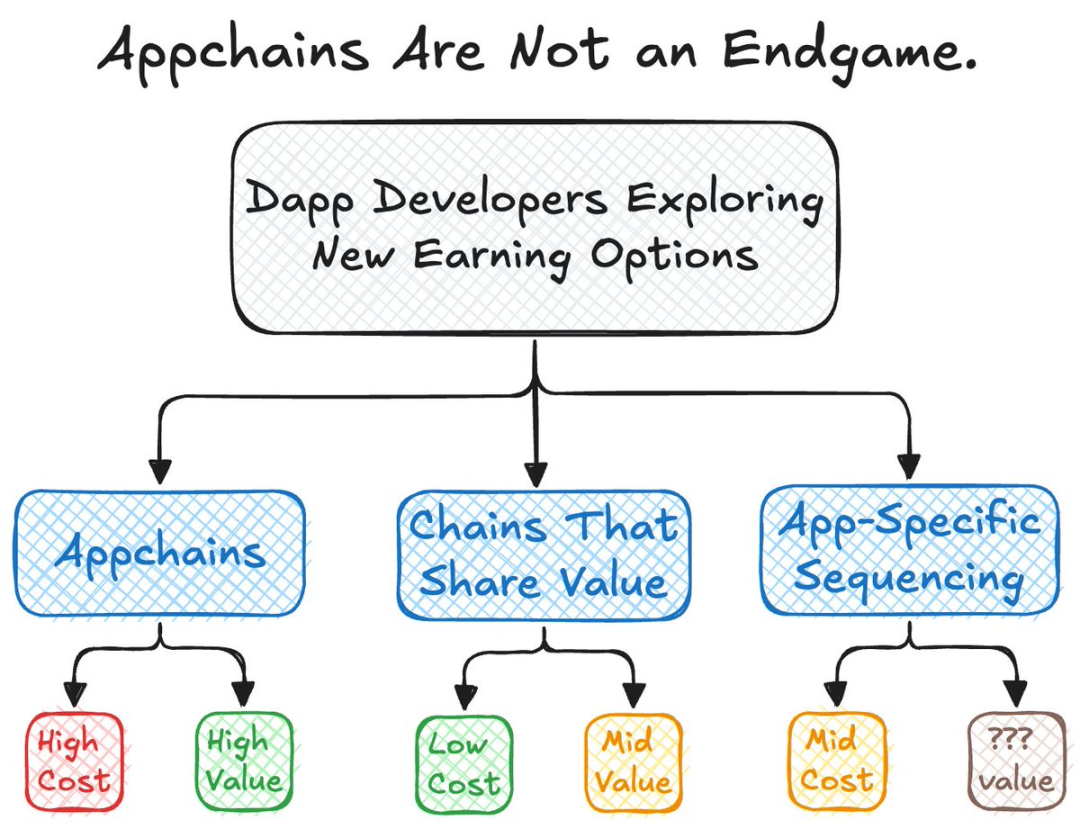
Like everything in cryptocurrency, each solution has its trade-offs.
1. Becoming an appchain: high cost + high value
There are countless advantages: you can extract the value you want, control your own network (if you are L2), easier to scale, avoid competing for block space, and so on.
The downside is: it's really expensive, really expensive. And it's harder to do because you have to build both the chain and the application at the same time.
Even if you want to build an L2 and use a solution similar to Alt Layer.
The view that every application will eventually become an Appchain is basically wrong, for three reasons:
Not every dApp is large enough to need to migrate to an Appchain.
Some dApps directly benefit from the architecture of the underlying chain.
Many dApps are quite comfortable developing on other chains.
2. Returning value L1/L2: low cost + medium value
Deploying applications on Rollup or L1 is much cheaper because you don't need to implement new rules for validation, inclusion, consensus, transaction processing, and so on.
In the case of Rollups: migrating your application to Rollup from Ethereum is very easy (in most cases) because Rollup is either EVM compatible (e.g., Arbitrum) or EVM equivalent (e.g., Taiko).
You still need to consider the architecture of the underlying chain, but you don't have to build it from scratch.
Perhaps in the future, we will have true chain abstraction, where developers only need to care about their dApp, but that's another story…
The return for developers is medium because it's not high (you don't own the economy of the chain), but it's not low either (besides fees, you can also get some return).
There are almost no implementations in this area currently because sharing MEV with dApps is still a complex process, and we need to do more research and development.
3. Application-specific sequencing: medium cost + uncertain value
The concept of application-specific sequencing is quite new, and people often confuse it with Appchain, but the difference is simple:
Appchain cares about sequencing and execution.
Self-sequencing dApps only care about sequencing and outsource execution to L1/L2.
The cost is medium because besides building the dApp, you also have to consider the sequencing of transactions, and the value is uncertain because this concept is quite new and has different concerns.
First, you still rely on proposers because of the inclusion game: you can send any bundle you want, but the decision to include your bundle is in the hands of the proposers.
If you take all the MEV, then the proposers have no clear incentive to include your bundle in the block.
In fact, this opens up another incentive market for proposers. They (dApp + proposers) should cooperate, otherwise neither of them has value or power.
Its value is also uncertain because we are not sure if the shared value from L1/L2 will exceed the value created by dApp through sequencing transactions.
Any chain is a dark forest (not just Ethereum!). So, back to the original question:
Is everything really moving towards AppChains?
Well, yes (some dApps benefit more from having their own chain rather than staying on existing chains).
Well, no (there are other solutions that fit the needs of dApps).
This forest is very large, and all options can be explored.
Every field in the world has diversity, including crypto. So choose what suits your needs best, or build your own solution!
免责声明:本文章仅代表作者个人观点,不代表本平台的立场和观点。本文章仅供信息分享,不构成对任何人的任何投资建议。用户与作者之间的任何争议,与本平台无关。如网页中刊载的文章或图片涉及侵权,请提供相关的权利证明和身份证明发送邮件到support@aicoin.com,本平台相关工作人员将会进行核查。


