Title: "Analyzing the Inherent Logic of PayPal Stablecoin Payments and the Evolutionary Thinking Towards Mass Adoption"
Author: Will Awang
On May 31, 2024, PayPal announced the launch of its stablecoin PayPal USD (PYUSD) on the Solana blockchain. This marks another significant milestone since PayPal first introduced PYUSD on the Ethereum mainnet in August last year. It not only provides its users with a new and efficient payment method but also offers important insights into the future trends of the entire payment industry.
In the process of writing the Web3 Payment Research Report and exchanging ideas with industry companies, I have been pondering a question: Is stablecoin payment really necessary? Coincidentally, with the launch of PYUSD on Solana, PayPal, from a very pragmatic perspective, has provided an answer about payment freedom:
"People want to pay as they please. The current payment networks are unable to meet the demand. Crypto can meet the demand and is practical. Therefore, as a financial technology company committed to promoting payment innovation, we are launching a stablecoin payment solution to meet people's current desire for flexible payments."
Therefore, this article will attempt to analyze PayPal's shift towards Crypto, the stablecoin payment solution launched with PYUSD on Solana, and the evolutionary thinking towards PYUSD's mass adoption. I hope this can provide reference for the industry, and welcome discussions.
I. Why PayPal Shifted Focus to Crypto
As a global leading payment company, PayPal has over twenty years of global payment experience. During these twenty years, along with the mature development of e-commerce, PayPal has not only established itself as a trusted beacon, providing users with the endorsement of trust for transactions, but also achieved the widespread application of Internet digital payment network.
PayPal's original intention has always been the same - to promote payment innovation and enable everyone to pay as they wish.
However, so far, payment innovation has been built on the same basic financial track as when the Internet emerged. Although the industry has been striving to provide global, instant, and seamless transactions, the reality often shows its shortcomings:
The settlement time for online payments is still long (averaging 2-3 days in the United States), markets, banks, and service providers need to operate on business days, further extending the settlement time; employers find it difficult to pay the increasingly distributed workforce; the increasingly globalized population finds it difficult to make cross-border remittances in a low-cost and efficient manner; businesses most commonly feel this friction, while consumers still endure long waits in what they perceive as a fast payment environment.
In short, people today cannot pay as they wish.
This is the reason why PayPal shifted its focus to Crypto, and the answer is simple: it can meet the demand and is practical.
Cryptocurrencies and blockchain technology can bring people closer to realizing their payment desires: fast, inexpensive, and global payments. This new next-generation financial/payment infrastructure can help PayPal better serve its 40 million users, enabling everyone to pay as they wish.
Therefore, more than a decade after the emergence of cryptocurrencies and blockchain technology, PayPal has once again come to a crucial moment in payment history, a moment filled with potential and opportunities, just like the early Internet in 2000.
Just as PayPal previously brought payments online, PayPal is now bringing payments onto the chain.

(flywheeldefi.com/article/paypal-steps-on-chain-with-pyusd)
II. Global Payment Predicament Awaits Improvement
The current payment channels and information transmission protocols (such as ACH, SEPA, and SWIFT) constitute the global payment network. They enable us to conduct large-scale transactions across regions and time zones and ensure relatively smooth payments. However, the current payment technology also forces us to make trade-offs between 1) payment settlement speed and 2) cost-effectiveness, for example:
- The circulation of funds will incur costs, and there needs to be prearranged cooperation and liquidity requirements between various intermediaries;
- The operating time limits (business days) and batch processing of parties across time zones mean that payments may need to wait for several days to settle;
- The arrangement of net settlement is difficult to meet the needs of small-value, high-frequency transactions.
However, as adults, we want both - low-cost and efficient settlement.
What people want is to pay more easily. Businesses want to pay suppliers without worrying about settlement time; individuals want to remit money to distant family members without paying high fees and waiting for days. Today's financial infrastructure cannot quickly meet people's needs for fast transactions, and PayPal does not want users to lose value in this waiting process.
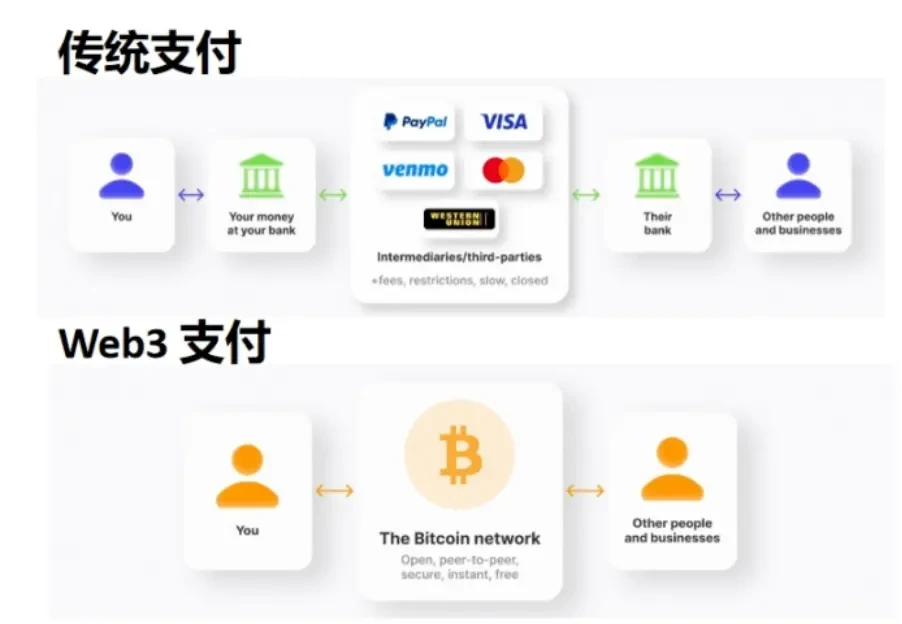
Today, cryptocurrency and blockchain technology provide a brand-new payment channel that can simplify payment settlement processes, making payments fast, inexpensive, and easily accessible.
Therefore, we need to use cryptocurrency and blockchain payment technology solutions to address the legacy issues of traditional payments: 1) slow settlement time; 2) high transaction costs; and 3) incompatibility with under-banked and unbanked regions on a global scale.
III. PayPal's Stablecoin Payment Solution

(The stablecoin from the payment giant PayPal is expected to lead the crypto industry towards the mainstream)
Definition of Stablecoin: Most cryptocurrencies have significant price fluctuations and are not suitable for payments, such as Bitcoin, which may experience large fluctuations within a day. Stablecoins are a type of cryptocurrency designed to solve this problem by maintaining a stable value, usually pegged 1:1 to a fiat currency (such as the US dollar). Stablecoins have the dual advantage of maintaining low daily fluctuations while providing the advantages of blockchain - efficiency, economy, and global usability.
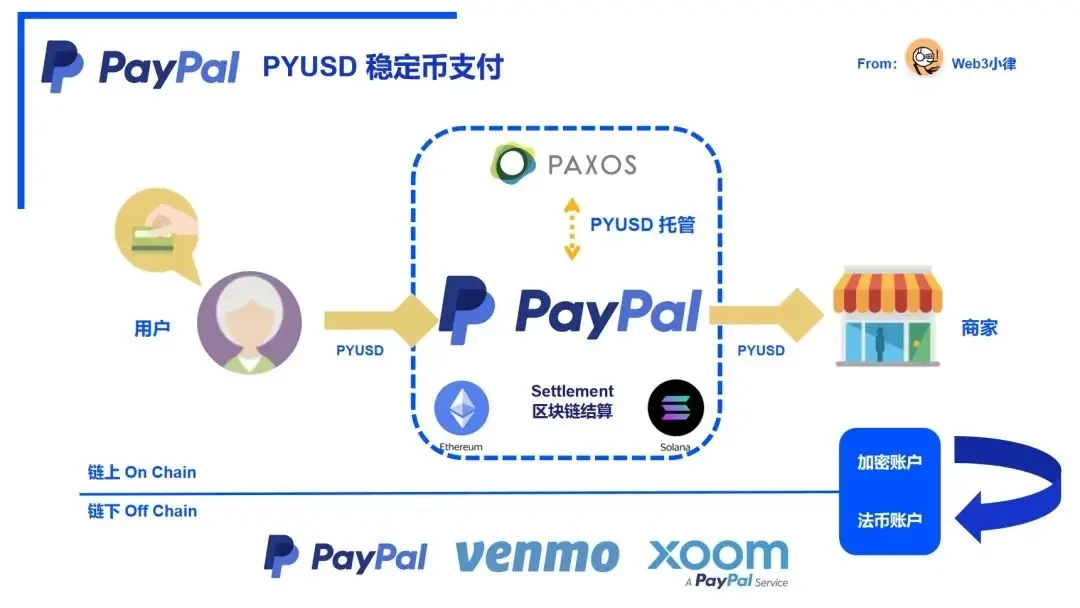
The stablecoin PYUSD launched by PayPal is a brand-new stablecoin payment solution aimed at achieving next-generation financial technology innovation. Built on PayPal's deep industry accumulation in payments and the high-performance Solana blockchain, PYUSD can achieve efficient instant settlement, reduce transaction costs, and provide highly secure and truly global payments.
PYUSD is a stable value storage tool (exchangeable 1:1 with the US dollar) launched by PayPal on the blockchain, and its emergence will address the aforementioned issues in the global payment industry. Eligible US users can buy, sell, send, receive PYUSD, and use it for payments.
- Purchase and transfer PYUSD within the PayPal and Venmo ecosystem, achieving a smooth deposit and withdrawal experience;
- Use PYUSD as a payment method for online transactions, such as checkout and payments for millions of PayPal merchants worldwide;
- Cross-border P2P payments with PYUSD on Xoom (a cross-border payment tool);
- Outside the PayPal ecosystem, PYUSD can be used on cryptocurrency exchanges (such as Crypto.com) and wallets (such as Phantom);
- PYUSD can also be used for various innovations, such as serving as a fast, low-cost financing tool for risk investments like Mesh.
PYUSD is building a truly stablecoin commercial scenario, providing the frictionless and reliable payment experience that mainstream consumers and merchants expect.
IV. Evolutionary Thinking Towards Mass Adoption of PayPal Stablecoin Payments
Based on PayPal's nearly 20 years of global payment compliance experience and the highest compliance standards of PYUSD, the combination of PayPal + PYUSD can upgrade previous stablecoin transactions to become the stablecoin payments we truly need.
When PayPal was founded, its responsibility was not only to promote the implementation of payments but also to introduce and disseminate a new technology - digital payments, which has now become ubiquitous in our lives. This successful experience can provide guidance and fresh insights for the launch of PYUSD stablecoin payments. Specifically, PayPal divides the evolutionary thinking towards Mass Adoption into three stages:
- Awareness
- Utility
- Ubiquity
4.1 Awareness through Introduction
As mentioned earlier, payments are ubiquitous and deeply rooted in habits and practices, so the transition needs to be gradual and stable, not happening overnight. Introducing a new payment method is both a behavioral and a technological or financial change.
The first step towards Mass Adoption is awareness - simply introducing the fact that a new technology exists to people.
At this stage, early adopters are the target audience, namely cryptocurrency holders - a group that accounts for about 15% of the global population and is relatively easy to reach. This is also the reason why PayPal launched PYUSD on Ethereum at the end of 2023, ensuring awareness among early adopters.
Now, with the launch of PYUSD on Solana, the second-largest market cap blockchain, it can cover the most active and enthusiastic groups in the crypto ecosystem, letting the world know that "PYUSD is really here."
In addition, the integration of PYUSD with the PayPal and Venmo applications introduces it to over 100 million users in the United States. Subsequently, efforts will continue to expand the influence of PYUSD outside the PayPal ecosystem through partnerships with cryptocurrency exchanges and payment partners.
PayPal knows from its previous successful experience that cognitive awareness is the necessary first step to bring a new payment mechanism to the masses.
4.2 Utility through Integration
The next step in adopting new payment technology is to achieve utility, that is, to transform the initial cognitive awareness into practical payment utility, just as PayPal initially established itself as a trusted platform for transactions between strangers through eBay.
Today, the payment people need must be fast and inexpensive. While PayPal's launch of PYUSD on the Ethereum mainnet provided it with great visibility, it did not fully meet all the standards required for PYUSD to fulfill its mission as a digital commercial payment tool - efficient, economical, and globally usable.
Therefore, PYUSD turned to Solana to achieve payment utility.
(Solana-based USD stablecoin launched by PayPal: a new chapter in blockchain payments)
Solana is a high-performance blockchain network built for finance, payments, loyalty programs, and is one of the most widely adopted blockchains. In the fourth quarter of 2023, it processed an average of 40.7 million transactions per day and had 2,500 active developers in its ecosystem. In addition, its blockchain's open-source, programmable, and composable nature can bring tremendous space and network effects.
Solana brings PYUSD far faster settlement speeds, lower transaction costs, stronger scalability, and global network support than other blockchains. Combined with Solana's advantages, users can truly achieve payment utility when using PYUSD:
- Real-time settlement: Most PYUSD transactions settle efficiently within seconds;
- Low transaction costs: Transaction costs on the Solana chain are only a few cents, regardless of the transaction amount;
- Finality of transactions: Merchants do not have to worry about customers canceling payments due to insufficient funds or other reasons;
- 24/7 trading: Available 24/7/365;
- Interoperability: PYUSD can be used outside the PayPal ecosystem, achieving interoperability with other gateways, networks, and wallets;
- Programmability and composability: PYUSD is developed on the widely adopted SPL token standard. This means that any product supporting this standard will automatically support PYUSD. Developers can freely experiment and build within and outside the PayPal ecosystem. Consumers, merchants, and institutions can enjoy a wide range of third-party developer experiences, using PYUSD for payment and financial use cases;
- PayPal's large user base: PYUSD is available for existing eligible US PayPal customers.
Therefore, launching PYUSD on Solana will help ensure the long-term adoption of stablecoin payments. In this process, transitioning PYUSD from the awareness stage to the practical payment utility stage.
With PYUSD now available on both Ethereum and Solana, it will attract more developers and ecosystem partners, and combined with the practicality on the PayPal and Venmo applications, PYUSD will provide users with more feasible and user-friendly use cases.
4.3 Ubiquity through Assimilation
The final stage of adopting any new payment technology is ubiquity, where the technology seamlessly integrates into daily life. At this stage, people can effortlessly use the new payment technology without even noticing - they are just paying as they please.
For PayPal, it has made digital payments a way for people and businesses in over 200 countries to remit money to each other, serving as a secure, reliable, and standardized P2P, B2B, and B2C payment method that is ubiquitous with the development of digital globalization.
V. Use Cases of PYUSD Stablecoin Payments on Solana
Let dreams come true, and let people pay as they please. Just shouting slogans won't cut it. Let's take a look at some real-world scenarios for PYUSD.
5.1 Cross-Border Peer-to-Peer Remittances (P2P)
Today, economic connections between individuals globally are closer than ever. However, cross-border money transfers between individuals represent a huge and growing market full of opportunities. Legal remittances to low- and middle-income countries reached a volume of $669 billion in 2023 (World Bank data), but cross-border remittances are not cheap.
With PYUSD, payers can transfer funds directly to recipients using a Solana wallet, with settlements almost immediate and costs close to zero.
Even for recipients without a Solana wallet, payers can collaborate with PYUSD payment service providers to save costs on cross-border remittances. Payment service providers connect to local fiat cash networks through PYUSD, allowing recipients to easily convert PYUSD into bank deposits or cash, enjoying near-instant, low-cost global remittance services.
5.2 Business-to-Business Transfers (B2B)
Due to the complexity of cross-border payments involving multiple intermediaries and international banking networks, most B2B payments may take several days to settle. Additionally, depending on the method of cross-border fund transfer, payment fees can be high.
By leveraging the programmable features of PYUSD, businesses can build their own services to seamlessly create near-instant, cost-effective cross-border transfers with relatively low technical requirements. Teams can also create smart contracts to manage the flow of PYUSD between accounts, improving the speed and accuracy of supplier payments (or any other B2B payments governed by contract agreements).
Furthermore, using PYUSD transfers does not necessarily require businesses to own or interact with PYUSD. Payment service providers can build B2B payment products to provide a fiat experience to end users.
5.3 Global Payments and Receipts (B2C)
PYUSD can significantly simplify global payments. PYUSD does not need to go through complex networks (including unique regional bank accounts, different currencies, intermediary banks, and digital wallet tracks), and can be paid to any compatible wallet address. Additionally, using programmable smart contracts with PYUSD can enable business payers to automate payment processes more effectively, even enabling real-time wage payments.
5.4 Microtransactions
Due to high transaction costs, traditional payment processing systems struggle to support microtransactions. Therefore, platforms processing microtransactions often batch payments, involving complex payment engineering, increasing risks, and preventing platforms from accepting microtransactions.
However, PYUSD on Solana will enable merchant platforms to easily handle microtransactions in near real-time and at low cost. Microtransactions support various use cases, such as tips, in-game purchases, and paying small fees to content creators based on reads or views.
5.5 Web3 Payments
Many Web3 merchants (such as NFT markets and blockchain-based gaming platforms) lack connections to traditional fiat bank accounts and require robust, non-volatile payment solutions, which PYUSD + Paypal can provide.
VI. Conclusion
Jose Fernandez da Ponte, Senior Vice President of PayPal's Blockchain, Cryptocurrency, and Digital Currencies Group, said, "The creation of PayPal USD is aimed at providing a fast, simple, and inexpensive payment method for the next wave of digital economy, once again fundamentally changing commerce. Offering PYUSD on the Solana blockchain further realizes our goal of creating a stable-value digital currency designed specifically for business and payments."
Since the launch of PYUSD on Ethereum last year, it has been operating more within the Paypal's Supper App. With the launch on Solana, whether it's to break the circle or to further explore, undoubtedly, the killer application of Web3 payments may have arrived - it is payments!
As we mentioned in the Web3 Payment Research Report before: the biggest opportunity for cryptocurrencies may not be to see them as cryptocurrencies, but to see them as a new payment method.
Payments bear the significant mission of bridging the on-chain cryptocurrency system with the off-chain fiat currency system. After the tokenization transformation through blockchain technology, it will give new value to the traditional monetary system, overcome previously insurmountable boundaries, and may permanently change the world economy.
免责声明:本文章仅代表作者个人观点,不代表本平台的立场和观点。本文章仅供信息分享,不构成对任何人的任何投资建议。用户与作者之间的任何争议,与本平台无关。如网页中刊载的文章或图片涉及侵权,请提供相关的权利证明和身份证明发送邮件到support@aicoin.com,本平台相关工作人员将会进行核查。