【Which node sales are the most sincere, data comparison Aethir, Sopon, CARV】
The earliest buyers of Xai nodes have seen returns of more than tenfold and are still mining continuously. So recently, multiple projects have also started node sales.
The rewards and unlocking of nodes actually vary greatly. Today, I will analyze the recent popular projects Aethir, Sopon, and CARV from a data perspective.
First, let's understand node sales. Node sales are actually a new way of token issuance. It is a mutually beneficial way. For the project, a decentralized network itself needs a large number of nodes. For the project party, node sales have also become a new way of financing. And for us retail investors, current projects are all institutionally overvalued when they go online, and it is difficult to find good money-making opportunities in the secondary market. Participating in node sales is an early investment in the project.
Overall, in terms of node token rewards, CARV is the most generous, with 25% of the total token rewards allocated to nodes, which is the most among the three, and 12.5% of the tokens will be released during the first year of the bull market, more than twice that of the other two projects.
In terms of sales, Sophon sold 30,000 ETH, Aethir sold 40,000 ETH. CARV is about to start, and it is expected not to be too bad. Everyone can use this as a reference.
- Brief introduction of the three projects
Aethir @AethirCloud
Is a decentralized computing power platform. Aethir aims to build a scalable, decentralized cloud infrastructure (DCI) that helps gaming and artificial intelligence companies, regardless of size, deliver products directly to consumers, no matter where the consumers are or what hardware they have. Aethir solves the problem of market fragmentation in a decentralized cloud manner.
Sophon @sophon
Is an entertainment-centered ecosystem, built using zkSync's superchain technology for modular aggregation. As a zkSync superchain using ZK Stack, Sophon aims to customize for any high-throughput applications (such as artificial intelligence and gaming applications).
CARV @carv_official
Aims to build the largest modular data layer, providing data services for GameFi and AI. By ensuring privacy, ownership, and control firmly in the hands of individuals, it fundamentally changes the way data is used and shared, creating a future where data creates value for everyone. CARV already has 2.5 million registered users, 1.2 million monthly active users, and over 750 gaming and artificial intelligence companies integrated into the CARV ecosystem.
- Node token total supply
CARV's total token supply is 1 billion, with 25% used for node rewards.
Aethir's total token supply is 42 billion, with 15% used for node rewards.
Sopon's total token supply has not been disclosed, with 20% allocated for node rewards.
Xai's total token supply is 2.5 billion, with 42.09% for DAC and nodes.
So Xai's 42.09% is for nodes and DAC, but the overall node reward is also relatively high. Among the recent node sales projects, CARV offers the most tokens for node rewards.
- First-year node token release
The release of node tokens in the first year is crucial. Because the next year is likely to be a bull market, the price will be relatively good. After that, it may enter a bear market, and with the continuous accumulation of token releases, coupled with institutions and teams starting to unlock, it is normal for the price to drop by tenfold. Therefore, for node releases, the focus is on how many tokens can be mined within the first year.
Xai's 42.09% is composed of two parts. Based on the official node release chart, Xai initially releases 1.712 million tokens daily, and when the circulation reaches 1.25 billion (expected to be 5-6 months after TGE), 856,000 tokens will be released daily. Based on calculations, Xai's first-year release is approximately 440 million tokens, of which 85% are used for node rewards, about 374 million tokens, accounting for approximately 14.98% of the total supply.
CARV's node reward is 25%, but its token release is relatively fast. According to the official white paper, CARV's token release in the first year is 50%, which is 12.5% of the total supply, similar to Xai.
Aethir's release rules are not clear, only stating a 4-year release period. The node reward is only 15% of the total supply, expected to be around 5-7% in the first year. The main reason is that Aethir has reserved a large portion of the reward for computing power providers for mining.
Sopon's node reward has a linear release over three years, with 27.78% released in the first year, which is 5.56% of the total token supply.
In terms of node token rewards, CARV's 12.5% release in the first year is the highest among the three projects. Aethir and Sopon's share for nodes is only 5% of the total supply, relatively much less.
- Node token redemption period
After mining the tokens, they are not immediately obtained, but rather converted into esXai, vATH, veCARV. There is a certain redemption period required to convert them into tokens that can be traded on exchanges.
For Xai, converting esXai to Xai requires a 180-day wait, with two options: if converted in 15 days, only 25% of Xai can be obtained. If converted in 90 days, 62.5% of Xai can be obtained.
Aethir's rules are as follows: if redeemed within 30 days, only 25% can be obtained, with the default redemption period being 180 days.
For CARV, converting veCARV to CARV requires a 150-day wait, with the same two options: if converted in 15 days, only 25% of CARV can be obtained. If converted in 90 days, 60% of CARV can be obtained.
Sopon's node release has not been disclosed.
Overall, all three projects have relatively long redemption periods, and all three projects are basically similar. If there are differences, CARV will have a slight advantage, as its 150-day redemption is one month shorter than XAI and ATH's 180 days.
- Other token unlocks in the first year
In addition to node rewards, we also need to consider other token unlocks, as the release of other tokens will increase the inflation rate.
In token allocation, in addition to the node mining part, it is often divided into three parts: one part is for project needs, such as for liquidity provision, operational activities, etc. This part is often released in large quantities at TGE, so it does not need much attention. The second part is ecosystem rewards, community, foundation, etc. This part often requires Dao voting due to the long-term development and use of the project. The third part is the release by institutions and teams, which requires special consideration.
In this regard, Xai seems less friendly. The team and institutions began unlocking six months after TGE, releasing about 1.5% of the total tokens monthly. The node reward tokens are open for redemption about 2 months after TGE, plus a 6-month redemption period. This means that institutions and teams will have a large number of chips circulating in the market earlier than the nodes.
CARV's investors start unlocking 6 months after TGE, and the team starts unlocking 9 months after TGE. The unlocking conditions are better than Xai, and it is worth noting that CARV's node mining token redemption period is 5 months, so the node tokens are unlocked earlier than the investor tokens.
Aethir and Sopon have a 12-month lock-up period for institutional and team tokens. However, in Aethir's token model, 35% of the total supply is for GPUs, released in sync with the nodes, meaning that twice the number of chips as the nodes will be unlocked at the same time.
- Node sales situation
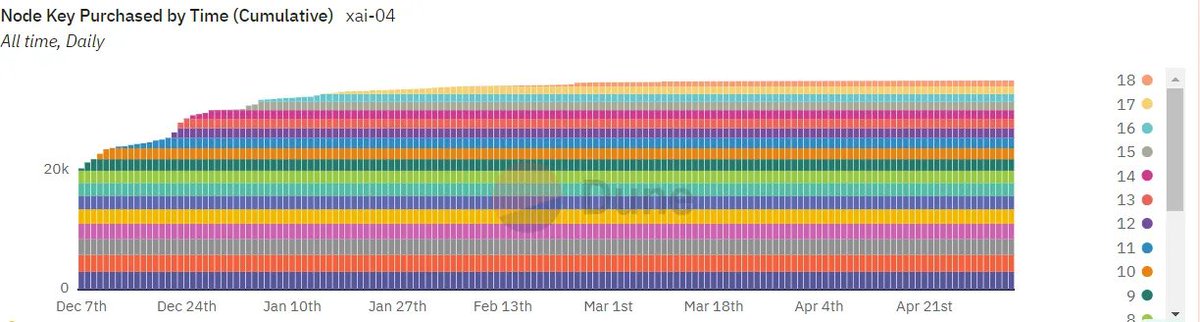
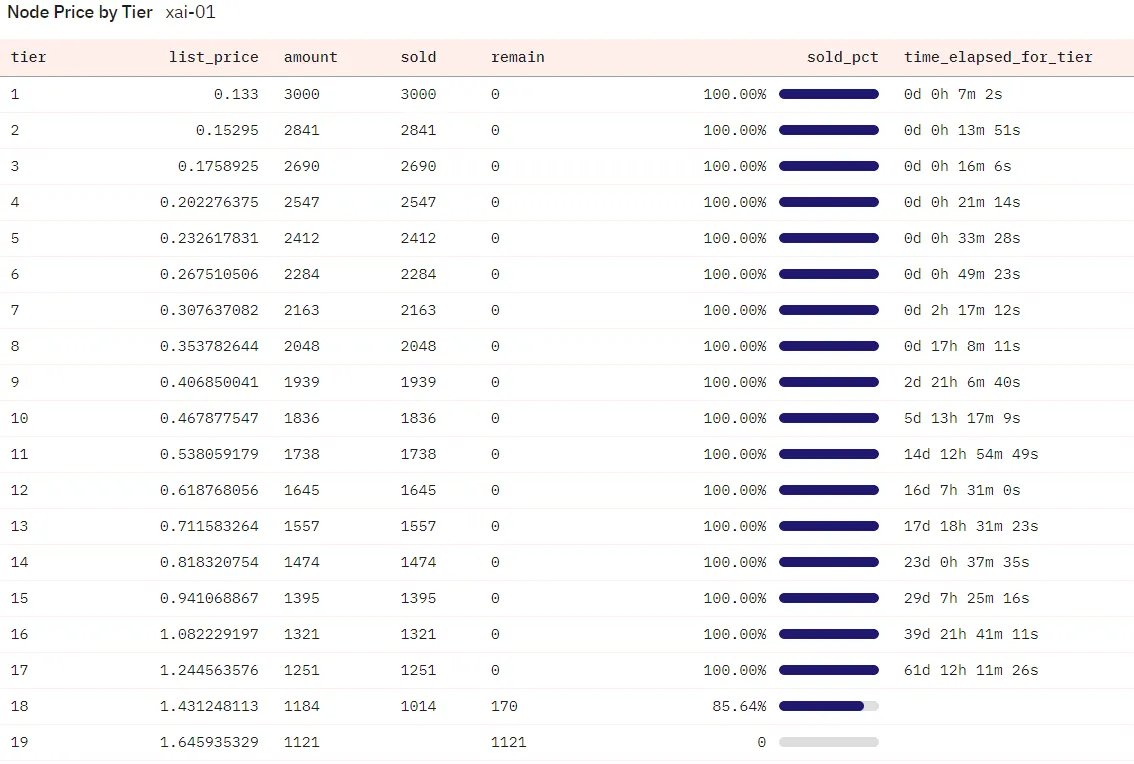
In node sales, Xai has sold 35,155 nodes, with sales amounting to 13,080 ETH, worth 40 million USD, and an average cost per node of 0.372 ETH. The node price has risen from a low of 0.133 ETH to 1.43 ETH, an increase of more than 10 times.
Aethir has sold 74,040 nodes, with sales amounting to 41,627 ETH, worth 130 million USD. The average cost per node is 0.56 ETH. The node price has risen from a low of 0.1259 ETH to 1.8232 ETH, an increase of 14 times.
Sophon has sold 121,261 nodes, with sales amounting to 31,087 ETH, worth 96 million USD. The average cost per node is 0.256 ETH.
In terms of node sales, XAI can be said to have started this round, and most of the projects for node sales are learning from XAI. However, XAI's data itself is not good, because when XAI was sold, the market conditions were not very hot. And because XAI was the first, many people had concerns about this form. Also, many people who participated in GALA nodes in 2021 have not yet broken even. However, after XAI was listed on Binance, the early node participants made substantial profits, bringing many users to projects that later conducted node sales.
Aethir's node sales not only benefit from the profit effect of XAI, but also coincide with the peak speculation in the AI sector. For other projects with good fundamentals, the potential outcome may lie between XAI and Aethir.
Summary
From the project perspective, Aethir, Sopon, and CARV are not in the same race, so they cannot be directly compared. However, each has its advantages. Aethir belongs to the AI sector and has scarce GPU computing power, which is currently the hottest sector. Sopon's project seems more like a quick gathering during the good market conditions. However, it is a project initiated by the original team of zksyc, with a very rich reputation and resources within the industry. CARV has been accumulating for many years, growing rapidly, and has a large number of users and ecosystem projects.
In terms of node sales, CARV is the most generous, with 25% of the total token rewards allocated to nodes, which is the most among the three, and 12.5% of the tokens will be released during the first year of the bull market, more than twice that of the other two projects.
In terms of sales, Sophon sold 30,000 ETH, Aethir sold 40,000 ETH. CARV is about to start, and it is expected not to be too bad. Everyone can use this as a reference.

免责声明:本文章仅代表作者个人观点,不代表本平台的立场和观点。本文章仅供信息分享,不构成对任何人的任何投资建议。用户与作者之间的任何争议,与本平台无关。如网页中刊载的文章或图片涉及侵权,请提供相关的权利证明和身份证明发送邮件到support@aicoin.com,本平台相关工作人员将会进行核查。


