Title: Upcoming Demand for Bitcoin Block Space and Its Impact on Mining Revenue, Author: Matthew Kimmell
Translator's Note: Perhaps what is different from all previous halving cycles is the change in the structure of miner income, which is jointly created by factors such as the future price space of BTC and the current development status of the Bitcoin ecosystem.
Image Source: Generated using DALL-E 3
Key Points
The Bitcoin halving will reduce the main source of income for miners. This leads to miners investing in more efficient machines and preparing for production losses.
It is expected that transaction fees will also significantly increase due to atypical use of Bitcoin block space. These fees are becoming a more important part of mining income, and may even offset the income reduction from the halving of block rewards.
Due to non-monetary use cases, there has been a recent surge in transaction demand for projects based on the Bitcoin network, such as on-chain markets, collectibles, and multi-layer platforms.
These projects have also paved the way for other new income strategies, such as Miner Extractable Value (MEV) and transaction accelerators, which take advantage of significant changes in the Bitcoin transaction market.
In the next halving period, transaction fees are likely to become the main source of miner income.
It is also very likely and reasonable that the upcoming growth in transaction demand may offset nearly half (~43%) of the impact of the halving on fee income.
Introduction
Everyone is waiting for the arrival of the Bitcoin block reward halving. While many in the community are celebrating, miners are more concerned as they face a significant reduction in mining income. As a result, as stories often unfold, miners have been actively preparing for the decrease in production. Installing more efficient machines, reducing debt, and optimistically hoping (begging?) for a surge in the market price of Bitcoin.
However, what if I told you that other factors in mining income this time around could significantly or even completely offset the impact of the halving? The historically insignificant transaction fees are likely to increase. And coincidentally, at the exact moment the halving takes effect, at the exact block, they begin to increase.
My prediction of a significant increase in fees is based on the motivations behind many changes in Bitcoin transactions. With new ways of using Bitcoin block space, a whole new realm for users, developers, and businesses with non-monetary use cases is forming, bringing higher differentials to the fee market. As we know, the simple peer-to-peer electronic cash system is taking on more complex settlement forms. This is not the first time, but it is happening at an unprecedented pace, to the point where these auxiliary use cases are becoming true players in the fee market.
Users are choosing to use external software that allows them to view Bitcoin from different perspectives. One such perspective is like putting on kaleidoscope glasses, allowing users to see the dispersed supply of Bitcoin in unique fragmented forms, rather than as a flowing ocean of homogeneous units. Another example is reading data files that can be attached to transactions, allowing users to claim ownership of various media tied to the coins they receive (think NFTs for clarity). And some are interpreting certain standardized messages in many transactions as the issuance or expenditure of external assets, observing any such transactions on the chain, and creating ownership tracking for a completely independent record system (think sidechains or main-chain-based L2, L3…).
This is unconventional. This is also controversial. But that is not the focus of this article. We will not discuss the right or wrong, good or bad of Bitcoin. This article will focus on the less-discussed part of mining income: transaction fees, and how the unusual demand vectors of Bitcoin transactions may potentially offset the income loss before and after the halving.
Unusual Demand Vectors for Bitcoin Transaction Demand
Standardization of Tokenized Assets
The initial efforts to introduce new assets into Bitcoin were creative but rough. Early experiments actually laid the foundation for popular Ethereum applications (and Ethereum itself), while highlighting certain challenges that ultimately stifled Bitcoin adoption.
Projects like Counterparty, Colored Coins, and Mastercoin (later rebranded as Omni) were significant innovations in the broader cryptocurrency space, leading to the birth and popularity of initial token offerings (ICOs) and decentralized exchanges (DEX), among several other pioneering technologies. However, they failed to gain widespread adoption and acceptance within the Bitcoin community. Unfavorable culture, scalability, and other technical issues, coupled with the competitive environment brought about by the rapid growth of these use cases outside the Bitcoin ecosystem, restrained their success. The adoption of these projects never truly took off and gradually faded from people's sight.
However, the demand for external assets is on the rise again. The new attempts have not addressed the challenges that hindered project development in the past, but the current market timing makes the situation different. Today, awareness of Bitcoin has become much more widespread, and there is an increasing amount of venture capital, and, albeit sounding foolish, the speculative frenzy around meme coins undoubtedly contributes significantly to this trend.
For whatever reason, or whether it is sustainable, we are seeing significant growth in transaction demand for some new Bitcoin token projects. For example, the BRC-20 assets, launched since March 2023, have spent over $180 million (4.8k BTC) in fees for issuance and transfers. These transactions account for nearly one-third (30%) of all Bitcoin transactions, and the fees generated since their release account for 17% of the total fees on the Bitcoin network.
This is particularly relevant to the fee market during the halving, as a new standard called Runes is being introduced, with significant initial demand and growing attention.
The future demand market value for Runes tokens exceeds $1.2 billion, already half of all BRC-20 assets, and the market has only been open since around November. It is worth noting that the issuance of Runes tokens must be done using Bitcoin transactions, and when BRC-20 assets were first issued, the fee level soared to over $16 per transaction and over 300 BTC per day.
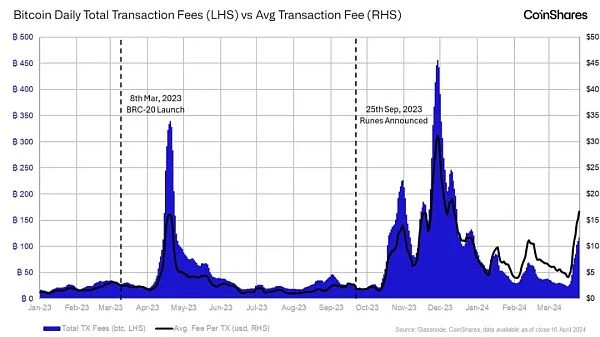
The potential impact is that when Runes tokens are released, there will be a significant amount of transaction demand on Bitcoin for the issuance of external assets, coinciding with the same block height as the halving. Meanwhile, other standards will not be abandoned with the introduction of Runes, as updates for BRC-20, Taproot Assets, and RGB are still ongoing.
If this transaction demand is similar to when BRC-20 was first released, fees are likely to reach 150 BTC per day, thus offsetting a full one-third of the mining income reduction caused by the halving.
However, Runes will not be the only catalyst for building transaction demand.
Collectibles
The Ordinals protocol has announced a method that allows users to voluntarily agree to a tracking system for the smallest unit of Bitcoin, called a satoshi (equal to 0.00000001 or 10^-8 BTC). According to the Ordinals protocol, each unit is assigned an ordinal number. By adopting such a standard, every subdivision of Bitcoin is marked and identified along a continuous numerical line, from the first minted satoshi to the last. In other words, when Bitcoin units are viewed in this way, each satoshi becomes a unique non-fungible unit.
By choosing to join, users can also embed additional uniqueness by attaching any data file to any unit, called an inscription. These files are called inscriptions. Users can mix inscriptions with any satoshis they own, while retaining the ability to transmit and store such modified satoshis on the Bitcoin network, similar to regular BTC.
As a result, many tiny units of Bitcoin have now been designated as images, text, or even complete video game files, giving them unique distinctions from each other and providing investors with reasons to value originally fungible Bitcoin units in different ways, based on their digital significance or related inscriptions.
As far as we know, the highest price for a satoshi in an auction to date was $240,000, with the inscription "Genesis Cat," hailed as a culturally and politically significant 1/1 artwork. It is part of a series of similar inscriptions aimed at symbolizing and supporting the restoration of features previously removed from the Bitcoin protocol. Another satoshi without an inscription was sold for $165,100, and its rarity is attributed to its origin tracing back to the first difficulty period of Bitcoin.
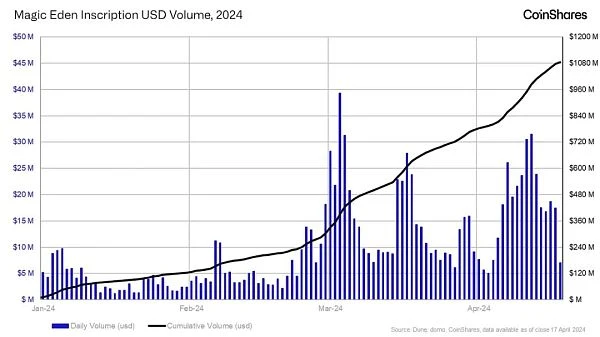
The evidence of these sales is encouraging for those seeking expensive satoshis. The purpose of trading Bitcoin units in the secondary market at prices far above their usual market value is to change the tendency of certain users to pay transaction fees. It can be said with certainty that the purchasing power of acquiring a satoshi could reach hundreds of thousands of dollars, making fee bids much higher than most peer-to-peer transactions.
Given that the halving is a completely predictable and scarce event in Bitcoin history, there will inevitably be competition in collecting satoshis and inscribing the first block. The demand for the first batch of minted satoshis after the halving is expected to be very valuable, to the extent that the Foundry USA mining pool even plans to share its earnings with miners if they are lucky enough to win a block. It may be temporary, but this intense competition is almost certain to lead to a surge in fees.
Privacy Transactions
Another possibility of atypical demand is transaction accelerators. Marathon launched a product called Slipstream in late February, which opens up a pathway for bypassing Bitcoin's mempool (native transaction waiting room) by allowing users to communicate directly with the MARA Pool and pay for transactions. While this product does not offer sustainable advantages in earning fees compared to other mining pools, there have been several successful examples.
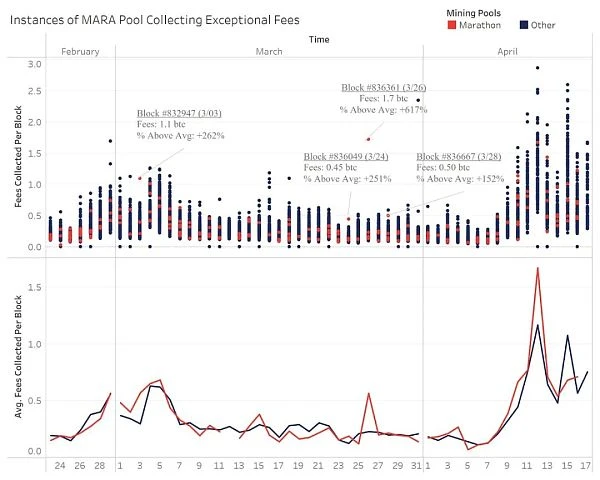
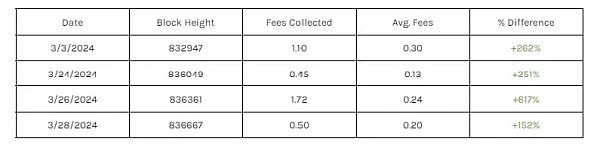
Although accelerators like Slipstream are not widely popular, they have the potential to indirectly increase transaction fees if there is enough demand. If transactions are submitted directly to the pool, they are not known to any other Bitcoin users in advance. Therefore, users may find that their transactions, the next ones to be processed, actually have to continue waiting because those directly submitted to the pool are quietly included. This may confuse consumers about how much exact fees should be attached to encourage timely transaction processing. With enough transactions flowing to these accelerators, a multilateral fee market emerges, one that is public as part of the Bitcoin protocol and one that is private.
In extremely urgent situations, users may choose to pay fees far above the actual expected market value. This blurred fee market could lead to an increase in fees. We have not seen this situation truly occur at any meaningful scale, but it is certainly worth noting.
Miner Extractable Value (MEV)
MEV is another emerging dimension of Bitcoin block space demand. MEV refers to the opportunity for miners to earn additional profits by manipulating the order of transactions within a block. Previously, MEV was primarily a potential feature of Bitcoin, often limited due to its stricter nature and simpler transaction model. However, with changes in Bitcoin software and changes in the way some users conduct Bitcoin transactions, the potential vectors of MEV will become more apparent, as mentioned in this article. Here is a brief explanation:
Collectibles: High-value tags for certain inscriptions and satoshis, as well as market inefficiencies in technology, lead to additional fees earned through purchasing or "sniping" and reselling mispriced market items, and sacrificing fees to chase higher-value satoshis for additional earnings.
Tokenized Assets (Runes, BRC-20, RBG, Taproot Assets, and possibly other assets): The above protocols provide fungible assets, opening the door for miners to engage in front-running and arbitrage transactions for additional rewards.
Bitcoin Plugins: With the rise of more external platforms, or so-called "Layer2," and the use of Bitcoin for settling value, miners may be able to exploit early design flaws and additional incentives to earn higher income.
Once again, the halving means another reduction in block rewards and a relative increase in the importance of transaction fees for miners. This may provide additional motivation for miners to pursue interests related to transaction selection and seek diversified income streams. As hired guns in a highly competitive industry, we believe that MEV strategies will be at least attempted.
The Increasing Relationship Between the Fee Market and Miners
The diversification of Bitcoin transaction demand may play a redeeming role in the mining economy. With the halving event reducing block rewards, these new uses of Bitcoin block space may significantly increase transaction fees. This is crucial for miners, as these fees can offset the loss of block rewards and maintain their profitability.
As mentioned earlier, the recent increase in fees will be driven by intensified competition in new niche markets, including the issuance of external assets and the search for unique collectibles. These applications not only bring additional transaction fees but may also encourage a more strategic approach to transaction processing.
Ultimately, the shift to a more complex and fee-dependent economic model highlights the importance of understanding and leveraging new demand carriers to remain competitive.
Looking ahead, the current level of transaction fees is expected to account for around 14% of post-halving mining income, a figure that is several times higher than in the past few years. However, I expect this percentage to become even higher, far exceeding 50% in certain blocks. During a two-month period at the end of 2023, this was mainly driven by high demand for inscriptions, with average fee levels accounting for 30% of post-halving mining income. If this average is repeated (193 BTC per day), it will cover 43% of the impact of the halving.
Given the current trajectory, transaction fees may become the main source of miner income in this halving period, which is entirely reasonable. However, the sustainability of these non-monetary demand-driving factors remains a pending question, whether they are leading to a long-term shift in the Bitcoin transaction market or just a short-term symptom of a bull market. Only time will tell.
免责声明:本文章仅代表作者个人观点,不代表本平台的立场和观点。本文章仅供信息分享,不构成对任何人的任何投资建议。用户与作者之间的任何争议,与本平台无关。如网页中刊载的文章或图片涉及侵权,请提供相关的权利证明和身份证明发送邮件到support@aicoin.com,本平台相关工作人员将会进行核查。