Original Author: Jaleel
The success of competitors often makes people feel cold.
As a crypto social platform long favored by Vitalik, Lens always seems to be compared with Farcaster by the community and users. And now, Farcaster has rapidly grown into a phenomenal crypto social platform in the short term.
Starting in January this year, Degen quickly gained popularity in the Farcaster community, and community members rewarded high-quality content they appreciated by adding the "DEGEN" tag in the comments. The Degen system determines the daily reward amount based on the user's activity and participation on Farcaster, incentivizing users to post valuable content on the platform. Many active users' daily rewards even reach thousands of dollars.
Related reading: "10 billion USD in three months, reviewing the growth of 'golden dog' Degen"
As of April 8th, according to Dune data, the decentralized social protocol Farcaster's total revenue has exceeded 1 million USD, and the number of users is about to exceed 300,000. In the past 30 days, users have posted an average of over 407,000 casts per day. Vitalik Buterin, who frequently used the main social platform, has also shifted from Twitter to Farcaster.
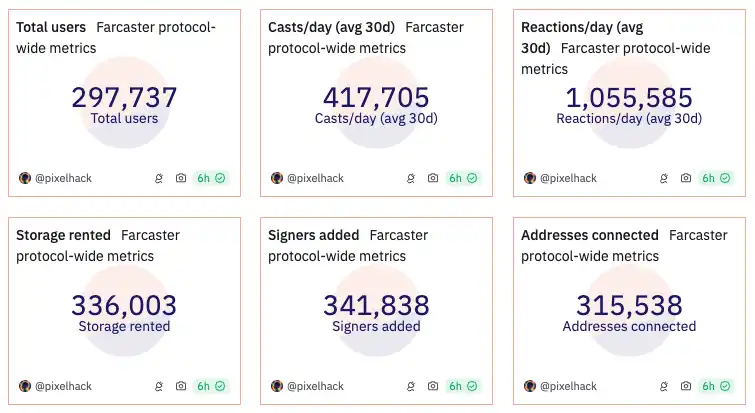
On the other hand, Lens, although its data has reached new highs since officially entering the permissionless stage, it still lags far behind Farcaster in terms of discussion and community enthusiasm, causing anxiety for Lens.
Does Lens also need to create its own DEGEN?
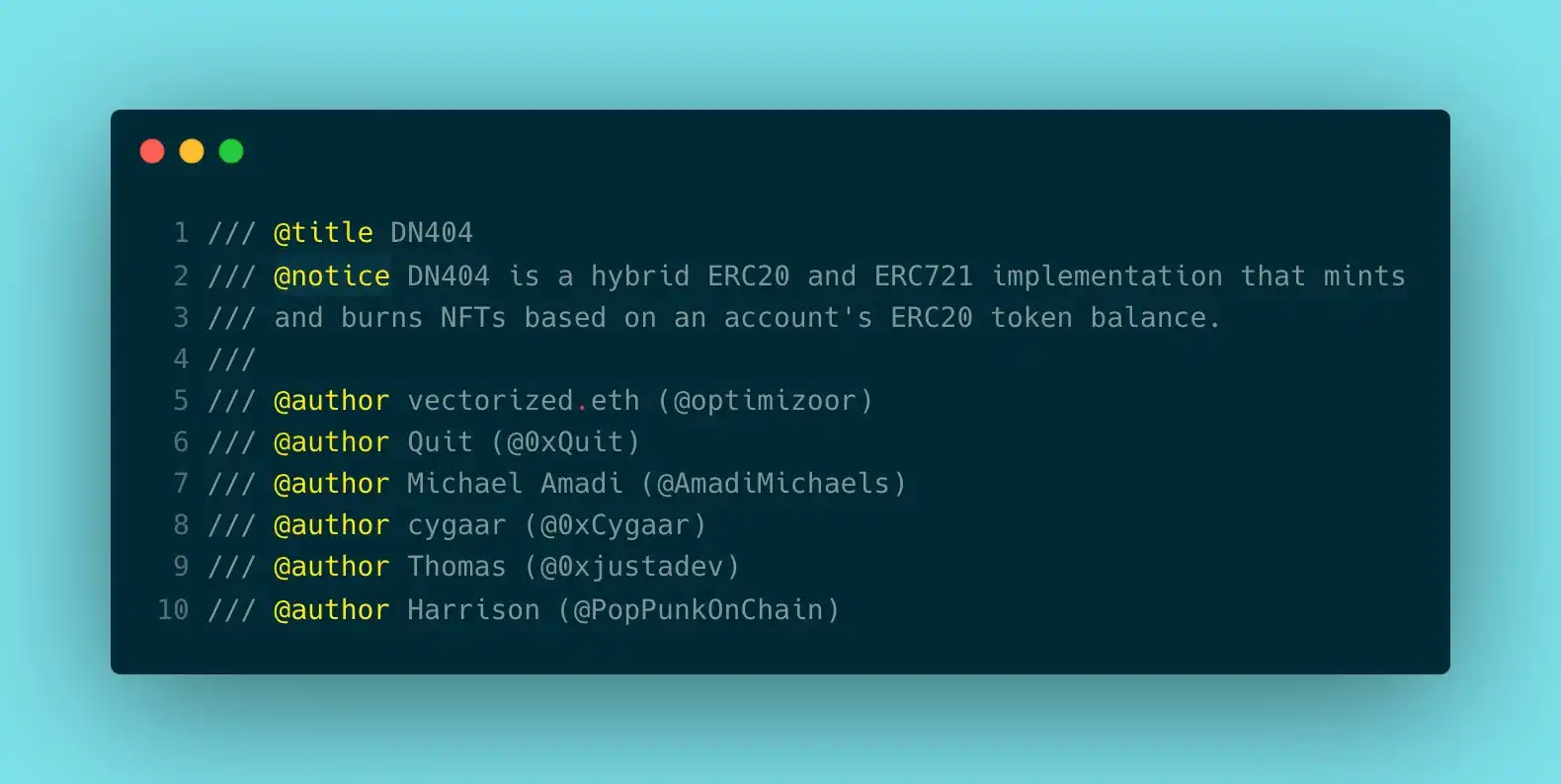
On March 6th, active users of the Lens platform were pleasantly surprised to find that they had received an airdrop of a new token called BONSAI in their wallets, with the airdrop price at that time being around 50 USD. This BONSAI token, based on the Polygon network, is a model of the DN404 token, marking the launch of the first 404 project on Polygon, similar to the Pandora_ERC404 project. 100,000 BONSAI tokens can be exchanged for a Bonsai NFT.
The "divisible NFT" standard followed by BONSAI (DN404) attempts to combine the characteristics of ERC20 and ERC721 tokens, creating a new hybrid token standard. Although ERC404 has quickly gained attention in the crypto world, it has sparked some controversy due to not conforming to existing standards and being inefficient, and may even fail in specific situations, while BONSAI seems to be able to solve this problem.
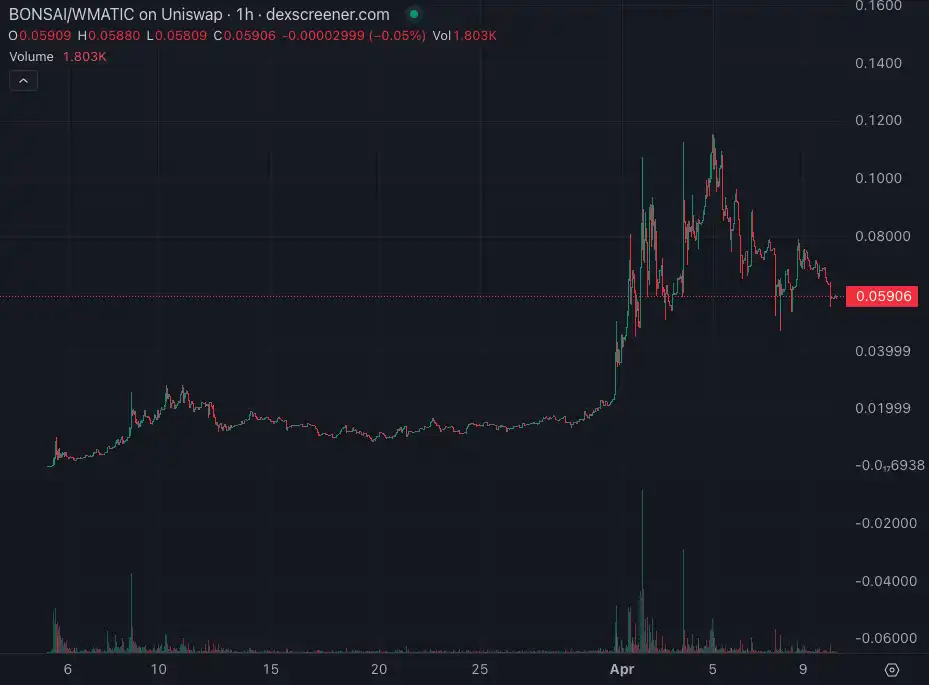
A month has passed, and the performance of the BONSAI token is remarkable, with prices continuing to rise. Although the price of BONSAI has fallen from its peak due to the orb platform continuing its airdrop activities, early users' airdrop value has still increased to 3,000 USD.
This significant growth is partly due to the active promotion of BONSAI by Stani, the founder of the Lens platform, on social media. Stani not only promoted the visibility of BONSAI through traditional means of publicity but also leveraged his influence in the crypto community to shape BONSAI as the main economic vehicle for creators on the Lens platform.
Now, when users reward and incentivize creators on the Lens platform, most people default to using BONSAI as the payment method. This change in behavior not only strengthens the use case of BONSAI within the platform but also sparks widespread attention and discussion, gaining popularity in a small circle.
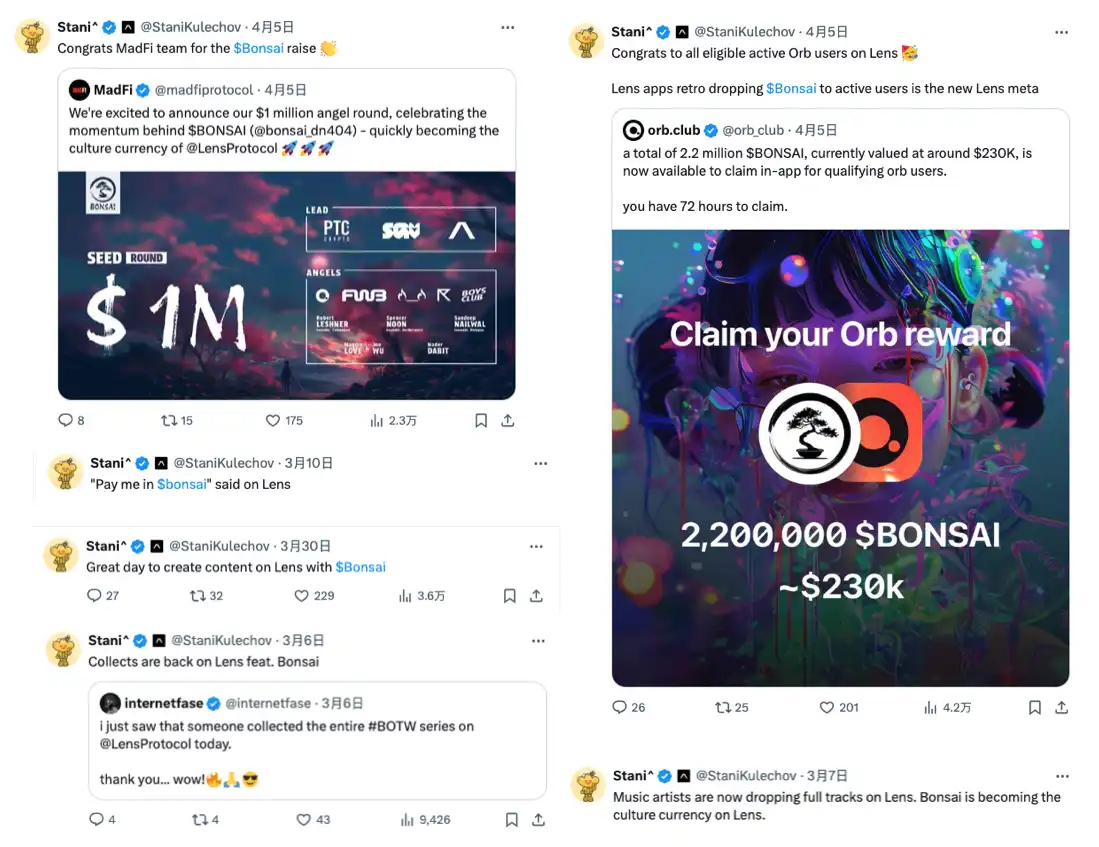
The development team behind BONSAI, MadFi, aims to encourage users to join specific content social clubs and subscribe to favorite creators on crypto social platforms through a social media reward mechanism. Recently, MadFi successfully completed a $1 million angel round of financing, with lead investments from Palm Tree Crew Crypto, Avara Ventures, and Social Graph Ventures, as well as support from multiple angel investors including Robert Leshner, Spencer Noon, and Sandeep Nailwal.
The MadFi team stated that the BONSAI token is experiencing organic growth, and creators have earned over 240,000 USD worth of tokens through the platform, making it the preferred currency after wMATIC. On the Lens platform, Bonsai's market share of monetized publications exceeded 75% in March, reaching a peak of 90% last week.
According to the team, BONSAI has been experiencing organic growth, with creators earning over 240,000 USD worth of tokens, surpassing wMATIC as the preferred currency for monetizable content.
In March, Bonsai's market share of monetized publications on Lens exceeded 75%, reaching a peak of 90%. As of the time of writing, the current share is 73.8%.
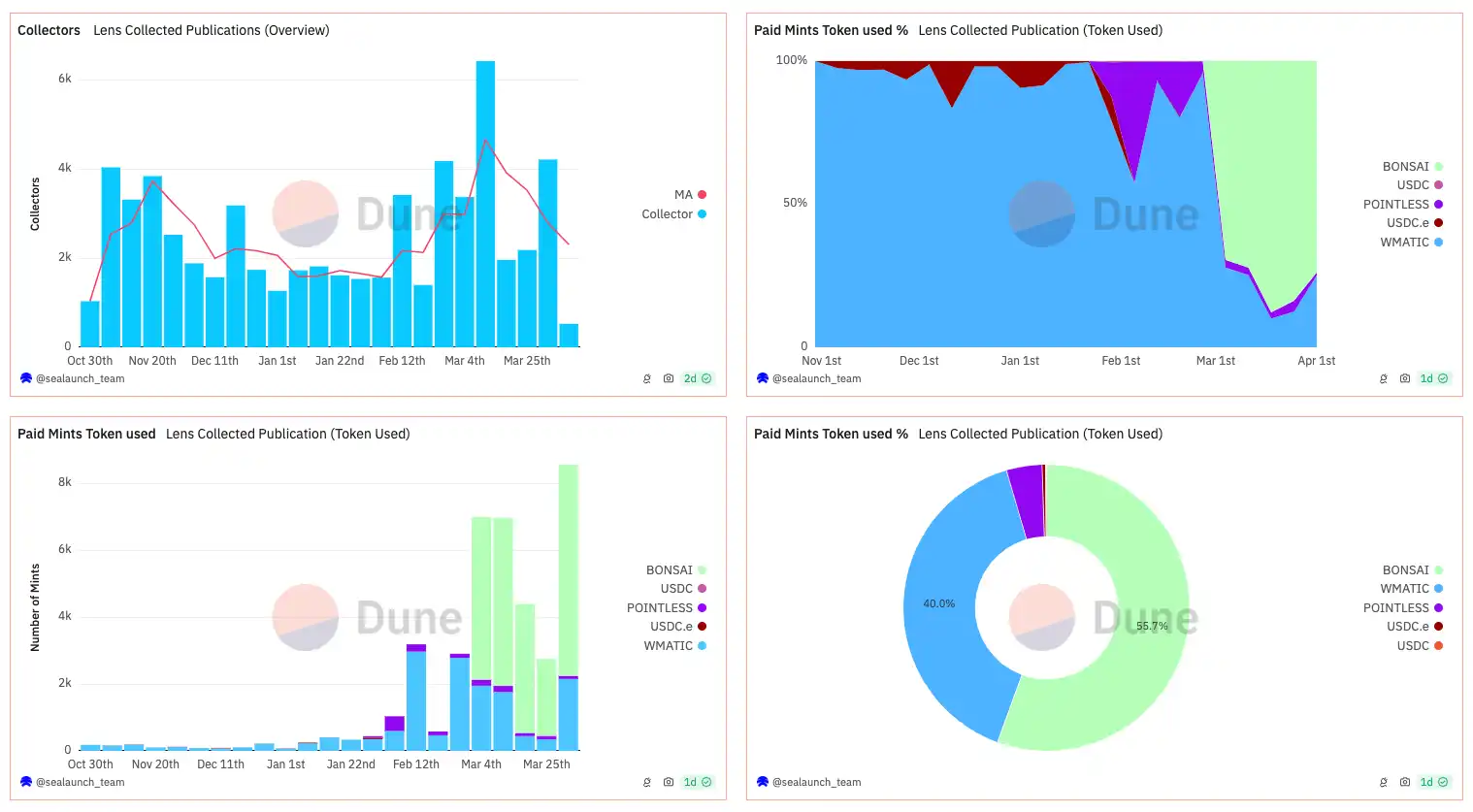
Carlos Beltran, co-founder and CEO of MadFi, shared his excitement about BONSAI becoming the default currency on the Lens platform. "The success of BONSAI demonstrates the huge potential of combining on-chain networks with high-quality content."
Recently, orb.club announced a total airdrop of 2.2 million BONSAI tokens, worth about 230,000 USD. Eligible orb users can now claim this airdrop within the app, with a 72-hour claim window.
With the joint efforts of multiple parties, BONSAI's positioning has become the Degen of Farcaster. As of the time of writing, Degen's fully diluted valuation (FDV) has reached as high as 1.3 billion USD, while BONSAI's FDV is 63.1 million USD. This comparison shows that, relative to other tokens in the market, the Lens platform and BONSAI itself still have huge growth potential and space.
On April 27th last year, Lens Protocol announced the launch of an Optimistic L3 scaling solution called Bonsai, specifically designed to handle large-scale transactions and support the needs of the next generation of Web3 social users. This solution is technically similar to Degen's L3 chain extension solution, but the day after its launch, Bonsai was renamed Momoka, continuing its mission to handle ultra-large-scale transactions.
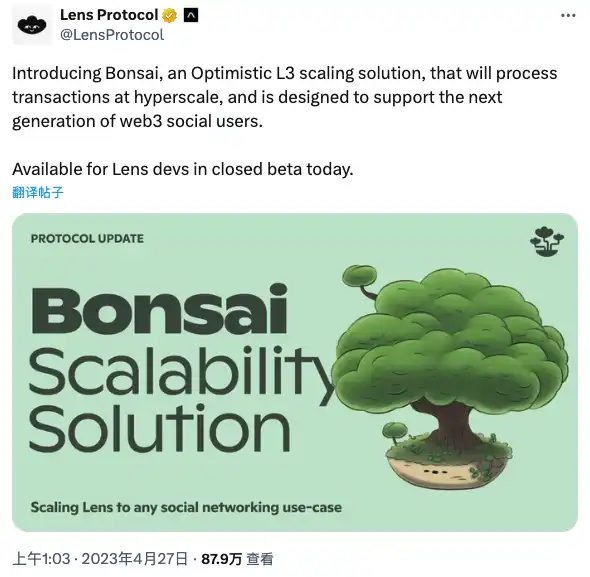
Bonsai (later renamed Momoka) is different from traditional L2 solutions in that it does not compress transactions back to the L1 layer, but optimizes a new way to send and store these transactions on a dedicated data availability layer. This unique approach allows Momoka to effectively scale processing capacity without sacrificing speed and cost.
To ensure the scalability of this scaling solution, Lens Protocol has partnered with Bundlr Network and the Arweave Ecosystem team to provide data availability (DA) guarantees. This collaboration enables wallets supported by the Ethereum Virtual Machine (EVM) to store DA logic and facilitate the rapid and reliable release of data.
Momoka has begun testing in several key applications within the Lens ecosystem, including Lenster, Lenstube, orb, Buttrfly, and Phaver. These tests not only validate the effectiveness of Momoka as an innovative scaling solution but also demonstrate Lens Protocol's commitment to driving the development of Web3 social platforms.
Through Momoka, Lens Protocol aims to build a robust foundation that supports the future needs of Web3 social networks, capable of handling ultra-large-scale transactions while reducing operational costs and driving the development of the entire ecosystem.
Reviving "Zombie Users"
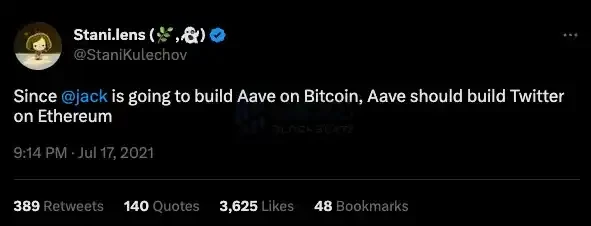
In July 2021, Jack Dorsey hinted that Square would create a new business to build a platform for "non-custodial, permissionless, and decentralized financial services." Stani Kulechov believed that this description was very close to what Aave was doing, and quoted Jack Dorsey's tweet, jokingly saying, "Since Jack Dorsey will build Aave on Bitcoin, Aave should also build Twitter on Ethereum." This hinted at the birth of the Lens Protocol, and at the subsequent LisCon conference, Stani once again teased this social graph project.
In February 2022, Stani publicly released the Lens Protocol on Twitter in the form of a signed open letter, and after testing, it officially launched on the Polygon mainnet in May of the same year.
A statement on the Lens official website summarizes the features of Lens very well for users, "With Lens Protocol, everything is in your control. You own your profile, where you use it, how you use it, and even how you profit from it. This means you have control over your content, and it exists as an NFT in your wallet. It's not just easy. It's what digital identity should be: all yours."
Because users own their data, they can bring it to any application built on the Lens Protocol. As true owners of the content, creators no longer need to worry about losing content, audience, and livelihood due to the whims of individual platform algorithms and policies. In addition, every application using the Lens Protocol benefits the entire ecosystem, transforming zero-sum games into collaborative games.
After two years of testing and development, the Lens Protocol announced on February 27th that it had officially entered the permissionless stage, allowing anyone to create a Lens profile to access the protocol, and developers can create new use cases by leveraging the budding community on the network.
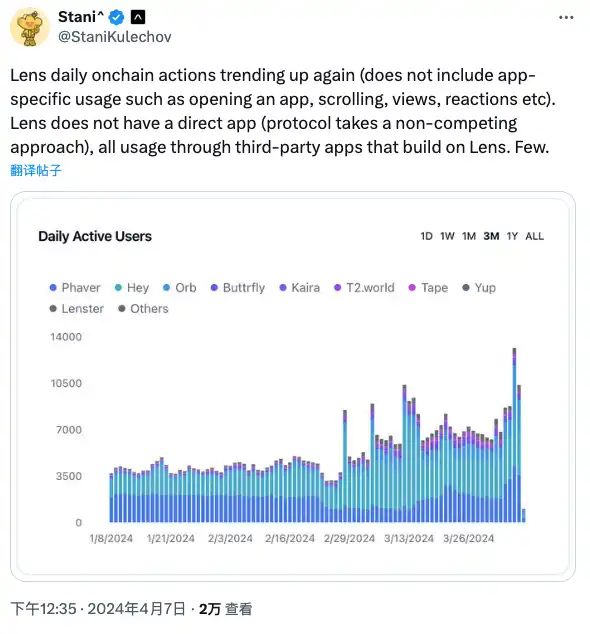
After the opening, Lens's daily on-chain operations show an upward trend (excluding application-specific usage such as opening applications, scrolling, viewing, reacting, etc.). It is worth noting that Lens does not have direct applications, and all usage is done through third-party applications built on Lens.
Although the daily on-chain operations data show an upward trend, Lens Protocol still lags behind Farcaster by an order of magnitude in terms of scale and user data.
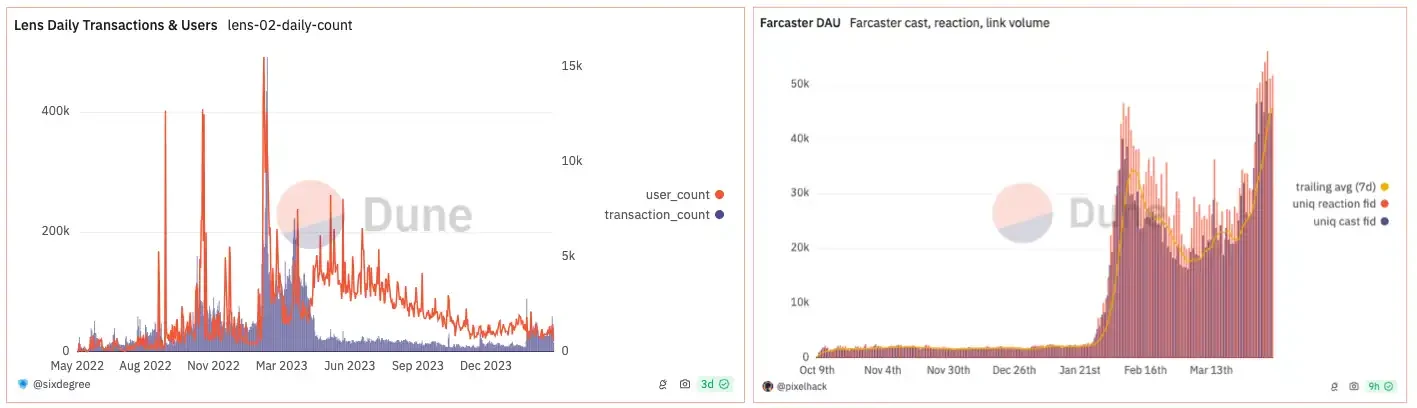
Left: Lens daily active user data; Right: Farcaster data
According to Dune data, the recent number of active users of the Lens Protocol is approximately 15,000, with only 1,200 daily active users. In comparison, Farcaster's performance is particularly outstanding, with the number of daily active users increasing by over ten times since 2024, reaching between 20,000 and 40,000 daily active users. A significant proof of this growth is that even Vitalik Buterin, the founder of Ethereum, has chosen to publish multiple exclusive articles on Farcaster.
Farcaster's success in attracting users and heavyweight figures highlights the need for Lens to invest more effort in increasing user activity and expanding the community. As a platform dedicated to building decentralized social networks, the Lens Protocol has unique value propositions and technological advantages, such as providing decentralized identity verification, supporting content creators, and rewarding community contributions. However, compared to Farcaster, Lens still has a long way to go in increasing daily active users and attracting public attention.
To narrow the gap with Farcaster, the strategies devised by Stani for Lens are crucial. By launching the Bonsai airdrop token, Lens can bring back users who joined last year due to economic expectations such as airdrops and "coin airdrops," allowing more early users to return.
In this process, Bonsai plays an important role in continuously adding value circulation to the protocol. Its continuous "rainbow sucking" effect—continuously attracting interest and resources within the community and ecosystem—is key to narrowing the gap with and even leading the competition. Through Bonsai, the economic incentives of Lens can strengthen community cohesion, promoting interaction and collaboration within the ecosystem.
In the short term, Bonsai does indeed stimulate the revival of more "zombie users," but in the long term, Lens still faces many challenges in building a community culture that can rival Farcaster and degen.
免责声明:本文章仅代表作者个人观点,不代表本平台的立场和观点。本文章仅供信息分享,不构成对任何人的任何投资建议。用户与作者之间的任何争议,与本平台无关。如网页中刊载的文章或图片涉及侵权,请提供相关的权利证明和身份证明发送邮件到support@aicoin.com,本平台相关工作人员将会进行核查。