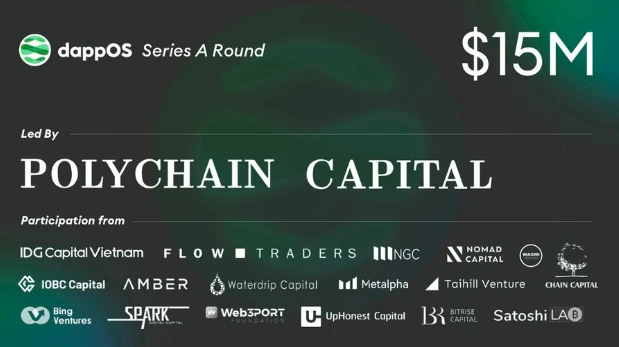
The rapid expansion of blockchain technology has brought both opportunities and challenges in achieving scalability and usability in an increasingly fragmented ecosystem. The intent execution network (dappOS) has innovatively introduced the Optimistic Minimum Staking mechanism to improve interaction efficiency at low cost and securely in a fragmented ecosystem.
At the end of March 2024, dappOS raised $15.3 million in a Series A financing led by Polychain, with a valuation of $3 billion. Prior to this, dappOS completed a seed round of financing, receiving investments from well-known institutions such as Binance Labs and Sequoia China.
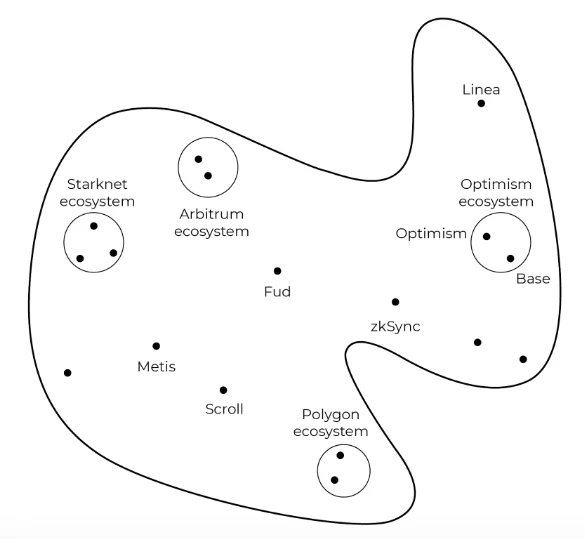
Vitalik, the founder of Ethereum, proposed in his keynote speech at the 2024 Hong Kong Web3 Carnival that the future Ethereum ecosystem will be Layer-2 Centric.
As blockchain technology continues to develop, usability and scalability are the current focus of infrastructure. The rise of numerous L1 and L2 signifies the beginning of a new era. L1 blockchains are foundational networks, such as Bitcoin and Ethereum, where all transactions are processed directly on the chain. However, with the growth of these networks, congestion and scalability challenges have emerged.
L2 solutions, such as Bitcoin's Lightning Network and Ethereum's OP Rollups, aim to alleviate scalability issues by processing transactions off-chain while ensuring their security is still guaranteed by the underlying L1 blockchain.
However, the prosperity of L1 and L2 has also brought new problems, such as the fragmentation and isolation between blockchain ecosystems. Additionally, the high valuations of L1 and L2 blockchains may lead to the emergence of new blockchains, attracting significant investments. This growth is expected to further fragment the Web3 ecosystem, making usability and interoperability a daunting task.
The emergence of decentralized applications (DApps) such as Web3 games and Web3 social networks is attracting users from the traditional Web2 world. These new users, unaccustomed to the complexity of blockchain technology, seek simplified workflows and intuitive interfaces. Therefore, a solution and infrastructure that meets their usage habits is extremely necessary.
dappOS: $15.3 million financing, launching the intent execution network
In response to the urgent need for simplified, user-centric infrastructure, a solution has emerged to bridge the gap within the fragmented ecosystem. As an intent execution network, dappOS has secured a $15.3 million investment in a Series A financing led by Polychain, with a company valuation of $3 billion.
This round of financing led by Polychain includes contributions from a diverse group of investors, including Nomad Capital, IDG, Flow Traders, and NGC. This funding will be used for further technical research and development.
Previously, dappOS was selected for the 5th season of the Binance Incubation Program in December 2022 and received seed round investments from Binance Labs and Sequoia China in July 2023.
The project addresses supply and demand issues within the blockchain ecosystem by creating a bilateral market. On one hand, service nodes stake collateral to provide various intent execution services. On the other hand, it provides developers with an infrastructure to efficiently generate intent tasks to meet the demand of users converting intent into on-chain results.
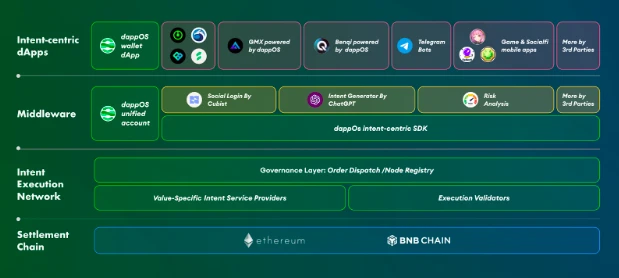
Innovative security solution OMS
To improve efficiency and generality, dappOS has introduced the OMS (Optimistic Minimum Staking) mechanism.
OMS requires each task to be associated with a predefined value and potential compensation in case of failure, allowing tasks to be executed before the results are verified. If a task fails, the network penalizes the responsible service provider through a consensus process, ensuring that either the user's submitted task is successfully executed or the user receives the predetermined compensation.
dappOS's OMS system benefits both service nodes, as they only need to stake slightly more than the minimum collateral value of uncompleted intent tasks, and users, who enjoy cost-effective and rapid task execution. The post-task verification process promotes decentralized verification strategies, enhancing the network's efficiency and security in handling diverse use cases.
With over 20 in-depth collaborative projects, including GMX, BENQI, and QuickSwap, dappOS has accumulated over 350,000 users.
In the rapidly expanding blockchain ecosystem and its complexity, dappOS provides a smooth, user-centric blockchain interaction solution. Its innovative approach promises to redefine the interaction between users and developers in the increasingly fragmented blockchain networks and application scenarios.
免责声明:本文章仅代表作者个人观点,不代表本平台的立场和观点。本文章仅供信息分享,不构成对任何人的任何投资建议。用户与作者之间的任何争议,与本平台无关。如网页中刊载的文章或图片涉及侵权,请提供相关的权利证明和身份证明发送邮件到support@aicoin.com,本平台相关工作人员将会进行核查。


