Preview of the Week (3.18-3.24), the Bank of Japan raised interest rates for the first time in 17 years, what impact will it have? With one month left until the BTC halving, can it break the pullback curse?
○/Author: Lao Li Mortar
Table of Contents for This Week's Research Report:
- Preview of key macroeconomic data and events in the cryptocurrency market this week;
- Review of key news in the cryptocurrency industry;
- Community interaction and sharing;
- Interpretation of important events, data, and research institute;
- Institutional perspectives + overseas perspectives;
- Top gainers in the cryptocurrency market last week and selection of hot community coins;
- Attention to project token unlock negative data;
- Top gainers in the cryptocurrency market concept sectors;
- Overview of global market macro analysis;
- Post-market judgment by the research institute.
1. Preview of key macroeconomic data and events in the cryptocurrency market this week:
March 18th (Monday): NVIDIA will hold the GTC2024 conference from March 18th to 21st, releasing the latest breakthroughs in accelerated computing, generative AI, and robotics; Arbitrum activates additional fee waivers; ether.fi opens for airdrop collection.
March 19th (Tuesday): NVIDIA CEO Jensen Huang delivers a keynote speech; US February new home construction; Bank of Japan policy interest rate.
March 20th (Wednesday): European Central Bank President Lagarde delivers a speech; Tokyo stock market closed; Reddit plans to price its IPO with a target price of $31 to $34.
March 21st (Thursday): The Federal Reserve announces interest rate decisions; Powell holds a monetary policy press conference; Eurozone March manufacturing PMI; US March Markit manufacturing PMI; AMD holds the "AMD AIPC Innovation Summit" in Beijing; Opentensor Foundation announces the Bittensor roadmap.
March 22nd (Friday): Japan's February core CPI.
March 23rd (Saturday): The 2024 Global Developers Pioneer Conference (GDC) will be held in Shanghai.
2. Review of key news in the cryptocurrency industry (exclusive summary):
Data:
Recently, the cryptocurrency market has presented a series of noteworthy data. If ETH falls to $3,008, it may trigger liquidations of up to $24 million, highlighting the volatility and potential risks of the cryptocurrency market. Meanwhile, GBTC saw a single-day outflow of $642 million, setting a record for the largest single-day capital outflow, indicating a waning enthusiasm among investors for Bitcoin. On the other hand, IBIT added 33,000 bitcoins weekly, indicating continued strong institutional demand for cryptocurrencies. These data provide us with real-time dynamics of the cryptocurrency market, helping us better understand and grasp market trends.
Projects and platforms:
Coinbase's allies have joined the lawsuit against the US Securities and Exchange Commission, a move that may have far-reaching implications for the regulatory environment of the entire cryptocurrency industry. Additionally, Bitcoin spot ETFs saw large net outflows, and blockchain concept stocks experienced a widespread decline, reflecting market sentiment fluctuations. Furthermore, Solana's market cap surpassed BNB, and RuneStone became the fourth largest NFT by market cap, reflecting the continuous development and evolution of the cryptocurrency ecosystem. The trading volume of the Bitwise Bitcoin ETF reached a record high, and the Ethereum Dencun upgrade was completed, further promoting the maturity and popularization of the cryptocurrency market.
Macro policies and regulations:
Insiders revealed that relevant departments seized billions of dollars' worth of cryptocurrency assets awaiting sale, sparking market attention to regulatory policies. Meanwhile, a Bloomberg ETF analyst pointed out that a spot Ethereum ETF will not be approved in May, which may impact investor expectations. In addition, Vanguard's CEO's comments on Bitcoin volatility and the judge's ruling on Craig Wright's identity show the regulatory stance on the cryptocurrency market. These policy and regulatory trends will have a significant impact on the future development of the cryptocurrency market.
Institutional research reports and perspectives:
Major financial institutions and experts have varying views on the cryptocurrency market. Standard Chartered Bank's forecast for Ethereum and spot Ethereum ETF shows optimism towards the cryptocurrency market. Bitwise's Chief Investment Officer believes that the drastic price fluctuations of cryptocurrencies have significantly decreased over the past decade, which may help boost investor confidence in cryptocurrencies. However, institutions like Vanguard express concerns about Bitcoin's volatility, believing it is not worth long-term investment. In addition, Bloomberg's report on strong demand for MEME coins and VanEck's forecast for the scale of the Ethereum ETF provide us with in-depth insights into different aspects of the cryptocurrency market. These research reports and perspectives help us gain a more comprehensive understanding of the current situation and future trends in the cryptocurrency market.
3. Community interaction and sharing:
Regarding the relatively weak market response to the positive news of the Ethereum Cancun upgrade and the recent weak trend of ETH, we have shared some insights in the community: The main reason is that the delay of the Ethereum ETF and the realization of the Cancun upgrade's positive effects led to negative sentiment. It rose quite a bit before the upgrade, or surged quite a bit. The Shanghai upgrade and the merger of ETH2.0 were also very flat, with almost no fluctuation after a slight shake. In comparison, there was a significant rise before the Cancun upgrade, nearly 88% in less than twenty days. In normal financial markets, it is common for expectations to rise in advance, and the actual announcement is a positive effect turning into a negative sentiment. It's the so-called "buy the rumor, sell the fact," or in other words, buy the expectation, sell the reality.
"Buy the rumor, sell the fact" is a common investment strategy in financial markets, with the core idea being that when news or events have not been officially confirmed or widely recognized, the market often experiences fluctuations due to expectations and speculation, allowing investors to buy related assets based on expectations. When the news or event becomes a reality, the market reaction tends to become rational, and the price of the related assets may return to normal levels or undergo adjustments, allowing investors to choose to sell.
Specifically, this phenomenon can be understood from several aspects. Market expectations and uncertainty: In financial markets, news and events often affect asset prices. When there are rumors or expectations about a company, policy, or economic data in the market, investors make trading decisions based on this information, leading to price fluctuations of related assets.
Emotion-driven trading: In the rumor stage, market sentiment often dominates. Investors may be influenced by optimistic or pessimistic expectations, leading to buying or selling decisions. This emotion-driven trading often causes prices to deviate from their fundamental value.
Fact and price adjustments: When rumors become reality, market sentiment may have weakened, and investors begin to focus on actual data and impacts. At this point, prices often adjust based on the facts, returning to a more reasonable level.
Profiting from market fluctuations: Investors can capture profit opportunities in market fluctuations by using the "buy the rumor, sell the fact" strategy. They buy assets during the rumor stage and sell after the fact is announced to profit from the price difference.
However, this strategy also carries certain risks. Not all rumors come true, and investors need to have the ability to judge information and tolerate risk. Additionally, market reactions may also be unexpected, leading to potential losses for investors. Therefore, when using this strategy, investors need to carefully analyze the market situation and make decisions based on their investment goals and risk tolerance.
In summary, "buy the rumor, sell the fact" is a trading strategy based on market expectations and uncertainty. Investors need to fully understand the market situation, analyze information rationally, and make investment decisions cautiously.
4. Interpretation of important events and data by the research institute:
The topic of SOL surpassing ETH is being discussed again, and we have already had many discussions on this last year. Here, we would like to share it with everyone again.
Our research institute believes that the recent strong rise of SOL may have been too dazzling, leading some speculators to have unlimited fantasies and "to the moon" illusions. Last year, there was an interesting viewpoint, which we also share here. Well-known angel investor Santos stated that Solana will eventually surpass Ethereum and have an 80% probability of doing so in this cycle. With the growth of capital inflows and the overall market value of the cryptocurrency market, the price of SOL may rise again, and the exchange rate of SOL to ETH may eventually equal 1:1. The above content represents Santos' personal opinion, and we believe that as a well-known angel investor, his views may have some reference value for market investors, but there are also many limitations.
Firstly, the previous rise of SOL was due to the overall outstanding performance of the Solana ecosystem driven by the DePin concept. From the increase in Google search volume, the performance of this asset coincides with the surge of meme coins. The concept of SOL chain inscription forging is hot, pushing SOL to rise to above $126 and surpassing Ripple and BNB in market value, ranking fourth in the cryptocurrency market value, second only to Bitcoin, Ethereum, and the stablecoin USDT. However, those familiar with the hot concepts in the cryptocurrency market should know that the duration of a hot trend is limited. Generally, when the hype subsides, related tokens will enter a period of decline. Therefore, it is doubtful whether SOL can continue to rise continuously. We believe that it is difficult for SOL to maintain a long-term bull market in the next annual cycle.
Secondly, speaking of hot trends, we predicted last year that the hot trend might switch to the Ethereum Cancun upgrade, which would attract more traffic and funds. Historically, most of Ethereum's upgrades have brought about certain market trends, and Ethereum may also rise. Although Solana has the reputation of being an "Ethereum killer," it still lags far behind in market consensus and value recognition. For example, it is often mentioned that currently about 94% of altcoin projects are developed based on Ethereum technology, while Solana's ecosystem share is relatively small. If Ethereum gains media coverage and market speculation at that time, it is likely to steal the current hype of Sol, and we even believe that the hype of Sol may not last until the speculation of the Ethereum Cancun upgrade next year.
Furthermore, FTX and Alameda are the main holders of SOL, currently holding 2 million SOL, worth about over $200 million, which may be liquidated at any time. In addition, there are 40.5 million SOL, worth over $4 billion, which will be released linearly on a monthly basis, mainly in 2025, with potential inflation expectations in the future. These two points are negative for the price of SOL, so in terms of exchange rates, it is difficult for SOL to be equivalent to ETH. After all, the historical highest price of SOL is only around $260, while ETH has historically risen to around $4868. Currently, there is still about a 20-fold price difference between the two, which means that we believe it is difficult for SOL to exceed ETH's increase by 20 times in the future.
Finally, Solana also has certain technological advantages. They claim to be the world's fastest blockchain, capable of processing up to 65,000 transactions per second, far exceeding Ethereum, and transaction fees are very low. Solana's speed and scalability have attracted many developers and users, especially in the DeFi and NFT fields. The Solana ecosystem also has many innovative projects and applications, providing it with rich functionality and liquidity, and increasing the demand and value of SOL. However, Solana also has disadvantages, such as in terms of security, Solana experienced two outages in 2022, resulting in user losses. In addition, in terms of the ecosystem, Solana's ecosystem is still in the early stages of development and there is a certain gap compared to Ethereum.
In conclusion, the cryptocurrency market is still in a highly uncertain state, and the direction of capital inflows is difficult to predict, and the trend of SOL is closely related to the overall environment of the cryptocurrency market. The fields of DeFi and NFT are still in the early stages of development, and their future development direction is not yet clear. Therefore, it is not scientific to solely judge whether Solana will surpass Ethereum in the future and whether the exchange rate price will be equivalent based on these two aspects. The above is our viewpoint.
5. Institutional perspectives + overseas perspectives:
Summary: The net inflow of Bitcoin spot ETFs has been negative for consecutive days, influenced by the increase in outflows from Grayscale and the decrease in demand for new ETFs in the United States. Recently, the price of Bitcoin has dropped significantly, marking the largest single-day decline since November 9, 2022. Traders and economists believe that this downward trend is driven by multiple factors, including outflows from spot ETFs. In addition, reports indicate a divergence between the price of Bitcoin and reversal indicators, suggesting a potential pullback to key support levels. Although some of the expected pullback has already occurred, it is not suitable to buy on dips at the moment. The decreasing sentiment of retail traders and consecutive net outflows from ETFs are key bearish points in the market. Miners will enjoy the last high subsidy month before the Bitcoin halving event in April. Analysts warn that Bitcoin is about to enter a "danger zone," as historically there have been pullbacks before halving events. Additionally, reduced inflows into Bitcoin spot ETFs and diminished expectations of interest rate cuts in the United States also put pressure on the price of Bitcoin. While the three major US stock indices collectively rose, the cryptocurrency market experienced a setback, with Bitcoin falling below key levels. Official data from Grayscale shows a continuous decrease in the amount of BTC held by GBTC. Ethereum also faces a significant correction as large investors take profits. The following is a detailed content.
James Butterfill, research director at CoinShares, stated that the net inflow of Bitcoin spot ETFs has been negative for the second consecutive day, which is due to the combined increase in outflows from Grayscale and the decrease in demand for new ETFs in the United States.
TradingView data shows that Bitcoin fell by over 8% yesterday, dropping below $62,000. This is the largest single-day percentage decline since November 9, 2022. On November 9, 2022, Bitcoin fell by over 14% due to the bankruptcy of the FTX exchange. Trader and economist Alex Kruger stated that the recent price drop of Bitcoin is driven by multiple factors, including outflows from spot ETFs.
10x Research released its latest report, stating in the monthly Bitcoin report released on March 8 that there is a divergence between the rise in the price of Bitcoin and the decline signals of three reversal indicators. The report mentioned that Bitcoin may pull back to $63,000, with $60,000 being a key support level. If it breaks the support, it may drop to between $52,000 and $54,000. Although the prediction of a pullback to $63,000 has been realized, it is considered premature to be bullish again at the moment (although it will certainly turn bullish at some point). It is still too early to buy on dips. A key bearish point is the decreasing sentiment of retail traders, reflected in the significantly reduced trading volume of altcoins and meme coins. ETFs have seen net outflows for two consecutive days (possibly), unless BlackRock saw inflows of over $400 million last night. Technically, it is still expected that the price of Bitcoin will drop below $60,000 and then attempt a more meaningful rebound. Based on previous new high signals, upward targets of $83,000 and $102,000 can be expected.
Before the halving event in April, Bitcoin miners will enjoy the last month of high subsidies, receiving 6.25 Bitcoins per block. Rekt Capital provided a detailed analysis of the risks that current Bitcoin holders will face in the future. Rekt Capital stated that within two days, Bitcoin will officially enter the "danger zone," as pullbacks have already begun before halving events in history. In past halving years, this "danger zone" has produced corrections of up to 40%, far exceeding the maximum retracement from the recent historical high of about $73,700.
According to Bloomberg, Bitcoin has been hovering near its lowest level in about two weeks due to a decrease in funds flowing into spot Bitcoin ETFs and concerns about the narrowing scope of interest rate cuts in the United States. Since reaching a historical high of nearly $73,798 on March 14, cryptocurrencies have been falling almost every day, raising questions about whether this cryptocurrency has temporarily peaked. At this time of decline, there is uncertainty about whether higher-than-target inflation will lead to a downward adjustment of interest rate expectations by Federal Reserve policymakers at Wednesday's meeting, indicating that the speculative investment environment is not very favorable. Meanwhile, demand for the U.S. spot Bitcoin ETF launched on January 11 has cooled. These products have received a net inflow of $11.6 billion to date, but investors withdrew from the group on Monday. Since the total cryptocurrency market value reached $2.9 trillion last week, the current market value has dropped to $2.45 trillion. K33 Research indicates that bullish bets using derivatives may face further setbacks, indicating that the rapid recovery of the digital asset market may encounter obstacles. Therefore, the risk of continued amplification of downward fluctuations due to long-term liquidation remains significant.
According to Securities Times, the three major U.S. stock indices collectively rose, with the S&P 500 index reaching a record high at the close. The Dow rose by 0.83%, the S&P 500 index rose by 0.56%, and the Nasdaq rose by 0.39%. The Federal Reserve is holding a two-day monetary policy meeting, with results to be announced on Wednesday. The market generally expects the Federal Reserve to maintain the status quo. The cryptocurrency market has once again encountered setbacks, with Bitcoin reaching a historical high of $73,881 last week, followed by a fluctuating decline, falling below the key level of $63,000. According to CoinGlass data, in the past 24 hours, over 241,800 people were liquidated in the cryptocurrency market, with a total liquidation amount of $739 million.
Grayscale's official data shows that as of March 19, GBTC held 368,558.4612 BTC, a decrease of 9,610.9114 BTC from the previous trading day. In addition, GBTC's assets under management (non-GAAP) amount to $23,742,893,574.31, with circulating shares of 413,290,100. On January 12, 2024, GBTC held 617,079.99 BTC, but since then, 238,910.62 BTC, worth $15.4 billion, have been withdrawn.
Data shows that ETH has dropped nearly 20% from its previous high, erasing recent gains. On-chain data shows that in the past four days, three major Ethereum wallet investors have taken profits from their holdings of Ethereum, selling 26,946 ETH worth $95.7 million and making a profit of $39 million. Analysts say that due to the profit-taking by whales, Ethereum may face a significant correction.
HashKey Exchange stated that despite Bitcoin's 13% drop from $73,000 to $63,000, the market needs to remain calm for five reasons: 1. The cryptocurrency market is relatively volatile, meaning prices may fluctuate; 2. Despite the volatility, the risk-adjusted returns of cryptocurrencies are still better than other asset classes; 3. Nothing can rise continuously, and the market always experiences retractions; 4. The volatility of long-term holders tends to stabilize; 5. Keep an eye on the big picture.
QCP Capital Market Report stated that despite the drop in spot prices, the funding rates for Bitcoin and Ethereum perpetual futures are still high, indicating that speculators are still buying long positions on dips with leverage. Some analysts believe that the current funding rates indicate that these assets still have greater downside potential.
In recent years, law enforcement agencies have seized hundreds of thousands of Bitcoins and other cryptocurrencies in operations to combat cybercrime. Through legal procedures, these illegally obtained cryptocurrencies will be handled in accordance with the law. According to sources, relevant departments have long been planning to sell the seized cryptocurrencies through legal means in an orderly manner. This is a long-accumulated and large-scale unified disposal of seized cryptocurrencies by relevant departments. Cryptocurrency analysts point out that the one-time sale of such a large amount of cryptocurrencies is expected to have an impact on the price trend to some extent. The value of the batch of seized cryptocurrencies held by relevant departments may be as high as hundreds of billions or even trillions of dollars. Industry insiders believe that this move by relevant departments will further standardize cryptocurrency regulation. Overall, this move reflects the determination and strength of relevant departments in the field of cryptocurrency regulation and has created a new model for national agencies to dispose of seized cryptocurrencies. Reminder: There is no conclusion yet on whether a large-scale sale of BTC and digital currencies at this node will have a significant impact. Investment is risky and caution is advised.
Six, Last Week's Cryptocurrency Market Performance and Community Hot Coin Selection:
The past week's performance of meme coins is as shown above, with OM surging by 120%; PHA, TORN, RAY, FRONT, and REI rising by about 40%-60%; and other coins ranking high in terms of gains. Potential trading opportunities can continue to be monitored this week, and it's important to seize the timing of market hotspots if there is a shift.
The following are the selected hot coin discussions in the community, for reference only and not as a basis for trading decisions:
According to Binance market data, due to Binance's delisting, DERP, MOB, and PNT fell by 23.25%, 15.95%, and 7.2% respectively.
ONDO briefly broke through $0.54, reaching a high of $0.54895, and is currently trading at $0.53860, with a daily increase of 30.89%.
According to on-chain analyst ai_9684, a whale previously sold 9,600 ETH at an average price of $1811 in November 2023, and then sold 720 MKR at an average price of $2867, making a profit of $1.02 million. Between March 11 and March 20, the whale has sold a total of 3,440 MKR, with a total value of $9.96 million and a total profit of $4.61 million.
According to Grayscale's latest statistics, the top 10 cryptocurrencies with risk-adjusted returns since 2024 are: FET, AGIX, RBN, AR, ZRX, TEL, THETA, RNDR, POND, and GNO. Grayscale points out that tokens related to AI technology (part of its Utilities & Services crypto sector) have outperformed other sectors in terms of risk-adjusted returns.
Seven, Project Token Unlocking Negative Data Focus:
According to TokenUnlocks data, ID and IMX will experience a one-time large-scale unlocking, including:
MantaNetwork (MANTA) will unlock 6.67 million tokens on March 18 at 15:30, worth approximately $20.33 million, accounting for 2.66% of the circulating supply.
Nym (NYM) will unlock 3.14 million tokens on March 19 at 8:00, worth approximately $816,000, accounting for 0.44% of the circulating supply.
Pixels (PIXEL) will unlock 54.38 million tokens on March 19 at 18:00, worth approximately $39.25 million, accounting for 7.05% of the circulating supply.
dYdX (DYDX) will unlock 575,340 tokens on March 19 at 23:00, worth approximately $2 million, accounting for 0.19% of the circulating supply.
Immutable (IMX) will unlock 34.19 million tokens on March 22 at 8:00, worth approximately $96.76 million, accounting for 2.46% of the circulating supply.
SPACEID (ID) will unlock 78.49 million tokens on March 22 at 8:00, worth approximately $127 million, accounting for 18.23% of the circulating supply.
This week, pay attention to the negative effects of these tokens' unlocking and avoid spot trading, seeking short opportunities in contracts. Among them, ID and PIXEL have a relatively large unlocking scale, so keep a close eye on them.
Eight, Last Week's Cryptocurrency Concept Sector Performance:
The performance of concept sectors in the past week is as shown above. Due to the overall decline in the cryptocurrency market, no sectors experienced positive gains in the past seven days. However, stablecoins, Cardano ecosystem, public services, algorithmic stablecoins, and cryptocurrency wallet tokens performed relatively well, with smaller declines in the bear market. Pay attention to the rotation and speculation opportunities in the above sectors during the downturn.
Nine, Global Market Macro Analysis Overview:
Last night, the global financial markets presented a diverse and complex situation, with significant differentiation in the trends of various asset classes. The three major U.S. stock indices collectively rose, reflecting market confidence in the U.S. economy. Specifically, while there were slight differences in the gains of the Dow, Nasdaq, and S&P, they all maintained an upward trend, indicating an overall optimistic market sentiment.
However, at the same time, the yield on the U.S. ten-year Treasury bonds declined, possibly due to market adjustments to future economic growth expectations and an enhanced expectation of interest rate cuts. The difference between the yields of ten-year and two-year Treasury bonds also reflects the market's expectation differences for long-term and short-term interest rates, which may have an impact on future market trends.
The decline in the VIX panic index indicates relatively stable market sentiment, with investors' concerns about the market easing. This helps stabilize the market and drive the rise of stock indices. However, the decline in Brent crude oil prices may reflect market concerns about global energy demand or expectations of future oversupply.
The slight decline in the price of spot gold may be influenced by various factors, including the rise of the U.S. dollar index and changes in market risk appetite. The rise of the U.S. dollar index yesterday may reflect increased market demand for the U.S. dollar, while also possibly being influenced by the weakening of expectations for interest rate cuts by the Federal Reserve.
In the cryptocurrency field, the prices of mainstream tokens such as Ethereum and Bitcoin have both declined. This may be related to the largest single-day outflow of funds from the Grayscale ETF, indicating a potential change in market sentiment towards cryptocurrencies. Additionally, the weakening of expectations for interest rate cuts by the Federal Reserve may also have an impact on the cryptocurrency market.
From an international political and economic perspective, Trump's request for the U.S. Supreme Court to dismiss the lawsuit against him for overturning the 2020 election results may have a certain impact on the U.S. political situation, indirectly affecting the financial markets. The actions of China and Japan in reducing their holdings of U.S. bonds may reflect a change in their attitudes towards U.S. dollar assets, which will have far-reaching effects on the global financial markets.
The interest rate decision of the Bank of Japan has also attracted market attention. The USD/JPY rose by over 1% intraday, indicating the market's reaction to the policy adjustment of the Bank of Japan. The Bank of Japan's decision to end negative interest rates and cancel its ETF and REITs purchase program may have an impact on the exchange rate of the yen and the global financial markets.
The lower-than-expected increase in Canada's CPI data may trigger concerns about the economic situation in Canada and affect the direction of its monetary policy. The increased bets on interest rate cuts in Canada reflect concerns about future economic growth and expectations for monetary policy adjustments.
Overall, last night's global financial markets presented a diverse and complex situation, with the trends of various asset classes being influenced by multiple factors. Investors need to closely monitor market dynamics and policy changes to develop reasonable investment strategies. At the same time, for emerging asset classes such as cryptocurrencies, investors need to maintain a cautious attitude and rationally deal with market fluctuations.
Ten, Future Market Analysis:
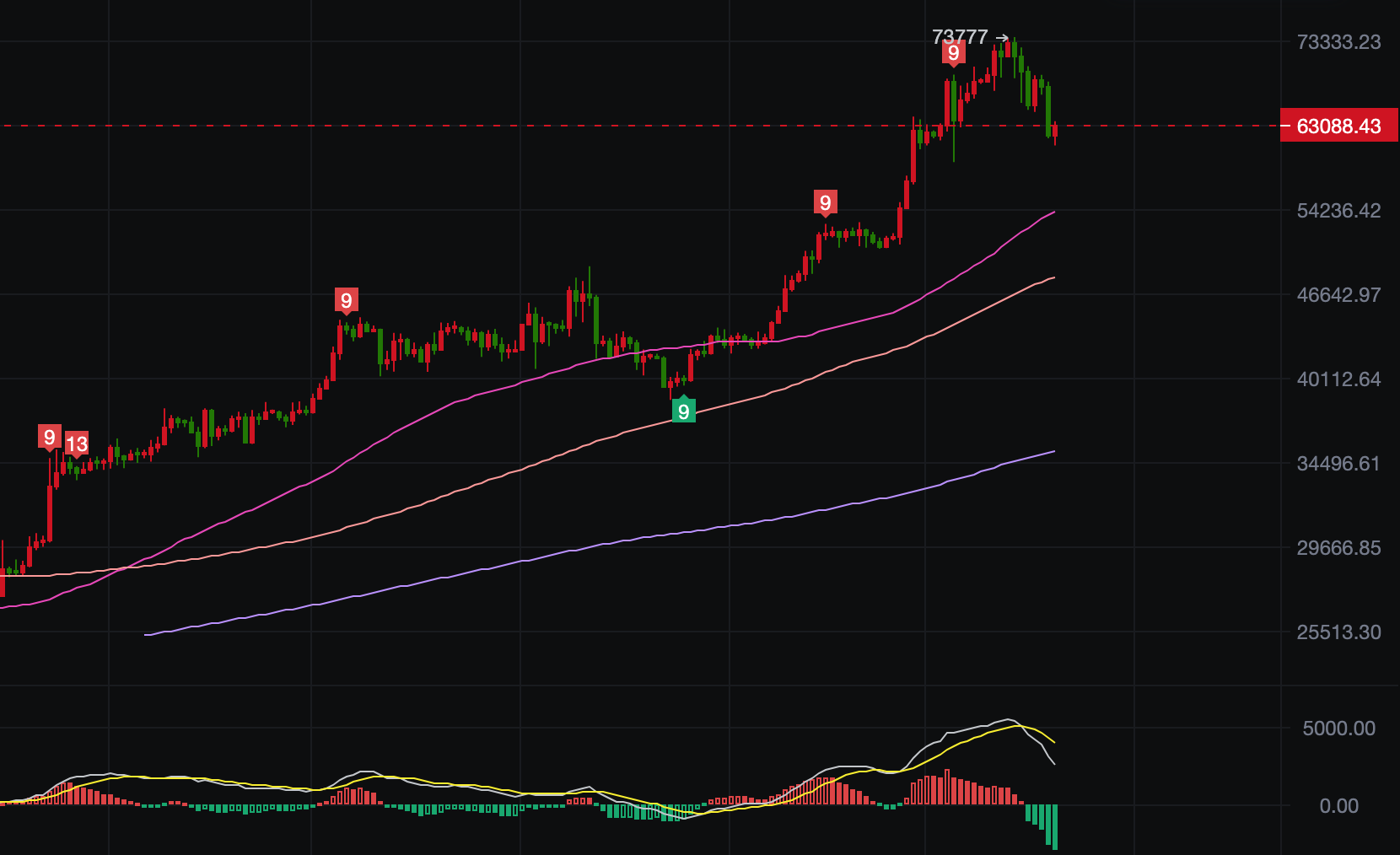
BTC has dropped from a short-term high of $73,777, breaking through the lower support of the converging triangle pattern at around $72,800. This is in line with our previous prediction. According to the pattern, the target of $62,800 has been reached, which is also the resonance position of the Vegas channel. Currently, it is testing the support level in the range of $59,000 to $60,500, which is the previous retracement position. Additionally, the 38.2% retracement level from the rise of $38,555 after the ETF landing is near $60,500. After hitting a short-term low of around $60,800, there has been a slight rebound. As we have previously analyzed, this decline is different from the previous all-at-once leveraged liquidation-style decline. Generally, a gradual decline like this is healthier, and the adjustment period will be longer than the previous leveraged liquidation-style decline. There have been several rebounds during this decline, but the height of the rebounds has gradually decreased, indicating that there may not be a V-shaped reversal to new highs in the short term.
As we discussed yesterday, the ETF data is not optimistic. Grayscale's GBTC saw the largest single-day outflow, while Fidelity's net inflow barely remained positive, and BlackRock's net inflow is also declining. ETFs are about to turn into net outflows, which may affect the change in market sentiment. Currently, the overall market situation is quite similar to our previous predictions, and the long/short ratio is relatively higher than before. We will continue to monitor the changes in ETF fund flows, as well as the expectation of the upcoming Bitcoin halving in a month. Additionally, from a fundamental perspective, the Bank of Japan raised interest rates at the beginning of this week, marking the first rate hike in seventeen years since 2007. Many institutions have borrowed a lot of yen to purchase financial assets during the era of negative interest rates and low interest rates in Japan. A rate hike in Japan will increase the cost for global institutions, thus having a certain negative impact on global financial assets. This week, the Federal Reserve is likely to maintain the status quo as expected, and we will see if it will have a coordinated impact on the cryptocurrency market.
Historical data shows that Bitcoin has experienced retracements 14-28 days before each halving. In previous halving years, this danger zone saw a high retracement of up to 40% in 2016 and a 20% retracement in 2020 before the halving. The former far exceeded the maximum retracement from the recent all-time high of about $73,700. As we have shared before, due to the current large base, even if the retracement this time is smaller than before, the retracement space will still be very large, and we need to pay attention to this. Additionally, this halving market is different from previous ones, as in the past, there was not a continuous rise like this before the halving. In 2020, the rise started six months after the halving. So this time is a bit different from previous halvings, possibly taking advantage of the ETF speculation and starting the expected market trend ahead of time.
Follow us: Lao Li Mortar
March 20, 2024
免责声明:本文章仅代表作者个人观点,不代表本平台的立场和观点。本文章仅供信息分享,不构成对任何人的任何投资建议。用户与作者之间的任何争议,与本平台无关。如网页中刊载的文章或图片涉及侵权,请提供相关的权利证明和身份证明发送邮件到support@aicoin.com,本平台相关工作人员将会进行核查。


