Title: On data availability layers
Author: Bridget Harris
Translator: kaori, BlockBeats
Data availability layers have become an important part of modular architecture, serving as plug-in components to reduce costs and expand blockchain scalability. The core function of the DA layer is to ensure that on-chain data is available for all network participants to use and access. Historically, each node had to download all transaction data to verify its availability, which was an inefficient and costly task. This is how most blockchains currently operate, and it is a barrier to scalability as the amount of data required for verification increases linearly with block size. Ultimately, end users suffer losses as the cost of data availability accounts for 90% of the transaction cost incurred by users on Rollup (currently, the cost of sending transaction data to Ethereum via Rollup is $1300-1600 per mb).
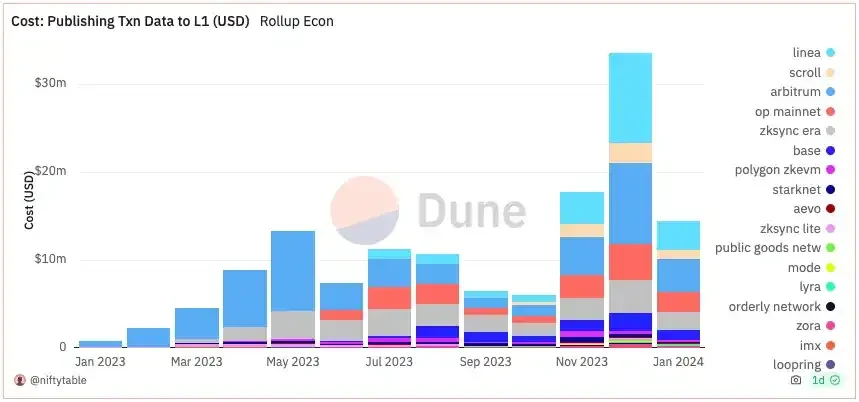
The introduction of Data Availability Sampling (DAS) fundamentally changes this architecture. Through DAS, light nodes can confirm data availability through multi-round random sampling of block data without having to download each entire block. Once the multi-round sampling is completed and a certain confidence threshold for data availability is reached, the rest of the transaction process can proceed safely. In this way, the chain can expand its block size while maintaining simple data availability verification, and significant cost savings are achieved: these emerging layers can reduce DA costs by up to 99%.
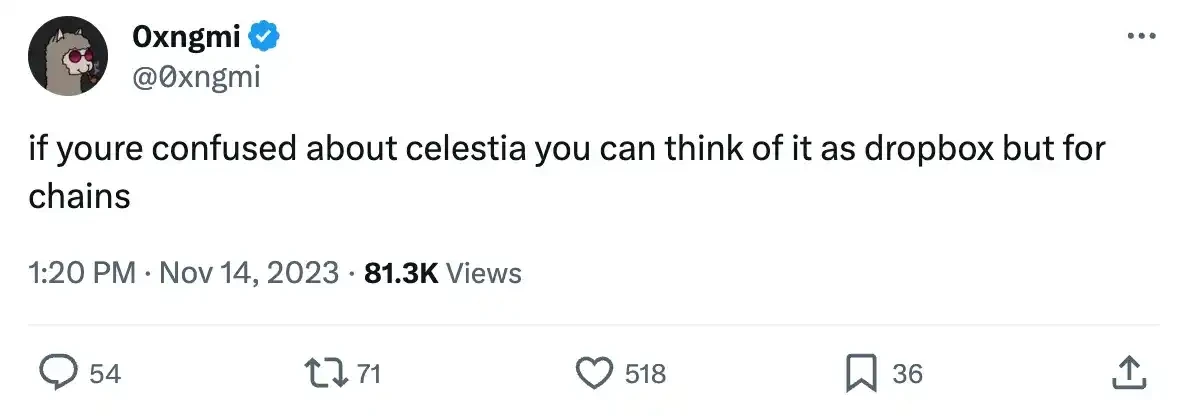
A very appropriate analogy for DA in 0xngmi
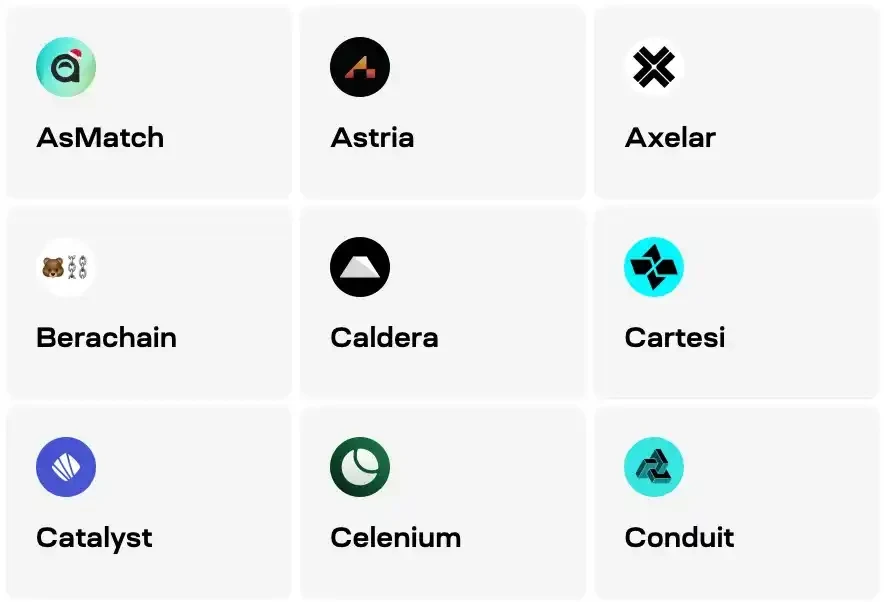
In addition to achieving higher throughput, data availability layers are also meaningful for improving interoperability. Inevitably, low-cost DA will drive the Cambrian explosion of new custom Rollup chains, making deployment increasingly simple through Rollup-as-a-service providers such as Caldera, AltLayer, and Conduit. However, with the emergence of L2 and L3 ecosystems, they are likely to become fragmented by default. It is already difficult for users to use new platforms—this situation will worsen if interoperability, liquidity, and network effects are limited. A unified DA layer as the foundation of each network will make capital flow simpler and attract a wider range of users.
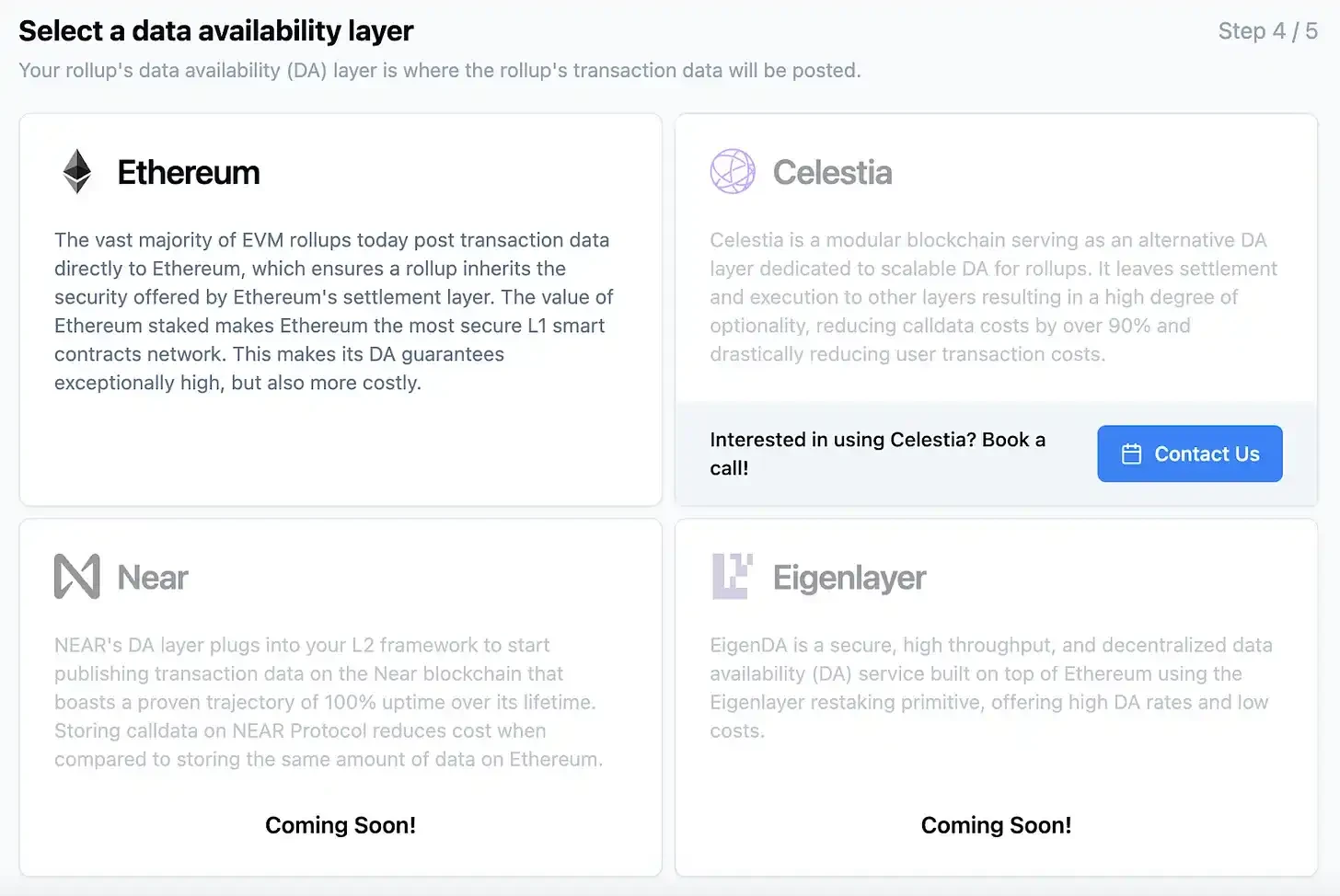
Avail, EigenDA, and Celestia are the main players in the DA ecosystem—each serving the same space but taking slightly different approaches in terms of infrastructure stack, execution, and listing.
In terms of technical architecture, Avail, Ethereum, and EigenDA adopt KZG commitments, while Celestia uses fraud proofs to confirm the correctness of block encoding. Generating KZG proofs, while a very strict method for data availability, imposes more computational overhead on block producers, especially as block size increases. On the other hand, Celestia assumes that data can be implicitly obtained through its anti-fraud scheme. As an incomplete computational "work" exchange, the system must wait for a period to enter the fraud proof dispute period, and then nodes can confirm that the block has been accurately encoded. KZG proofs and fraud proofs are both undergoing rapid technological advancements; their trade-offs may become more complex, and it is currently unclear which mechanism will strictly outperform the other.
For Avail, they adopt a KZG commitment architecture, making it very suitable for zk structures. If zk dominates in the future and Celestia relies on optimistic fraud proofs, this may pose a challenge for Celestia. Additionally, even if all full nodes go offline, Avail's P2P light client network can still support the network; whereas in Celestia's architecture, light clients cannot operate without full nodes. Both Avail and Celestia use erasure coding under DAS (distributed storage), dividing data into fragments, increasing redundancy, and allowing data to be reconstructed for verification.

Compared to the technical stack of Celestia and Avail, EigenDA fully leverages the existing infrastructure of Ethereum. If data needs to be sent to Rollup contracts to prove its availability, EigenDA will inherit the same finality time as Ethereum. If Rollup fully adopts EigenLayer, finality can be achieved more quickly.

To achieve consensus, Avail adopts BABE + GRANDPA inherited from Polkadot's SDK, while also using Nominated Proof of Stake (NPoS). NPoS is used to nominate a group of validators that delegators hope to see elected, while BABE specifies who will propose the next block, and GRANDPA serves as the block finality algorithm.
Celestia uses Tendermint as the consensus mechanism, allowing users to stake their TIA to receive validator staking rewards. Although Celestia can achieve fast finality through Tendermint, the actual guarantee of data availability has a waiting period due to its optimistic architecture (users must have time to submit fraud proofs).
EigenDA itself does not have a consensus, but has two mechanisms to ensure the validity of data availability:
Proof of custody: This is essentially an economic security mechanism that ensures nodes store data, but does not actually guarantee that the data is provided to everyone in the network. If nodes do not comply, they will be slashed, for example, if they cannot prove they own the data.
Sufficient decentralization: Ensuring the decentralization and resistance to collusion of the operator set is crucial for the network to operate normally. With a large and independent set of validators, data provision becomes a competition, and many market participants are willing to join. At this scale, collusion becomes extremely difficult.
An interesting point to note is that Celestia's active validator set is composed of the top 100 validators with the most staked tokens, and this threshold may decrease in the future. Additionally, each of their validators stores the entire dataset. EigenDA, on the other hand, will optimize for nodes storing a small portion of the data (potentially millions in the future), so if enough nodes are honest, the data can be reconstructed. More details about the origin of EigenDA (and more) can be found in Sreeram's recent post.

Finally, Avail has made a beneficial comparison of the core components of the main DA layers.
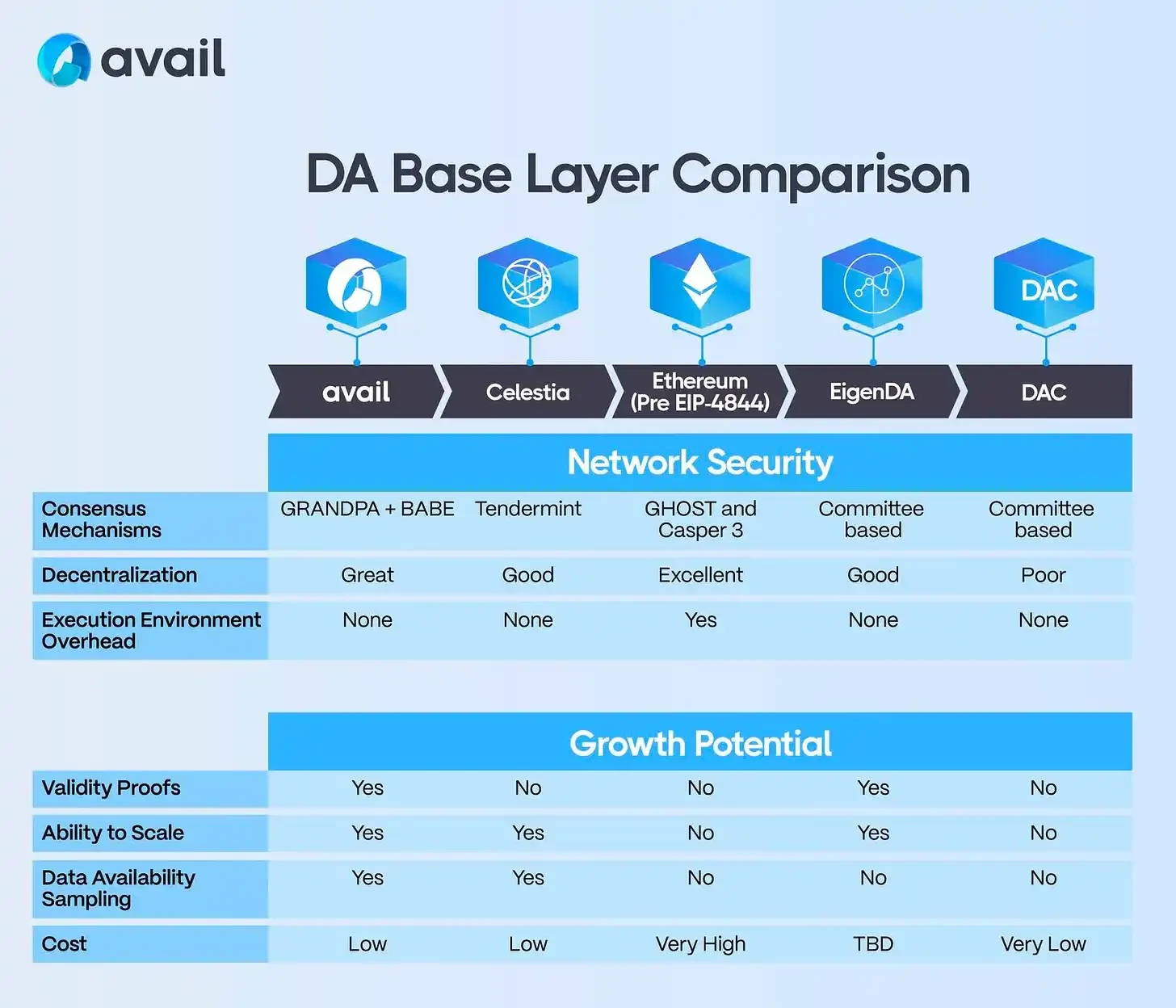
New discussions have also emerged about the trade-offs of each design. David Hoffman pointed out that Celestia is a complete blockchain in itself—a complex stack that requires more than just pure DA. On the other hand, EigenDA is just a set of smart contracts, but it relies on Ethereum, unlike Celestia and Avail.
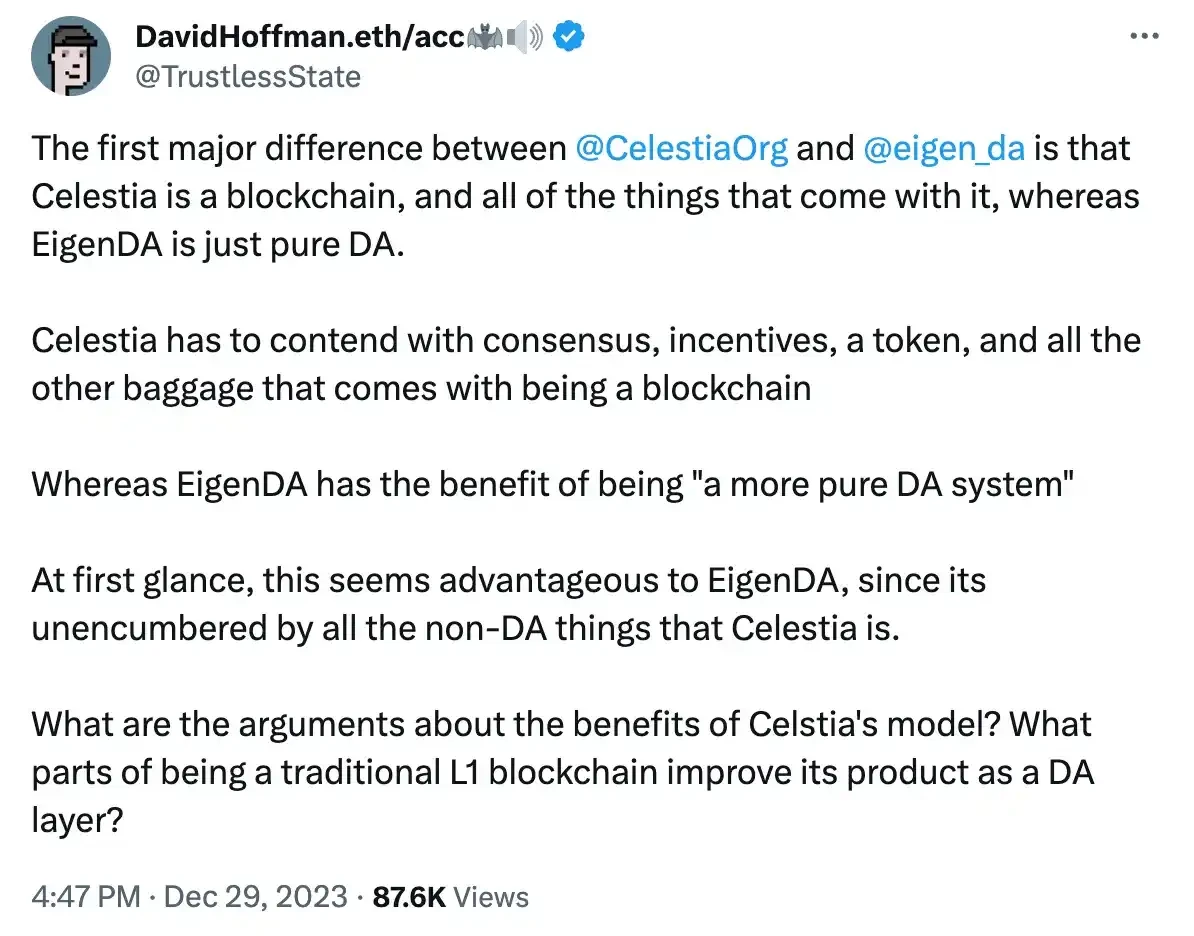
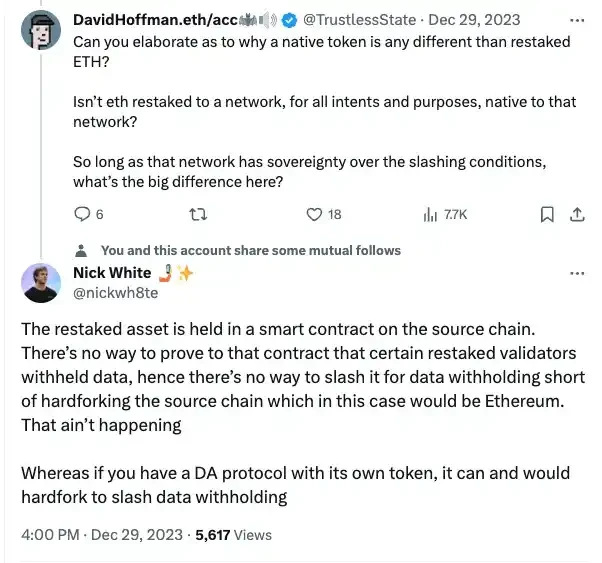
The Celestia team believes that tokens are necessary for security, and EigenDA will ultimately need tokens because it is impossible to cut off the availability of on-chain data. They argue that to ensure nodes are honest, data is available, and malicious nodes are punished, the network must be able to verify through an incentive structure, including native tokens. Here, Nick White of Celestia criticized EigenDA: "Validators retaining data for re-verification will not be slashed unless the source chain is forked—this is highly unlikely, as it is Ethereum."
From a branding perspective, EigenDA is a product that is extremely consistent with Ethereum. The EigenLayer team is building based on EIP-4844 and danksharding—according to Sreeram, EigenDA is being built as the "unique ETH-centric data availability layer." He explains that by definition, a data availability layer is a modular product, but other DA "Layers" are actually blockchains themselves.
Packaging the DA layer into the blockchain does bring significant benefits to Rollups running natively on it, primarily in the form of security guarantees. However, Sreeram mentioned that his team's goal in building EigenDA is to create a product that provides data availability services for the Ethereum ecosystem from first principles—a true "Layer" adjacent to the Ethereum ecosystem. He pointed out that separate consensus is not needed here, as Ethereum-based Rollups already rely on network ordering and consensus. (Sreeram explained this recently on the Bankless program.)
Avail is built with validity proofs and DAS, achieving a high degree of flexibility and interoperability in the ecosystem. Their architecture lays the foundation for a scalable framework designed to support services across many different platforms. This "neutral" stance allows for greater interoperability and capital flow, and also attracts non-Ethereum-centric ecosystems. The ultimate goal here is to obtain ordered transaction data from all chains and aggregate them into Avail, making it the coordinating center for all of web3. To kickstart the network, Avail recently launched node conflict activities on its incentive testnet, allowing users to run validators and light clients and participate in network challenges.
The Celestia ecosystem consists of RaaS providers, shared sorters, cross-chain infrastructure, and covers ecosystems such as Ethereum, Ethereum rollups, Cosmos, and Osmosis.
Each of these design choices, whether technical or marketing, comes with interesting trade-offs. Personally, I am not sure if the data availability category will be a winner-takes-all or commoditized market—on the contrary, there may be an oligopoly market where projects choose the DA layer that best suits their needs. Depending on the type of protocol, teams can optimize for interoperability, security, or preferences for a particular ecosystem or community. If custom use case aggregation explodes as expected, they will integrate the DA layer without hesitation—and there will be more than one strong option to choose from.
This technology—and the overall modular narrative—is still relatively new, with Celestia having just launched recently, and Avail and EigenDA set to enter the mainnet in the coming months. However, the technological advancements in modularism so far have been excellent (many of these concepts were just ideas a few years ago!). By fundamentally improving the way we build and use blockchains, the DA layer will undoubtedly become one of the core technologies of this cycle and beyond.
免责声明:本文章仅代表作者个人观点,不代表本平台的立场和观点。本文章仅供信息分享,不构成对任何人的任何投资建议。用户与作者之间的任何争议,与本平台无关。如网页中刊载的文章或图片涉及侵权,请提供相关的权利证明和身份证明发送邮件到support@aicoin.com,本平台相关工作人员将会进行核查。


