Original Author: Filecoin Network
Key Points
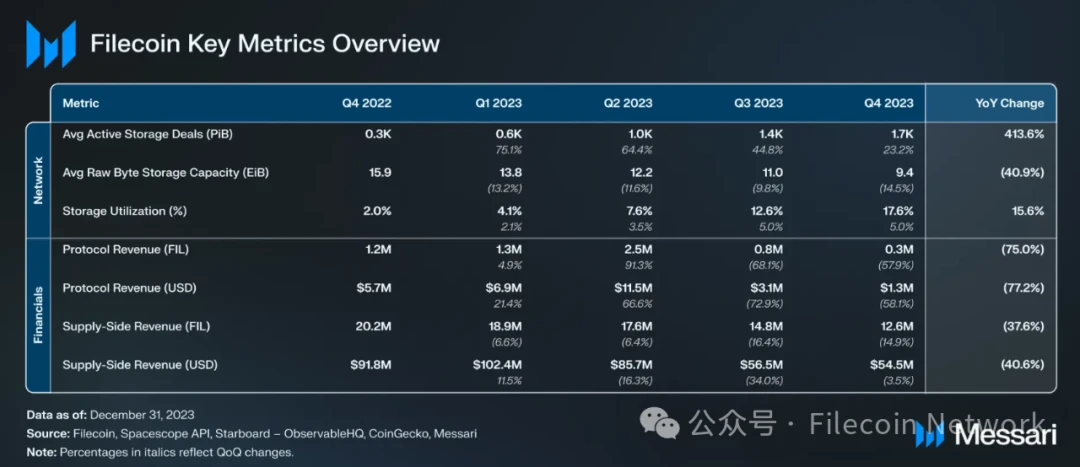
The Filecoin storage market continued to grow in the fourth quarter of 2023, with active transactions increasing by 23% quarter-on-quarter and 414% year-on-year. Meanwhile, due to a 15% quarter-on-quarter decrease in Filecoin storage capacity, storage utilization increased from 13% in the third quarter of 2023 to 18% in the fourth quarter.
By the end of 2023, there were over 1800 users loading datasets on Filecoin, with 465 users having dataset sizes exceeding 1000 TiB, representing a 10% quarter-on-quarter increase and a 196% year-on-year increase.
The Filecoin Virtual Machine (FVM) introduced Ethereum-style smart contracts to enable new use cases. Since the launch of FVM in March 2023, the Total Value Locked (TVL) had exceeded $230 million by the end of 2023.
The deployment of Uniswap V3 proposal on FVM has been successfully executed, potentially ushering in a new phase of DeFi applications built on the Filecoin network.
FIP0001v2 community initiative aims to improve and expand the Filecoin Improvement Proposal (FIP) and governance processes.
Filecoin Basic Information
There is a serious problem with relying on centralized data storage: it is difficult to systematically verify the integrity of stored data. Today, the Filecoin storage network is a peer-to-peer version of Amazon S3, built on the InterPlanetary File System (IPFS). IPFS serves as the distributed data storage and sharing layer of the Filecoin network. Filecoin regularly verifies data storage validity and dynamically prices storage transactions based on supply and demand, rather than a fixed pricing strategy.
A storage transaction is like a contract with a Service Level Agreement (SLA)—users pay storage providers to store data for a specified period. To ensure data security, Filecoin uses an encrypted economic incentive model and verifies storage through zero-knowledge proofs periodically. Filecoin rewards storage providers with the native network token FIL to incentivize participation in storage transactions. If a storage provider fails to provide reliable online time or engages in malicious behavior, they will be subject to corresponding penalties (slashed).
For data retrieval, Filecoin users pay retrieval providers to access data. Unlike the on-chain transaction method proposed for storage transactions, retrieval transaction proposals settle fees off-chain to expedite retrieval. In addition to storage and retrieval, Filecoin aims to provide an open market for running data through contract computing capabilities (cod.cloud), offering a more efficient alternative to traditional centralized systems.
Key protocol upgrades to enable data computing services include smart contracts (Filecoin Virtual Machine- FVM) and expansion (Interstellar Consensus). The Filecoin Virtual Machine, launched in March 2023, introduces Ethereum-style smart contracts to facilitate new use cases in areas such as liquidity mining, perpetual storage, and distributed computing.
Key Metrics
Performance Analysis
The Filecoin blockchain is used for decentralized storage of data in the following ways:
Demand side, representing storage users who need data storage.
Supply side, representing storage providers with excess network capacity.
Usage
Active storage transactions between storage users and providers measure the data storage demand from both Web2 and Web3 users on the Filecoin network.
Storage Transactions
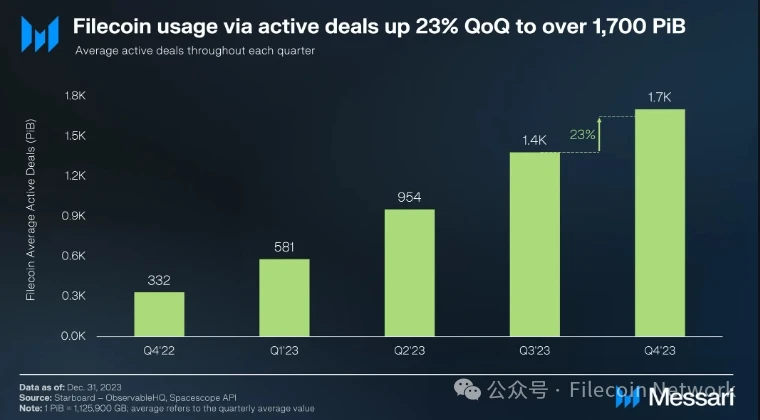
In the fourth quarter of 2023, Filecoin continued to adopt decentralized storage through active transaction growth. With the active transactions in this quarter, nearly 1,700 PiB is stored on the Filecoin network, representing a 23% quarter-on-quarter increase from 1,400 PiB in the third quarter of 2023 and a nearly 4-fold increase from 332 PiB in the fourth quarter of 2022.
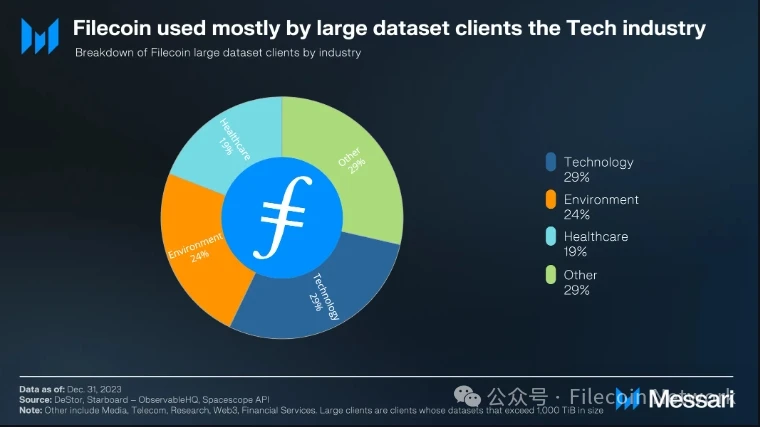
According to the segmentation of active storage transactions based on industry use cases, the technology (35%) and natural resources (31%) sectors are the most prominent users of Filecoin. To encourage further adoption, Filecoin offers various storage services, including NFT.Storage, Web3.Storage, Seal, Banyan, and Steeldome.
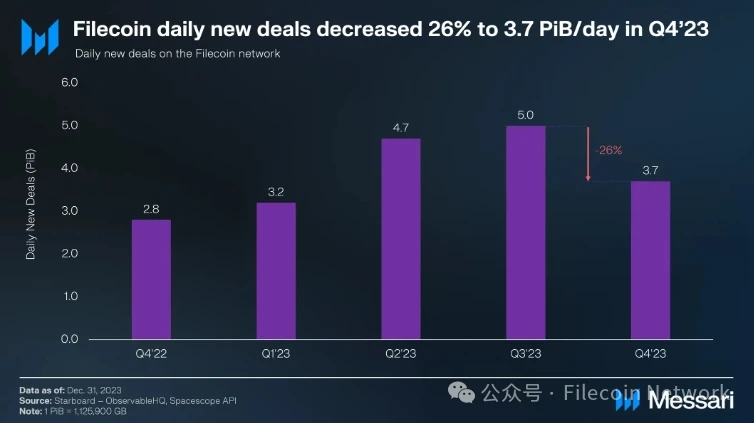
Meanwhile, after continuous growth in daily new transaction volume over the past four quarters, there was a 26% quarter-on-quarter decrease. Although the slowdown in new transactions is still positive, this deceleration in new transaction growth corresponds to an overall decrease in returns for storage providers (further details will be provided in the "Supply Side Revenue" section). Additionally, the increase in new transactions corresponds to an improvement in Filecoin network utilization.
Storage Utilization and Capacity
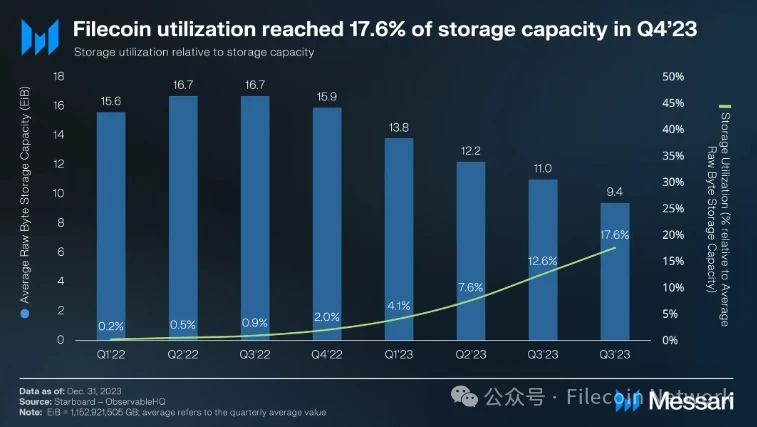
In the fourth quarter of 2023, Filecoin's storage utilization relative to total available storage capacity increased to 17.6%, up from 12.6% in the third quarter of 2023. While this growth is a positive signal for Filecoin's adoption through active storage transactions, it must be considered in the context of network capacity.
In the fourth quarter of 2023, the average raw byte storage capacity of Filecoin decreased by 15% quarter-on-quarter to 9.4 EiB. Since reaching a historical high of nearly 17 EiB in the third quarter of 2022, the average raw byte storage capacity has gradually declined.
The decrease in storage capacity is further reflected in the decline in the total number of storage providers. This metric has continued to decline to over 3390 providers at the end of the fourth quarter of 2023, after reaching a historical high of over 4100 providers in the third quarter of 2022.
Storage Users
Messari's guide on distributed storage networks indicates that Filecoin is currently suitable for providing cold storage solutions (such as archiving and recovery) for enterprises and developers. Its competitive pricing and ease of access make it an attractive choice for Web2 users seeking cost-effective alternatives for storing large volumes of archived data. In addition to cold storage, active work is being done on Banyan, Lighthouse, RIBS, retriv, Seal, and Flamenco.
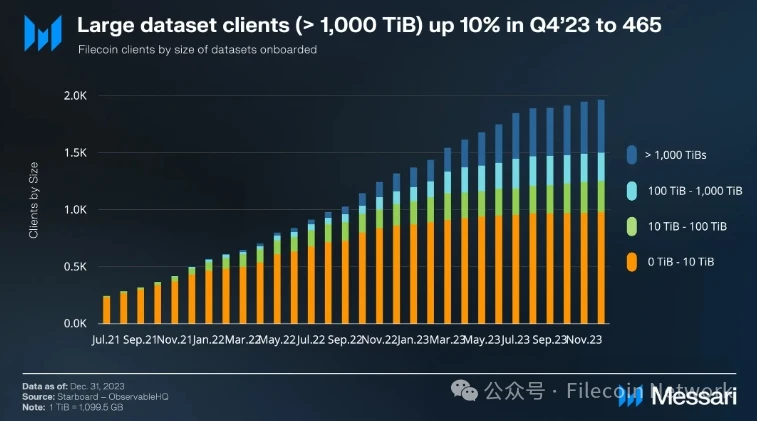
As of the end of the fourth quarter of 2023, a total of 1808 users have loaded datasets on Filecoin, with 465 users loading large datasets (storage size exceeding 1,000 TiB), representing a 10% increase from 421 users in the third quarter of 2023.
According to the Filecoin User Resource Manager, the primary user base ranges from New York City and the USC Shoah Foundation to OpenSea or Layer-1 network Solana and other Web3 platforms. Other notable institutions using the Filecoin network include:
- Victor Chang Cardiac Research Institute maintains and shares research data
- Democracy’s Library stores datasets collected at the end of management
- SETI Institute uses Filecoin to store astronomical research data
- UC Berkeley collaborates with Seal Storage for storage of physical research
- GenRAIT uses Estuary to store critical genomic data on Filecoin
- Starling Lab stores sensitive digital records of human history
- Ewesion, the fastest-growing graphic file host in China, uses Filecoin for data storage
- DeSci Lab uses decentralized data storage on Filecoin to enable other researchers to replicate and independently verify their research findings
An overview of featured users of the Filecoin network can be found [here](http://https://filecoin-explorer.com/expanded-view?hstc= 224880773.3fb633f764c45c8b1c96d01937fceede.1696881075314.1697063173784.1697098377625.3&hssc= 224880773.1.1697098377625&__hsfp= 100422932).
Retrieval
To meet storage retrieval needs, the Saturn project, a content delivery network (CDN) for Filecoin and IPFS, is currently being developed. The Saturn project aims to serve the retrieval market with fast and low-cost content delivery services, with node operators earning FIL from a fund pool of approximately 30,000 FIL per month to fulfill retrieval requests. Meanwhile, the FILStation application brings distributed retrieval to the desktop, and the SPARK module for checking retrievals on the network is now available on FILStation.
In terms of retrieval performance, Saturn aims to provide reliable content retrieval for both Web2 and Web3 use cases. Its focus is on improving retrieval speed and performance, with most data coming from IPFS mirrors. More in-depth information about Saturn's decentralized CDN, its highlights to date, and roadmap can be found here. An overview of Saturn node performance can be found on the Saturn dashboard.
FVM Usage
The Filecoin Virtual Machine (FVM) has brought Ethereum-style smart contracts to Filecoin. Since its launch in March 2023, the Total Value Locked (TVL) has exceeded $230 million by the end of 2023. DeFi applications provide more opportunities for storage providers to access FIL, making data loading more efficient. As of December 31, 2023, over 2700 unique contracts have been deployed on FVM, with over 22,000 monthly active users generating over 1.8 million transactions.
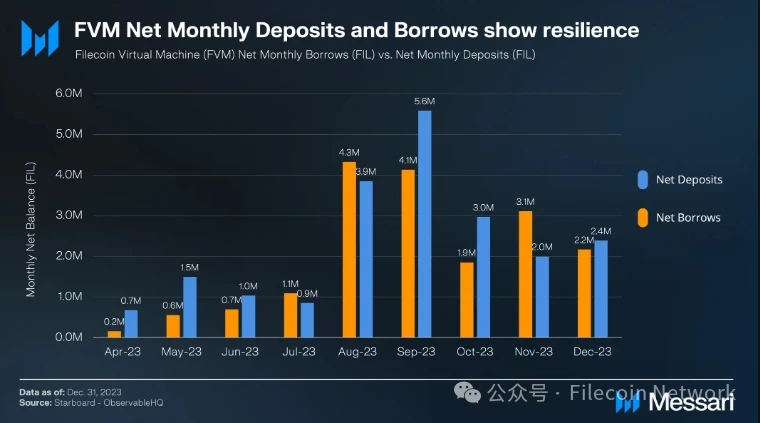
According to FVM Explorer statistics, the net deposits in DeFi amount to 14.2 million FIL (approximately $85.2 million), distributed as follows: 9.1 million FIL in GLIF, 3.8 million FIL in stFIL, 2.8 million FIL in SFT Protocol, and over 1.9 million FIL in HashKing. As per the FVM DeFi leaderboard, as of December 31, 2023, the net borrowings in DeFi total 12.3 million FIL (approximately $73.8 million). Both monthly net deposits and net borrowings showed a recovery growth throughout the fourth quarter of 2023.
The proposal to deploy Uniswap V3 on FVM has been approved and successfully executed in October. The deployment of Uniswap contracts on the mainnet is expected to usher in a new phase of DeFi applications based on the Filecoin network. With Filecoin continuously gaining new users and valuable datasets, it may become the foundation for developing monetizable FVM data use cases.
Revenue
Filecoin's revenue framework is similar to Ethereum's, as its transaction fee design is similar to the EIP-1559 mechanism. This gas system consists of network fees, compensating for the resources used by burning network fees. Both storage users and storage providers generate protocol revenue.
Protocol Revenue
According to Messari's revenue analysis, Filecoin's protocol revenue consists of the following four components:
- Base fees - Dependent on message congestion, required for any storage proof.
- Batch fees - Used for batch packaging of storage proofs.
- Overestimation fees - Used for optimizing gas usage.
- Penalty fees - Imposed on storage providers for failures.
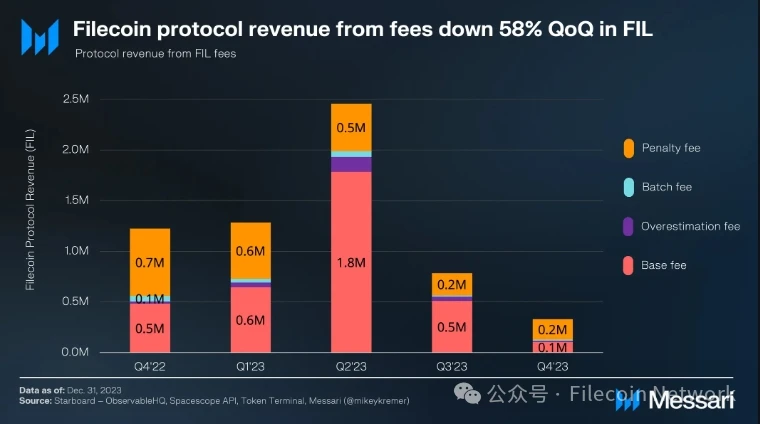
Despite the increasing demand for Filecoin storage, protocol revenue from FIL fees decreased by 58% in the fourth quarter of 2023, to 300,000 FIL (a 58% decrease to $1.3 million in USD terms). The decline in protocol revenue is consistent with an overall decline in revenue from the demand side of decentralized cloud storage space.
The main reason for the decline in Filecoin's protocol revenue is the basic fees on the demand side, which decreased by 80% in FIL terms. Filecoin is actively reducing the cost of importing data into the network, for example, by reducing decentralized storage costs by 40% through the Decentralized Storage Alliance DSA initiative.
Supply-Side Revenue
Filecoin's supply-side revenue includes:
- Block rewards distributed to storage providers by the network.
- Payments for storage deals anchored by contracts.
- "Tips" fees for expediting transactions.
In the second quarter of 2023, block rewards accounted for over 99.9% of supply-side revenue, with "tips" making up only a small portion. The new FIL token minting mechanism depends on the following:
- Exponential decay mode (30% of the total) - Block rewards are highest in the early stages to encourage participation, with exponential decay over time.
- Baseline mode (70% of the total) - Allocates block rewards based on increasing storage capacity.
The combination of these two modes helps maintain participation after the early stage of block reward distribution ends (see exponential decay mode) and continues to reward the additional value brought to the network by increasing storage capacity (see baseline mode).
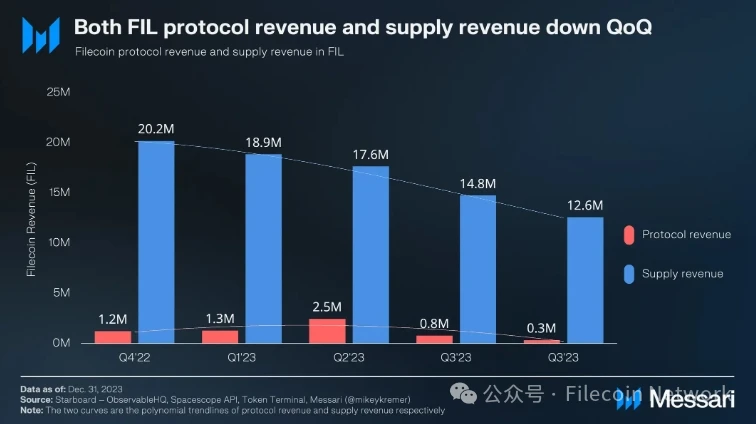
Supply-side revenue in FIL decreased by 15% to 12.6 million FIL in the fourth quarter of 2023 (a 4% decrease in USD terms), which is related to the overall decrease in FIL reward issuance resulting from the exponential decay mode and baseline minting model. The reduction in FIL reward issuance may continue in the coming quarters. For in-depth discussions and various simulations on future FIL issuance, please refer to Messari's recent research on FIL circulating supply.
Ecosystem Overview
The Filecoin ecosystem has been actively expanding its builder channels, regularly hosting hackathons and accelerator events to help early-stage projects and teams secure funding from Protocol Labs or affiliated entities. The ecosystem aims to support various use cases in different fields, including data infrastructure, streaming, metaverse, and gaming. As of December 2023, over 100 known projects are being developed in the Filecoin ecosystem, with most projects providing data services using Filecoin's applications and protocols.
- Banyan: Decentralized storage similar to Web2, suitable for areas beyond enterprise archives.
- Lighthouse: Permanent data storage service with one-time payment pricing model.
- Numbers Protocol: Maintaining data authenticity for digital media and generative AI.
- Berty: Secure messaging and social media app.
- Dether: Cash access and diversified financial transaction mechanism.
- Tableland: Cloud database based on SQL.
- Basinv2: Data management and collaboration used by Tableland, WeatherXM Network, and Bacalhau computer network.
Contracts focusing on media and entertainment include:
- Mona: 3D art gallery in the metaverse.
- NFTwitch: NFT minting platform for Twitch content.
- Huddle01: Decentralized video conferencing.
- OPGames: NFT minting related to gaming.
- FileMarket: Web3 store builder and marketplace.
- Xone: Metaverse solution connecting artists and fans.
The following use cases aim to leverage Filecoin infrastructure to drive specific data needs in various fields:
- Cryptosat: Using mini-satellites to prevent side-channel attacks and achieve secure verification.
- Bela Supernova: Storing patient health data.
- ZKsig NFT: Market access control.
- DataMarket: Data purchase and settlement functionality.
Qualitative Analysis
Major Developments
Filecoin Watermelon Upgrade (V21)
The Filecoin Watermelon upgrade (V21) was successfully activated on December 12, 2023. This upgrade simplified operations for storage providers and improved the Filecoin protocol and FVM.
Sushi Deployment on Filecoin
Sushi was the first deployment of a DEX on Filecoin. Sushi V2 and V3 users will be able to trade on the Filecoin network and provide liquidity without the need for bridging or local FIL tokens.
Filecoin MetaMask Wallet
The Filecoin MetaMask wallet was launched in the fourth quarter of 2023, allowing users to connect Filecoin decentralized applications, manage Filecoin accounts, send FIL to local and FEVM accounts, and access FEVM transaction information through MetaMask (source).
Global Privacy Alliance
Protocol Labs and the Filecoin Foundation joined forces with Nym, Oasis, and Aztec to form the Global Privacy Alliance (source). The alliance aims to promote "privacy by design" in the tech industry and create a legal fund to support privacy-centric practices.
Key Events
FIL Bangalore Summit and ETH India Summit
Members of the IPFS, Filecoin, FVM, and libp2p ecosystems participated in the FIL Bangalore Summit and ETH India Summit in December 2023. The Filecoin project track received over 150 submissions, and the Filecoin project track at Pragma received over 70 submissions.
FIL Developer Summit
The FIL Developer Summit focused on Filecoin retrieval and data availability. The retrieval track focused on improving data retrieval, while the data availability track focused on effectively building and efficiently transmitting data.
2023 Protocol Labs Week
The annual gathering of Protocol Labs, LabWeek 2023, focused on InterPlanetary Consensus (IPC), Filecoin Virtual Machine (FVM) unlocking for Filecoin DeFi growth, and new Filecoin projects and developer tools. Additionally, significant modifications were made to the Notary election process on FilecoinPlus Day.
Key Decisions
Deployment of Uniswap V3 on FVM
The proposal to deploy Uniswap V3 on FVM was passed in October and successfully executed. The deployment of Uniswap contracts on FVM may usher in a new phase of DeFi applications built on the Filecoin network. As Filecoin continues to attract new users and valuable datasets, it may become the foundation for monetizable FVM use cases centered around data.
FIP0001v2
FIP0001v2 is a coordinated effort to improve and expand Filecoin governance. The FIP0001v2 draft proposes five different types of Filecoin Improvement Proposals (FIPs): Technical FIPs, Cryptoeconomic FIPs, Community FIPs, Security FIPs, and Filecoin Request for Comments (FRC). For more details, see the FIP0001v2 draft.
Summary
Filecoin data storage accelerated in the fourth quarter of 2023, with active storage deals increasing by 23% quarter-over-quarter and 414% year-over-year. Although storage capacity decreased by 15% quarter-over-quarter, storage utilization increased from 13% in Q3 2023 to 18% in Q4 2023.
By the end of 2023, over 1800 users had loaded datasets on Filecoin, with 465 users having datasets larger than 1,000 TiB, representing a 10% increase quarter-over-quarter and a 196% increase year-over-year. In terms of FIL, storage fee revenue decreased by 58% in Q4 2023 (in USD terms), consistent with the overall decrease in demand-side revenue for decentralized cloud storage space.
The proposal to deploy Uniswap V3 on FVM was successfully executed, potentially ushering in a new phase of DeFi applications built on the Filecoin network. As Filecoin continues to attract new users and valuable datasets, it may become the foundation for monetizable FVM use cases centered around data. Prominent examples include perpetual storage (similar to Arweave), collateralized loans for storage providers, and distributed computing. If Filecoin can continue to meet demand, it has the opportunity to become a leading provider of distributed storage and cloud services for Web3 and traditional applications.
If you would like to let Messari know what you liked about this report, any missing elements, and other thoughts, please fill out this brief form. All feedback is subject to Messari's Privacy Policy and Terms of Service.
免责声明:本文章仅代表作者个人观点,不代表本平台的立场和观点。本文章仅供信息分享,不构成对任何人的任何投资建议。用户与作者之间的任何争议,与本平台无关。如网页中刊载的文章或图片涉及侵权,请提供相关的权利证明和身份证明发送邮件到support@aicoin.com,本平台相关工作人员将会进行核查。


