Scientists have found a way of integrating living human brain cells into computing systems, and may potentially obsolete the “A” in AI.
A team from Indiana University Bloomington recently published a paper about a new system dubbed “Brainoware,” which they say uses human brain organoids in completing advanced AI tasks. These organoids—artificially grown masses of cells or tissue that resemble an organ—are currently mounted on a high-density multielectrode array, and are quite primitive today. However, researchers hope their use paves the way for biocomputers that can execute the same tasks that computers do but with minimum energy consumption.
"A human brain typically expends about 20 watts, whereas current AI hardware consumes about 8 million watts, to drive a comparative ANN (artificial neural network)," the research paper argues. “Brainoware could provide additional insights for AI computing because brain organoids can provide BNNs (biological neural networks) with complexity, connectivity, neuroplasticity, and neurogenesis, as well as low energy consumption and fast learning.”
"Human brains use far less energy and learn much faster, so some researchers see biocomputing as the way forward," wrote Michael Le Page on Twitter in March, but noted that pushing the field to the limit could raise thorny questions.
Le Page quoted Cambridge developmental neurobiologist Madeline Lancaster, who said, “Whether these push them beyond an ethical limit is something we certainly want to avoid, and the scientific and ethics community is coming together to define where that limit would be.”
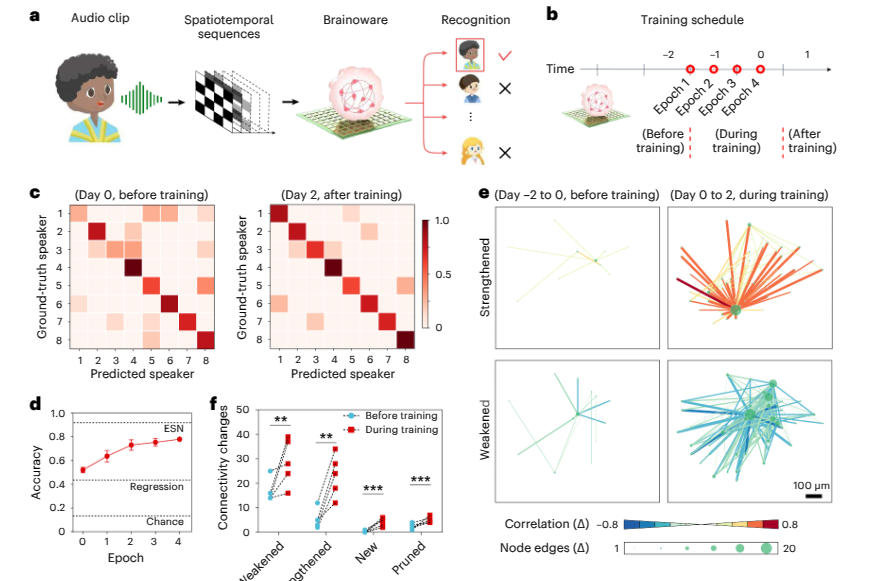
Brainoware sends and receives information from the brain organoid through “adaptive reservoir computation.” This method enables unsupervised learning from training data, which can still shape the functional connectivity of the organioid. The system's practical potential was demonstrated through tasks like speech recognition, where it distinguished individual speakers' voices with increasing accuracy after training.
For example, the organoids were trained to identify the voice of one individual in a set of 240 audio clips of eight people pronouncing Japanese vowel sounds. After the training, the organoids could complete the task with over 70% accuracy.
Science is still a long way from building living robots, however. The organoids could only identify a speaker, not understand the speech, meaning there's a very long and winding path before the tech achieves a practical use in medicine or engineering.
Titouan Parcollet from the University of Cambridge told New Scientist magazine that the potential of biocomputing is vast but admitted that “current deep-learning models are actually much better than any brain on specific and targeted tasks."
The researchers also warned that their “current organoids still suffer from high heterogeneity, low generation throughput, necrosis/hypoxia and various viabilities,” making them unviable right now for anything other than research purposes.
Parallel to Brainoware's development, AI has been creatively applied in fields like healthcare, with innovations that help restore mobility to quadriplegics and AI models capable of reading minds. All together, these advancements highlight the versatile and transformative nature of AI technologies.
Edited by Ryan Ozawa.
免责声明:本文章仅代表作者个人观点,不代表本平台的立场和观点。本文章仅供信息分享,不构成对任何人的任何投资建议。用户与作者之间的任何争议,与本平台无关。如网页中刊载的文章或图片涉及侵权,请提供相关的权利证明和身份证明发送邮件到support@aicoin.com,本平台相关工作人员将会进行核查。


