Author: Daniel Li, CoinVoice
Recently, as the cryptocurrency industry has entered another bull market, people's attention to mining new hundredfold tokens and discovering potential projects has been increasing. In this round of the market, projects or tokens related to Bitcoin have become the focus of attention for many people, whether it's ORDI or STAS, they have created their own myths.
Currently, the market generally believes that the next bull market will be led by Bitcoin, and projects related to Bitcoin will play an important role in driving it. However, relying solely on inscriptions or MEME coins cannot support Bitcoin in leading the entire bull market, and the market needs to further explore the potential of Bitcoin. Stacks, as the representative of Bitcoin smart contracts, will take on more responsibilities. It will further unleash the potential of Bitcoin smart contracts and prepare for the next bull market.
Stacks: A Complete Bitcoin Layer 2 Solution
The Stacks public chain was co-founded by Muneeb Ali and Ryan Shea in 2013, initially named Blockstack, and later renamed Hiro Systems PBC. The project raised funds under SEC regulation according to Reg A, becoming the first blockchain project to comply with SEC standards, which also earned it wide recognition and trust. To date, Stacks has completed 5 rounds of financing, totaling $88 million.
Stacks Versions
Stacks 1.0: The Stacks 1.0 version was an early version of Stacks, aimed at providing users with decentralized identity verification and storage services. Founded in 2013, this version represented the initial exploration and development of the Stacks project in the decentralized application field.
Stacks 2.0: The Stacks 2.0 version was officially launched on January 14, 2021. This version introduced a consensus mechanism called "PoX," enabling the Stacks public chain to interoperate with the Bitcoin blockchain and provide higher security and scalability.
Stacks 2.1: The Stacks 2.1 version was officially activated on March 20, 2023. The new version strengthened the connection to Bitcoin, including improvements in Stacking mining efficiency, Clarity language upgrades, better bridging functionality, and decentralized mining. This version supports the direct sending of Stacks assets to Bitcoin addresses, strengthening the connection to Bitcoin.
Nakamoto Version: Stacks is set to launch a version called "Nakamoto" in Q4 2023, which will transform Bitcoin into the foundational settlement layer and reserve asset for the open metaverse. It will also introduce an asset called "sBTC," which can be minted in a decentralized manner on Stacks and supports a 1:1 exchange for actual Bitcoin assets.

Stacks Technical Principles
Stacks adopts a unique sidechain model, different from traditional sidechains. It integrates with the Bitcoin main chain by submitting anchoring transactions containing digests of Stacks chain block headers and additional information to ensure their immutability, allowing applications and smart contracts to settle transactions on the Bitcoin main chain.
In addition, Stacks has its own independent chain and programming language, Clarity. By empowering developers to design dynamic smart contracts on the second layer, Stacks enhances the functionality of Bitcoin's first layer. It achieves mutual connectivity between the two layers, enabling complex computations and interactions to take place on the second layer, while relying on the Bitcoin base blockchain to ensure transaction security and finality. This innovative architecture allows Stacks to expand the utility and functionality of Bitcoin, providing new opportunities for developers to build decentralized applications and smart contracts.
Technical Features of Stacks:
Proof of Transfer (PoX) Consensus Algorithm: Stacks uses a unique PoX consensus algorithm, where miners and validators are two different roles. Validators stake STX to mine Bitcoin, while miners stake BTC on the Bitcoin main chain to mine STX. This consensus algorithm ensures the security and decentralization of the Stacks network and transfers the value of Bitcoin to the Stacks ecosystem through the mining process. The innovation of the PoX consensus algorithm lies in increasing the security and stability of the Stacks network through the transfer of Bitcoin's value, while providing a sustainable economic model.
Clarity Smart Contract Language: Clarity is the smart contract language on Stacks, characterized by security, verifiability, and lack of side effects. It adopts a static type system and functional restrictions to ensure that contracts have no ambiguous behavior during execution. The design of Clarity reduces the likelihood of contract errors and provides reliability and auditability. Its rich type system and side-effect-free programming paradigm enable developers to build complex contract logic, increasing the predictability and security of contracts.
Gaia Storage System: Gaia is the decentralized storage solution provided by Stacks. It emphasizes user data ownership and privacy protection, allowing users to associate their data with their identity and use it in decentralized applications. Gaia ensures data privacy and security through encryption and flexible storage provider selection. Storing user data outside the blockchain improves the performance and throughput of Stacks applications.
sBTC: sBTC is a project in the Stacks ecosystem that realizes the programmability of Bitcoin and decentralized financial applications. By introducing a trustless two-way peg mechanism, sBTC brings Bitcoin assets to Stacks, enabling users to use full smart contracts on Stacks and trade Bitcoin assets in a decentralized environment. The introduction of sBTC brings more liquidity and funds to the Stacks ecosystem, driving its development and growth.
Stacks Unleashing More Potential of Bitcoin
The frenzy of Ordinals has sparked a culture of building on Bitcoin, and as more developers pour into the Bitcoin ecosystem, the originalists of Bitcoin are becoming increasingly resistant. They believe that excessive development of Bitcoin's functionality will change its "store of value" characteristic, which is detrimental to Bitcoin's long-term development. On the other hand, Bitcoin builders believe that as the first public chain, Bitcoin cannot only serve as a value public chain; it needs to take on more responsibilities. In the past, both sides have insisted on their views and seemed unable to convince each other.
Until recently, with the hype of Bitcoin spot ETFs, the narrative surrounding Bitcoin has become the mainstream trend, and the long-standing impasse between Bitcoin originalists and builders seems to be on the verge of resolution. Just last month, at the "Bitcoin Builders Hong Kong" event jointly organized by Stacks, ALEX, Xverse, and Spartan Group, Yan Ma, a partner at Spartan Group, expressed his views on this. He believes that the store of value property of Bitcoin as an asset can be discussed separately from other functionalities. The original important characteristics have not changed at the L1 level and will not change, but at the L2 or other levels, Bitcoin has more possibilities.
Currently, among the many second-layer solutions for Bitcoin, the Lightning Network and Stacks stand out. The Lightning Network currently focuses on token payments and asset on-chain areas, while Stacks, as the representative of Bitcoin smart contracts, unleashes more potential of the Bitcoin public chain. While respecting Bitcoin's characteristics as a value public chain, Stacks has achieved similar functionality to Ethereum, allowing developers to build various smart contracts and decentralized applications on the Stacks public chain, while enjoying the security and decentralization features brought by Bitcoin.
Changes Brought to the Bitcoin Ecosystem by Stacks
Enhanced Bitcoin Functionality: By expanding Bitcoin's scripting capabilities, Stacks has enabled decentralized finance (DeFi), the metaverse, Web 3.0, and other use cases. These innovations have broadened the applications of Bitcoin in various fields. Developers can build dApps that use real Bitcoin for payments, collateral, token issuance, non-fungible token (NFT) trading, and decentralized autonomous organization (DAO) operations. This enhanced functionality unleashes the potential of Bitcoin and opens up new possibilities for its development in decentralized applications and decentralized finance.
Improved Bitcoin Security: Stacks' consensus mechanism and technological improvements contribute to enhancing the security of Bitcoin. Through interaction with the Bitcoin main chain, Stacks transactions inherit not only the immutability of Stacks but also the security of Bitcoin. This allows participants in the Bitcoin ecosystem to enjoy a more reliable and secure trading environment, enhancing overall trust. Improved security is crucial for the further development and widespread application of Bitcoin.
Increased Bitcoin Transaction Efficiency: Stacks' technological improvements have increased the transaction throughput of Bitcoin and the responsiveness of dApps while maintaining the security of Bitcoin settlements. This means that Bitcoin transactions can be confirmed and processed more quickly, improving overall transaction efficiency. This is a significant improvement for the growing number of Bitcoin users and transaction volume.
Establishment of a Native BTC Ecosystem: Stacks has built a native ecosystem for Bitcoin. By finding a way to directly execute operations on Bitcoin, Stacks has achieved scalable transactions and general smart contracts. This native BTC ecosystem makes Bitcoin the core asset of the entire ecosystem, further driving the widespread application and development of Bitcoin. Bitcoin holders can participate in various DeFi activities, governance, and decision-making, and enjoy more liquidity and usage options.
Overview of Stacks Ecosystem Projects
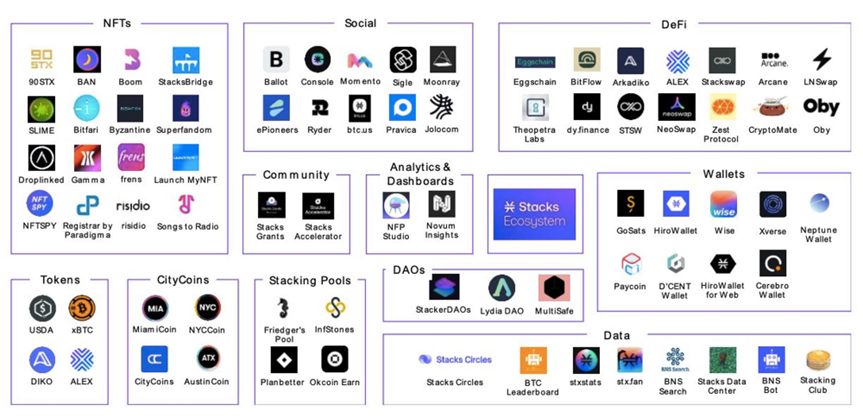
The purpose of Stacks is to establish a programmable, composable ecosystem that inherits the security and decentralization of Bitcoin. With the resurgence of the Bitcoin narrative, the Stacks ecosystem has also experienced a surge in activity. As of now, the total value locked (TVL) in Stacks has surpassed $20 million, recovering nearly half of its historical peak. Additionally, both the number of wallets and smart contracts have shown a significant increase. It is expected that with the reopening of the Bitcoin market, the Stacks ecosystem will attract more projects and developers. Here are a few noteworthy projects in the Stacks ecosystem.
ALEX
Smart contracts for Bitcoin have always been the "holy grail" of the crypto space. However, due to the complexity of BTC asset bridging, the liquidity of BTC assets has not been fully developed, and the BTC ecosystem still holds enormous potential for the crypto lending market. ALEX, as an open-source DeFi protocol based on the Stacks public chain, aims to provide a complete DeFi product for the Bitcoin network, similar to Uniswap on Ethereum.
The underlying integration of the Stacks public chain aims to bridge native Bitcoin with the highest security while supporting decentralized applications and smart contracts. Thousands of transactions on this blockchain will produce a hash on Bitcoin as part of the consensus, and Stacks transactions will automatically "settle" on every Bitcoin block, connecting the Bitcoin network and the Stacks blockchain, and expanding the functionality of Bitcoin. It is due to these aforementioned features of Stacks that low-cost bridging of native Bitcoin becomes possible for ALEX.
The mainnet version of ALEX currently includes features such as Swap, lending, staking, yield farming, and Launchpad. In addition, amidst the hype of BRC20, ALEX has also launched a BRC20 order book exchange. $ALEX is the native token of Alex Labs and serves as a reward medium for providing liquidity and staking on the platform. The current price of $ALEX is $0.06036.
Xverse
Xverse is a company that provides a Bitcoin Web3 wallet supporting Ordinals and BRC-20 tokens. The wallet uses cold storage security technology to ensure the security of user assets. Through Xverse, users can easily manage Bitcoin assets and Stacks-based assets, including Bitcoin and Bitcoin non-fungible tokens (NFTs).
The user interface of Xverse's wallet is simple and easy to use, similar to other Ethereum Virtual Machine (EVM) compatible wallets, using mnemonic phrases for backup and recovery, reducing the entry barrier for usage. Additionally, Xverse allows users to securely manage assets such as Bitcoin on the first layer and Stacks on the second layer network. After creating a wallet, two addresses are automatically generated, one for receiving and sending Bitcoin assets, and the other for managing assets on the Stacks network.
In addition to meeting users' needs for managing Bitcoin and Stacks-based assets, Xverse also features a "stack" function, allowing users to earn Bitcoin rewards by staking Stacks tokens (STX). This provides users with an additional source of income. Currently, Xverse is planning to enable fast BTC payments through the Lightning Network and sBTC. Once implemented, Xverse is undoubtedly set to become the most convenient Bitcoin Web3 wallet in the Stacks ecosystem.
Gamma
Gamma is the largest NFT trading platform in the Stacks ecosystem, consisting of three core products: an NFT marketplace, Launchpad, and a social platform. Gamma aims to bring together collectors, creators, and investors in the Bitcoin ecosystem to explore, trade, and showcase NFTs.
With the rise of Ordinals, NFT activities on Stacks have been gradually increasing. The Gamma platform supports the transfer of Stacks ecosystem tokens and plans to support Stacks NFT trading in the future. In recent weeks, trading volume on Gamma has seen continuous growth. Users can use the Gamma bot to mint unique digital works for collection or sale. With Gamma.io's code-free Bitcoin NFT creation tool, users can create NFTs in just a few minutes.
GAMMA is the native token of Gamma, designed for protocol-managed, automated, and actively managed centralized liquidity, allowing users to stake GAMMA and receive 10% of the fees from all liquidity pools on Gamma as rewards. The current price of the GAMMA token is $0.2327.
免责声明:本文章仅代表作者个人观点,不代表本平台的立场和观点。本文章仅供信息分享,不构成对任何人的任何投资建议。用户与作者之间的任何争议,与本平台无关。如网页中刊载的文章或图片涉及侵权,请提供相关的权利证明和身份证明发送邮件到support@aicoin.com,本平台相关工作人员将会进行核查。