The original author: Luo Jia Micro
Celestia (TIA) airdrop was officially distributed on October 31st, and many on-chain users received TIA token airdrops, with some users receiving airdrops in multiple wallet addresses. How to consolidate TIA tokens from multiple addresses without being identified as a witch account? Can multiple address deposits effectively avoid the project's anti-witch judgment? Which exchange has a better multi-address deposit feature? This article will provide a detailed explanation of the advantages and usage of multi-address deposits, teaching you how to properly claim airdrops.
1. Current inconveniences of claiming airdrops
The so-called witch account refers to a person controlling multiple on-chain addresses, pretending to be different users for interaction. For the project team, the behavior of witches actually disrupts the decentralization process of the project. Therefore, during the airdrop distribution process, the project team may actively screen for witches, or they may be reported by the community, leading to the cancellation of their airdrop eligibility.
In order to obtain more airdrop eligibility, a user usually uses one address to frequently send/consolidate assets to multiple addresses, and such on-chain behavior can easily be identified as a witch account, resulting in the loss of airdrop eligibility.
2. Advantages of multi-address deposits
To prevent the project team's witch judgment, the most important thing is to isolate addresses. In simple terms, do not distribute/consolidate funds on-chain, but generate multiple different addresses through exchanges for consolidation to avoid this problem.
Therefore, the application of multi-address deposits is born, its greatest advantage is the ability to generate different addresses for distributing/consolidating funds, avoiding being judged as a witch account by the project team. In addition, multi-address deposits also provide higher security and privacy. Each account (including sub-accounts) can add multiple independent deposit addresses. Each deposit provides multiple addresses for users to choose from, making it difficult to trace the user's transactions, thereby increasing the level of privacy protection.
3. Comparison of multi-address deposit features of various exchanges
Currently, several mainstream centralized trading platforms have launched multi-address deposit features, including Binance, Bitget, and OKX. The following is a comparison of the multi-address deposit features of these exchanges.
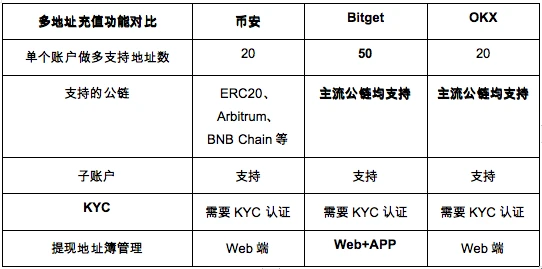
The multi-address deposit features of these three exchanges are similar. Comparatively, Bitget supports a greater number of addresses for a single account, with one account able to generate 50 separate addresses, making it more convenient to use without the need to switch between multiple sub-accounts. In terms of the number of supported public chains, Bitget and OKX also support more, providing users with a wider range of options. Therefore, if there are higher requirements for the number of addresses and supported public chains, it is recommended to choose Bitget and OKX.
In addition, another important aspect of anti-witch behavior is: do not choose the same amount for transfers and withdrawals, use random amounts and random times; do not have multiple accounts perform the same path of on-chain interaction at the same time, such as multiple accounts conducting the same sequence of interactions with several DeFi platforms in a day. By following these guidelines, you can effectively avoid being identified as a witch, and the probability of receiving airdrops will also greatly increase.
免责声明:本文章仅代表作者个人观点,不代表本平台的立场和观点。本文章仅供信息分享,不构成对任何人的任何投资建议。用户与作者之间的任何争议,与本平台无关。如网页中刊载的文章或图片涉及侵权,请提供相关的权利证明和身份证明发送邮件到support@aicoin.com,本平台相关工作人员将会进行核查。


