Interview, Editing: Jack, BlockBeats, Vision, Metastone
Organization: Sharon, Kaori, BlockBeats
Market Makers, or Liquidity Providers, focus on providing liquidity to the market to ensure the healthy development and stable operation of projects. In the traditional financial field, market makers are subject to strict regulation; however, in the crypto industry, the development of market makers appears to be quite "wild," which has led to criticism such as "contributing to the collapse of many projects," "intermediaries profiting from spreads," and "creating a false prosperity" in this niche industry.
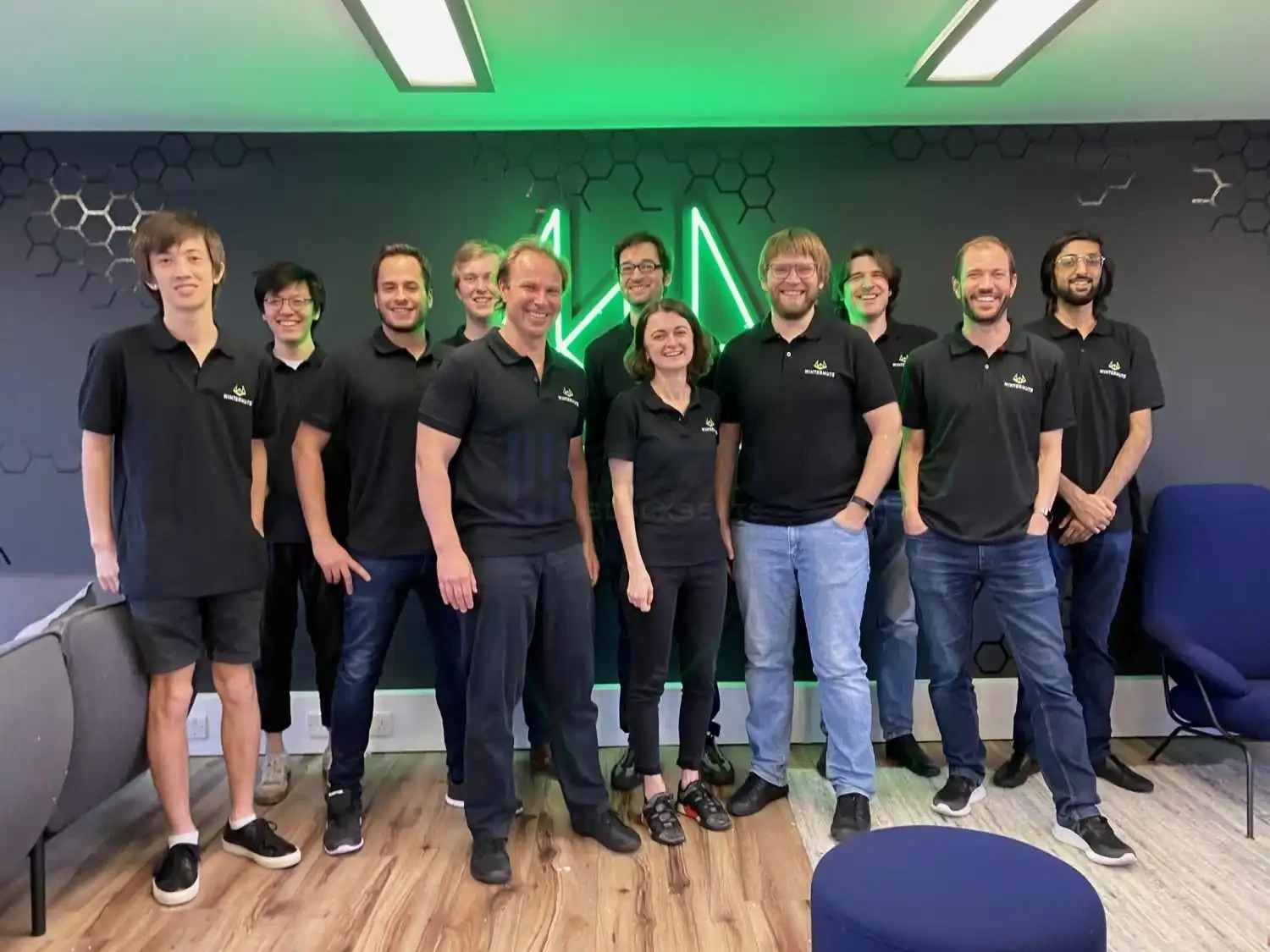
The bankruptcy of FTX, a series of major platforms suffering heavy losses, and market makers and lending becoming disaster areas have made it difficult for the general public to understand market makers, feeling like playing a game of blind man's bluff. Behind all the controversies, regarding regulation, liquidity, and competition, what are the thoughts of market makers? At the TOKEN 2049 conference, BlockBeats exclusively interviewed Yoann Turpin, co-founder of the well-known crypto market maker Wintermute.
Wintermute is one of the most well-known market makers in the cryptocurrency field, having participated in market making for projects such as dYdX, OP, BLUR, ARB, and APE. Its co-founder, Yoann Turpin, graduated from EDHEC Business School and has held positions such as co-founder and CFO of Innovify and founder of Kaifuku Capital.
Maintaining "Market Neutrality"
How large is Wintermute currently? According to information on the Wintermute official website, as of the time of writing, its cumulative trading volume has exceeded $20 trillion. According to watchers data, Wintermute's largest trading asset currently comes from Ethereum, but this accounts for less than 1% of its token portfolio's volume.
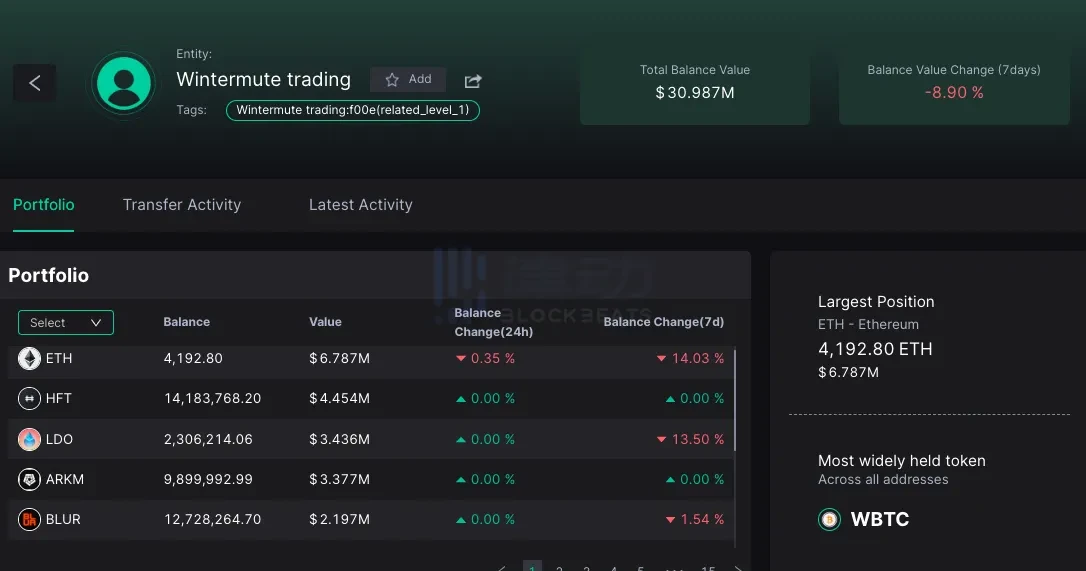
Image Source: watchers
BlockBeats: Please introduce yourself and Wintermute.
Yoann: We co-founded Wintermute in 2017, and now we have a team of nearly 100 people. Compared to the 20 people in 2021, our scale has grown considerably, reflecting changes in Wintermute's form. We are striving to become a more diverse platform, focusing more on trading markets. In 2021, we entered the derivatives market in Singapore.
We are increasingly involved in over-the-counter trading, so we have more clients, but we actually face counterparties, and we trade on our proprietary accounts. Wintermute has now become the world's largest spot market maker, accounting for 16% to 20% of the total trading volume. In the derivatives market, we rank in the top 5 in options. We are very active in investments, with approximately 100 investment projects, which means we have about $100 million on the balance sheet of various venture capital assets.
We have also incubated some projects, such as Bebop. In addition, we are increasingly involved in public investments. Wintermute hopes to maintain the company's scale at a relatively small level, so that we can focus enough on a goal. Once you have two or three businesses within the same company, things can get a bit chaotic, so we believe the best approach is to spin things off or have others support the execution of these ideas. You will see some results in the coming weeks, with more frameworks for incubation and exploration.
As a co-founder, I am mainly focused on venture trading and business development trading, especially in the Asian region, which means I will be doing a lot of exploration in Korea. I visited Japan and Peru earlier this year, and will go to New York next year. We will be back and forth in Hong Kong, and in the coming years, we will try to explore the Southeast Asian market, including Indonesia.
Avoiding Overexpansion
BlockBeats: How did you weather the bear market? What strategies will Wintermute adopt during the DeFi liquidation process, and what impact will on-chain derivatives have on the subsequent market?
Yoann: Basically, when the market falls, we will start buying first, because people will also actively push us into a position, and we are basically forced to go long, and then buy and sell. Our idea is that even if we may lose on long positions, we can make enough money to make up for the loss through the spread from buying and selling. This is how we weather the bear market.
Regarding DeFi, this is an interesting question, because sometimes people misunderstand that we are selling on DeFi protocols. What they see online is actually more about buying on CeFi and then putting it into DeFi, because DeFi has more abundant liquidity. Perhaps we just bought a lot of tokens on Binance or other exchanges, and then we have to sell them somewhere, and DeFi also comes into play in this regard. But overall, we remain very "market-neutral." Market neutrality means that we do not make money by going long or short, but by making money through hundreds of thousands of trades every day to capture spreads.
BlockBeats: In fact, regarding the follow-up question about this, I remember a few months ago there was a huge market crash, and there were rumors that it might have been caused by liquidation providers or market makers withdrawing from the market, one of which might have been Wintermute. How do you view this?
Yoann: As the largest spot liquidity provider, people would think of us when a huge crash occurs, but in reality, we are doing very well. Market trends will fluctuate, and the entire market has wealth effects. Imagine that we operate very well in a team of less than 100 people. Our competitors have 200-500 employees. I think their market opportunities may be the same or even lower. This is because we manage cash very well, and we do not want to overexpand. Although our performance may not be as good as other companies in the crypto industry in the summer, in 2021, we did not overexpand, and our business model survived the winter (compared to other competitors).
Choosing Tokens Based on Their Scale and Longevity
BlockBeats: What criteria do you consider when choosing trading tokens? Do you need to borrow from foundations to start trading? For example, which tokens do you like? Any preferences? What assets do you decide to become market makers and provide liquidity for?
Yoann: Obviously, this is more like a partnership. We borrow assets from foundations, and we hope that the interests of all parties can be aligned, without occupying too high a percentage of the diluted value. So we need to borrow at least 2 to 3 million dollars of a certain token to have an impact on the business level. But we also do not want to borrow more than 2 to 3% of the FDV, so when we choose, the project's scale must be large enough. Basically, the FDV of the projects we choose needs to exceed $100 million. If they are already listed, they need to have enough presence on the exchange. Usually, people come to us because they need a reputable market maker to help them list on other exchanges.
Our trading volume on some exchanges can account for 10%, 20%, 30%, or even 60%. This is a close partnership between us and the exchanges. The standard is that most T1 teams will provide liquidity. We just need to ensure that the team meets good standards and whether they are committed to long-term development. At the same time, there are also business considerations, needing enough trading potential or existing trades.
BlockBeats: Can you still make money in extreme situations? For example, in the case of a sharp price drop?
Yoann: In the case of a sharp price drop, we usually have enough structure to profit from it, but a sharp price drop is basically bad for everyone. Because a sharp price drop means that some people are liquidated, and these funds have essentially been lost. But even in the traditional financial field, you will see this situation. (When the market is not good), we see the government's balance sheet increasing just like at that time. So basically, the better we do, the smaller the impact of liquidation on the market, I mean it's a balance, but there will also be better prices entering the market.
Ethical Self-Regulation Achieves Self-Supervision
Feuds with DWF Labs
In the niche field of market makers, in addition to Wintermute, one cannot fail to mention one of its competitors, DWF Labs. The two companies staged a public dispute in March this year, with DWF Labs accusing Wintermute of instigating the blockchain media The Block to smear them, and Wintermute questioning DWF Labs' malicious intentions and security risks. In response, Yoann also stated that DWF Labs treats "over-the-counter trading as investment," which fundamentally poses a problem.
Related Reading: "DWF Labs and Wintermute Publicly Feud? An Overview of the Market Making Projects of the Two Major Market Makers"
BlockBeats: What is your opinion of DWF Labs? Because I know you have strong opinions about their approach. Do you think this is market manipulation? Do you think they are market makers?
Yoann: In our terms, they are not market makers, but where they confuse many people is that they declare over-the-counter trading as investment. People usually think that investments always have a long-term nature, while trading is more short-term. But if you announce an investment and then sell it immediately after the announcement, it's hard to (consider it an investment). In many ways, this is the nature of the open and almost permissionless system we are in. There are also some more obvious cases, such as involving various bans and fundraising. Like, you will see people randomly sending cryptocurrencies to influence certain (negative) things, and the reasons are not sufficient.
I believe it is best to maintain the openness of the system, and people should increasingly understand where they are sending their funds. I think (the industry) needs some mild regulation because you certainly do not want bad actors. In fact, this is just repeating some of the mistakes of traditional finance, such as excluding many people from the banking industry. So the crypto industry needs to find a balance in it, and this balance will eventually be achieved over time. This is also the reason we set out. Is ethical self-regulation achieving self-supervision?
The biggest criticism of market makers in the market is that there are a large number of people who "manipulate the market" rather than "provide liquidity to guide the market's healthy development." Wintermute prefers to position itself as a "liquidity provider" rather than a "market maker," and currently, Wintermute achieves self-supervision through the ethical self-regulation of the entire company.
Staying Away from the US Market to Avoid Regulatory Issues
BlockBeats: The next question is about regulation. If the SEC strengthens regulation and begins to focus on tokens or NFTs, will this fundamentally change Web3? I want to know your thoughts on this.
Yoann: In 2021, we did not deal with the SEC at all, so we intentionally decided to register for spot trading in the UK; and in the UK, they explicitly stated that they do not want to provide derivatives to retail, so we completely avoid this risk by putting the derivatives business in Singapore. But in the US, we have almost no business because all our business activities basically happen outside the US. So in many ways, we intentionally avoid (SEC regulation) this issue, and we are actually now more focused on Asia, so we moved to Singapore.
Positioning as "Liquidity Providers" Rather Than "Market Makers"
BlockBeats: Another point about regulation is that in the traditional financial field, the role of market makers is subject to strict regulation; but in the crypto field, many market makers are to some extent not regulated and they also collaborate with exchanges. So can you talk about the issue of market maker regulation in the crypto industry?
Yoann: Generally, those who are unethical, whether in brand development or business expansion, will be exposed and will not have a good ending. Usually, we decide to operate a very conscious and ethical business, doing everything we can to be as ethical as possible, which actually goes beyond the categories of "legal" and "illegal." Everything we do is legal, but beyond that, just because something is not illegal does not mean it is right, so we consider more aspects such as the consistency of long-term interests.
In fact, a lot of education is needed in the crypto field, which is very time-consuming and difficult. Some of the work I am doing now is to ensure that we are not misunderstood. We largely stopped using the term "market maker" to describe ourselves and only use "liquidity provider" (to describe ourselves), which is also completely applicable in traditional finance.
There may be a point of confusion in the crypto field because liquidity providers are sometimes seen as "more passive LPs in DeFi AMM pools," but in reality, what we do a lot is provide liquidity, help discover prices, and strive to find the true price of a token at any time. Some who claim to be market makers actually do not make an effort to help find the true pricing of tokens, which is completely the opposite for the ecosystem. But I think these issues will be gradually resolved over time, and the opportunity for resolution depends on one's own hardcore competitiveness and the ability to operate the business honestly and correctly.
Of course, you cannot expect everyone to maintain noble ethical standards or to comply with rules. We have this requirement for our own team. Internally, we have obviously achieved this and require people to maintain quite high standards. But for other participants? For competitors, we only have one rule, basically dividing competitors into good and bad, and we do not rush to judge people too quickly because reality is often more complex and has more gray areas than people say.
So we believe that for good competitors, we invest together with them. For example, if we borrow funds from a foundation, and they need another liquidity provider to provide liquidity for their token, we sometimes recommend other competitors to each other. So in this sense, there is competition. But only those we believe have been around for a long time and can truly get the job done and have synergies in most cases are included in what we consider to be "good competitors." However, even within the category of good competitors, if you dig deeper, we actually provide quite different services. We focus very much on engineering, primarily building, which is why we have only about 8 people in business expansion, including me, it's 9 people.
Solana or Successor to Polkadot
Yoann also discussed the future of public chains in this interview. According to defiLlama information, currently, in terms of locked-in volume, Ethereum still ranks first, but Yoann believes that Solana is likely to replace Polygon as the public chain with the second most influence after Ethereum.
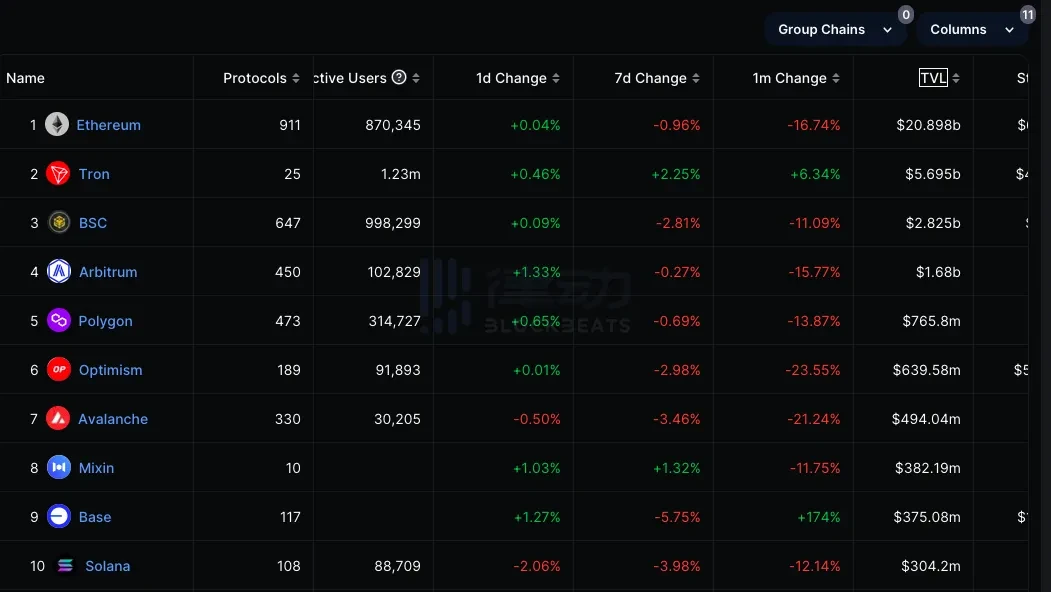
Image Source: defiLlama
BlockBeats: The last question is, we know that Concensys has launched Linea, Coinbase has launched Base, and Layer 2 is emerging in the market. Modular blockchains have become an important way to expand Ethereum. What are your thoughts on this trend? Do you have other strategies for positioning in Layer 2 or blockchain?
Yoann: Regarding Layer 2, the disclaimer is very clear, we have invested in almost all projects, except for StarkWare. It's not that StarkWare is a bad solution, it's just that when we understood StarkWare, it was already valued at $20 billion, and we tend to prefer earlier investments. In addition, due to our choices in the DeFi field, we are often invited to integrate with various Layer 1 and Layer 2 projects because now a lot of value largely comes from trading.
As for Coinbase, I think over the years, Coinbase has actually been intentionally supporting DeFi and strengthening this aspect, so I am not surprised by their actions. For us, we always face a dilemma, which is choosing which chain to integrate and trade with. We are successful in business, but we also face the same problems as the entire industry, which is it is difficult to find reliable smart contract developers.
BlockBeats: We have seen some trends of returning to Ethereum, and it seems that EVM compatibility is actually very important, just because Ethereum has the largest developer community. I remember that Polkadot used to have the second largest developer community, but now the situation is different. Which chain do you think might be the next influential one?
Yoann: I would say, after Polkadot, it might be Solana. But even with Solana, it's hard to verify the numbers because if you consider Solana's developers, many teams participate in hackathons, build the first app on Solana, and then consider that the app is not specific enough, and then turn to build other apps.
Last year, we invested in three teams that participated in hackathons on Solana and eventually developed there. So you will see many situations where the authenticity of the data is difficult to determine. But Ethereum can be said to be the leading platform in building applications, although there are other teams, such as many teams are working to achieve Bitcoin's functionality. So that's another aspect. We see progress in engineering, but it's not necessarily progress in trading.
免责声明:本文章仅代表作者个人观点,不代表本平台的立场和观点。本文章仅供信息分享,不构成对任何人的任何投资建议。用户与作者之间的任何争议,与本平台无关。如网页中刊载的文章或图片涉及侵权,请提供相关的权利证明和身份证明发送邮件到support@aicoin.com,本平台相关工作人员将会进行核查。