Original: "AdeepdiveonSolana,ahighperformanceblockchainnetwork”
Authors: Mustafa Bedawala, Arjuna Wijeyekoon
Translation: Odaily Planet Daily

As the FTX incident continues to ferment, Solana occasionally returns to the public eye.
Data shows that although the number of daily active addresses on the Solana network hit a new low for the year, the TVL has grown by over 150% since the beginning of the year. Meanwhile, MakerDao is also planning to migrate to Solana, and last week Visa chose Solana as the public chain for its pilot transaction of USDC. Solana, which has gone through hardships, seems to be regaining vitality.
Of course, the above does not mean that Solana already has the ability to compete with the "Ethereum-centric multi-L2 universe," but perhaps people's patience for the "king of public chains" is also running thin. Visa, which has experimented with both Ethereum and Solana, recently published a research report on Solana, interpreting its high throughput, low cost, and robust node infrastructure.
Odaily Planet Daily now presents the essence of the paper in translation.
Blockchain networks have long been proposed as new innovative payment channels. However, they have faced difficulties in scaling over the years, failing to meet the desired transaction characteristics of security, high throughput, and low cost for consumers. Over the past year, our Visa team has been closely monitoring the technological innovations behind blockchain scalability and has been encouraged by the significant progress made on new L2 networks on Ethereum and alternative blockchain networks built from scratch.
Our goal is to deeply understand the technical attributes of blockchain and attempt to leverage them to enhance our existing network and build new products for commercial and fund flows.
While we believe that the payment ecosystem may use multiple blockchain networks, we believe that the Solana blockchain network has the potential to become one of the networks that help drive mainstream payment processes. With its speed, scalability, and low transaction costs, Solana has the potential to meet payment needs and help establish itself as an efficient blockchain settlement channel for stablecoins like USDC. The Solana blockchain network combines many key features and novel innovations that are worth exploring for anyone interested in payment technology.
Visa-scale transaction throughput
As a global payment network, Visa has the ability to process over 65,000 transactions per second. While Solana has not yet achieved the large-scale transaction execution of Visa, it averages 400 user-generated transactions per second (TPS), which can surge to over 2,000 user-generated TPS during peak demand. This is a significant level of throughput that can support testing and pilot payment use cases. In comparison, Ethereum averages about 12 TPS, and Bitcoin is at 7.
Parallel transaction processing
As the foundation of its high transaction throughput design, Solana can process transactions in parallel, greatly enhancing the network's efficiency. Transactions affecting different accounts can be executed simultaneously, enabling Solana to effectively support many other-party payments and settlement scenarios that occur primarily between two parties or in a single direction.
In Solana, smart contracts can also be executed in parallel. Transactions specify the states or accounts they interact with, allowing validators to run non-conflicting transactions simultaneously. Unlike other chains such as Ethereum that use a single-thread model, Solana employs a multi-threaded approach to achieve parallel transaction execution. In simple terms, while blockchains like Bitcoin and Ethereum process transactions sequentially, Solana's architecture allows for the simultaneous processing of multiple transactions. This design helps prevent congestion in one part of the network from affecting the overall network performance.
Low and predictable transaction costs contribute to payment efficiency
In terms of cost, Solana's transaction fees are not only affordable (usually less than $0.001), but also predictable. This low cost and predictability make it an attractive network that can enhance the efficiency of existing payment operations and save costs.
From a cost perspective, Solana stands out compared to Bitcoin and Ethereum, whose transaction fees may fluctuate unpredictably based on transaction demand on the network. A network with unpredictable transaction costs may make it more difficult for payment companies to manage in their products and could lead to a confusing consumer experience.
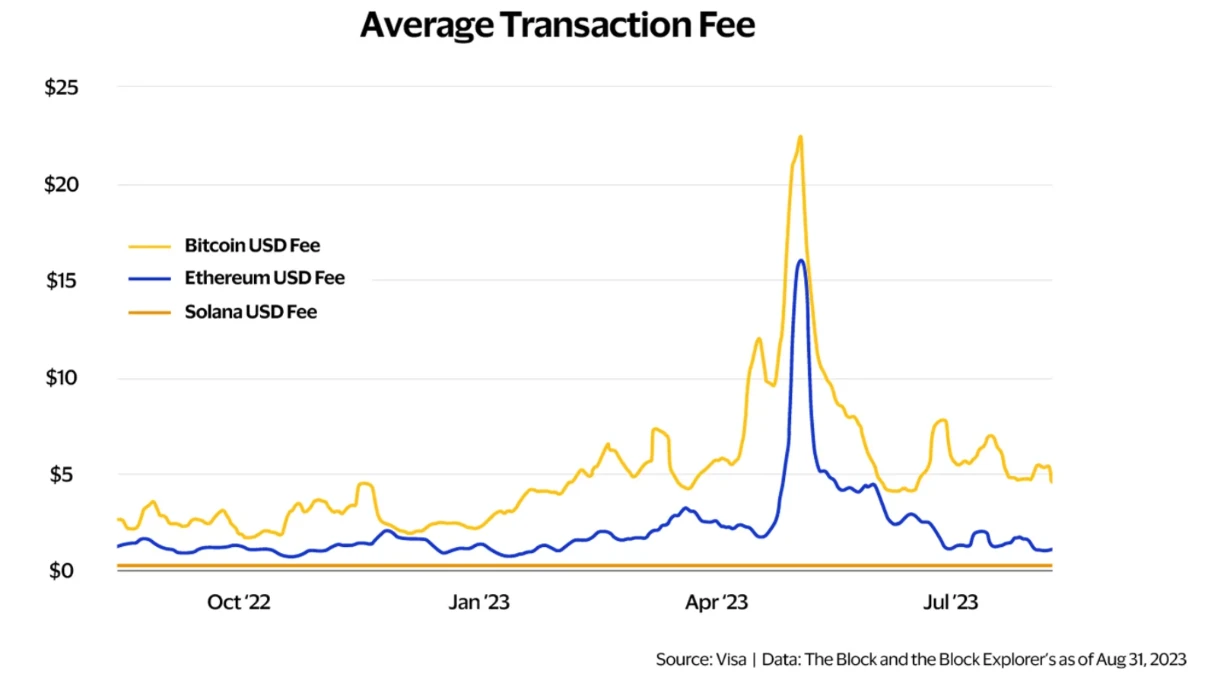
Achieving cost predictability through a localized fee market
Solana's localized fee market is unique in the blockchain space. This innovation is closely related to Solana's parallel processing capability, where non-overlapping transactions are executed on different threads, similar to vehicles traveling on different roads. Network congestion is a significant reason why other blockchain networks may increase fees, which could have negative impacts on the entire system. A surge in the popularity of an NFT release could increase network congestion, making peer-to-peer transactions occurring simultaneously more expensive, or even economically infeasible. The following image compares fee markets (Solana versus Ethereum and other gas-based networks).
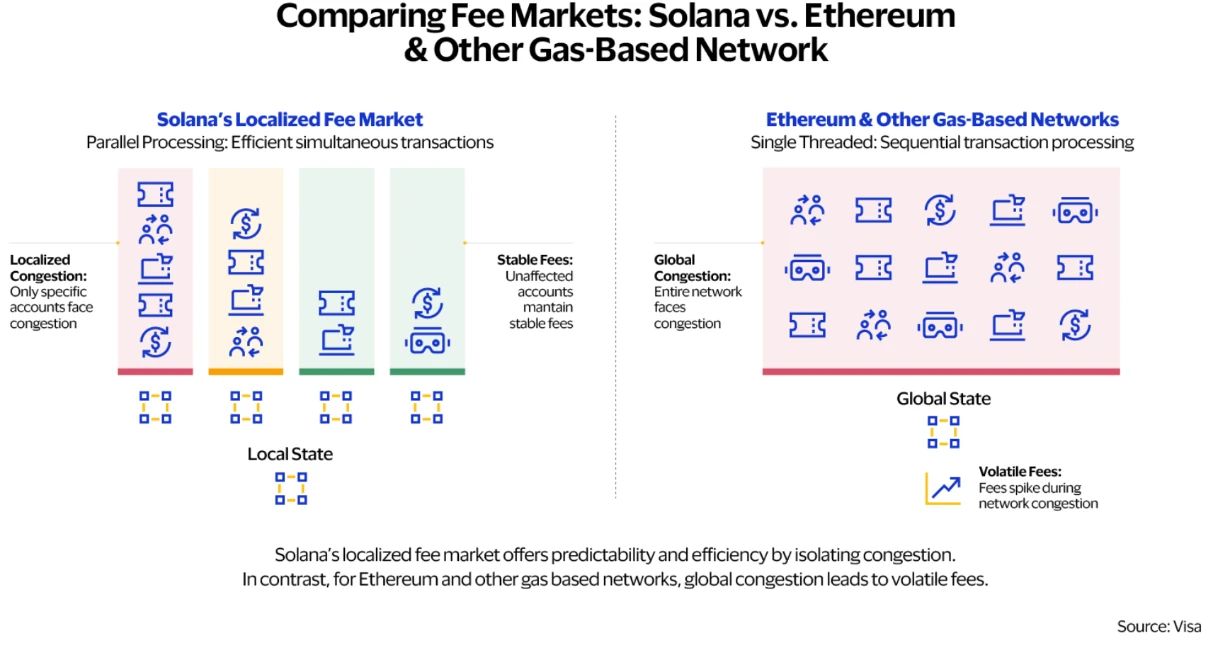
Solana's approach ensures that congestion in one account (e.g., Alice's USDC balance) does not affect other accounts (e.g., Bob's USDC balance). If an account becomes busy due to high demand for a specific asset (e.g., an NFT), only the fees for that specific account increase. The fees for other accounts are not affected by this congestion and remain stable. By allowing the parallel execution of computations with different states, Solana can create a fee market based on "state contention" regions, rather than a single global fee market.
Consumer expectations of transaction finality
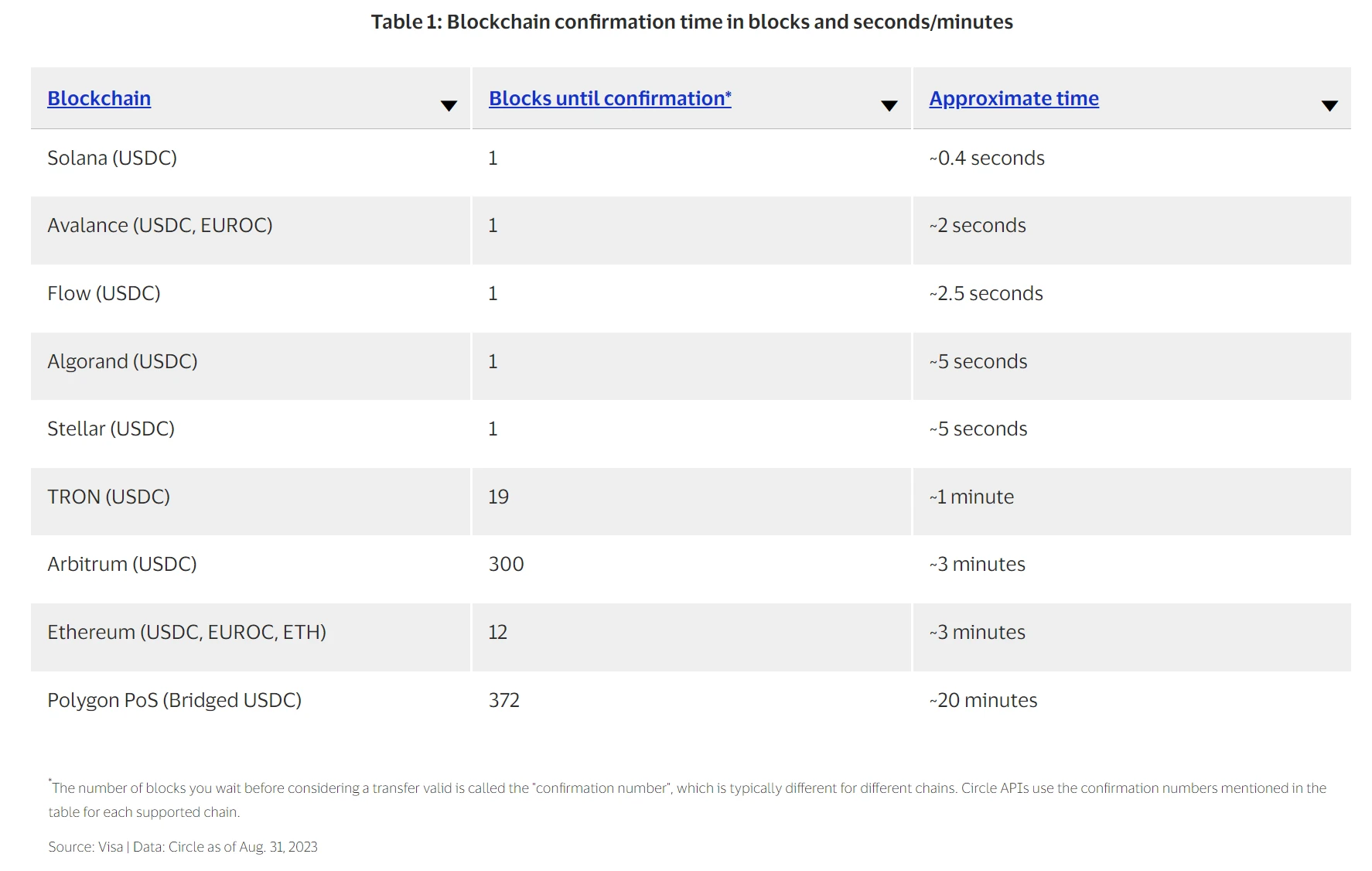
Transaction finality measures the speed at which users can expect their operations to be confirmed on a blockchain network. For payments, the time it takes to confirm transactions is equally important as network throughput. For example, Ethereum averages about 12 transactions per second, but during congested periods, users may have to wait several minutes for transaction confirmation due to gas limits and smart contract demands. Solana aims for a time period of about 400 milliseconds, which can practically range from 500 to 600 milliseconds.
The vast majority of applications on Solana use "optimistic confirmation" to achieve finality. Optimistic confirmation is a mechanism used on the Solana blockchain that achieves finality before all validators (or entities responsible for generating blocks) vote. Through optimistic confirmation, if over two-thirds of the delegated stake validators vote on a block and no block that has been optimistically confirmed is rolled back or fails to finalize, then that block can be considered finalized.
This mechanism allows Solana to achieve finality faster than many other blockchains. Faster transaction completion can provide a better payment experience. In contrast, Bitcoin may require up to 60 minutes to create an additional six blocks before a transaction is considered secure and final. The following image illustrates the block generation times of different chains.
Availability: A large number of nodes and multiple validator clients
A payment network can only be effective if it is consistently available when users need to make payments. For a blockchain network, availability is best measured by the number of independent participants or nodes running the network for consumers to initiate transactions.
As of July 2023, the Solana network has an impressive 1,893 active validators—entities responsible for generating and voting on blocks. Additionally, there are 925 nodes called RPC nodes, which may not create blocks themselves but maintain local records of transactions.
Having a large number of nodes in a blockchain network enhances its resilience and redundancy. If some nodes encounter issues or go offline, as long as a sufficient number of nodes remain operational, the network can still function normally without data loss. The Solana community also emphasizes the diversity of node geographical locations and infrastructure providers to make the network more resilient to events such as natural disasters or changes in provider access policies. The Solana network has nodes in over 40 different countries and has hundreds of unique hosting arrangements and different locations. This helps ensure the smooth and reliable operation of the network, even in the face of technical challenges.
Validator clients are software tools that enable node operators to act as validators on proof-of-stake blockchains. The diversity of validator clients increases the network's resilience. While one client may have errors or vulnerabilities, another client may not. This ultimately reduces the likelihood of a single software flaw crippling the network.
Initially, Solana only used a validator client provided by Solana Labs. In August 2022, JitoLabs launched the second mainnet validator client, Jito-Solana. Shortly thereafter, JumpCrypto introduced Firedancer (in the testing phase), an independent C++ validator client. Firedancer stood out for its potential significant performance improvements, demonstrated by achieving 600,000 TPS in real-time. The goal of having different validator clients is to maintain the stability of the network. Apart from Ethereum, Solana is one of the few chains with multiple completely independent validator clients.
Meeting modern demands
Solana's unique technical advantages, including high throughput parallel processing, low cost localized fee market, and high resilience with a large number of nodes and multiple validator clients, collectively create a compelling value proposition for a scalable blockchain platform for payments. These are some of the reasons why we decided to expand our stablecoin settlement pilot project to the Solana network. When piloting our stablecoin settlement feature on Solana, we plan to test whether Solana has the capability to meet the needs of modern enterprise financial operations.
免责声明:本文章仅代表作者个人观点,不代表本平台的立场和观点。本文章仅供信息分享,不构成对任何人的任何投资建议。用户与作者之间的任何争议,与本平台无关。如网页中刊载的文章或图片涉及侵权,请提供相关的权利证明和身份证明发送邮件到support@aicoin.com,本平台相关工作人员将会进行核查。


