Title: Ethereum's Rollups are Centralized: A Look Into Decentralized Sequencers
Source: Binance Research
1. Key Points
❖ Transaction sequencing has become an increasingly serious issue in the second layer ("L2") space. The primary role of L2 rollups is to provide a secure venue for low-cost transactions. L2 rollups provide an execution layer for users and then submit their transaction data to the superior first layer ("L1"), such as Ethereum's Arbitrum, Optimism, zkSync, etc.
❖ Sequencers are entities with the authority to group these transactions into ordered batches. Sequencers receive unordered transactions from users, process them off-chain into batches, and generate a batch of compressed ordered transactions. These transactions can then be included in blocks and sent to the parent L1.
❖ Rollups do not actually require sequencers; this is just a design choice aimed at providing users with a better experience in terms of lower fees and faster transaction confirmation. For example, just as most rollups use the Ethereum base layer for data availability, they can also use it for sequencing. However, the Ethereum base layer may be relatively inefficient and expensive. This means that, to date, every major L2 rollup project has found that running a centralized sequencer is more convenient, cheaper, and more user-friendly.
❖ Since sequencers control the sequencing of transactions, they have the authority to censor user transactions (although complete censorship is unlikely as users can directly submit transactions to L1). Sequencers can also extract maximum extractable value ("MEV"), which may result in economic losses for user groups. Additionally, liveness may also be a significant issue, as if the sole centralized sequencer goes down, users will be unable to use the sequencer, impacting the entire rollup.
❖ The solution to the problem is a shared, decentralized sequencer. A shared sequencer essentially provides decentralized services for rollups. In addition to addressing issues such as censorship, MEV extraction, and liveness, shared sequencers also introduce cross-rollup functionality, opening up various new possibilities. Projects such as Espresso, Astria, and Radius are developing innovative shared sequencing solutions, each with unique features in their respective architectures. Espresso aims to leverage EigenLayer to guide its network, while Astria maintains close ties with the modular data availability network Celestia. Radius brings its unique encrypted mempool into the conversation.
2. Introduction
As the Ethereum L2 rollup ecosystem continues to grow, one often overlooked aspect is the sequencer. Sequencers are responsible for transaction sequencing, and using a sequencer with rollups can provide a better user experience, lower costs, and faster transaction confirmation. However, the issue lies in the fact that, to date, all major Ethereum L2 companies have found that running their own centralized sequencer is the most convenient, user-friendly, and cost-effective. Considering the power sequencers hold in terms of transaction censorship, MEV extraction, and creating single points of failure (i.e., liveness issues), this may be seen as an undesirable outcome and not in line with the spirit of cryptocurrencies.
While most cryptocurrency companies have already addressed the decentralization of their respective sequencers and included it as part of their roadmap, there has not yet been a true consensus on how to achieve decentralization. It should also be noted that both Arbitrum and Optimism have launched their own solutions since the second half of 2021, and it can be said that they have not made substantial progress in decentralized sequencers.
In this report, we will carefully examine the role of sequencers in the Ethereum rollup space. Then, we delve into projects researching solutions, namely decentralized shared sequencing networks. We will provide detailed introductions to these projects and the uniqueness of their solutions. We also contemplate what this means for the future development of the Ethereum L2 rollup space.
3. What is a Sequencer?
At its core, a blockchain is a distributed data ledger composed of timestamped transaction data organized into blocks. Initially, this transaction data is unordered and unstructured. Once ordered, it can be organized into blocks and executed to create a new state for the blockchain. For a first layer ("L1") blockchain like Ethereum, this transaction sequencing occurs within the Ethereum base layer itself.
In the most popular scalability solution for Ethereum—Layer-2 ("L2") rollup layer, transaction sequencing has become an increasingly serious issue. Remember, the primary role of rollups is to provide a secure venue for low-cost transactions. Simply put, L2 rollups provide an execution layer for users and then submit their transaction data to the superior L1, such as Ethereum's Arbitrum, Optimism, zkSync, etc. Batches of transactions submitted to L1 typically contain hundreds or thousands of compressed L2 transactions, reducing the cost of sending data to L1.
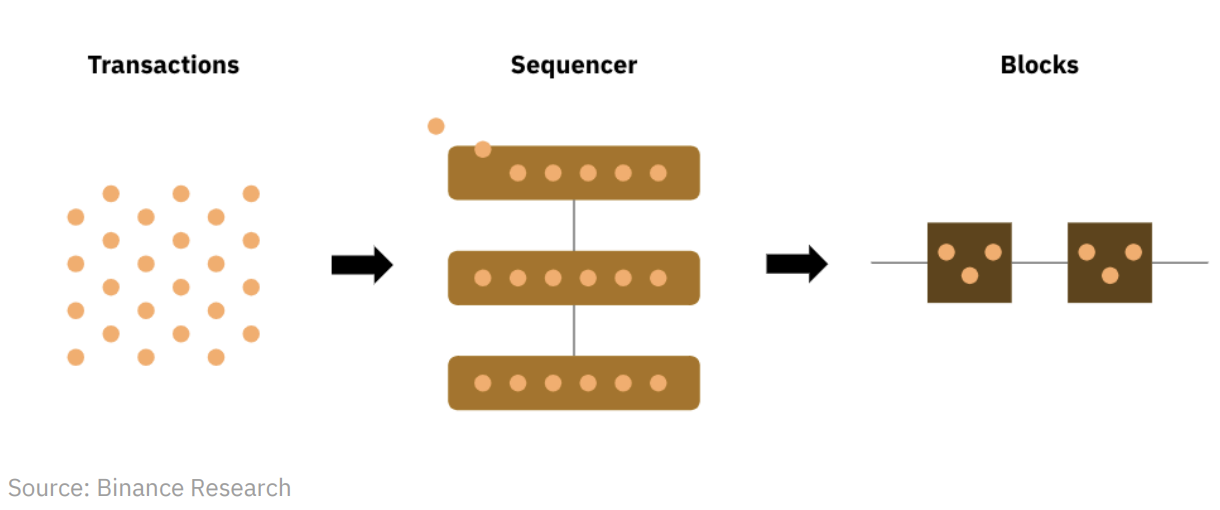
In the L2 rollup world, sequencers are entities with the authority to group transactions into ordered batches. Sequencers receive unordered transactions from users, process them off-chain into batches, and generate a batch of compressed ordered transactions. These transactions can then be included in blocks and sent to the parent L1. Batched transactions can also be used on the data availability ("DA") layer (typically Ethereum for most rollups). It also provides soft commitment to users, meaning that upon receiving a user's transaction, the sequencer provides an almost immediate receipt as "soft confirmation" (1). "Hard confirmation" is received after the transaction is sent to the L1 layer.
Figure 1: Scope of Sequencers?
Why do Rollups use Sequencers, and why is it an issue?
Fundamentally, sequencers have a very clear goal: to improve the user experience. Using sequencers for L2 transactions is akin to using a "fast lane," meaning lower fees and faster transaction confirmation. In fact, sequencers can batch hundreds or thousands (2) of L2 transactions into a single L1 transaction, saving gas fees. Additionally, the soft confirmation provided by sequencers means that rollup transactions can offer users quick block confirmations. This combination helps improve the user experience of using L2 rollups.
It is important to remember that rollups do not require sequencers; it is simply a design choice for a better user experience. For example, just as most rollups use Ethereum L1 to enhance data availability, they can also use it for sequencing. Justin Drake of the Ethereum Foundation recently referred to these as "rollup-based" (3). However, the Ethereum base layer is likely to be relatively inefficient and expensive, especially considering the large volume of L2 transactions. Essentially, the transaction throughput of rollups will be limited by the Ethereum L1 data sequencing rate. To date, every major L2 scaling project has found that running a centralized sequencer is more convenient, cheaper, and more user-friendly. While L2 users can bypass sequencers by directly submitting transactions to L1, they must pay transaction gas fees to L1, and transactions may take longer to finalize. This largely contradicts the original intention of using L2 rollups for transactions.
Figure 2: Sequencers can help aggregate multiple transactions into a single L1 transaction, making transaction costs on L2 several times lower than on Ethereum L1.
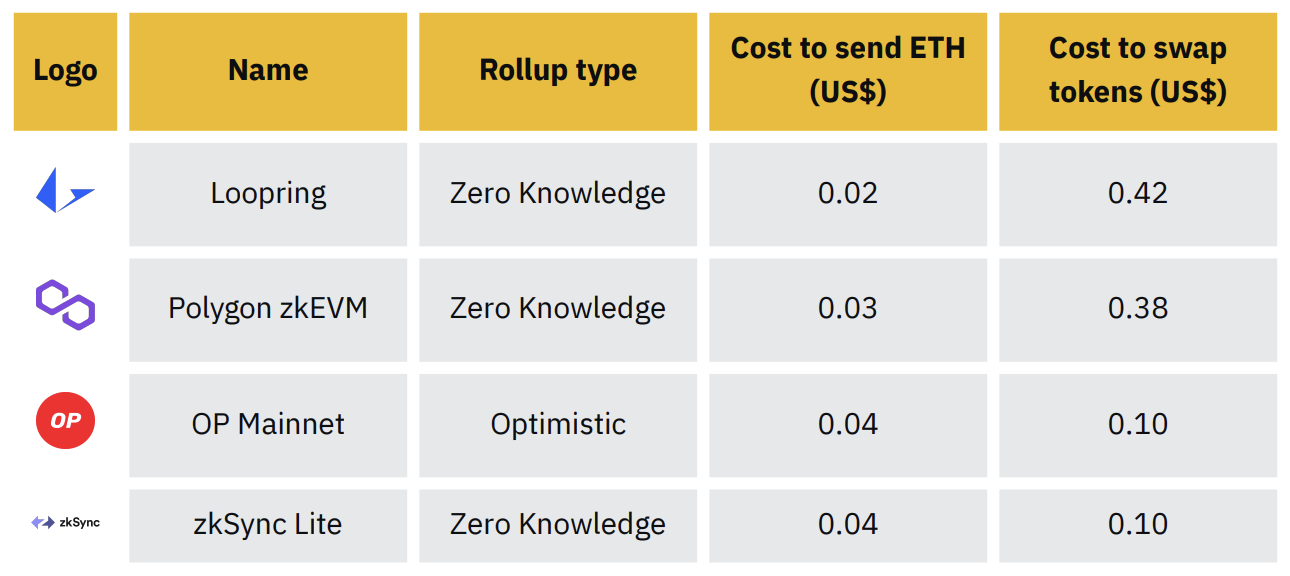
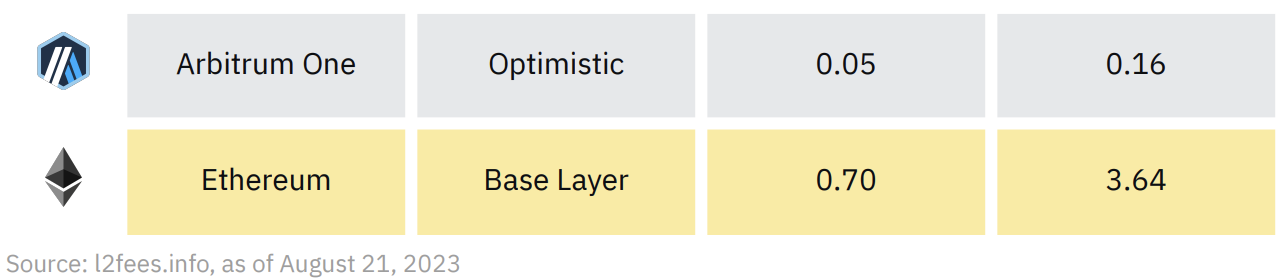
Given that sequencers control the sequencing of transactions, theoretically, they have the authority not to include user transactions (although if users have the capability and willingness to pay gas fees, they can directly submit transactions to L1). Sequencers can also extract MEV from transaction batches, which may result in economic losses for user groups. If there is only one sequencer, as is the case with all major rollup transactions currently, the centralization risk is even greater. In this scenario, liveness may become an issue, meaning that if the sole sequencer fails, the entire rollup will be affected. Having multiple sequencers can reduce this risk.
In this setup, sequencers can be seen as semi-trusted parties for users. While sequencers cannot prevent users from using L2, they can delay user transactions, causing users to pay additional gas fees and extract value from user transactions.
Relevance of MEV
MEV is particularly important here. MEV refers to the value obtained from block production, beyond first-order mining (or staking) block rewards and gas fees. It is obtained by manipulating transactions within blocks, i.e., by including, excluding, and changing transaction order. Common forms of MEV extraction include frontrunning and sandwich attacks.
Given the role sequencers play in L2 rollups, they have visibility into all user transactions off-chain. Additionally, as these sequencers are typically operated by the project itself or affiliated teams, such as the Optimism Foundation for the OP Mainnet (4) and the Arbitrum Foundation for Arbitrum One and Nova (5), many users are concerned about their inability to see potential MEV extraction. Even without these concerns, with projects running their own centralized sequencers, the trust and decentralization of these protocols will also impact users. The credibility and decentralization of these protocols will certainly be questioned.
Current State of the Sequencer Market
At the time of writing this article, all major Ethereum L2 versions rely on centralized sequencers. As more and more Ethereum transactions move to L2 solutions, despite the Ethereum validator set itself being decentralized, it seems that a significant portion of transactions (i.e., those on L2) will be influenced by centralized power in the form of a single sequencer.
Figure 3: All top Ethereum L2 rollups use proprietary centralized sequencers
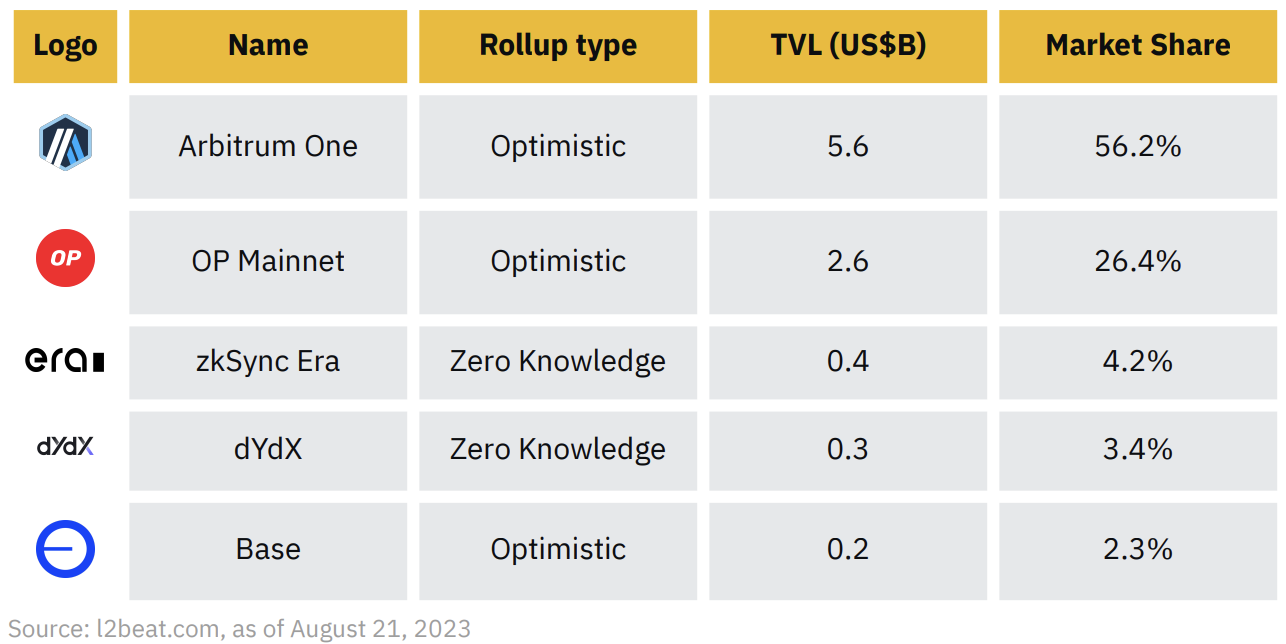
As expected, most of these companies have already addressed the decentralization of their respective sequencers and included it as part of their roadmap. While this is a positive signal indicating that decentralization is part of the L2 vision, it should be noted that Arbitrum and Optimism have already launched their own solutions since the end of 2021, and it can be said that they have not made substantial progress in decentralized sequencers.
Figure 4: All top rollups have addressed the decentralization of sequencers in their documentation
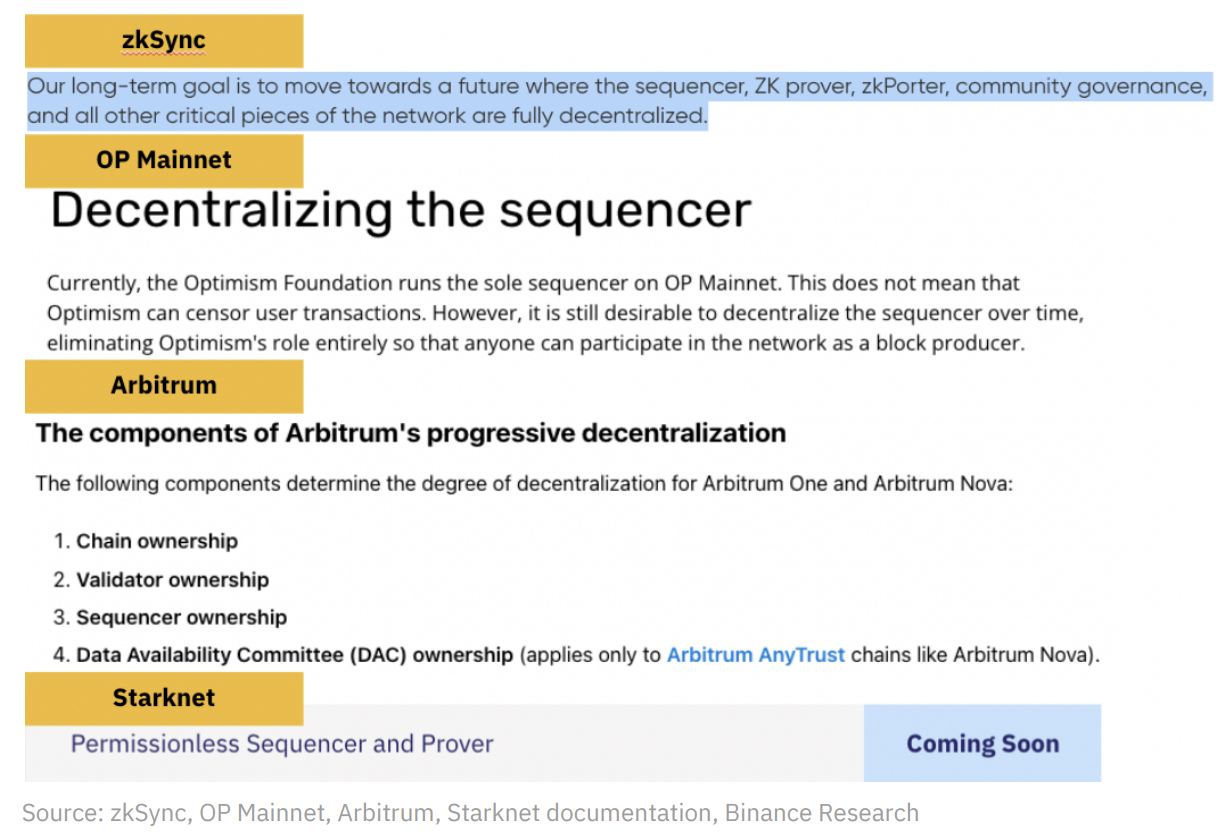
Most top companies seem to be allocating resources to improving their core products and features rather than focusing on decentralization. This is not entirely a criticism, as focusing on decentralization before having a competitive product is not in the best interest of any company in a competitive environment, which is understandable to some extent. However, as network companies mature, this viewpoint is changing, and discussions are rapidly shifting towards decentralized sequencers and increasing credibility.
Other Issues
It is worth emphasizing that there is some discussion about the level of risk associated with relying on centralized sequencers.
As mentioned earlier, since sequencers control the sequencing of transactions, they can exclude user transactions and extract MEV. However, sequencers ultimately cannot completely exclude users from rollup transactions. Users can bypass sequencers and directly submit transactions to L1 (as long as they are willing and willing to pay the additional gas cost). While a misbehaving sequencer may cause transaction delays and additional costs for users, it ultimately cannot completely censor. Prior to this, no major L2 company has been extremely focused on decentralizing its sequencers, which is likely one of the reasons. Nevertheless, sequencers reordering transactions to extract MEV remains a problem, especially with private mempools like OP Mainnet(6).
Perhaps the bigger issue is liveness. Given that major rollup programs are running a single centralized sequencer, if these sequencers encounter issues, the entire rollup program will be adversely affected. While users can still complete transactions by directly accessing L1, this is not a particularly sustainable method and is unlikely to work for most transactions. Remember, the whole point of using L2 rollup is to save transaction costs. Given that one of the fundamental principles behind cryptocurrencies is to prevent reliance on a single centralized provider (as in traditional finance), centralized sequencers are clearly an important issue that needs to be addressed, and one of the key unlocks that shared sequencers will bring to the L2 rollup market.
4. Solution: Decentralized Shared Sequencers
Overview
The new solution to address the above issues is decentralized shared sequencers. While the solutions of different projects are different, the basic idea is to replace the single centralized sequencer. Here, "shared" refers to the ability for multiple different rollups to use the same network, meaning that transactions from multiple rollups will be aggregated in a mempool before sequencing (helping to reduce the potential for MEV extraction and censorship). "Decentralized" refers to the concept of leader rotation, meaning that transactions are not always sequenced by a single actor, but a leader is selected from a decentralized set of actors. This helps prevent censorship and provides liveness guarantees.
This operates very similarly to how different L1s use leader rotation mechanisms. In fact, building a decentralized sequencing layer is similar to building a decentralized L1, requiring the construction of a validator set. As we will see later in this section, different projects have taken different approaches to meet this requirement.
Shared sequencers aim to mitigate MEV extraction issues, provide censorship resistance, and improve the liveness guarantees of rollups, addressing the issues faced by centralized sequencers (as mentioned above). Additionally, there are two points worth noting:
Decentralized as a service: Shared sequencer solutions aim to provide decentralized sequencer services for any number of rollups. Then, all these rollups will benefit from the censorship resistance and liveness that a decentralized network can provide, without having to build the network themselves. Given that this could be a very expensive and time-consuming process, this is a major selling point of the shared sequencer network. Remember, no company has currently decentralized its sequencers, and most of them have enough funding(7)(8)(9) to do so, which means this is not a completely trivial issue. If companies like Astria or Espresso can provide plug-and-play decentralized sequencer services, rollup companies can continue to focus on differentiation and performance optimization to better serve different users.
Cross-rollup composability: Since these shared sequencer solutions aim to handle transaction sequencing for multiple rollups, they can provide unique interoperability guarantees that are currently not available. For example, users should be able to specify that transactions on Rollup 1 can only be included in a block if different transactions on Rollup 2 are also included in the same block. By enabling this conditional transaction inclusion, shared sequencers can unlock new possibilities, including atomic cross-rollup arbitrage.
Many projects are researching shared sequencing solutions. We will focus on several of them and their strategies in the following sections.
Espresso
Espresso Systems is a company dedicated to building tools that bring Web3 into the mainstream, with a particular focus on L2 rollups and the Ethereum ecosystem. Prior to developing the shared sequencer, they have been focused on improving blockchain privacy and have developed the CAPE (10) application. They have also contributed to open-source developer tools through initiatives like the Jellyfish (11) cryptography library and Hyperplonk (12).
In November 2022, Espresso began sharing their work on the Espresso Sequencer.
Overview
The Espresso Sequencer is a decentralized shared sequencing network designed to decentralize rollups while providing secure, high-throughput, low-latency transaction ordering and data availability.
Its design purpose is to handle decentralized sequencing and data availability for rollups, serving as a middleware network between rollups and the underlying L1.
The design of the Espresso Sequencer is agnostic to the virtual machine ("VM"), meaning it can be used for non-Ethereum virtual machines, as well as zero-knowledge ("zk") virtual machines and optimistic virtual machines.
How does it work?
The core of the sequencer is the HotShot consensus protocol. Based on the HotStuff (13) consensus protocol, HotShot combines the latest developments from multiple different domains (14) (such as pacemakers, verifiable information dissemination ("VID"), etc.).
HotShot is open and permissionless, decentralizing power in the sequencer network while providing high throughput and fast finality, ensuring security and effectiveness. HotShot adopts a proof-of-stake ("PoS") security model, and one of the key requirements proposed by the Espresso team is to achieve strong performance without affecting the scale of the validator set. Specifically, HotShot should be able to scale to include all Ethereum validators (currently over 700,000 (15)) participating.
Espresso Systems aims to achieve Ethereum-level security for its sequencer by using the existing Ethereum validator set. This setup has two key reasons:
Security: The cost of launching a decentralized PoS consensus protocol is extremely high and requires a significant amount of energy. Even then, obtaining a sufficient number of network participants may be a huge challenge. By using the same validators as Ethereum, the sequencer can achieve a level of security, effectiveness, and decentralization that would be difficult to achieve on its own. The Espresso sequencer can benefit from sharing the cryptographic economic security of the second-largest decentralized cryptocurrency, recognized as second only to Bitcoin.
Incentivizing Consistency: Conceptually, it makes sense for Ethereum L1 validators to participate in the protocol running on Ethereum L2 rollups. In practice, in a centralized sequencer setup, almost all fees and MEV generated by rollups may be captured by the sequencer. If this value is not shared (or shared minimally) with L1 validators, there is reason to be concerned about its impact on the security of rollups. For example, L1 validators may be bribed to fork the rollup, gaining more profit than honest management of rollup contracts. Decentralizing the sequencer and collaborating with L1 validators ensures its security, reducing such concerns.
Espresso will seek to extend its economic security beyond Ethereum itself by resetting contracts, particularly through a partnership with EigenLayer. Through EigenLayer repricing, users can stake their Ethereum and Ethereum staked tokens ("LST") across multiple protocols, extending economic security beyond Ethereum itself. This allows them to earn fees in return, but they also agree to additional slashing conditions. Restaking is an effective way to subsidize entry into the system, as stakers do not need to deploy additional capital, only use their previously staked Ethereum. This reduces the capital cost of ensuring the security of other protocols, meaning the Espresso Sequencer can access Ethereum's staking capital base and decentralized validator set without launching its own validator set.
Tiramisu Data Availability (16)
As emphasized earlier, most rollups rely on L1 blockchains (such as Ethereum) to provide data. However, this is not ideal, as block space on L1 blockchains like Ethereum is scarce and very expensive, resulting in high transaction fees for users - an undesirable outcome. Espresso Systems uses its efficient Tiramisu data availability solution to address this issue.
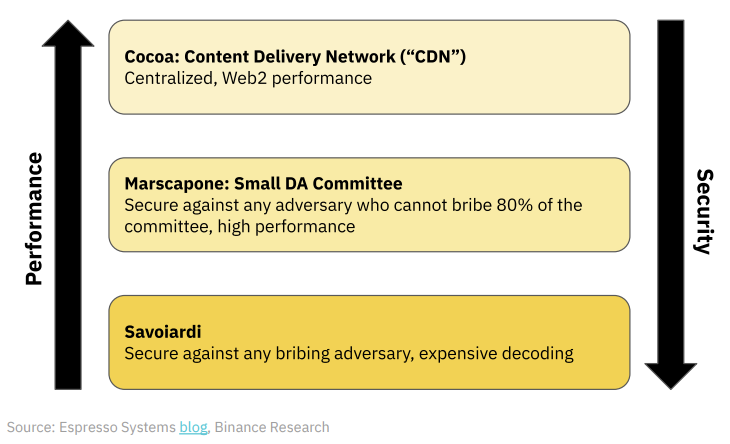
Like the classic Italian dessert, the Tiramisu solution has three novel layers. Together, they ensure data delivery to parties in need of data - in our case, various rollups ordering transactions from the sequencer.
The foundational layer of Tiramisu is called Savoiardi. This is an anti-bribery layer (similar to Ethereum's danksharding proposal), providing the highest level of security. However, due to this feature, it is the least user-friendly layer of the three. To address this, Espresso adds two layers to its solution.
Mascarpone is the middle layer, ensuring efficient data recovery by electing a small data management committee.
Cocoa is aptly named the "top layer sprinkling" of the entire system. Cocoa helps Tiramisu provide "Web2-level performance" by providing a content delivery network for Tiramisu. This aids in efficient data recovery and significantly speeds up data propagation. Given that this layer is inherently centralized (17), it is entirely optional, and Tiramisu can function perfectly without it. It helps accelerate data availability and can be easily modified or removed.
It should be noted that Espresso Systems designed its protocol with flexibility and modularity in mind, allowing rollup projects using its sequencer to use any other data availability solution if they do not wish to use Tiramisu.
Figure 5: Three layers of the Tiramisu data availability solution
Notable Partners (18)
Since July, the Espresso Systems team has been continuously announcing partnerships. EigenLayer was the first company to announce such a partnership, given its significance in the architecture of the Espresso Sequencer, it is worth closely monitoring its development. EigenLayer itself launched the first phase of its mainnet on June 14.
Alongside the announcement of the Doppio testnet, Espresso also announced a partnership with Polygon zkEVM. This partnership represents the first end-to-end integration of the Espresso sequencer with a full-featured zk-rollup (a fork of Polygon zkEVM). The testnet allows users to submit transactions to the fork, which are then routed and ordered by nodes running the HotShot protocol of Espresso.
Espresso supports Injective's integration of its sequencer into Cascade, an IBC (19) Cosmos SDK chain. Cascade is the first cross-rollup Solana SVM rollup in the IBC ecosystem, allowing the deployment of Solana contracts on Injective and the broader IBC ecosystem. Integration with the Cascade testnet is expected to be completed by the end of 2023, with the mainnet expected to be completed in 2024.
AltLayer has also joined the Espresso Systems ecosystem. AltLayer is a rollup-as-a-service platform that allows developers to launch highly scalable rollups supporting multiple virtual machines. Through their collaboration, developers will be able to decide whether to use AltLayer's solution and/or the Espresso Sequencer to launch their rollups. The teams will also collaborate to develop other integrated products, seeing how their designs complement each other.
Espresso Systems is working with Caldera to deploy an optimistic rollup based on the OP Stack, which uses the Espresso Sequencer and Tiramisu. Caldera enables developers to deploy custom rollups for their applications. With the deployment of this extension, future L2s built on Caldera will be able to easily choose to use the Espresso Sequencer and Tiramisu as plug-in components for their extensions.
Third-layer ("L3") as a service company Spire announced its integration with the Espresso Sequencer and Tiramisu. Spire's infrastructure allows developers to easily deploy their own L3 app chains on top of zkEVM L2. Spire will work with the Espresso team to integrate their solution into the Spire L3 framework. The testnet is expected to be completed by 2024.
Latest Updates
November 28, 2022: Americano is the first testnet for Espresso Sequencer and HotShot. The initial post contains more technical details; however, it is important to note that this is an internal testnet and not open to the public.
Figure 6: Project roadmap released with the Americano testnet and initial announcement
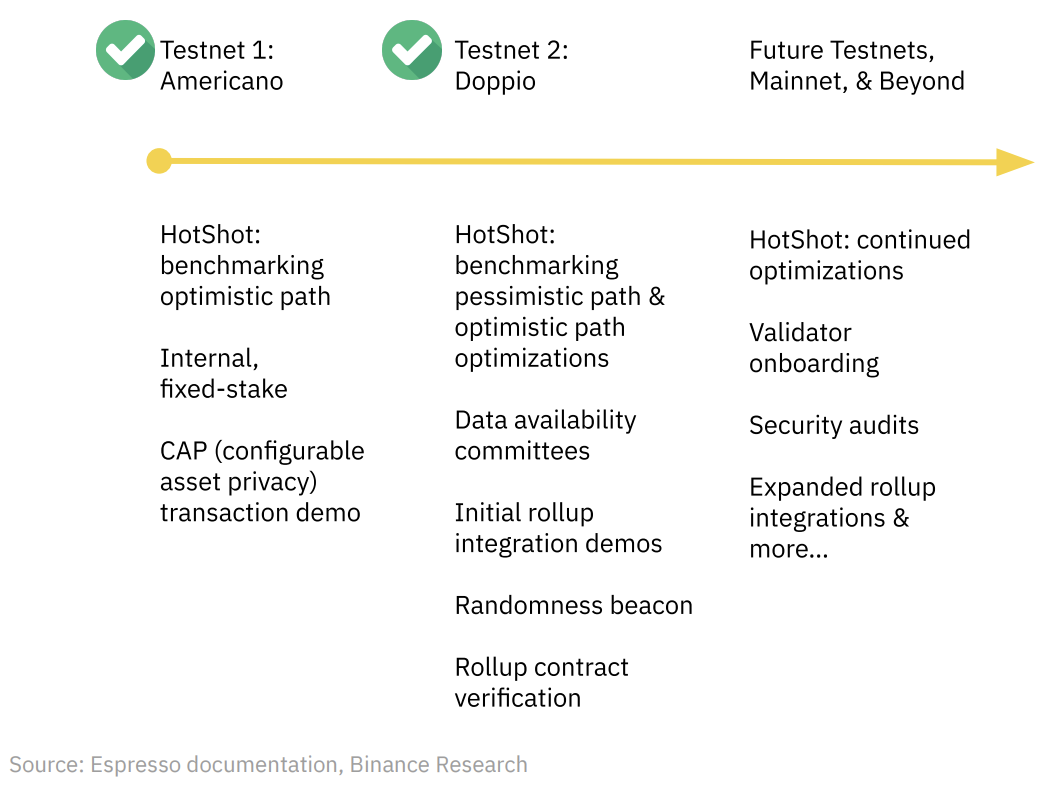
July 20, 2023: Doppio is the second major milestone and testnet for HotShot and Espresso Sequencer. At the same time, Espresso Systems released the whitepaper for the entire project. Doppio brings many efficiency improvements to HotShot, including decentralized verifiable information ("VID"), a new view synchronization sub-protocol, and signature aggregation of quorum certificates (20). Doppio also implements the first two layers of Tiramisu, with the expectation that the future testnet will include the third and final layer. Espresso Systems also announced the first end-to-end integration of its sequencer with a full-featured zk-rollup, specifically a fork of Polygon zkEVM.
August 4, 2023: The Doppio testnet is officially open to the public. Documentation on how users can submit transactions to the zkEVM fork has also been released. Performance benchmarks (21) have been published, along with expected next steps. Specifically, they announced the start of integrating some rollups and rollup-as-a-service companies into their sequencer. They also announced that they will contribute to the OP Stack through the concept of Optimism leader election verification work (following a recent RFP acceptance (22)).
Astria
Astria is building a shared sequencer network and is one of the leading companies pioneering the elimination of centralized sequencers. At the same time, they are developing Astria EVM, which will be the first rollup supported by their shared sequencer network. The project will benefit from fast, censorship-resistant transaction ordering from their network and will utilize Celestia for data availability. Celestia is a modular blockchain network and DA layer, with which Astria is very familiar. Founder Josh Bowen has previously worked on Celestia, and the project and its ecosystem are mentioned multiple times in Astria's introductory blog.
Overview
Astria's shared sequencer network allows multiple different rollups to share a single, permissionless, decentralized sequencer network. With this network, Astria provides an out-of-the-box solution that gives rollups censorship resistance, fast block confirmations, and atomic cross-rollup composability.
How does it work?
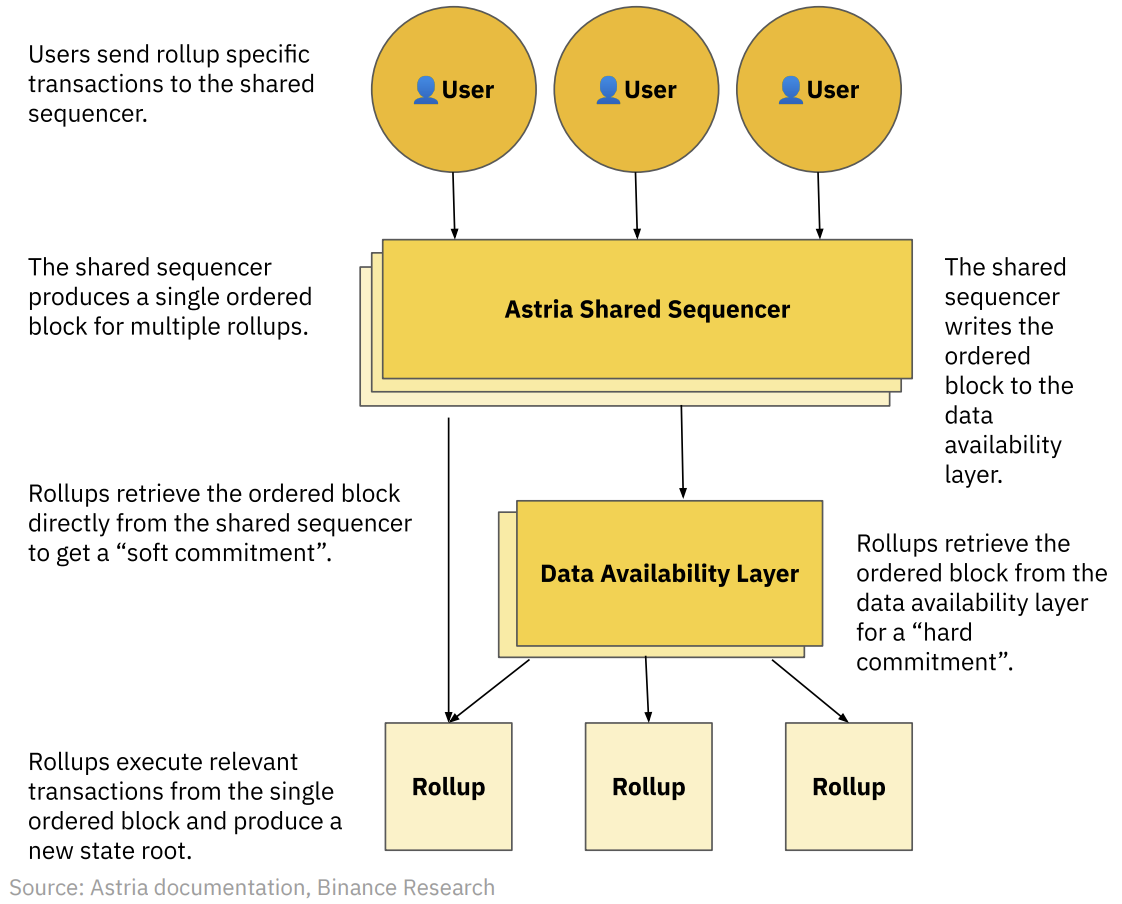
Astria's shared sequencer network itself is a middleware blockchain that achieves consensus on a set of ordered transactions using CometBFT (23) (a fork of Tendermint Core). The network is designed to accept transactions from multiple rollups, then order them into a block and write them to the DA layer.
Rollups can immediately retrieve ordered blocks from Astria after creating a block, providing fast block confirmations for users through "soft commitments." Alternatively, rollups can retrieve ordered blocks from the DA layer for "hard commitments," as once written to the DA layer, transaction ordering is considered final. This provides users with the strictest finality, which can be very useful in high-value transactions and other scenarios.
Figure 7: Astria's shared sequencer network
Astria EVM
As mentioned above, Astria EVM will be the first cryptocurrency powered by Astria's shared sequencer network.
Currently, most rollup projects execute transactions and ordering themselves, using Ethereum as a data transformation layer. Astria EVM will focus on execution while using Astria's shared sequencer for ordering and Celestia for DA.
Figure 8: Three key layers focusing on the L2 process, showing how rollups tend to utilize their proprietary sequencer and Ethereum's DA capabilities (we also show Ethereum L1 itself for comparison)
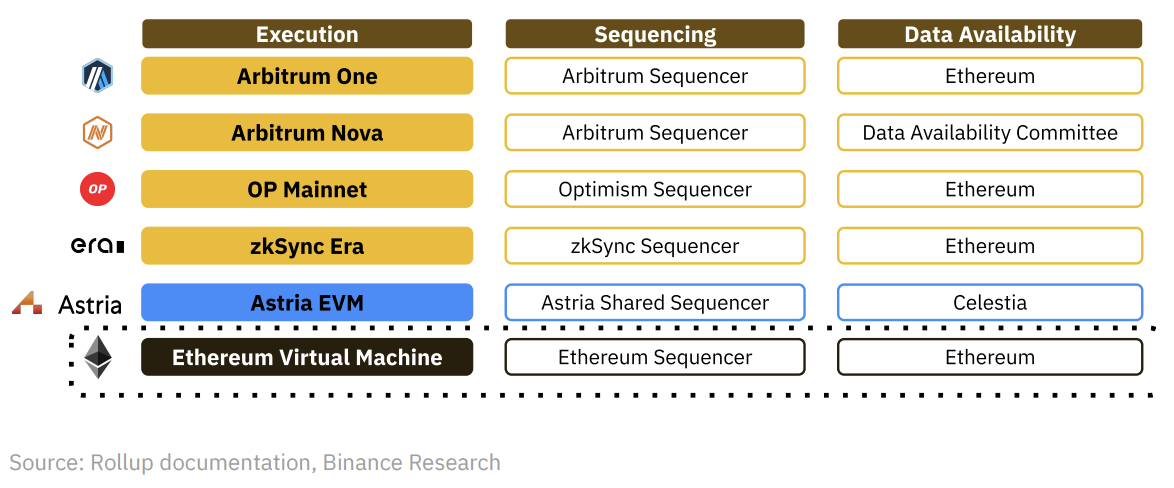
The goal of Astria's EVM is to help launch the rollup ecosystem on Celestia by acting as a liquidity and bridge hub. This also means that the Astria team has a live test case to understand how rollups can best integrate with their shared sequencer network.
Vision
Astria's future vision includes thousands of decentralized sovereign rollups, each tailored to unique use cases and applications.
Their shared sequencer network plays a crucial role in their vision, simplifying the rollup development process. Their solution means that rollup developers can focus on innovative use cases while seamlessly integrating with decentralized networks, providing them with fast, censorship-resistant transaction ordering and cross-rollup composability.
Astria Development Cluster
On August 16, Astria released its development cluster (24), which includes all the different components needed to launch rollups on Astria's shared sequencer network. The goal of the cluster is to make development and testing of the Astria network and integration with Astria as simple as possible.
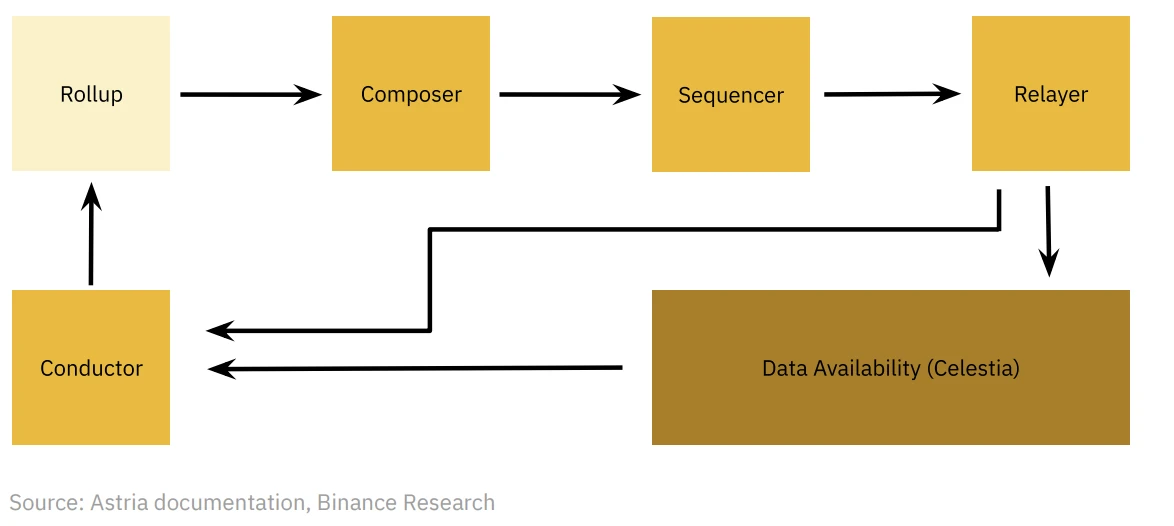
The components include:
Astria Sequencer: Block-producing nodes for transaction ordering. The development cluster relies on a single node. In the mainnet, a decentralized set of nodes will be used.
Data Availability Layer: Local Celestia network providing hard termination.
Rollup: Geth (25) rollup nodes for execution and state storage.
Composer: Retrieves pending transactions from the rollup's mempool and submits them to Astria's CometBFT mempool.
Conductor: Filters these program blocks for each rollup after receiving a single program block. These filtered blocks are then passed to rollup execution.
Relayer: Sends ordered data blocks to the conductor and data availability layer Celestia.
Recently, Astria announced that they will deploy rollup technology on their development cluster, and we will be watching which companies decide to deploy rollup technology.
Figure 9: Different components of the Astria Development Cluster
Latest Updates
In April 2023, Astria announced a $5.5 million seed round investment (26).
As mentioned, in August 2023, the team unveiled their development cluster.
The Astria team is also working on a Devnet to kickstart related work. It is expected to be completed in the coming weeks.
Their code is open source, and further documentation is available on their official GitHub page.
Radius
Radius is building a trustless shared sequencing layer that uses cryptographic techniques to decentralize sequencing, prevent censorship, and minimize harmful MEV. Their solution is blockchain-agnostic and can be used for various types of rollups.
How does it work?
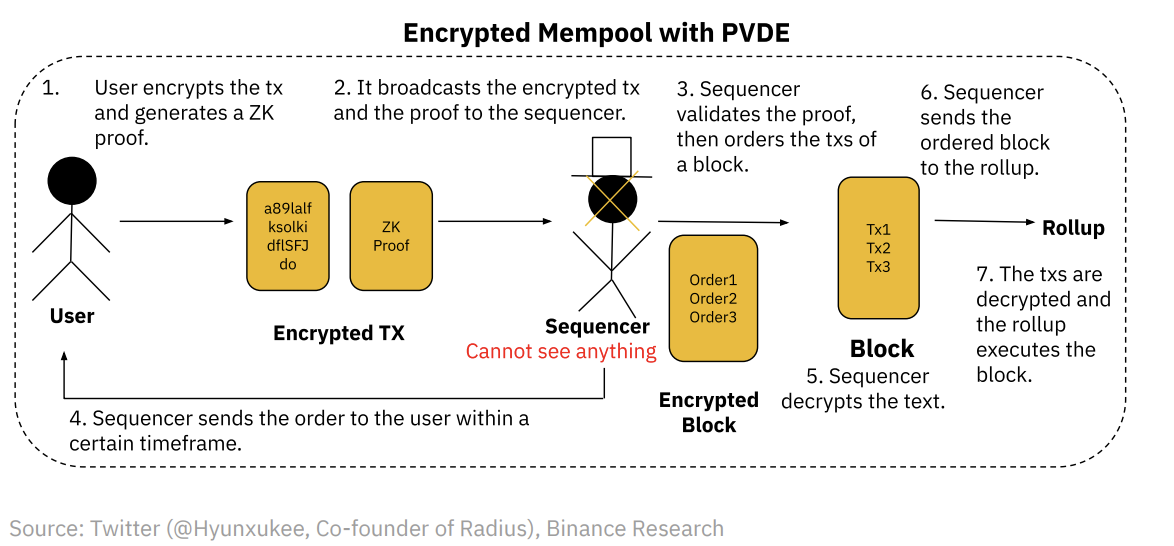
Radius uses encrypted mempools to achieve its goal. Essentially, the content of each user transaction is encrypted after submission. When the sequencer orders transaction groups, it cannot see the content of each transaction, preventing the sequencer from extracting MEV or engaging in censorship.
Figure 10: Radius transaction flow
This ultimately means that Radius' solution can address MEV and censorship issues with just one sequencer. Because transaction content is encrypted, even a single sequencer cannot act maliciously. This means there is no need to introduce a consensus mechanism, which may be advantageous in terms of speed and scalability. This is also where Radius' solution differs from Astria and Espresso solutions, as the former relies on a consensus mechanism to order transactions.
While the encrypted mempool on a single sequencer solves the two key issues of centralized sequencers—MEV and censorship—it still presents a single point of failure. To ensure real-time processing, Radius adopts a decentralized sequencer network where multiple sequencers run simultaneously. One of these sequencers is selected to operate as the ordering layer. There are various suggestions (27) on how to select a single sequencer, including secret election mechanisms and sequencer group sharding.
Practical Verifiable Delayed Encryption ("PVDE")
Radius adopts a zk-based encryption scheme PVDE (28) to create an encrypted mempool.
User transactions are temporarily encrypted based on time-locked puzzles. The sequencer then orders the encrypted transactions. The sequencer needs to solve the time-locked puzzles to obtain the decryption key. This requires time and computational resources and prevents the sequencer from prematurely decrypting transactions (i.e., before transaction ordering).
To prevent attacks, users generate ZK proofs to prove the validity of their transactions and decryption keys. The sequencer can verify these proofs before ordering, effectively preventing meaningless decryption (i.e., attacks) and resource wastage.
MEV Market
Radius also proposes an optimized block space design. They are attempting to create an auction-based market (29) where traders submit bundled cross-rollup MEV transactions. The transaction of the highest bidder will be included in a block by the sequencer, maximizing cross-rollup arbitrage profits and creating a more efficient rollup market.
Latest Updates
In June 2023, Radius announced the completion of a $1.7 million seed round financing.
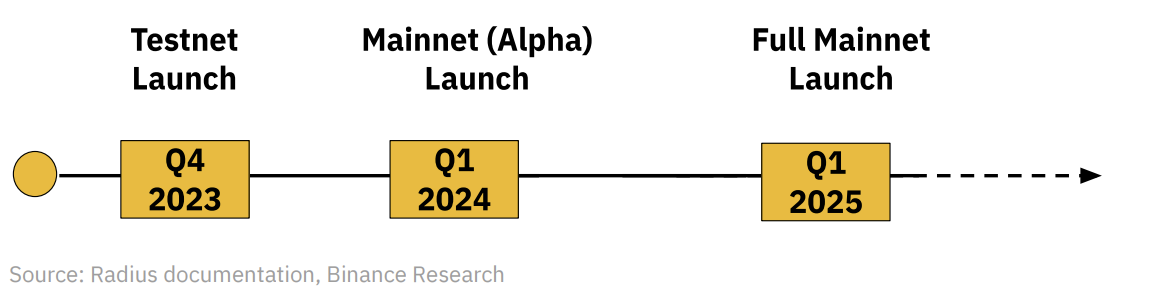
Roadmap:
Others
While we have introduced some of the larger and most well-known projects in the shared sequencer space, there are other projects developing similar or closely related solutions.
NodeKit: The NodeKit team is building NodeKit SEQ, a decentralized shared sequencer built into a custom L1 blockchain.
They are also building NodeKit Chain, which is an EVM-based rollup.
Their Twitter page also indicates that their solution will be launched on the Avalanche subnet (30).
AltLayer: AltLayer is a "rollup-as-a-service" platform that allows developers to launch highly scalable L2 rollups supporting multiple virtual machines.
While "rollup-as-a-service" companies are a separate domain and not within the scope of our report, AltLayer's decentralized sequencer network (31) is worth mentioning.
AltLayer's shared sequencer network is called the Beacon Layer, which is a permissionless middleware blockchain. Nodes in the blockchain are called validators (similar to any PoS network).
When a user wishes to create a rollup using AltLayer's platform, they can specify the number of sequencers required to run the rollup, the minimum staking amount required for each sequencer, and the set of tokens in which staking can be denominated. AltLayer recommends that each rollup project have at least five different sequencers.
Once validators join the beacon layer and provide the minimum staking, they can act as sequencers for various rollup projects based on the staking and some randomness. Similar to any PoS blockchain, there is a risk of staking being slashed in case of misbehavior.
This process means that developers can relatively quickly deploy an encrypted rollup using AltLayer's infrastructure and then use the beacon layer to ensure it is decentralized. If you agree with the future-centric idea of rollups, services like AltLayer are definitely worth paying close attention to.
5. Outlook
Existing L2 rollups seem to have to make a choice. On one hand, they can continue as they are, using a single centralized sequencer. On the other hand, they can start integrating with third-party shared sequencer networks or develop their own internal solutions.
- Continue using a single centralized sequencer:
a. This is the simplest course of action and may also be the financially prudent one. The monetization of sequencers is a key revenue source for all major scaling solutions (32) and undoubtedly an important part of the business model. In fact, newly established L2 scaling company Base recently confirmed its intention to monetize sequencers during the Coinbase Q2 earnings call (33).
b. Maintaining a centralized sequencer presents issues such as censorship, MEV extraction, and the risk of a single point of failure, in addition to contradicting the fundamental ethos of cryptocurrencies. Consider a scenario where a key member of a major crypto organization mysteriously disappears or gets into serious trouble. If they operate a centralized sequencer, it could potentially impact their encrypted rollups, daily operations, and user experience. In such a case, many other participants in the industry are likely to start seriously committing to decentralized sequencers according to their roadmaps. This is a simple example of why decentralized sequencers may be more important than initially thought.
- Integration with third-party shared sequencer networks:
a. With the ongoing development and launch of shared sequencer networks like Espresso and Astria, this will become a major option for existing networks. In fact, considering the integration of Espresso with the Polygon zkEVM fork, some major network companies seem to be actively exploring this option.
b. Outsourcing sequencing work to experts is a wise choice for many companies compared to the risks of managing a centralized sequencer or the effort and cost of developing internal solutions.
c. One of the most important factors to consider here is the interoperability of the sample libraries. This may be the most obvious advantage of running on a shared sequencer compared to running in their own proprietary "silos." As emphasized earlier in this report, running on a shared sequencer and the interoperability it brings can unlock various new possibilities, including cross-rollup arbitrage and conditional transaction inclusion.
- Developing internal proprietary solutions:
a. This may be the most time-consuming and expensive of the three options, so it will be interesting to see which companies choose this route.
b. One key issue we have seen with large cryptocurrencies is the accumulation of token value. Most top Ethereum L2 companies have used ETH as the token for gas fees, which prevents their native tokens from accumulating value. One possible solution is for rollup companies to develop internal sequencing solutions, backed by token holders; for example, users can stake their native rollup tokens to act as sequencers and charge fees for their services.
c. The downside of this approach is the impact on interoperability. Rollup systems running their own proprietary sequencing solutions have less interoperability compared to those running on a shared sequencer.
d. Optimism announced its "Law of Chains," which is a recent development worth considering. The Law of Chains is a set of guiding principles for chains in the OP Stack superchain ecosystem. Its essence is to establish a framework for these chains to work in a more unified manner. This is likely to extend to shared sequencing solutions for chains based on the OP Stack, which may be a solution to the interoperability issue discussed earlier (at least for OP Stack chains).
As second-layer cryptocurrencies continue to emerge and grow in scale and transaction volume in the cryptocurrency world, issues surrounding centralization and interoperability will continue to ferment. This topic has been a focus of attention over the past year, and we expect it to continue to expand as major cryptocurrency issuers approach their one- and two-year anniversaries and more cryptocurrency issuers enter the market.
We believe that at least some companies will choose to integrate with third-party sequencer networks like Espresso and Astria, but we also see other companies choosing to develop their own internal solutions. Some larger companies, especially those that have already launched native tokens, are likely to see value in developing their own solutions to maximize profits and increase token utility. Whatever happens, this is a very important aspect that we need to pay close attention to, and we will be keenly interested in closely monitoring this trend.
6. Conclusion
Users want and prefer faster transaction confirmations and lower fees. While centralized sequencers have been the primary solution for L2 companies so far, ideally, companies and users should be able to choose the best decentralized version of this technology. This is where companies like Espresso Systems, Astria, and Radius play a crucial role in the L2 story.
Two key driving factors here are decentralization and rollup interoperability. Decentralization is crucial for many reasons. It is the philosophical foundation of cryptocurrencies, just one of them. On a more practical level, a centralized sequencer represents a single point of failure, affecting the effectiveness of encrypted rollups and posing a threat to their resilience. This is not to mention the potential for extensive MEV extraction, some of which may be hidden from users and extracted in private mempools. The possibility of censorship (even temporary) and delayed transactions is also a concern, especially when considering the strong desire for industry growth. Rollup interoperability is equally crucial, especially when people hold a rollup-centric view of the future of the cryptocurrency industry. If there are more and more rollups in the market, for specific applications or otherwise, these rollups should be able to communicate and collaborate seamlessly. Otherwise, how do we achieve a Web2-type user experience?
There will certainly be challenges in the future, and some large companies may be inclined to create their own proprietary solutions rather than use shared sequencer networks. One way to address this issue is for shared sequencer networks to address value accumulation and revenue distribution through economic mechanisms, as strong network effects can be achieved when many companies share a single sequencer.
This topic will continue to heat up in the coming months, and we believe that many new participants will enter the market, both in the rollup and shared sequencer spaces. It will be very interesting to observe the choices of different projects. We look forward to closely monitoring this trend.
免责声明:本文章仅代表作者个人观点,不代表本平台的立场和观点。本文章仅供信息分享,不构成对任何人的任何投资建议。用户与作者之间的任何争议,与本平台无关。如网页中刊载的文章或图片涉及侵权,请提供相关的权利证明和身份证明发送邮件到[email protected],本平台相关工作人员将会进行核查。