Original Author: PAUL VERADITTAKIT, Partner at Pantera
Original Compilation: DeepTech TechFlow
This article is the second in a series of decentralized social articles written by Pantera partner PAUL.
The series explores how today's technology and trends address a range of issues in decentralized social networks, providing specific explanations and explorations for each issue.
Previous article: The Future of Web3 Social (Part 1): Building Social Graphs to Solve Customer Acquisition Problems
In 2017, a group of researchers from the MIT Media Lab claimed in Wired magazine that decentralized social networks "will never succeed." In their article, they listed three impossible challenges:
(1) Attracting (and retaining) users from scratch (2) Handling user personal information (3) User-oriented advertising issues
They believed that in these three cases, existing tech giants such as Facebook, Twitter, and Google, due to their extensive economies of scale, left no room for any significant competition.
Fast forward to the present, what was once considered "impossible" seems no longer so out of reach, and we seem to be at the dawn of a conceptual transformation in social media networks. In this three-part series (this is the second part), we will explore how new ideas in decentralized social (DeSo) address these "ancient" problems, including:
(1) Using an open social graph layer to solve the cold start problem (2) Solving the user identity problem using biometric and cryptographic technology (3) Addressing income issues using token economic models and incentive mechanisms
In this article, the author mainly discusses the solution to problem 2.
The User Identity Problem in Social Media
Modern social media faces the problem of bots. While social media platforms have an obligation to maintain freedom of speech, the problem becomes tricky when the "users" involved are not actual humans but bots.
It has been proven that bots have had a significant impact on public discourse, from alleged interference in the U.S. presidential election to influencing public perceptions of COVID. Especially in emphasizing anonymity, security, and privacy, any decentralized social media platform will inherit the "bot problem" – that is, in the age of artificial intelligence, how do you convince people that the accounts on your platform are real and not bots?
One naive approach is to adopt traditional KYC protocols, but this approach immediately encounters privacy issues – the other side of the problem. Why should anyone trust any social media platform to store our sensitive data (from government IDs to private messages and financial transactions) that can reconstruct a person's entire personal, social, and professional life?
Therefore, the "user identity" problem essentially lies in the tension between confirming that users are "indeed human" and ensuring privacy of personal data. In this article, we will explore two different approaches to solving this problem: one is the biometric method (using zero-knowledge proofs), and the other is the social guarantee method.
Worldcoin and Biometric Authentication
In the field of "proof of personhood," Worldcoin is one of the most famous and controversial projects. In addition to having OpenAI CEO Sam Altman as one of its supporters, Worldcoin's solution to the "proof of personhood" problem is very direct: using retinal scans to create biometric proof that you are a human (because robots do not have retinas) and obtaining a certification token from it. As for data privacy, Worldcoin claims to use zero-knowledge proofs to ensure that the obtained biometric data is securely stored.

Worldcoin's argument is that as artificial intelligence plays an increasingly significant role in society, it is necessary to distinguish humans from robots in a way that protects privacy and is decentralized. By using retinal scans from the Worldcoin sphere, people can obtain a "digital passport" called World ID, making it possible for holders to qualify for a global basic income mechanism based on cryptocurrency and participate in new mechanisms for global democratic governance. Essentially, this World ID is intended to be the social primitive mechanism for future digital social networks.
In its documentation, Worldcoin emphasizes its privacy-first approach. For example, it states that it deletes the images collected by the sphere, stores only the hash of the user's iris, and runs zero-knowledge proofs (zk-SNARKs) to share proof of personhood information without disclosing any personal data. Although at the current launch stage, these hash values are stored in a centralized database, the team is committed to storing these iris hash data on the blockchain once the hash algorithm is fully mature.
However, despite these privacy assurances, there are still many controversies regarding real privacy, security, and fair guarantees. For example, some claim that Worldcoin operators' credentials were stolen, and World IDs were sold on the digital black market, allowing users to obtain Worldcoin tokens without undergoing retinal scans. There are also overall fairness issues, with the MIT Technology Review publishing a sharp article in April 2022, accusing Worldcoin of deception, manipulation, and exploitation of nearly 500,000 users (mainly in developing countries) during the testing phase, even calling it a form of "crypto-colonialism." In fact, as of August 2, 2023, Kenya, once one of the largest data collection sites for Worldcoin, has banned Worldcoin scans due to security, privacy, and financial concerns.
In addition to these project-specific controversies, there are broader concerns about Worldcoin's overall adoption of dedicated hardware for biometric authentication. Because the sphere is essentially a hardware device, even if Worldcoin's software is flawless, there is no guarantee that there are no hardware backdoors, allowing Worldcoin (or other third-party manufacturers) to secretly collect users' actual biometric data or insert false personal profiles into the system. To skeptics, all of Worldcoin's privacy assurances (zero-knowledge proofs, iris hashes, on-chain decentralization) seem to be just an ironic statement.
Proof of Personhood and Social Guarantee
Another approach to solving the proof of personhood problem is to use the social guarantee method. Essentially, if verified humans Alice, Bob, Charlie, and David all "guarantee" that Emily is a verified human, then Emily is likely also a human. The core issue here is therefore a game theory design problem – how do we design incentive mechanisms to "verify humans" to the maximum extent.
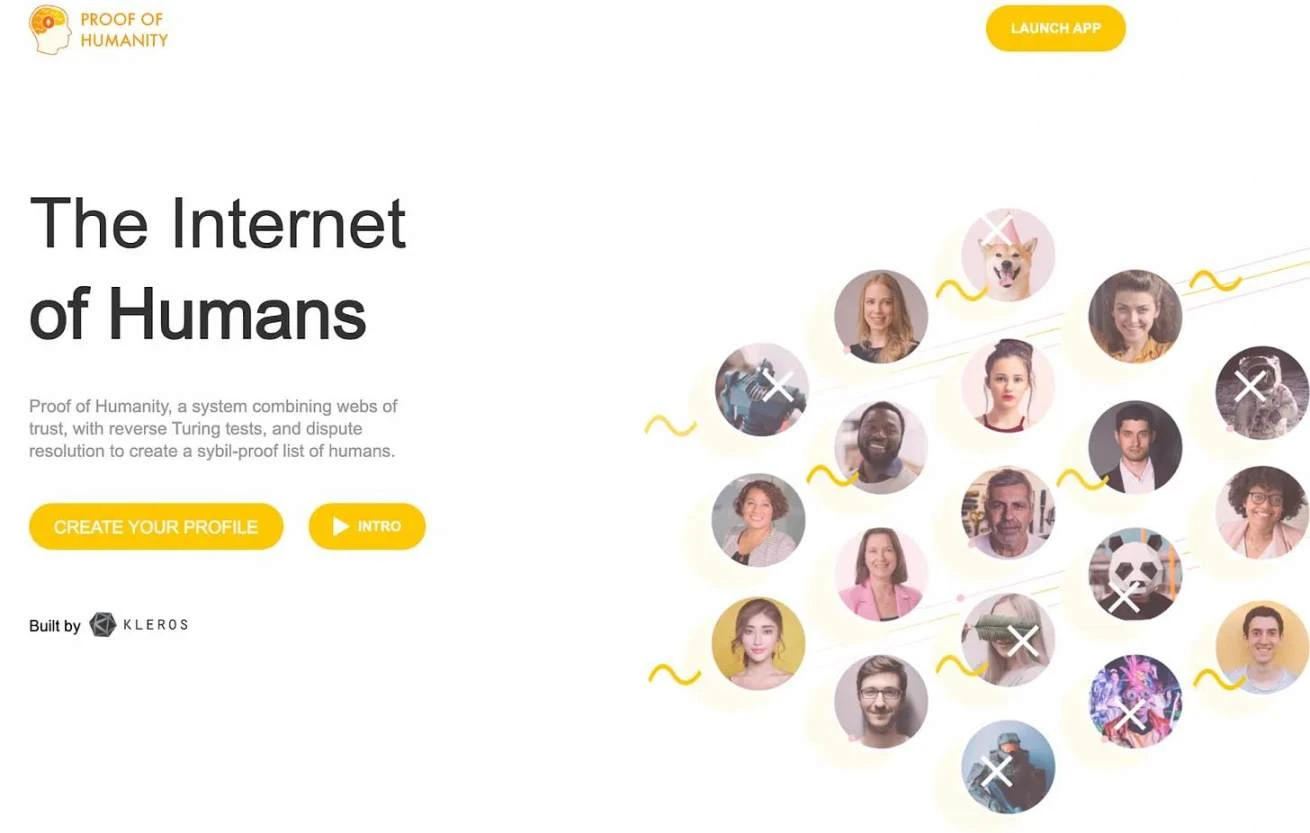
Proof of personhood is one of the oldest and most important projects in this field. To "prove your personhood," you need to
(1) Submit personal information, photos, and videos, along with a 0.125 ETH deposit, (2) Have humans already in the registry vouch for you, (3) Pass through the "3 challenge periods." If someone challenges you during this period, the case will be submitted to the decentralized court Kleros, and the deposit will be at risk.
During the proof process, users are first paired with a voucher. After pairing with the voucher, they will have a video call to verify the match between personal data and the real person. Like Worldcoin's paper, the proof of personhood community has long had a universal basic income (UBI) idea, which would be provided to individuals verified in the proof of personhood registry.
Some other projects are also on a similar path, using social graphs to verify people's identities, including BrightID's video call verification, where everyone verifies each other, Idena's ongoing captcha creation and resolution game, and Circles' trust-based circles.
The biggest appeal of these social verification-based platforms may be that they seem less invasive than Worldcoin, which requires you to scan your iris on a metal sphere. Some of these methods, such as Idena's captcha "checkpoint ritual," even seem to retain a certain degree of anonymity, without requiring extensive sharing of personal data or third-party identity verification centers.
The Future of Proof of Personhood
As artificial intelligence continues to advance and demonstrate increasingly human-like characteristics, designing novel proof of personhood mechanisms becomes increasingly important, not only for the incentive measures discussed in many proof of personhood projects, but more importantly as a way to better purify and regulate future social networks.
However, from data privacy to process invasiveness, and to the effectiveness of determining human identity, this process involves many trade-offs and is a famous "challenge in cryptocurrency." As Vitalik pointed out, there seems to be no single ideal form of proof of personhood and proposed a possible hybrid path as a suggestion: a biometric-based bootstrapping method, but transitioning to more social graph-based methods in the long term.
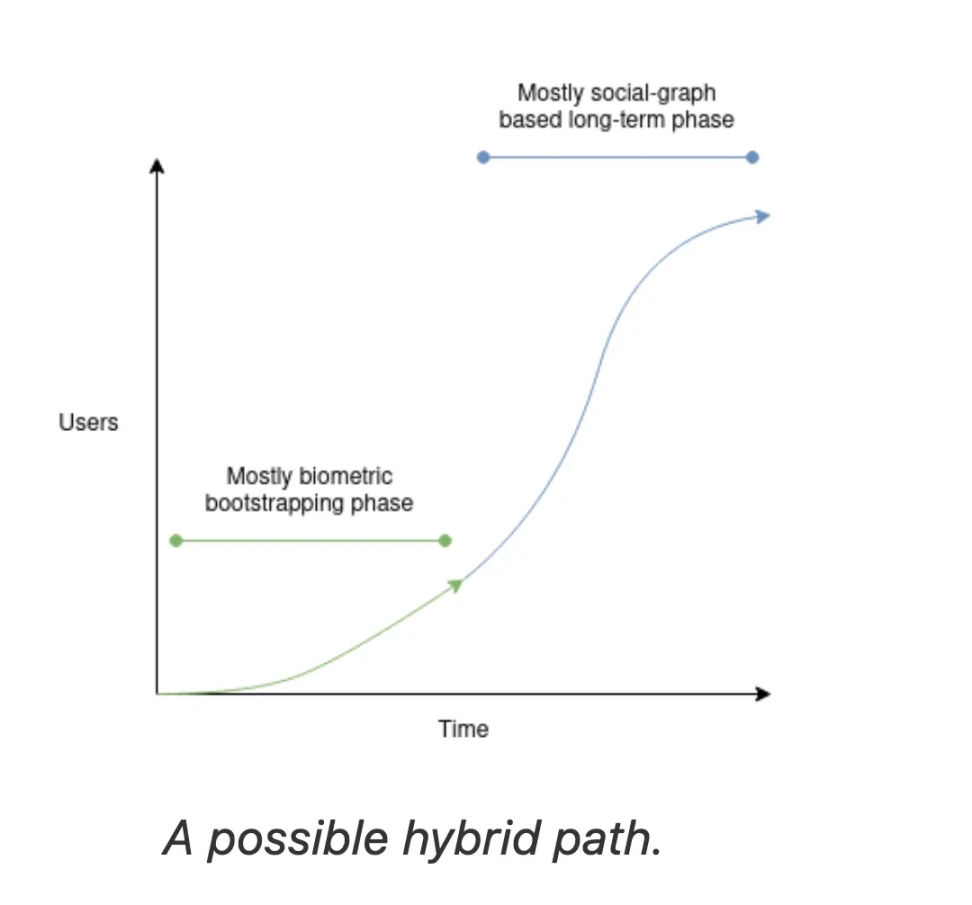
Looking ahead, this field needs more process, code, and data transparency. In short, there cannot be an ironic paradox where users need to "trust this is a solution that requires no trust." Only through this approach can we truly create a social network foundation that aligns with the original decentralized and privacy vision of cryptocurrency.
免责声明:本文章仅代表作者个人观点,不代表本平台的立场和观点。本文章仅供信息分享,不构成对任何人的任何投资建议。用户与作者之间的任何争议,与本平台无关。如网页中刊载的文章或图片涉及侵权,请提供相关的权利证明和身份证明发送邮件到support@aicoin.com,本平台相关工作人员将会进行核查。


