The security incident that Harmony (ONE) encountered is evolving from an ordinary token theft event into a trading game around new supply, potential selling pressure, and on-chain rollback.
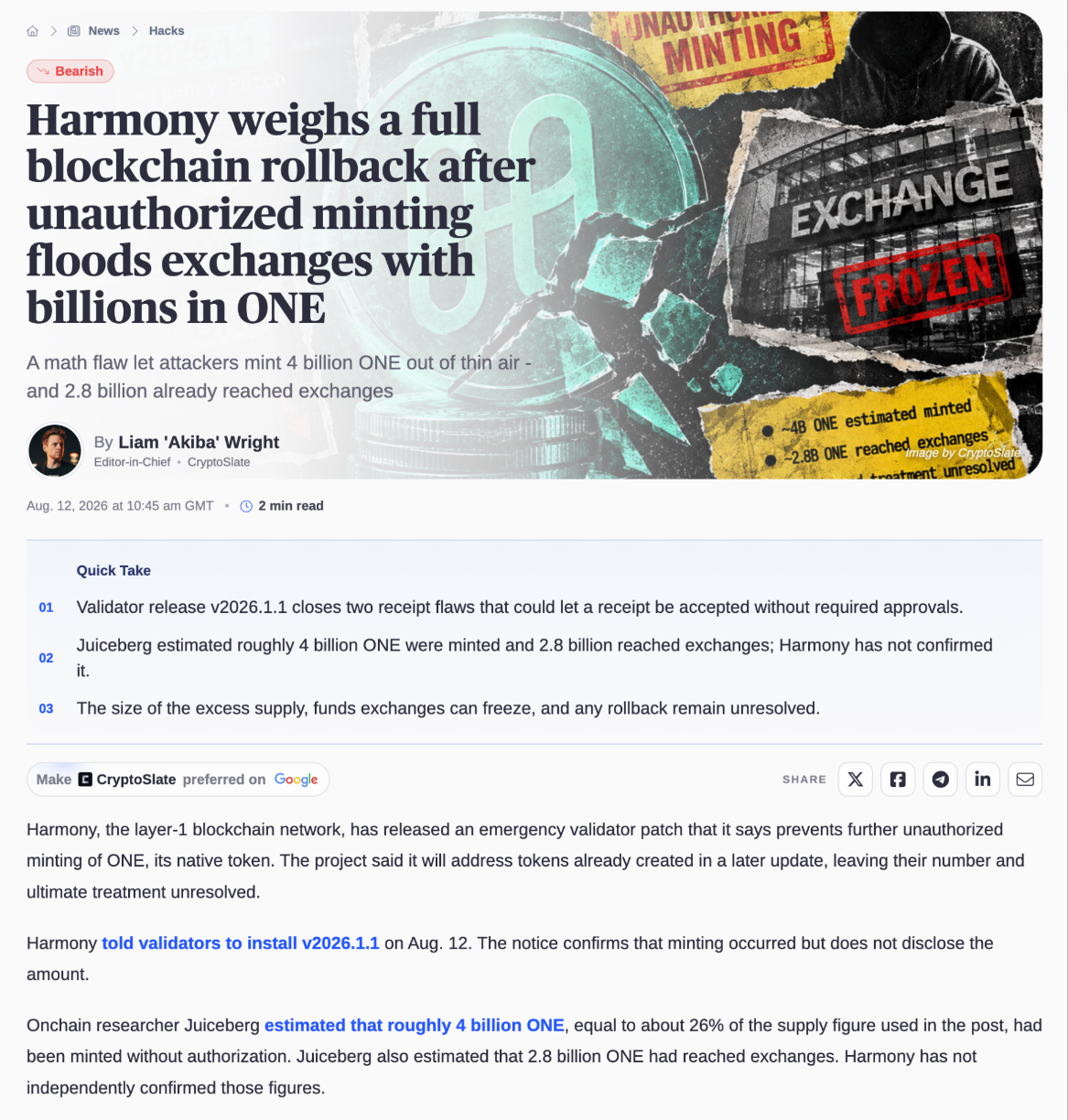
On August 12, Harmony confirmed that an unauthorized ONE minting event occurred on the network. On-chain analyst Juiceberg estimated that the attackers may have minted about 4 billion ONE, which is approximately 26% of the circulating supply before the incident; of which about 2.8 billion are said to have already been transferred to exchanges. It is important to note that these specific numbers are still estimations based on on-chain analysis and not final data confirmed by Harmony.
For traders, the real question to focus on is no longer “how much has ONE fallen,” but:
How much of the newly minted 4 billion ONE will actually enter the market?
What does 4 billion new ONE mean?
Calculating from the circulating supply of about 15 billion before the incident, approximately 4 billion new ONE is equivalent to over a quarter of the original circulating amount.
This is significantly different from ordinary hacking incidents.
Traditional coin theft events are essentially: assets being transferred from one address to another.
The more serious aspect of this incident is that: the attackers are alleged to have gained the ability to create new assets.
This means the market is not just facing the loss of ONE from a specific address, but that all ONE holders may simultaneously face supply dilution.
Juiceberg further estimates that approximately 2.8 billion related ONE have already been transferred to exchanges. Harmony stated that it is cooperating with relevant exchanges to freeze the involved funds.
Therefore, for the price of ONE, the truly dangerous variable is not “4 billion already exist,” but:
How many of these new tokens can be sold.

ONE has given the first round answer through price
After the incident, ONE quickly dropped, once touching a historical low of about $0.0005735 before rebounding. Different data sources report varying statistics on the drop, but many reports indicate that there was a significant decline in ONE at the start of the incident.
This aligns with the market's most direct pricing logic:
New supply → Increased potential selling pressure → Circulation dilution → Repricing of valuation.
But the problem is that the first round of price shock has occurred and doesn’t mean the end of the incident.
If a large amount of involved ONE continues to enter exchanges, the market may face new selling pressure again.
Conversely, if the involved assets are frozen by exchanges and cannot continue to be sold, and are eventually handled effectively, then the supply shock counted in the price may gradually dissipate.
Thus, the price itself is no longer the most important leading indicator; rather, the on-chain supply direction is more worthy of attention.
Harmony has patched the漏洞, but what about the 4 billion ONE?
This is currently the market's key second question.
Harmony has launched an emergency validator version v2026.1.1 to fix issues that may have allowed unauthorized transactions/minting to be accepted, and has suspended related bridging services. At the same time, the project party is coordinating with exchanges to freeze the involved funds.
However, patching the漏洞 can only solve: whether new ONE can continue to be created in the future.
It cannot automatically solve: what to do with the already created ONE?
One of the proposed solutions currently being discussed in the market is blockchain rollback.
This is also one of the most noteworthy variables for traders in this incident.
If rolled back, does that definitely benefit ONE?
Not necessarily.
A rollback seems to directly eliminate the on-chain state caused by the attack, but it also means:
Some normal transactions that occurred after the attack may also be revoked.
This raises another question:
At what point should the blockchain rollback occur?
Moreover, if some new ONE have already entered centralized exchanges and been transacted, simply rolling back the Harmony chain’s state does not mean that transactions completed within the exchanges can be automatically restored.
Therefore, rollback is not a simple “beneficial button.”
It actually involves three levels:
1. How to restore supply;
2. How to freeze or recover the involved assets;
3. How to handle the finality of historical state on-chain.
Harmony currently is only considering rollback as one of the options for resolution and it does not mean that a rollback has already been completed.
Three variables traders should focus on now
01|Is the involved ONE still flowing to exchanges?
This is the most direct supply pressure indicator in the short term.
If the involved address continues to transfer ONE to exchanges, then even if the price rebounds, it cannot simply be understood as the selling pressure being over.
Conversely, if exchanges freeze related assets and the on-chain available balance continues to decline, then the actual supply shock the market is facing may start to shrink.
So when looking at ONE now, don’t just look at the K-line; it’s best to also monitor the involved wallets and the capital flow of the exchanges.
02|How will Harmony ultimately handle the new supply?
This is the core variable that will determine the mid-term price logic.
Currently, what needs to be observed is: rollback, freezing, burning, or other handling plans?
Different solutions will have varied impacts on the actual circulating supply of ONE, market confidence, and network governance.
It is especially important to distinguish between two concepts: Fixing the漏洞 ≠ The risk of the additional 4 billion ONE has disappeared.
The former addresses the “continuation of issuance,” while the latter addresses the “already issued assets.”
03|Has the rebound of ONE been confirmed from the supply side?
This is the aspect traders are most likely to overlook.
The rebound of ONE from historical lows does not directly prove that the market has completed its pricing of the incident.
What’s more worth observing is : While the price rises, is the involved ONE still moving to exchanges?
If the price rebounds, but the new supply continues to enter the market, then this may just be a technical correction following the event.
If subsequent new supply risks decrease while price establishes support again and volume recovers, then the market may start to transition from:
“Pricing of the safety incident”
to:
“Fundamental repricing.”
What Harmony truly faces is the second test of trust
Another reason this incident is worth attention is:
Harmony is not encountering a major security incident for the first time.
In 2022, Harmony's Horizon Bridge suffered an attack of about $100 million; this incident has drawn the market's attention back to Harmony’s network security and supply mechanisms.
Therefore, even if the 4 billion newly minted ONE are ultimately handled properly, the market still needs to answer a more long-term question:
Can Harmony rebuild market trust in its network and supply mechanism?
This may be more important than a one-time price crash.
Because for a cryptocurrency, the market prices not only the current supply, but also a more hidden variable:
Whether future supply remains trustworthy.
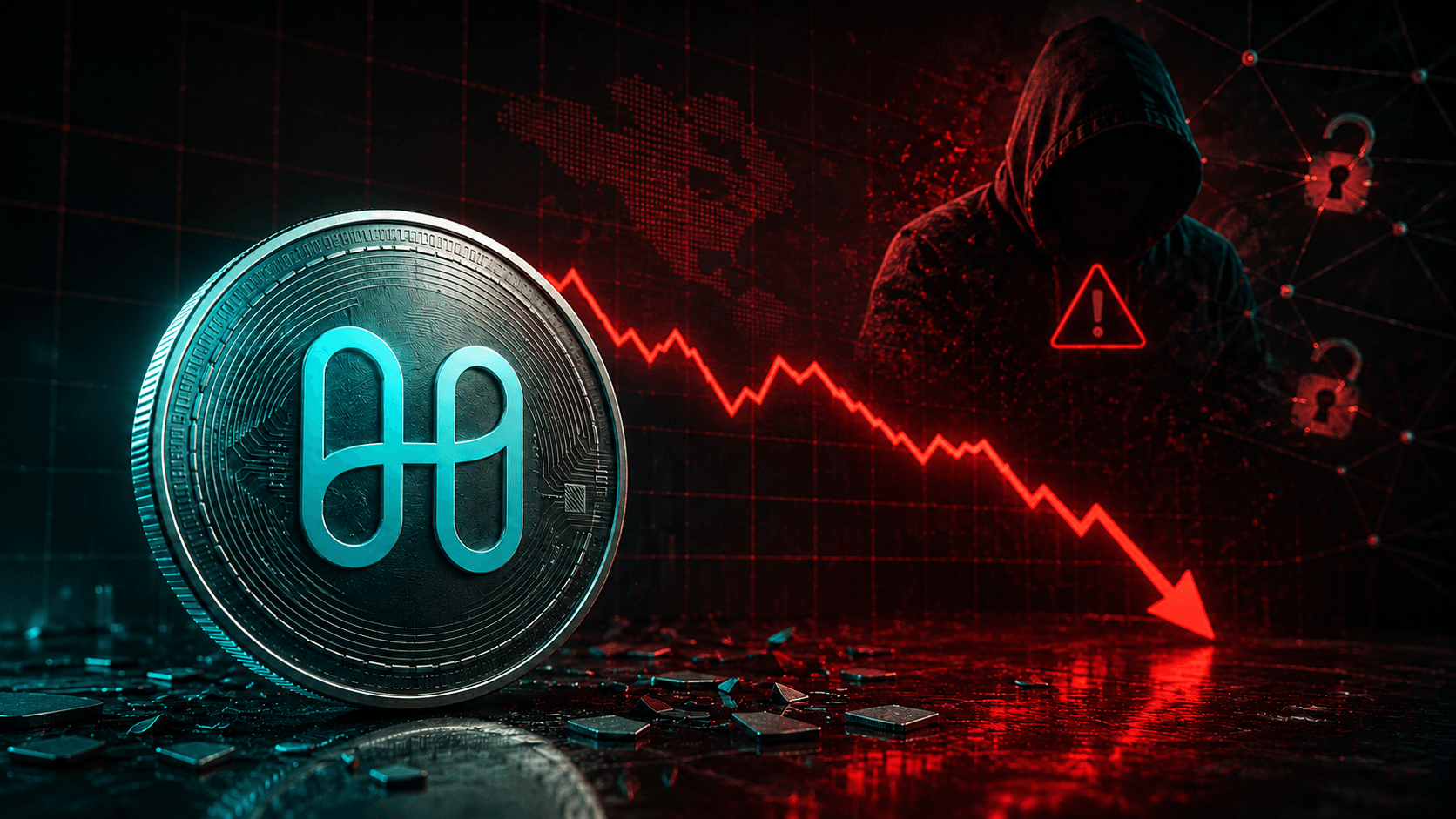
What traders really need to focus on is not “how much ONE has fallen”
The most noteworthy aspect of this incident is not whether ONE dropped 30% or 40% at one point.
What truly changes the trading logic is:
After a token's supply mechanism has a漏洞, a substantial amount equivalent to approximately a quarter of the original circulation may be added in a short period, while the market awaits the project team's decision on how to handle these assets.
Therefore, the trading logic of ONE can be simplified into a chain:
Whether involved ONE continues to flow into exchanges → The status of exchanges freezing → Harmony's final handling plan → Whether actual circulating supply recovers → Whether price can re-establish support after the supply risk declines.
Before these variables are actually materialized, judging ONE has bottomed purely based on “over-sold” status still carries significant risks.
Note: The estimated figures such as approximately 4 billion ONE, approximately 2.8 billion entering exchanges, etc., primarily come from on-chain analyst Juiceberg's estimate. Harmony has confirmed the occurrence of unauthorized minting incidents but has not publicly confirmed all quantities; hence this article treats the relevant figures as on-chain estimates rather than final verified data from the project party.
🎁 AiCoin exclusive registration benefits are here!
Registering for OKX through the AiCoin exclusive link grants a permanent 20% rebate
👉 Register for OKX now:
https://jump.do/zh-Hans/xlink?checkProxy=true&proxyId=2
📢 Join the AiCoin community for more information on new coins from exchanges and earning opportunities
Official Telegram community:
AiCoin Chinese Twitter:
OKX benefit group:
https://aicoin.com/link/chat?cid=l61eM4owQ

The content of this article represents the author's personal viewpoint and does not reflect the position of this platform. The viewpoints, conclusions, and suggestions in the text are for investor reference only and do not constitute any investment advice related to this platform. The market has risks, and investment should be cautious.
免责声明:本文章仅代表作者个人观点,不代表本平台的立场和观点。本文章仅供信息分享,不构成对任何人的任何投资建议。用户与作者之间的任何争议,与本平台无关。如网页中刊载的文章或图片涉及侵权,请提供相关的权利证明和身份证明发送邮件到support@aicoin.com,本平台相关工作人员将会进行核查。