Author:Zhao Ying
Robust corporate earnings are providing the strongest support for the U.S. stock market bulls. Goldman Sachs partner John Flood believes that as market positions become "cleaner," the S&P 500 index is expected to reach a new all-time high this year, with the core logic driving this judgment being – earnings.
According to Goldman Sachs data, the S&P 500 index's second-quarter earnings per share (EPS) year-on-year growth tracking value hit 45%, well above the market consensus expectation of 22% at the beginning of the quarter. Even when excluding approximately $151 billion of Alphabet and Amazon's equity investment-related "other income" and other non-recurring items, the S&P 500 EPS growth still reached 26%, accelerating from the first quarter and marking the fastest growth since 2021. Meanwhile, analysts have begun to raise profit expectations for 2027, with positive adjustments across most sectors.
In terms of positioning, Goldman’s sentiment and positioning indicators have retreated from previous highs, with fast positioning indicators generally turning bearish, hedge funds showing significant deleveraging, and retail investor leverage also beginning to cool. John Flood believes that this "cleaner" positioning environment creates conditions for further market upward movement.
Earnings Exceed Expectations, Growth is the Fastest in Five Years
Goldman Sachs data shows that the S&P 500 index’s second-quarter EPS year-on-year growth tracking value reached 45%, significantly exceeding the initial 22% consensus expectation. Among them, 19 percentage points of growth came from the $151 billion in equity investment-related "other income" from Alphabet and Amazon, while Microsoft also contributed around $3 billion of similar income.
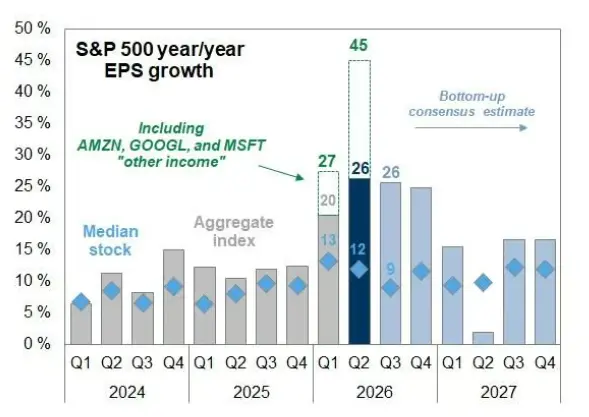
Excluding the aforementioned non-core income sources, the S&P 500 EPS growth still reached 26%, further accelerating from the first quarter, achieving the fastest growth pace since 2021. From the individual stock level, the median EPS year-on-year growth tracking value of S&P 500 constituents is 12%, also exceeding the initial 9% consensus expectation, indicating that the earnings improvement is broadly strong and not driven solely by a few tech giants.
Forward Expectations Continue to Be Upgraded, Correction Breadth Remains Positive
Strong second-quarter performance not only reflects past operational achievements but also drives analysts to continuously revise forward earnings forecasts upward. Since the start of the third quarter, market consensus expectations for the S&P 500 index’s 2027 EPS have been raised by about 1%, with the energy and financial sectors receiving the most significant upward revisions.
In terms of revision breadth, the number of companies in the S&P 500 constituents with upgraded earnings expectations continues to exceed those with downgraded expectations, maintaining positive revision breadth. Goldman Sachs believes that this comprehensive upward revision trend is an important foundation supporting market valuation.
Positioning "De-Bubbling," Creating Space for Upside
In terms of market sentiment and positioning, Goldman’s sentiment and positioning indicators have fallen to the 53rd percentile, significantly retreating from previous highs. Most fast positioning indicators have turned bearish: although futures positioning remains high, it is no longer at extreme levels, the purchase/put ratio has decreased, investor surveys show a decline in optimistic sentiment, and the equity positioning of actively managed funds (NAAIM index at 79.7) has also contracted.
On the hedge fund level, deleveraging is particularly significant—total leverage has given back half of this year’s gains, and net leverage has decreased since the beginning of the year. For retail investors, leverage levels have begun to cool, with margin balances in the Korean stock market falling from historic highs, and Japan's financing buying scale also retracting from the highest levels since 1990. The buying intensity of U.S. investors for semiconductor stocks has also slowed.
John Flood believes that the "de-bubbling" of the aforementioned positioning indicates a healthier market structure, with potential selling pressure alleviated, creating more favorable conditions for the index to rise further.
Valuation Relatively Low, AI Cycle Provides Long-term Support
From a global horizontal comparison, Goldman Sachs data shows that U.S. stock valuations are currently at a relatively "cheap" level compared to other major markets.
Meanwhile, John Flood points out that the main dividends of the AI super cycle have not yet been fully released, and the world’s largest tech companies continue to increase capital investment, driving the breadth and depth of profit improvement.
However, Goldman also highlights a seasonal risk worth noting: among the 13 midterm election years since 1974, the median return of the S&P 500 index from early August to election day is 0%. This means that even if the earnings fundamentals continue to improve, there is still uncertainty regarding John Flood’s prediction of new highs within the year in terms of timing. Goldman’s conclusion is: the earnings landscape provides strong support for bulls, but whether it can continue remains a key variable.
免责声明:本文章仅代表作者个人观点,不代表本平台的立场和观点。本文章仅供信息分享,不构成对任何人的任何投资建议。用户与作者之间的任何争议,与本平台无关。如网页中刊载的文章或图片涉及侵权,请提供相关的权利证明和身份证明发送邮件到support@aicoin.com,本平台相关工作人员将会进行核查。


