Key Takeaways
- Bearingpoint found Swiss crypto use at 23%, versus Germany’s 11%.
- Crypto Valley hosted 1,749 firms after Switzerland’s 2021 DLT Act.
- DZ Bank and Dekabank could bring crypto access to 80 million clients.
The Bearingpoint survey, released July 30, questioned more than 4,000 adults across Germany, Austria, and Switzerland. Austria landed in the middle, with 18% of respondents reporting at least occasional cryptocurrency use, reinforcing that the gap is not simply about interest in digital assets but how each market has evolved over time.
YouGov conducted the online survey between June 18 and June 29, polling 2,031 people in Germany, 1,003 in Austria, and 1,001 in Switzerland. The sample was weighted by age, gender, and region, providing a representative snapshot of adults in each country.
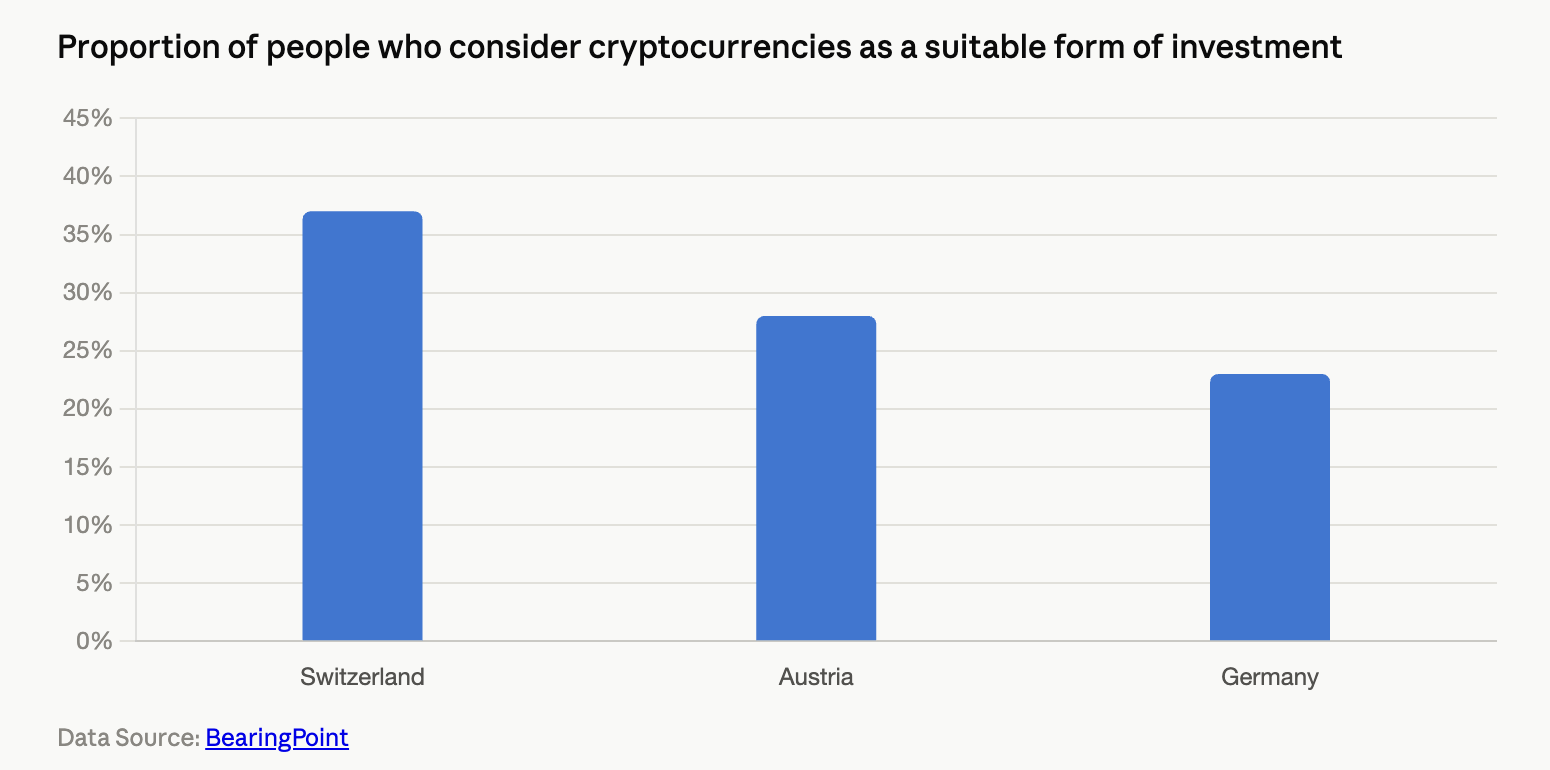
The differences run deeper than ownership. In Switzerland, 37% of respondents viewed cryptocurrency as a worthwhile investment, compared with 28% in Austria and 23% in Germany. Swiss respondents were also more willing to see digital assets eventually serving as international trade or reserve currencies, with 45% expressing that view versus 36% in Austria and 32% in Germany. Those figures typically emerge only after people become comfortable with the technology, not simply aware of it.
Switzerland also led in openness toward government-issued digital money. Forty-four percent of respondents said they would consider using a central bank digital currency (CBDC), such as a digital franc, in everyday life, compared with 38% in Austria and 29% in Germany. A central bank digital currency is simply a digital version of government-issued money rather than a privately issued cryptocurrency.
Dr. Robert Bosch, Bearingpoint’s global head of financial services, said the findings show Switzerland is not just more receptive to cryptocurrency but more willing to embrace digital money overall. Bosch remarked:
“Germany discusses risks, while the neighbors are already using and investing more strongly.”
Switzerland’s lead reflects decisions made years before today’s adoption figures. Parliament approved the country’s Distributed Ledger Technology Act in September 2020, and the framework became fully effective on Aug. 1, 2021. Distributed ledger technology, or DLT, is the shared record-keeping system that allows blockchain networks to securely record and verify transactions.
Instead of writing an entirely new cryptocurrency law, Switzerland updated existing financial and civil legislation. The changes clarified how tokenized assets fit into established legal structures, addressed bankruptcy treatment and introduced licensing for specialized DLT trading facilities. That kind of legal certainty tends to attract companies long before it shows up in consumer surveys.
The timing mattered. While much of Europe was still building its regulatory framework, Swiss companies were already operating under clear rules. That gave founders, investors and financial institutions time to establish businesses, refine products and gain practical experience before broader European regulations arrived.
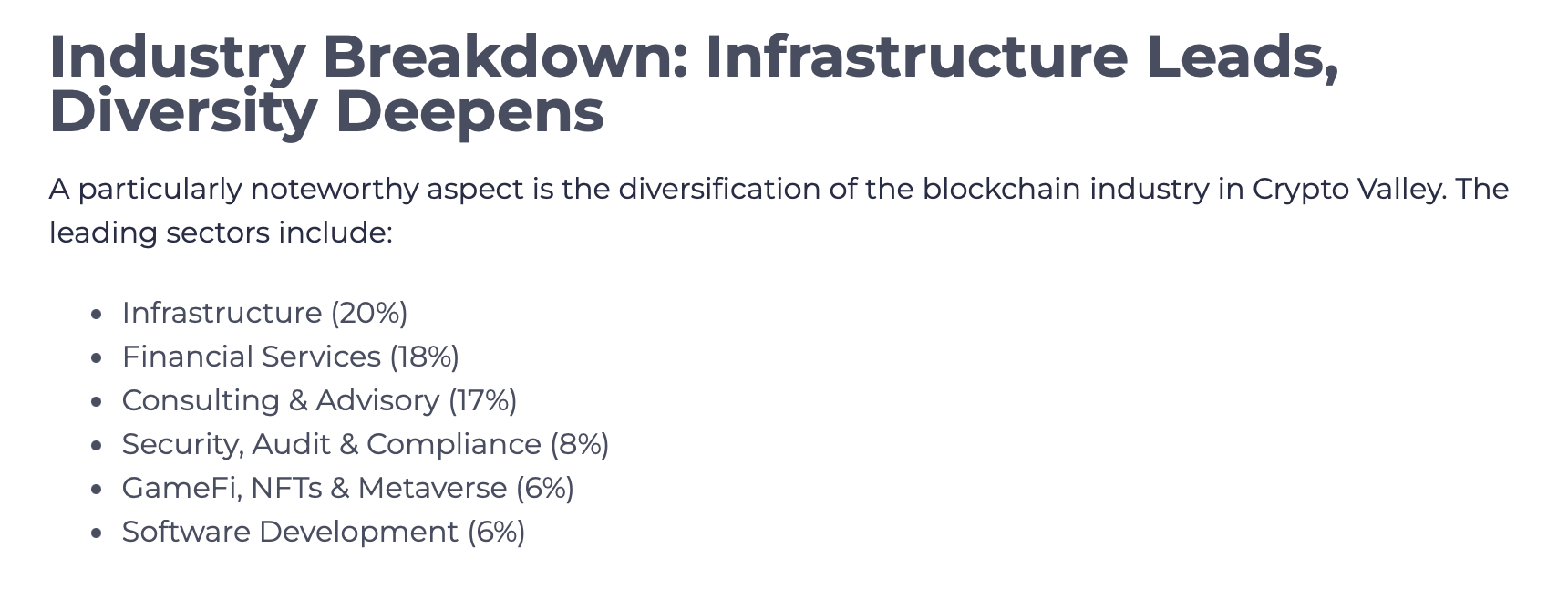
Screenshot from a CV VC Crypto Valley Company & Industry Report release in May 2025.
Those early decisions also helped fuel Crypto Valley, which spans Switzerland and Liechtenstein. The ecosystem counted 1,749 active blockchain and DLT companies in its 2024 industry report, representing 14% annual growth and a 132% increase since 2020.
Zug remains the center of Crypto Valley, hosting roughly 719 companies, or 41% of the ecosystem, while Zurich accounts for about 15%. Additional clusters have expanded across Geneva, Ticino, Lucerne, Neuchâtel, and Liechtenstein, giving blockchain businesses access to lawyers, banks, developers, venture capital firms, and technical talent without leaving the region.
That concentration creates an advantage that is difficult to replicate. As more companies establish operations, specialized financial services, compliance expertise and investment capital tend to follow. Switzerland has become home to organizations connected with Ethereum, Cardano, Solana, Polkadot, Tezos, Sygnum Bank, Amina Bank and Bitcoin Suisse, reinforcing that cycle.
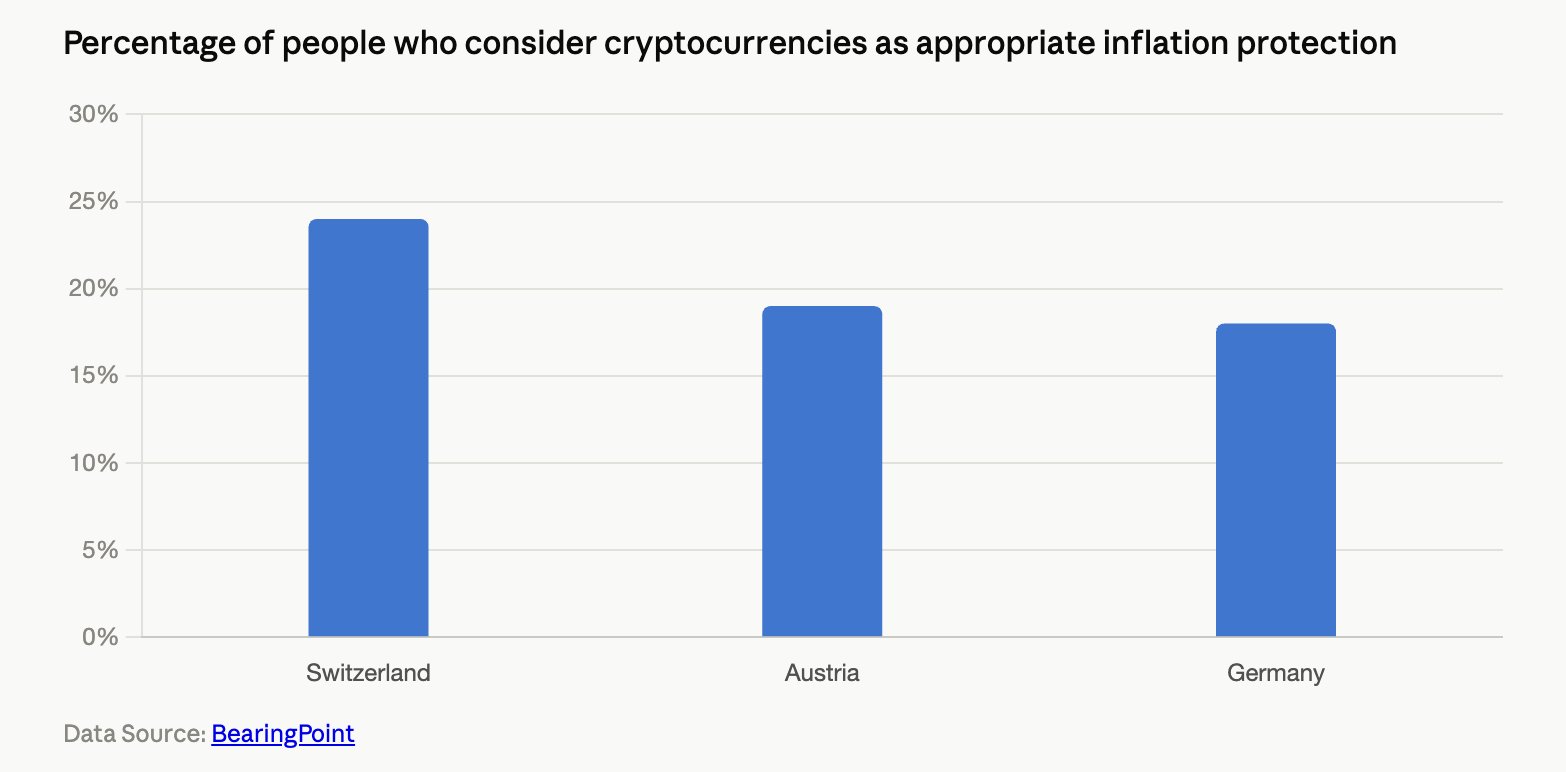
The survey also found cryptocurrency adoption remains strongest among younger adults and continues to vary by gender, education, and income. In Switzerland, 36% of respondents between 18 and 24 reported using cryptocurrency, while Austria and Germany showed the same pattern at lower participation levels. Those demographic trends help explain who is adopting first, but they do not account for Switzerland’s broader national lead.
The findings suggest digital assets are being added to traditional finance (TradFi) habits rather than replacing them. Between 80% and 87% of respondents across the three countries still viewed government-issued currencies as effective payment instruments, while about 64% of Swiss respondents continued to favor gold as an inflation hedge.
That combination has become increasingly common. People often view cryptocurrency as another financial tool instead of an alternative to traditional money, allowing banks and policymakers to expand digital offerings without displacing established financial products.
Germany still trails Switzerland in retail adoption, but its banking sector could reshape that picture. Cooperative banks associated with DZ Bank and savings banks linked to Dekabank collectively maintain roughly 80 million customer relationships, giving them a reach few cryptocurrency platforms can match.
DZ Bank received authorization in late December 2025 for its “meinkrypto” platform, which is being integrated into the VR Banking App. The service launched with bitcoin, ether, litecoin and cardano, while custody is handled by Börse Stuttgart Digital. Individual cooperative banks must still decide whether to activate the feature.
Dekabank is building a similar platform for Germany’s Sparkassen network, which serves about 50 million customers. The rollout is expected to continue through 2026, initially supporting bitcoin and ether. Integrating cryptocurrency into familiar banking apps removes one of the biggest hurdles for newcomers by eliminating the need to open accounts with separate digital asset platforms.
Switzerland built its advantage through regulatory certainty and years of ecosystem development. Germany is pursuing a different strategy by using established banks and existing customer relationships to broaden access under Europe’s regulatory framework.
That approach gives Germany enormous distribution potential, but Switzerland still benefits from years of accumulated expertise, infrastructure, and business concentration. Future Bearingpoint surveys, along with customer adoption figures from Germany’s banking platforms, should provide a clearer picture of whether the gap begins to narrow or whether Switzerland continues to pull ahead.
免责声明:本文章仅代表作者个人观点,不代表本平台的立场和观点。本文章仅供信息分享,不构成对任何人的任何投资建议。用户与作者之间的任何争议,与本平台无关。如网页中刊载的文章或图片涉及侵权,请提供相关的权利证明和身份证明发送邮件到support@aicoin.com,本平台相关工作人员将会进行核查。


