Written by: Zhao Ying, Wall Street Watch
Barsh's "market autonomy" narrative is creating new uncertainties.
The Federal Reserve maintained interest rates at the July FOMC meeting, but Chairman Barsh's statement at the press conference sparked widespread controversy in the market. He claimed that as the forward guidance fades, the market has learned to "play the game rather than watch the referee," and that the tightening of financial conditions is spontaneously completed by the market. However, critics argue that this narrative is fundamentally flawed—the Federal Reserve has never been a referee but is one of the most important players on the field, and changes in communication strategy do not alter this fact.
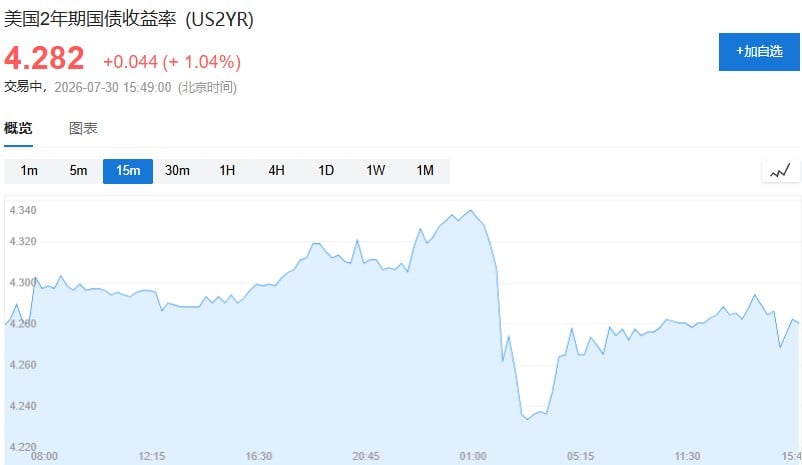
This meeting saw a rare occurrence of three dissenting votes, with regional Fed presidents Hammack, Kashkari, and Logan all supporting a 25 basis point rate hike. After the meeting, the U.S. Treasury yield curve steepened significantly, with the 30-year Treasury yield breaking above 5.20% at one point, while the two-year yield experienced significant volatility after the press conference, initially declining by 10 basis points before narrowing to a 4 basis point decline. Institutions like Goldman Sachs, Barclays, and Nomura generally believe that the Federal Reserve is tacitly allowing the bond market to replace official interest rate hikes, but this strategy harbors risks of derailing inflation expectations and exacerbating policy volatility.
Barsh's Core Argument: Let the Market Do the Federal Reserve's Work
At the July FOMC press conference, Barsh interpreted the significant rise in both long-term and short-term U.S. Treasury yields since the last meeting as a positive signal. He stated that during the interval between the two meetings, "the market's attention has focused on real data and real economic dynamics, and the response of prices to information is real-time; the reduction in forward guidance may be one factor."
He further indicated that market participants are learning to "play the game rather than watch the referee," which he views as progress, asserting that "the central bank does not always need to be the center of attention."
This statement is not the first of its kind. Barsh has conveyed similar signals since the last meeting, but this time the wording is clearer and more emphasized. The underlying policy logic is that if the Federal Reserve has credibility and inflation risks rise, the bond market will spontaneously sell off, leading to higher real and nominal interest rates, tightening financial conditions, and a cooling marginal economy—this process does not require the Federal Reserve to explicitly signal a rate hike.
Why the "Referee Argument" Does Not Hold Water
Robert Armstrong, a columnist for the Financial Times, has directly criticized Barsh's framework, labeling it "fundamentally wrong." Armstrong pointed out that Barsh's core claim is that before he took over the Federal Reserve, the market's response to economic data was mediated by the Federal Reserve's policy expectations, and now that mediation has been removed, the market can directly respond to "real economic developments."
However, this is far from reality. The Federal Reserve sets short-term interest rates; any market participants betting on the direction of short-term rates necessarily need to form a judgment about the Federal Reserve's next actions. This logic does not change regardless of the length of the Federal Reserve's press release or whether the Chairman's responses are substantive.
As former New York Fed President Bill Dudley recently wrote: "Financial markets are not pricing what the Federal Reserve should do, but what they think the Federal Reserve will do." Armstrong's conclusion is: the Federal Reserve is not a referee, but a player, and a very important one. Adjustments in communication strategy cannot change this basic fact.
The Potential Risks of "Market Replacing Rate Hikes"
Barsh's strategy also faces inherent contradictions in practice. The boundary between "letting the market do the Federal Reserve's work" and "the market pressuring the Federal Reserve" is extremely blurred. If the market spontaneously tightens financial conditions, and the Federal Reserve subsequently chooses to stand pat, then the Federal Reserve is effectively relaxing financial conditions through "non-action"—because the market's tightening expectations have been falsified.
The market movements following the July meeting provide preliminary evidence. The two-year yield fluctuated dramatically after the press conference, ultimately declining only slightly, reflecting the high uncertainty of the short-term policy path; meanwhile, the rise in the 30-year yield may indicate that long-term inflation expectations are on the rise—this signal emerges precisely against the background of three committee members voting in favor of a rate hike, which does not serve as a strong endorsement of Barsh's credibility.
Analysts at Goldman Sachs, Barclays, and Nomura all believe that the Federal Reserve is currently tacitly allowing the bond market to replace official rate hikes, but this strategy could also push up long-term yields and create the risk of derailing inflation expectations and increasing future policy volatility.
The Market Dilemma in an Information Vacuum
Barsh's communication strategy may not fundamentally be wrong, but the issue lies in the way he describes this strategy, which creates additional confusion. Positioning the Federal Reserve as a "referee" rather than a "player" is a misleading statement about how the market operates, making it more difficult for market participants to interpret policy signals, thus facing greater uncertainty.
Armstrong believes that unless Barsh and the market are fortunate enough, this issue will become increasingly prominent over time. Even without a financial crisis occurring, the strategy of "silencing forward guidance" cannot be maintained indefinitely. Against the backdrop of unresolved inflation risks and a continuously steepening yield curve, the communication tension between the Federal Reserve and the market will be a core variable that investors need to continue to monitor in the next phase.
免责声明:本文章仅代表作者个人观点,不代表本平台的立场和观点。本文章仅供信息分享,不构成对任何人的任何投资建议。用户与作者之间的任何争议,与本平台无关。如网页中刊载的文章或图片涉及侵权,请提供相关的权利证明和身份证明发送邮件到support@aicoin.com,本平台相关工作人员将会进行核查。


