In the first half of 2026, crypto venture capital rounds plummeted by 78%. Capital has shifted from spreading nets widely to controlling mature tracks, with traditional institutions making up more than half, seed rounds are dead, and stablecoins and prediction markets are rising.
Written by: Starbase Accelerator
Overview of Report Content
On July 14, 2026, Tiger Research released "The Age of Control: Crypto Venture Capital in H1 2026," in collaboration with Web3 asset data platform RootData. Based on 9,416 investment transaction data from 2018 to the first half of 2026, the report systematically outlines the structural changes in the crypto venture capital market. The report explores the following dimensions:
- Reshaping the VC landscape: which institutions survive, which vanish, and how capital concentrates on the forefront;
- Migration of financing rounds: the collapse of seed rounds and the deep logic of capital siphoning in later rounds;
- Entry of traditional finance: evolution of institutional capital from "testing the waters" to "taking control";
- Cold and hot track differentiation: rise of payment stablecoins and prediction markets, while GameFi and NFTs retreat;
- Shift in investment paradigms: a transition from "spreading nets and betting" to "holding infrastructure".
From "Spreading Nets" to "Holding Control": The Paradigm Shift in Crypto VC
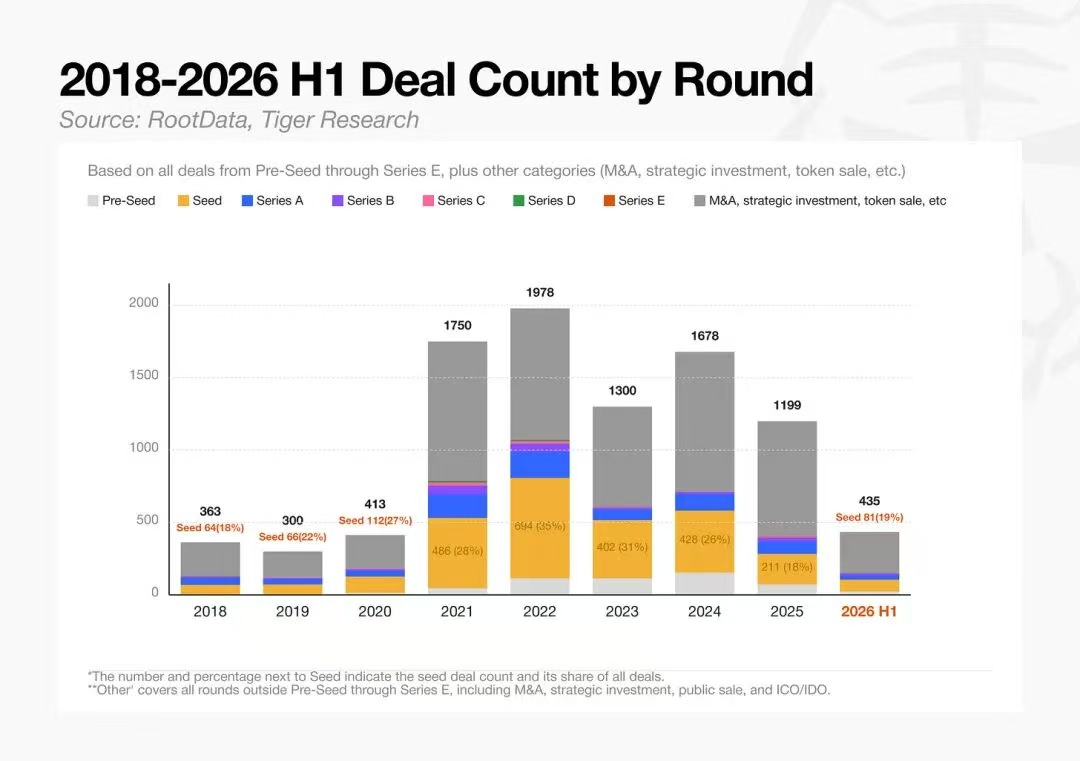
In the first half of 2026, the crypto venture capital market presented an extremely contradictory landscape: the total financing reached 13.3 billion dollars, roughly on par with the total of 13.2 billion dollars in 2024, but the number of financing rounds was only 435, plummeting by 78% from a peak of 1,978 rounds in 2022. This is not a simple market contraction but a profound structural reconstruction—capital is shifting from "spreading nets" to "precise holding." The data analysis by Tiger Research and RootData on 9,416 investment transactions since 2018 reveals a clear trend: the market is polarizing.
On one end are a few large crypto-native VCs (like a16z crypto, Paradigm, Pantera Capital), which concentrate resources to take lead positions, raise due diligence thresholds, and seek board seats and governance influence;
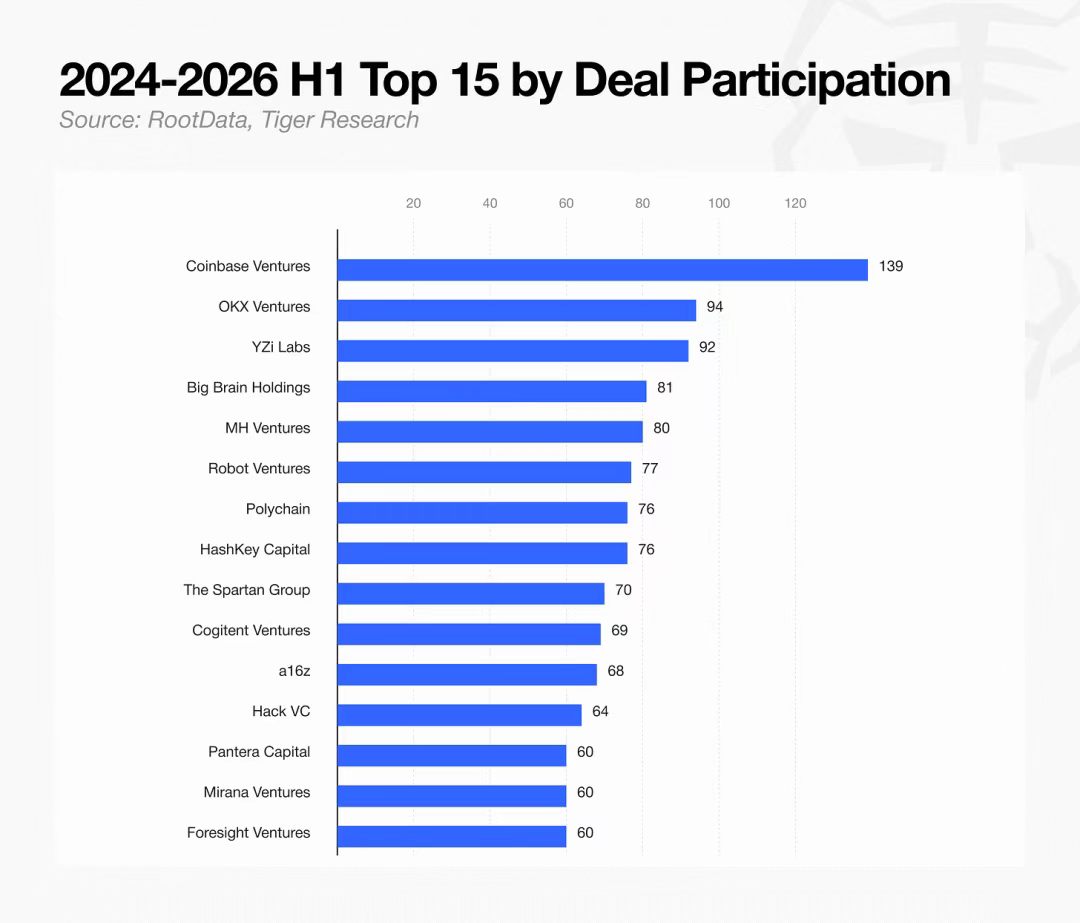
On the other end are exchange-based VCs (Coinbase Ventures, OKX Ventures, YZi Labs, etc.), which use liquidity and marketing support as competitive weapons, dominating follow-on investments. Coinbase Ventures ranked first in participation rounds with 140 transactions from 2024 to the first half of 2026, followed closely by OKX Ventures with 94 transactions, and YZi Labs (formerly Binance Labs) with 92 transactions ranking third.
Mid-sized VCs, caught in the middle, face the fate of being quickly squeezed out of the market. Institutions like AU21 Capital, LD Capital, and Shima Capital, which adhered to a "speed first, diversified portfolio" strategy in the last bull market, saw transaction numbers plunge by as much as 98.9%, effectively losing market influence. Their failure is not coincidental—when the market shifts from "narrative-driven" to "revenue-validated," funds lacking differentiated advantages are naturally eliminated.
Collapse of Seed Rounds and Capital Siphoning in Later Rounds
In the first half of 2026, there were only 81 seed round transactions, down 88% from 694 in 2022, with their proportion of total transactions decreasing from 35.3% in 2022 to 18.7%. Two signals are behind this: first, investors are clearly avoiding early-stage projects with unverified business models; second, the number of new projects truly needing seed round financing has been decreasing.
In stark contrast is the concentration of capital in later rounds. Series A and later rounds accounted for 75.2% of total investment, with Series A total financing (745 million dollars) surpassing seed round total financing (423 million dollars). Average transaction sizes have taken a stair-step leap: seed rounds at 5.4 million dollars, Series A at 22.4 million dollars, Series C at 127 million dollars, and Series E at 202 million dollars. Transactions over 100 million dollars reached 32 in the first half of 2026, making up 7.4% of all transactions, a significant rise from 1.1% in 2024; the average transaction size jumped from 11.7 million dollars in 2024 to 47.4 million dollars, nearly quadrupling.
Entry and Control of Traditional Financial Institutions
Traditional financial institutions participated in 54.5% of investment transactions in the first half of 2026, maintaining a high level since first exceeding half (53.9%) in 2021. Their participation methods are also changing—no longer are they making tentative early investments; they are directly entering mature projects with large amounts of capital.
A typical case is a16z leading a 355 million dollar round for Digital Asset (developer of Canton Network), where core institutional players like BNP Paribas, HSBC, S&P Global, and Hanwha Investment & Securities chose to invest directly rather than through venture capital subsidiaries. These institutions no longer judge by "TGE timetable" or "token economics," but by auditable revenue structures and necessary regulatory licenses.
Radical Changes in the Landscape of Tracks: Who is Rising and Who is Dying
After the approval of Bitcoin spot ETFs in 2024, the infrastructure track once accounted for 50.9% of total investment but plummeted to 14.8% by the first half of 2026. In its place, four major dominant tracks emerged: payment and stablecoins (25.3%), centralized exchanges (18.2%), and prediction markets (17.5%).
The death spiral of GameFi: the number of transactions in the gaming track collapsed from 141 in 2024 to just 5 in the first half of 2026, a decrease of 96%; financing fell from 758.6 million dollars to 44.8 million dollars. Early GameFi models excessively relied on token issuance to create financial returns rather than sustainable gaming experiences, and once user growth slowed, token devaluation and user loss mutually reinforced each other, forming a "death spiral." User traffic data, once seen as key indicators in due diligence, have thus lost reliability, leading capital to effectively shut off into this track.
The retreat of NFTs and social entertainment: NFT transactions fell from 27 to 2, financing dropped from 114.9 million dollars to 14.7 million dollars; social entertainment saw transactions fall from 74 to 11, with financing dropping from 512.1 million dollars to 70.1 million dollars.
DeFi's "silent concentration": transaction numbers decreased by 71%, but total investment only fell by about 34%. The average transaction size grew from 4.5 million dollars in 2024 to 10.4 million dollars in the first half of 2026. The 175 million dollar token round completed by Morpho on June 9, 2026 (led by a16z crypto, Paradigm, Ribbit Capital) alone accounted for 17.7% of DeFi's total investment in the first half of the year, indicating the market concentration.
Explosive growth of payments and stablecoins: this track's financing soared from 143.9 million dollars in 2024 to 2.85 billion dollars in the first half of 2026, increasing approximately twentyfold. However, it is important to note that this growth is mainly driven by a few large M&As—Mastercard's 1.8 billion dollar acquisition of BVNK and Payward's (parent company of Kraken) 600 million dollar acquisition of Reap, together accounting for about 84% of total investment in this track for the first half of the year. After acquiring Bridge, Stripe further collaborated with Paradigm to build a dedicated stablecoin payment chain, Tempo, and successfully launched the mainnet in March 2026; subsequently, Bridge's co-founder Zach Abrams became the interim head of the Open USD (OUSD) global alliance stablecoin project, which already has over 140 participating companies. Through acquisition, Stripe has simultaneously controlled its own platform and the industry standards alliance, marking a shift in competition for stablecoin infrastructure from company-level acquisitions to a battle for global standard-setting.
CEX's "self-investment": investment in the CEX track jumped from 3.0% in 2024 to 18.2%, but M&A accounted for 75.5% of total investment in this track from 2024 to the first half of 2026, and this proportion increased from 58.8% in 2024 to 78.9% in 2025. Representative transactions include: Naver's acquisition of Dunamu shares (pending regulatory approval), Coinbase's 2.9 billion dollar acquisition of Deribit, Kraken's 1.5 billion dollar acquisition of NinjaTrader, and Abu Dhabi's sovereign wealth fund MGX's 2 billion dollar strategic investment in Binance. Large exchanges are playing dual roles as both "investees" and "strategic investors."
The meteoric rise of prediction markets: after the CFTC officially approved the compliant operation of prediction markets in May 2025, this track has entered the mainstream view of institutions. Kalshi's cumulative trading volume surpassed 100 billion dollars in June 2026, completing a 1 billion dollar round led by Paradigm and another 1 billion dollar round led by Coatue; Polymarket received cumulative investment commitments of approximately 1.6 billion dollars from the Intercontinental Exchange (ICE). This track is forming a landscape of "dual oligopoly + repeated institutional betting."
The "silent rise" of custody: financing increased from 2.04 million dollars in 2024 to 317.1 million dollars in the first half of 2026, a 15-fold increase. Anchorage's single round strategic investment of 100 million dollars accounted for about one-third of total investment in this track in the first half of the year. The demand for institutions to directly hold crypto assets has spurred a rigid growth of compliant custody infrastructure.
Conclusion: From "Betting" to "Control"
The report reveals a fundamental shift: the focus of crypto investment has changed from "sowing short-term seeds" to "holding infrastructure and protocols."
Before the approval of Bitcoin spot ETFs in 2024 and the improvement of the regulatory environment, the crypto market was a realm of "indiscriminate betting," dominated by numerous small, narrative-driven investments. This strategy ultimately led to the collapse of GameFi and NFT tracks and the elimination of VCs adhering to this strategy.
Today's capital no longer pursues short-term bets but aims for long-term control over investment targets and on-chain infrastructure. It concentrates large amounts of capital on a few established targets with auditable revenue structures and regulatory permissions, or directly acquires equity to control the infrastructure itself.
In the past, investments in early projects were signals released by VCs to the market—"smart money" entering would drive token prices up or attract retail participation early on. But today, direct acquisitions of infrastructure and obtaining licenses by structural capital no longer convey any followable signals to retail. The reaction of retail investors to VC investment news is weakening, essentially due to the structural change of market capital itself.
Retail investors now also need to assess potential investments with the same caution as VCs. The old betting strategy for retail and in the "Age of Control," capital no longer bets on seeds, but directly acquires the fruits.
免责声明:本文章仅代表作者个人观点,不代表本平台的立场和观点。本文章仅供信息分享,不构成对任何人的任何投资建议。用户与作者之间的任何争议,与本平台无关。如网页中刊载的文章或图片涉及侵权,请提供相关的权利证明和身份证明发送邮件到support@aicoin.com,本平台相关工作人员将会进行核查。


