From PayPal to Stripe, from stablecoins to Agent, does the payment industry encompass four generations, will this time be victorious?
Written by: Zuo Ye
Storm clouds gather, the wind fills the building, Stripe is once again trying to acquire PayPal. Fortune changes, the last time was 30 years ago when Peter Thiel's PayPal merged with Elon Musk's first X.com.
I don't understand why everyone is talking about PayPal's sluggish growth, as if this FinTech track holds dire prospects for us. Twenty years ago, Peter Thiel embarked on his journey from payments, initiating his first entrepreneurship, and the PayPal mafia was unified. Wherever Musk went, the public welcomed him warmly, truly taking full advantage of the timing, that kind of vibrant life and flourishing environment is still vivid in memory. After just twenty years, has Payment transformed into our burial ground?
Growth is a miracle, stablecoins are not
Stripe's failure to go public during the pandemic now seems to be a mistake.
Stripe's various efforts are all aimed at the elusive dream of going public, and under the backdrop of expansive monetary policies during the pandemic, Stripe first touched a $100B valuation.
However, it did not follow closely behind the likes of Coinbase and others in going public, leading its valuation to tumble again and again, mistaking the opportune moment for individual effort, thus, in deep reflection, Stripe embarked on an acquisition journey.
Stripe started as a developer-friendly platform with one-click API integration, which is quite enticing for developers; it is also the most unique approach in the payment industry, not fixating on fees and scenarios, but targeting the actual people behind the scenes.
Stripe aims to repeatedly leverage its experience, entering the acquiring system from the B-side, entering stablecoins from the C-side, and even planning for Agent-side ACP/MPP protocols, hoping to reshape the entire payment industry.
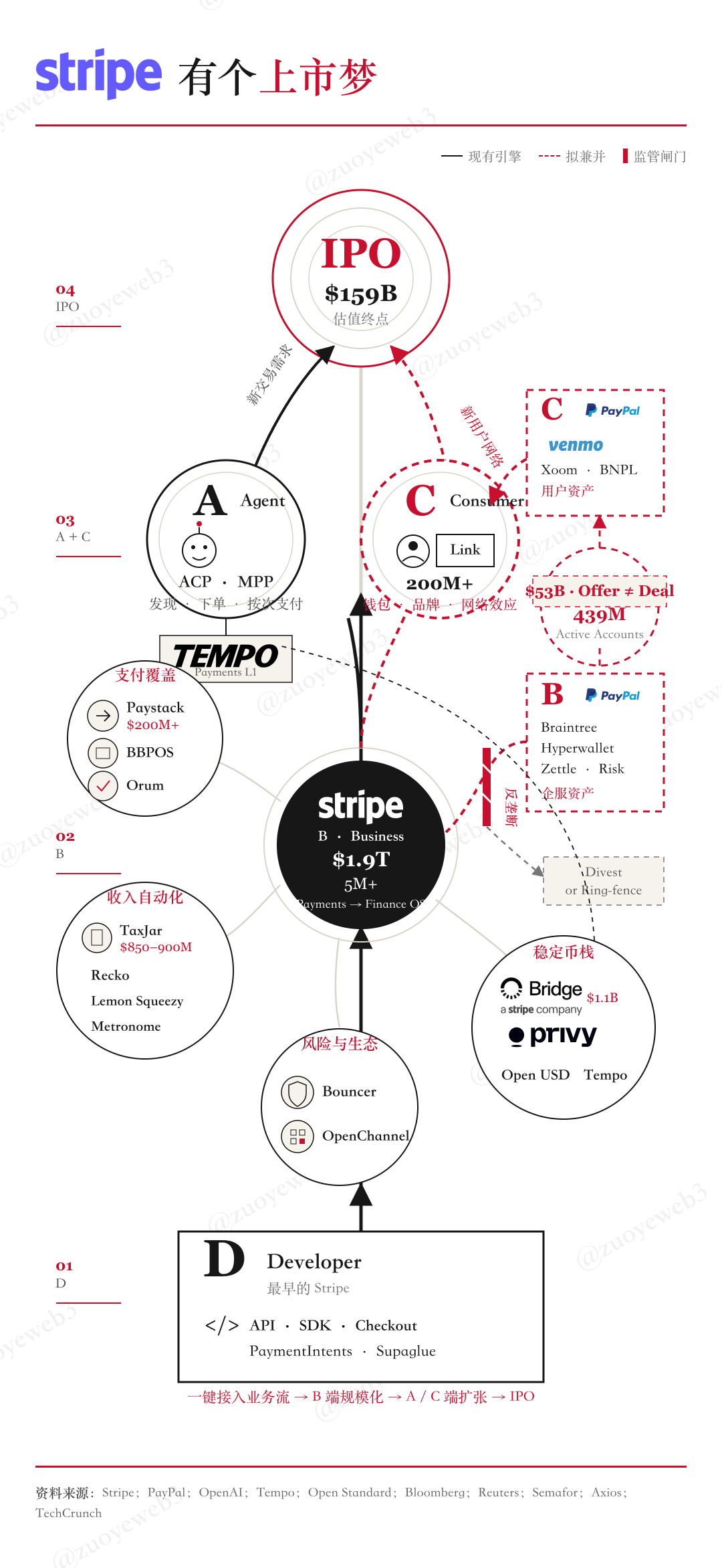
Image description: Stripe's rocky path to going public
Image source: @zuoyeweb3
The payment industry always has two characteristics that hinder Stripe's continued progress:
- The highly fragmented nature of the payment industry remains unchanged. By targeting a single country, industry, or even a few companies, one can continue to survive and cannot be directly eradicated by external forces;
- Payments are an adjunct to banking. Developers and B/C-side businesses ultimately represent an external manifestation of banking processes, making stablecoins ultimately fall back into the bank's orbit.
Especially the series of acquisitions related to stablecoins, from the issuance of Bridge to the wallet entry of Privy, and even Tempo and OpenUSD, it is very difficult to replicate Stripe's past glory.
This acquisition proposal for PayPal is actually Stripe's attempt to use stablecoins to address its loss in the C-side sector, trying to make up for itself with PayPal's C-side business.
PayPal's issue is not that it cannot keep up with the times; neither Venmo nor PYUSD has salvaged PayPal's downward trend.
In other words, PayPal is simply too old; the structural incapacitation of the entire enterprise cannot be revived just by starting new businesses.
Stripe, which started slightly later, still wants to create more narrative possibilities for itself before its IPO.
If Stripe captures the backend developer market, then the stablecoin market captures the frontend—the story of the issuance network has likely ended. Tempo and OpenUSD may impact Circle's stock price but cannot touch Tether by a single cent.
If Stripe's ceiling is just Coinbase or Circle, then going public is destined to end in an underwhelming fate. In comparison to Adyen's market cap and Airwallex's valuation, Stripe's stablecoin narrative and X Agent narrative could be useful.
- Stablecoins are not part of the daily current payment system, but are a visible trend;
- Agents still need to find an entry point to join the existing system.
In the positive news, Agents are currently using stablecoins to frantically buy computing power and tokens, but aside from the suspicion of quantity, Agents still haven't entered Web3 business, let alone more conservative companies and banking systems.
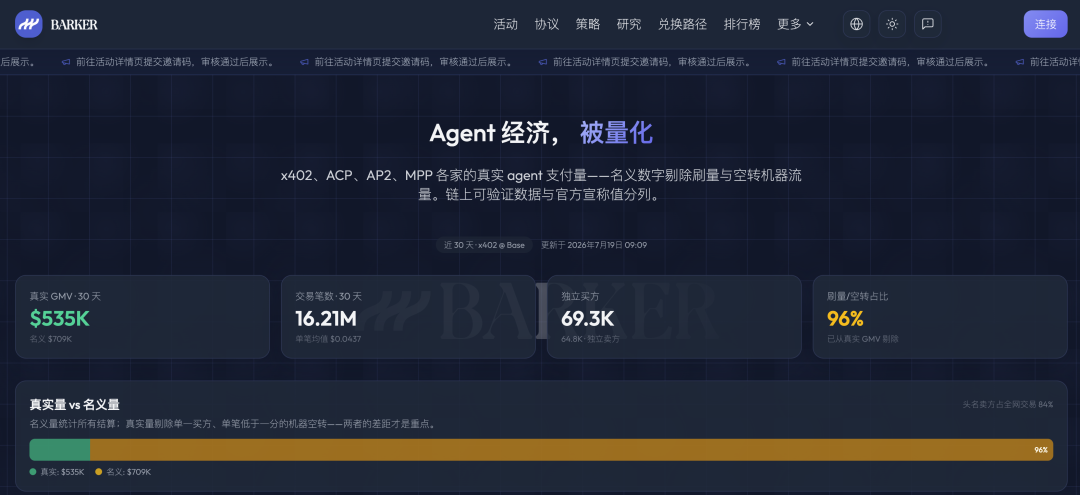
Image description: Agents are currently mainly used for volume boosting
Image source: @BarkerMoneyX
A side (future), B side, C side, D side (where they made a fortune), but Stripe's valuation finds it hard to escape from the reasonable value ceiling of $50 billion in FinTech; $100 billion includes too much proactive imagination.
If it cannot briefly arrive at the future, then expanding scale and ecology is the only area where Stripe can exert force; you can think of Stripe as a type of option product.
- Agents will use OUSD stablecoins, operating on Tempo, Stripe should be at the level of Visa;
- Agents will use stablecoins, but if OUSD fails, Tempo may seize part of the market, so Stripe should have a $100 billion valuation + Tempo public chain valuation;
- Agent economies are difficult to realize, Agentic Payments are covered by new concepts; at least Stripe still has its own business.
Investment losses are indeed a mistake, but missing out would lead to lifelong regrets. Starting from the difficult problems Stripe has posed to the primary market, it is worth further pondering how the entire payment industry will evolve.
Payments are just an entry point, value-added services profit
Agents are a future visible to the naked eye, provided they can survive to that day.
Standing in mid-2026 is a very subtle juncture; if the clear legislation is passed in the final time window, stablecoin earnings may seal the deal.
At the same time, the long-term future of the Agent economy is currently focused on alternative models for white-collar and blue-collar workers, as well as hardware fields like new wearable devices and AIOS mobile phones.
The transformation of payments by Agents has not sparked social concern; there are reasons to believe this is the hidden opportunity of stablecoins, a beta opportunity gifted by the times.
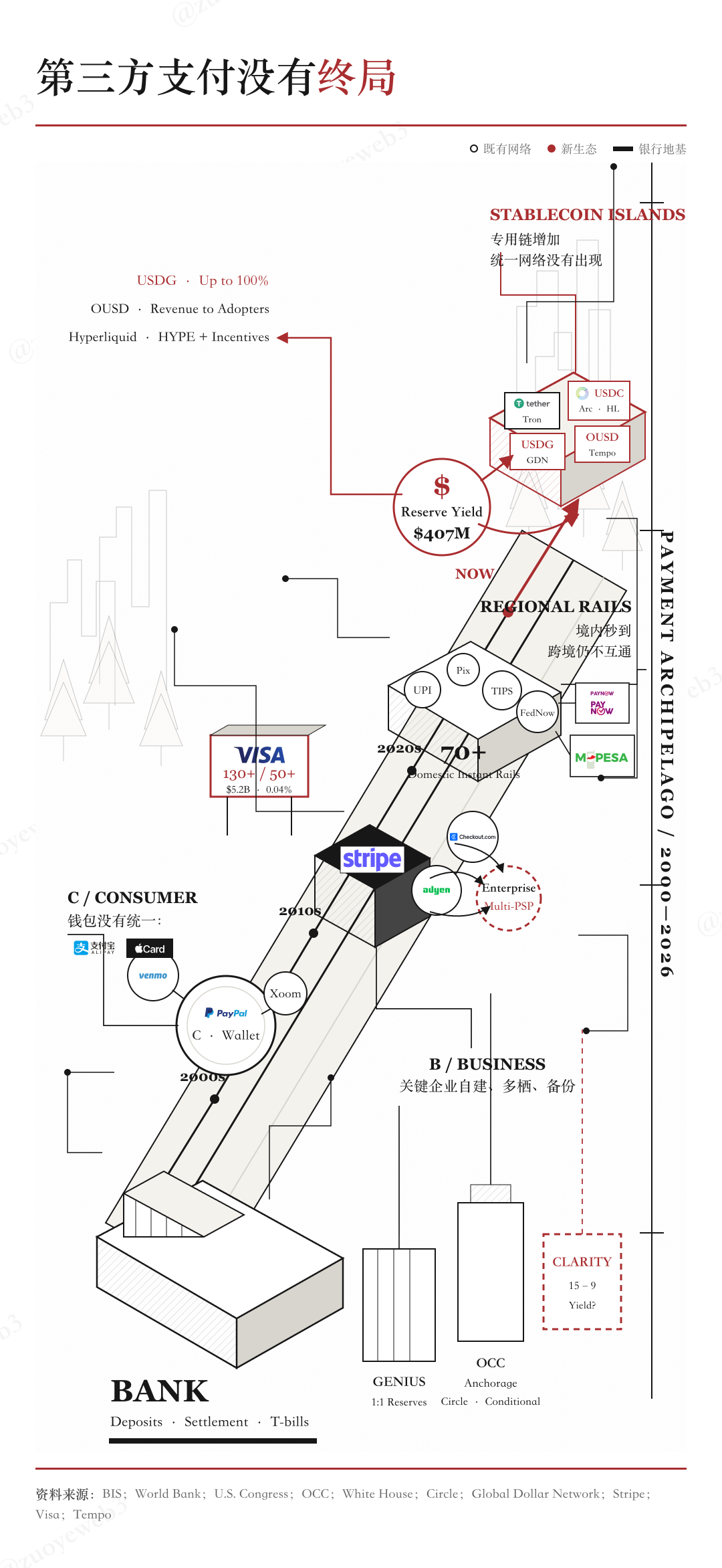
Image description: The eternal motion of the payment industry
Image source: @zuoyeweb3
However, the operational model constructed by the payment industry in the past with "licenses + localization" may face sustained shocks from clearing networks.
Stablecoins still require entry like deposits upfront, as well as on-chain circulation and monetization, which is where the compliance backing of the banking industry lies.
In the 30 years of FinTech waves ushered in by the internet, the banking industry has ultimately strengthened its control over payments, and did not experience direct transformation or even disappearance like publishing, consumption, entertainment, or dining.
Under the technological wave, banks have become increasingly transparent, but still hold the terminal touchpoints of cash and account opening locations. In a certain sense, the fragmentation of the payment industry can be attributed to the segmentation of banks into blocks and regions, and licenses and sovereign boundaries are merely an acknowledgment of reality.
Yet, within the actions of Stripe and Circle lies another possible future for payments: acquiring customers through stablecoins on the front end and turning profits through clearing on the backend.
Stripe and Circle are actually quite similar; they represent the intersecting forms of the future of FinTech and Crypto, both working on public chains (Tempo vs Arc), stablecoins (OUSD vs USDC), and clearing networks.
The reason it is not a revenue-sharing model for stablecoin issuance is because Circle has already begun subsidizing the Hyperliquid channels; OUSD directly shares profits with partners, and both sides have begun to spiral downwards, which is not the future.
However, the clearing system for the first time allows both public chains to earn profits from payment and stablecoin network effects solely relying on funding efficiency, without needing to forcefully subsidize partners.
The clearing system is not complicated; traditional fiat currency clearing relies on card organizations, SWIFT, national central banks, and commercial banks, which is already overwhelmed with layers upon layers.
Emerging stablecoin public chains, however, have no historical burdens and can focus on improving clearing efficiency. As Circle and Stripe secure the OCC banking charter (conditionally approved), they will inevitably move towards clearing after profit-sharing from stablecoins.
And the clearing network may partially detach from the commercial banking system, keeping profits within itself.
Conclusion
Stripe missed the window to go public during the pandemic, plunging into the trench warfare of third-party payments. This battle is an eternal Verdun model; it can never crush the small players in the region and across various industries by sheer scale.
A different approach must be adopted, facing the banking industry with efficiency. From PayPal to Stripe, from stablecoins to Agent, does the payment industry, represented by four generations, stand a chance of victory this time?
免责声明:本文章仅代表作者个人观点,不代表本平台的立场和观点。本文章仅供信息分享,不构成对任何人的任何投资建议。用户与作者之间的任何争议,与本平台无关。如网页中刊载的文章或图片涉及侵权,请提供相关的权利证明和身份证明发送邮件到support@aicoin.com,本平台相关工作人员将会进行核查。


