Key Takeaways
- CENTCOM confirmed two U.S. deaths and one missing service member after Iran’s July 17 strike on Jordan.
- Brent and WTI crude gained 3% to 7% as Iran threatened the Strait of Hormuz, source of 20% of global oil.
- Trump said the U.S. would finish military objectives “very shortly” as strikes on Iran entered an eighth night.
U.S. Central Command disclosed that Iran fired ballistic missiles and drones at Muwaffaq Al Salti Air Base in Jordan late on July 17. Two service members died, a third remains missing, and four others were hospitalized and later discharged.
CENTCOM called the barrage retaliation for the ongoing U.S. bombing campaign, now in its eighth night as of July 19. American jets struck Qeshm Island near 6:10 a.m. local time Sunday, reportedly hitting coastal surveillance sites, air defenses, and drone facilities. Iranian media reported additional hits near Shadegan in Khuzestan province and around Sirik, with no immediate reports of new mass casualties from those strikes.
The fighting traces back to a war that began in late February 2026. A memorandum of understanding reached in June briefly paused hostilities, but the truce has broken down repeatedly amid strikes tied to control of the Strait of Hormuz. Neither side has moved toward a ground invasion, but the campaign has widened to hit civilian infrastructure alongside military sites.
A second U.S. service member died July 18 in northern Iraq during a controlled detonation of unexploded ordnance left by an earlier Iranian drone strike. Another sustained minor injuries. CENTCOM explained that it withheld both service members’ names pending family notification.
President Donald Trump said the troops “died to prevent Iran from getting a nuclear weapon.” He pledged to contact their families directly and said the United States would finish its military objectives “very shortly.”
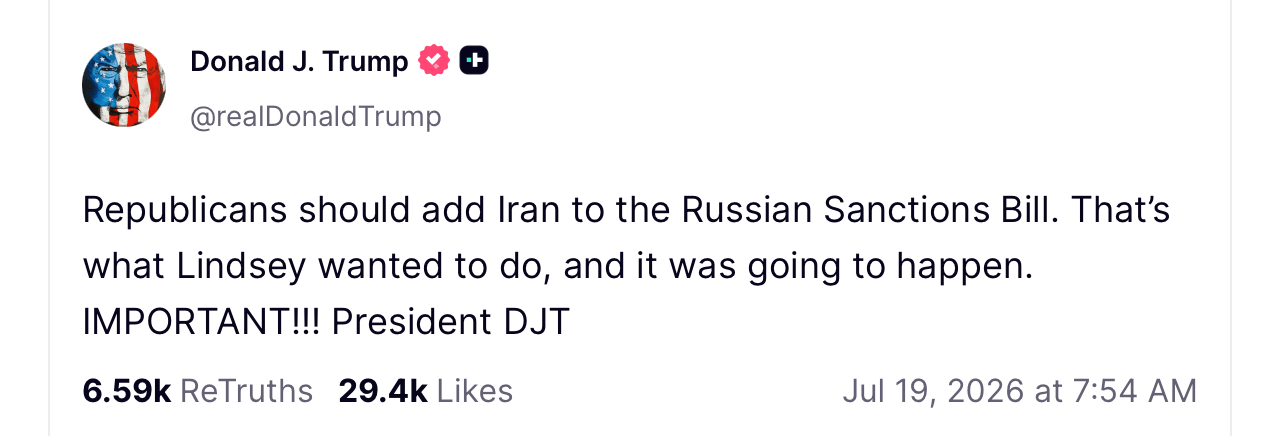
Image source: Truth Social.
Trump also pressed Iran on trust. He called recent Iranian outreach for a deal a sign of “desperation” and questioned whether Tehran would honor any agreement covering its nuclear program or access to the Strait of Hormuz. On Truth Social, he pushed Republicans to add Iran to the pending Russia sanctions bill.
Iranian Supreme Leader Mojtaba Khamenei condemned the U.S. strikes as a violation of the memorandum reached last month, calling Trump’s signature on the deal “utterly worthless and devoid of credibility.” He warned of “unforgettable lessons” if the campaign continued.
The Hill reported that Deputy Foreign Minister Kazem Gharibabadi accused Washington of abandoning the terms of the interim agreement. Iranian state outlets Tasnim and IRNA reported strikes near Sirik, Shadegan, and Bandar Abbas, along with damage to a desalination plant at Bonji and a second facility on Qeshm Island that cut water access for thousands of residents.
Iran claimed retaliatory hits on U.S.-linked sites in Kuwait, including an ammunition depot at Al Adiri camp and a Patriot radar installation at Ali Al Salem base. Iranian media put recent losses at more than 50 dead and 500 wounded, a figure not independently verified.
The Strait of Hormuz carries close to a quarter of the world’s seaborne oil, and the threat to shipping there pushed Brent and West Texas Intermediate crude higher through the week, with gains in the 3% to 7% range tied directly to the strikes. Tanker traffic through the Strait fell to a two-month low.
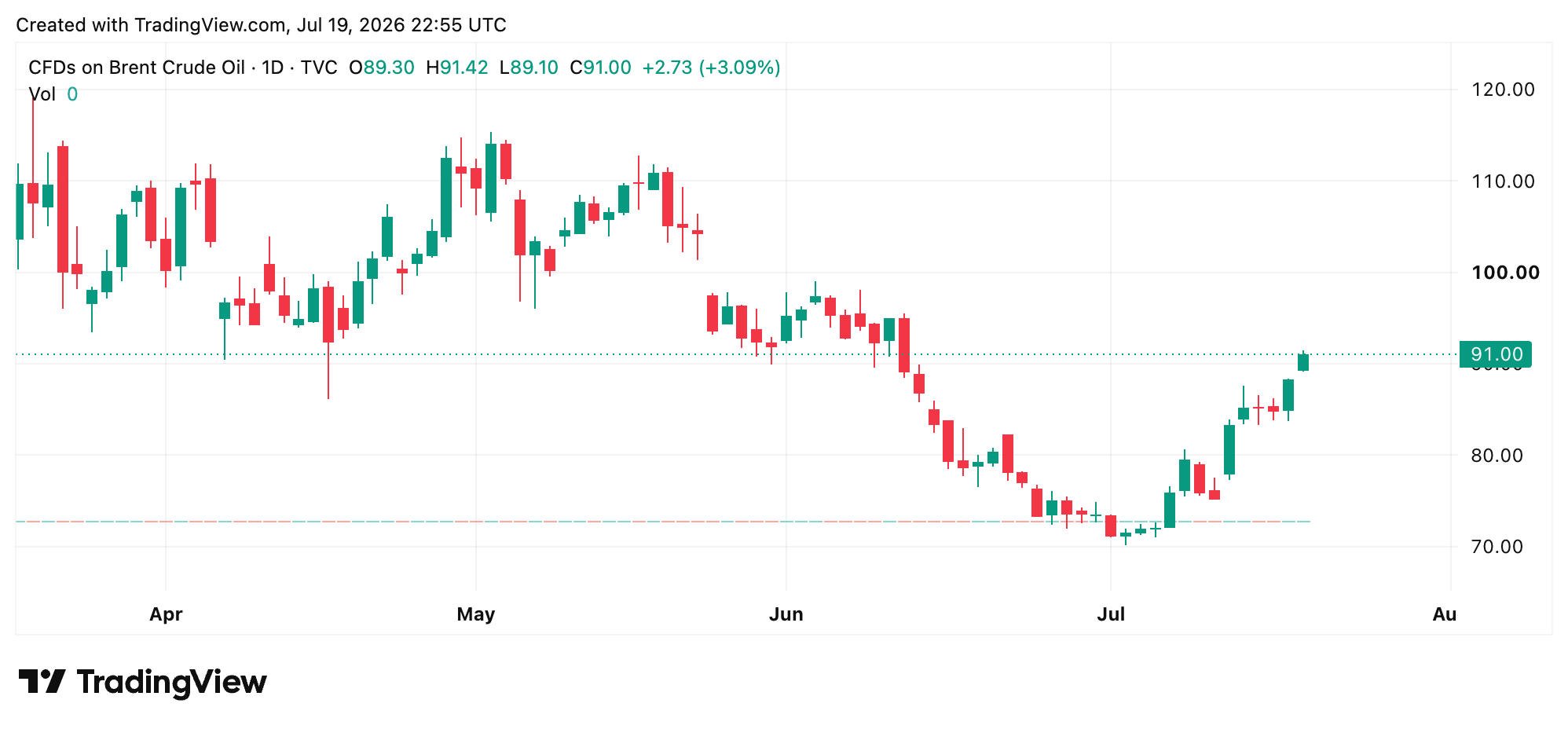
CFDs on Brent Crude near 7 p.m. EDT on Sunday evening.
U.S. equity futures turned cautious as Monday approached. The S&P 500 slipped toward the 743 level, and Nasdaq futures dropped roughly 1.5% as tech and semiconductor names lagged, while energy and defense stocks gained ground. Gold pushed closer toward the $4,000 mark as investors sought safety, and the dollar strengthened on the same flows.
Bitcoin traded lower alongside equities this past week, but it is managing to trade just under the $65,000 range. Seven-day stats show BTC is still in the green by 1.5% as of July 19 at 7 p.m. EDT. The crypto economy as a whole is up a modest 0.08% over the last day, standing at $2.21 trillion.
Alongside these markets, U.S. Treasury yields fell this week as bond prices rose on demand for safety, and options and commodity trading volume climbed as investors watched for signs of a de-escalation or a fresh Hormuz incident.
The State Department issued a Worldwide Caution advisory urging American citizens abroad to exercise increased vigilance as the conflict widens. No ground invasion has officially occurred, but strikes on infrastructure, from desalination plants to power facilities, have expanded the war’s reach beyond military targets and raised humanitarian concerns over water access for civilians.
Trump signaled the campaign would continue without a fast resolution, telling reporters he expected the U.S. to hit Iran “extremely hard” if Tehran does not agree to terms. Khamenei’s office, on the other hand, has maintained that further U.S. strikes would draw a proportional response, framing Iran’s retaliatory attacks as defensive measures against what officials called repeated aggression.
免责声明:本文章仅代表作者个人观点,不代表本平台的立场和观点。本文章仅供信息分享,不构成对任何人的任何投资建议。用户与作者之间的任何争议,与本平台无关。如网页中刊载的文章或图片涉及侵权,请提供相关的权利证明和身份证明发送邮件到support@aicoin.com,本平台相关工作人员将会进行核查。


