
Original | Odaily Planet Daily
Author | Wenser
Yesterday evening, the Ethereum Foundation protocol support team officially announced that the team has been formally disbanded. Previously, Wang Xiaowei, a co-executive director of the Ethereum Foundation who was seen as "one of the representatives of the EF organizational reform," has also officially resigned. So far this year, at least 8 senior personnel have left the Ethereum Foundation.
On the other side of the organizational and personnel changes are the independent non-profit institutions such as ETHLabs and Ethereum Institutional that are carving up the organizational functions of the Ethereum Foundation; it is also the recent technical progress of the Ethereum Foundation's security team using AI agents for red team testing of the ETH network and discovering real vulnerabilities.
As the ETH price faces one wave of industry skepticism after another, what lies ahead for the Ethereum Foundation is a more complex and diverse set of contradictions and challenges following internal reforms, related to the division issues that the Ethereum leadership is directly facing.
The Ethereum Foundation Enters an Era of Decline: Multiple Forces Emerge, Talent Drain, and AI Changes
For a long time, the Ethereum Foundation (hereinafter referred to as EF) has faced criticism for its rigid system, decision-making by a few individuals, organizational values, and market sentiment-manipulating sell-off actions. The criticism within the Ethereum community against EF has been particularly fierce; not long ago, Bankless founder David Hoffman even went as far as to express his dissatisfaction with EF by "selling off the last ETH position," urging the Ethereum community to build the ecosystem in their own way.
Now, the formal disbanding of the EF protocol support team has exposed the internal contradictions and division crises within the EF organization to everyone as if it were a clap of thunder. It is noteworthy that this round of organizational changes is particularly different from the organizational changes initiated by Ethereum founder Vitalik last year—this is a thorough personnel purge, regarded as "the largest round of layoffs since the establishment of EF," rather than previous changes in some leadership personnel.
When the Ethereum Ecosystem Leader Chooses to Cut Ties for Survival: The Story of EF's Major Layoffs
Everything starts with the official announcement of "EF New Structure" released by EF on June 23.
In this lengthy article of several thousand words, EF distinguishes the new organizational structure into protocol layer, access layer, user layer, community layer, and institutional layer, and then mentions that "this organizational restructuring involves layoffs of 54 people, accounting for 20% of EF's membership." Even more disheartening is that the announcement begins by stating: "Through this process, we have obtained the structure, activities, and personnel needed to execute the critical tasks that lie ahead." In other words, the laid-off personnel and departments are considered redundant, unnecessary, and without value.
It must be said that EF, which has always presented itself as a research organization and ecosystem leader with an academic demeanor, has shown its ruthless side of organizational management for the first time.
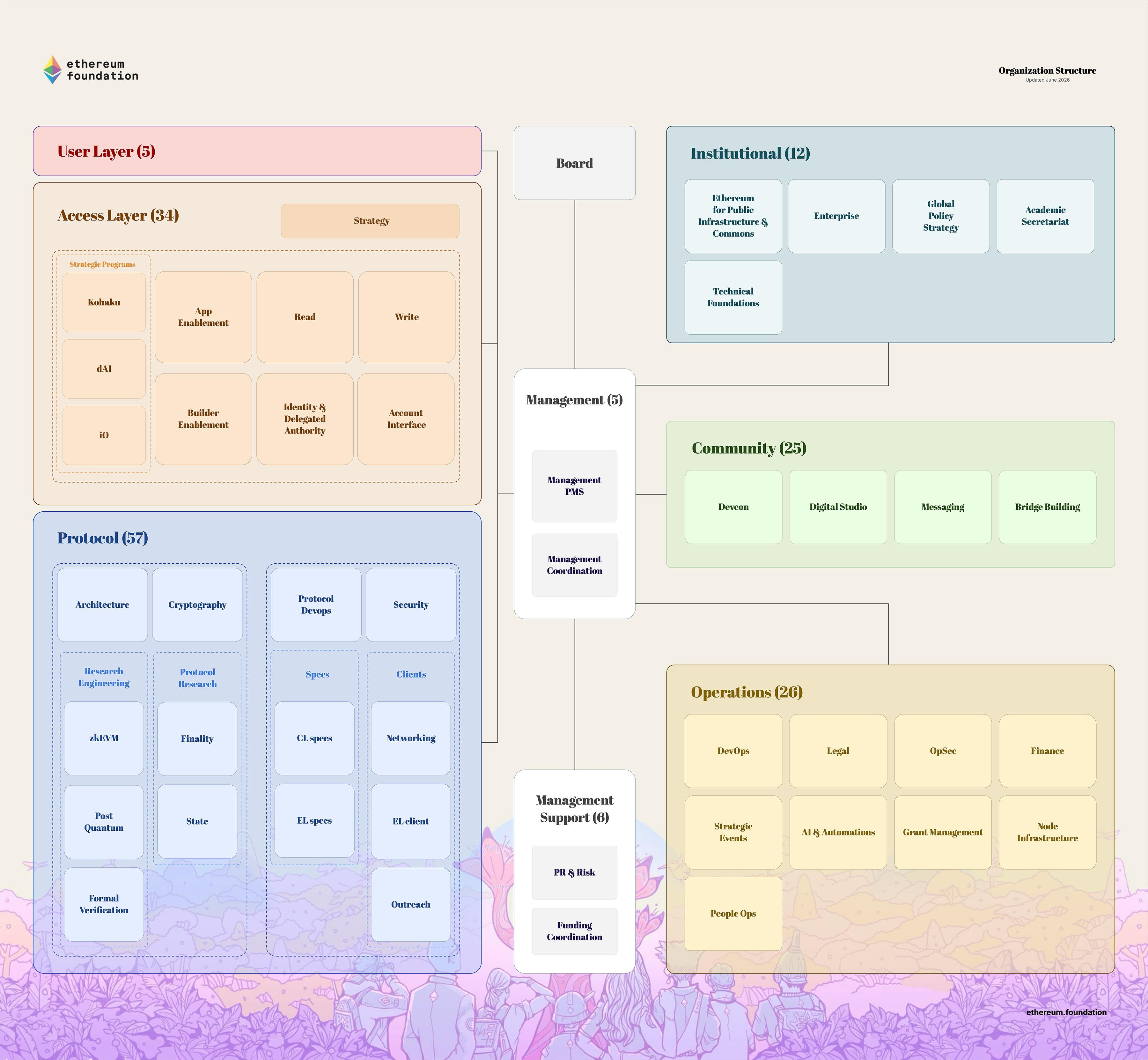
EF New Structure Diagram
The Disbandment of the EF Protocol Support Department Marks an Important Sign of EF Organization's Split
It is worth mentioning that the work content of the EF protocol support department leans towards infrastructure construction, mainly responsible for coordinating the Ethereum protocol development process, including organizing and coordinating core developer meetings, tracking Ethereum network upgrades, supporting EIP promotion, running the Ethereum protocol, etc. Now, its main functions have been allocated to the protocol layer part of EF.
On the very same day that EF announced the new structure, the non-profit research and development lab Ethlabs, co-founded by five former EF researchers, officially announced. This organization aims to promote Ethereum as the settlement layer for the global economy and has garnered support from a series of investment institutions, Ethereum ecosystem projects, independent individuals, and EF Foundation members, including Ethereum co-founder Joe Lubin (chairman of Sharplink, founder of Consensys), ETH treasury company BitMine (a treasury company under Tom Lee for Ethereum), Sharplink, and crypto investment organization SNZ.
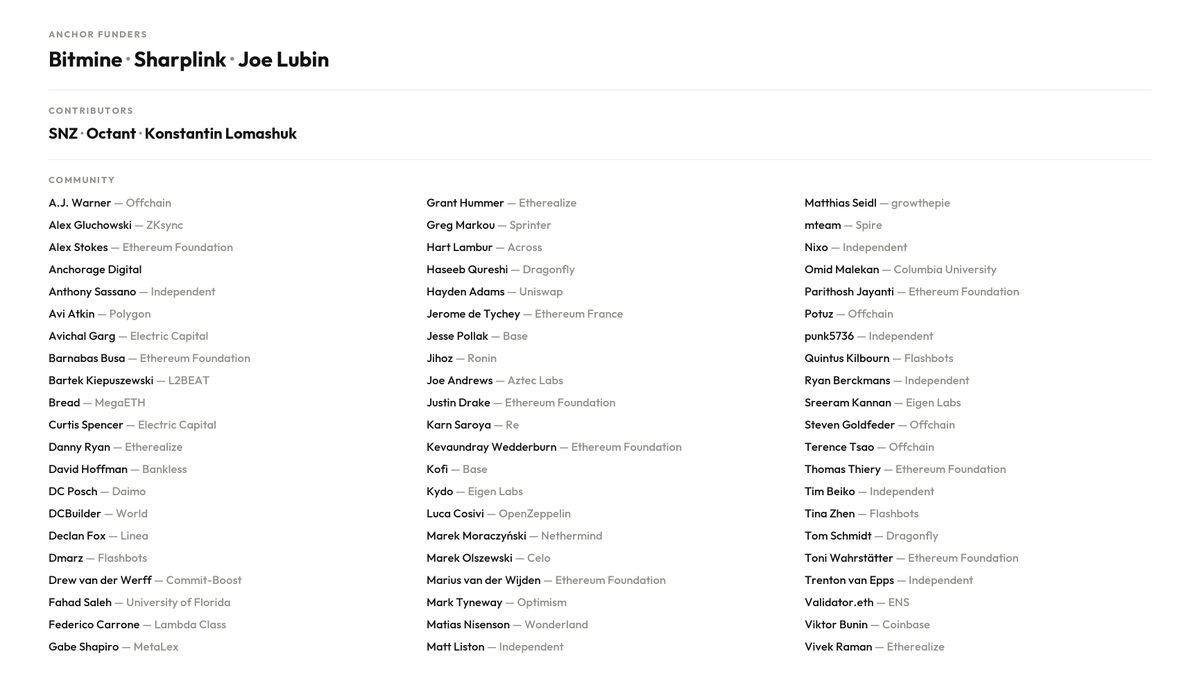
ETHLabs Community Participant List (Source: Official Account)
On July 1, Ethereum Institutional, co-founded by former EF members David Walsh, Marius Smith, and Matthew Dawson, officially debuted.
This organization focuses on the concept of "Ethereum's financial institution application program," committed to promoting the institutionalization and institutional-level applications of Ethereum and its secondary nodes, applications, and the entire ecosystem. At the same time, the organization emphasizes its collaboration with Ethlabs, Etherealize, and the Enterprise Ethereum Alliance, responsible for connecting institutional needs and explaining the value proposition of Ethereum to banks; Ethlabs focuses on transforming related needs into technical products. As a non-profit independent organization, Ethereum Institutional will provide free consulting related to Ethereum applications for banks and asset management companies.
One week later, Ethereum Institutional announced the launch of core team recruitment, focusing on hiring institutional business development (Institutional GTM), marketing and community operations, as well as solution architecture and technical project leadership positions in the upcoming weeks.
Thus, the EF layoff crisis concluded with the emergence of two non-profit independent organizations and the disbandment of the protocol support department, marking an imperfect ending to the "internal organizational reform" pushed by Vitalik last year. Apart from the organizational-level division and the loss of senior talents such as executive director Wang Xiaowei, EF is also facing the impact of AI technology.
The Era of AI Cyber War Begins, EF Security Team Tests Upgrades
Yesterday, researchers from the EF protocol security team stated in a blog article that a series of AI agents have been deployed to test the software dependent on the Ethereum ecosystem, searching for vulnerabilities in encryption systems, protocol codes, and smart contracts.
Vulnerabilities found by the AI agents include a remotely triggered panic issue in the peer-to-peer layer libp2p gossipsub used by the Ethereum consensus client, which has been fixed and disclosed on Github as CVE-2026-34219.
Researchers state that the AI agents are organized into specialized roles such as reconnaissance, searching, patching, and validation to find potential attack paths, reproduce faults, and verify if they are applicable to production code. EF indicates that AI has not replaced security researchers, but rather changed the way of working, allowing the team to cover significantly more than manual reviews, but requiring researchers to make more cautious judgments about a large number of seemingly credible conclusions.
With the news of the official launch of the GPT 5.6 model today, the security maintenance of the Ethereum protocol may be jointly handled by AI models and EF security researchers in the future. Moreover, although EF now states that "AI has not replaced researchers," with the continuous development and evolution of AI models, the personnel of the EF security team and even the entire organizational level may further shrink. In other words, EF will also face the challenge of AI models on organizational structure and its own functional roles.
Summary: The Phase of EF's Organizational Change Comes to an End, Perhaps to Become an Ecological Mascot in the Future?
Last January, we conducted a systematic analysis of EF's organizational changes in the article "Vitalik Takes the First Shot at 'Reform,' Where is the Ethereum Foundation Going?" At that time, Vitalik ambitiously pushed for EF's organizational reform; this May, after more than a year of organizational innovation, Vitalik instead shifted his stance, stating that "the Ethereum Foundation should not become the center of the ETH ecosystem and will turn to a smaller, long-termism approach."
It must be said that after ETH has grown to an asset worth hundreds of billions, EF, an official ecological organization established nearly 10 years ago, has already entered an awkward situation of "a large ship cannot easily turn," no wonder Vitalik had previously declared—"no longer writing regular blog posts, deciding to try writing some science fiction novels on decentralized governance themes."
As former EF researcher and Ethlabs member Ansgar Dietrichs said earlier this month in a podcast, "After five years of failing to break through $5,000, ETH still lacks a clear value narrative."
Currently, it seems difficult for EF to uphold the banner of "revitalizing the Ethereum ecosystem and driving ETH prices higher"; the subsequent large-scale adoption and institutional investments may have to rely on organizations like ETHlabs, Ethereum Institutional, and Etherealize.
Perhaps, in the near future, playing a role as an "ecological mascot" may be more suitable for EF.
免责声明:本文章仅代表作者个人观点,不代表本平台的立场和观点。本文章仅供信息分享,不构成对任何人的任何投资建议。用户与作者之间的任何争议,与本平台无关。如网页中刊载的文章或图片涉及侵权,请提供相关的权利证明和身份证明发送邮件到support@aicoin.com,本平台相关工作人员将会进行核查。


