Vitalik publishes the "Lean Ethereum" roadmap, with a decisive window for ETH institutionalization.
Written by: Liam 'Akiba' Wright
Translated by: Saoirse, Foresight News
Vitalik Buterin released a blog post titled "Lean Ethereum" on the X platform on July 4, clearly defining a timeline for Ethereum's development narrative towards the institutional market: this public chain, seen as financial foundational infrastructure, now needs to complete its self-reconstruction in the public eye.
In the X blog post published over the weekend, Vitalik defines "Lean Ethereum" as an upgrade combination plan taking three to four years, and describes it as the third major version iteration after Ethereum completed its merge upgrade.
The accompanying sketch of the Ethereum Foundation structure is merely a draft for multi-party coordination reference, not a finalized plan. The planning outlines several core development goals: achieving second-level transaction finality, a mainnet capacity of 1 billion Gas per second, scaling layer-two networks to a trillion Gas level, realizing post-quantum safety at the base level, and prioritizing privacy features as a core development goal for layer-one networks.
This planning also clarifies the investment logic for ETH in the market. Institutional investors need to assess whether Ethereum can maintain its position as a stable and reliable financial foundation during several years of underlying reconstruction. The settlement assurance capability that originally attracted institutions to Ethereum must also smoothly navigate this comprehensive upgrade transformation.
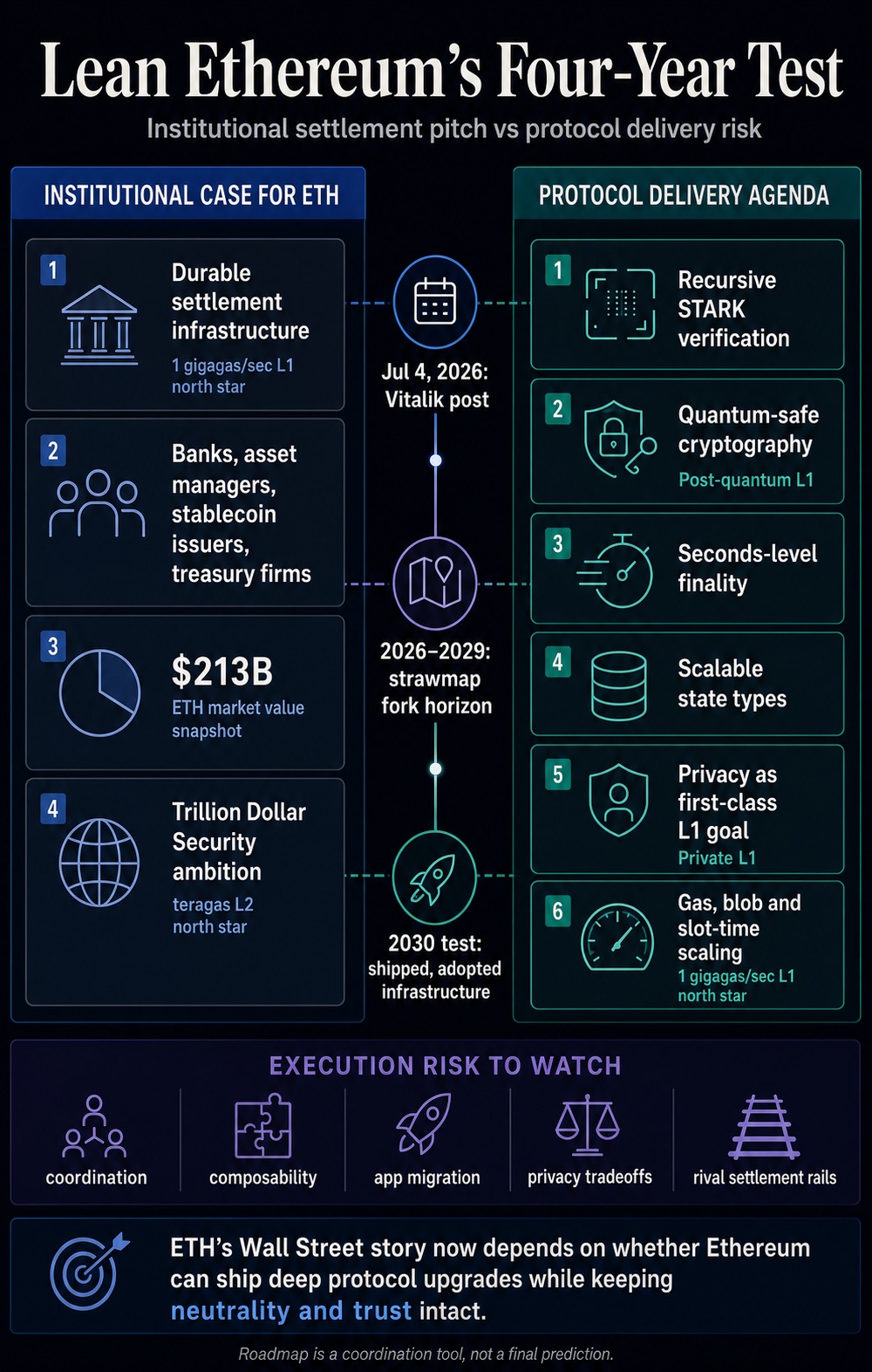
Vitalik’s "Lean Ethereum" four-year upgrade plan published on July 4, 2026, presents a value logic for Ethereum facing Wall Street institutions alongside six major underlying technology upgrade tasks. It exists alongside risks of multi-party coordination and disrupted composability. Over the next four years, Ethereum must complete a full set of foundational transformations while maintaining its network neutrality and credibility attributes to realize the grand vision of institutional-grade settlement infrastructure.
Institutional Financial Demand Meets Major Protocol Changes
Ethereum's layout towards Wall Street has long extended beyond spot trading. Its target clientele now includes banks, asset management companies, stablecoin issuers, asset tokenization departments, and publicly listed companies integrating ETH into their balance sheets and using Ethereum as a settlement foundation.
The "trillion-level secure asset" plan launched by the Ethereum Foundation in 2025 plainly states this grand vision: Ethereum aims to create a sufficiently secure foundation allowing individuals, enterprises, institutions, and even governments to hold huge assets on-chain.
The "Lean Ethereum" proposal is specifically designed to realize this institutional vision.
The Ethereum Foundation has established a section for "Institutional Ethereum" as an official interface for banks, asset management, publicly listed companies, tokenization projects, and stablecoin institutions; it has also set up Ethlabs to utilize treasury funds for research and development to support the narrative of ETH's monetary value. Bitmine, Sharplink, and Joe Lubin are deeply involved in the operation of these two major sectors, creating an external support system for the institutional market while the Ethereum Foundation maintains a protocol-neutral position.
This industry backdrop makes "Lean Ethereum" far from a mere technical concept. For Ethereum to be promoted as a stable and reliable settlement collateral, this roadmap must reduce industry uncertainties rather than introduce new risks.
Market data from CryptoSlate on July 5 shows that the trade price of ETH is about $1,763, with a total market capitalization of approximately $213 billion. The size of Ethereum is sufficient to influence institutional funding direction, but its volatility also keeps financial institutions highly focused on the risks involved in the upgrade's implementation.
For finance heads at banks and enterprises, due diligence on ETH is entirely different from typical cryptocurrency speculation. They need to evaluate whether the new underlying network architecture can maintain predictable settlement throughout the simultaneous upgrades of applications, wallets, clients, layer-two networks, and privacy tools.
A complete roadmap must translate into implementation to build a credible path from the existing Ethereum to a newly expanded, upgraded network that retains its neutrality and security. "Lean Ethereum" stands at the crucial juncture of this transformation.
Why the Entire Upgrade Plan Is Crucial
The multiple core transformations listed by Vitalik in the blog post are easily overlooked if treated merely as professional terminology; each directly affects institutional user experience:
Recursive STARK proof alters the on-chain verification logic, no longer requiring the full execution of transactions repetitively. Relying on proof significantly reduces chain verification costs and enhances scalability. For institutions, this directly impacts the long-term operational costs and asset audit credibility.
Post-quantum encryption is a long-term strategic arrangement. Banks and asset management institutions need to custody assets that will last for decades; the underlying signature and proof systems must withstand future quantum computer attacks. This sketch directly establishes post-quantum safety as a core development goal for layer-one networks, addressing it at the protocol level.
Finality of transactions and optimization of the Gas cap both directly influence institutional daily operations. Faster transaction finality can shorten capital settlement waiting periods; ongoing increases in the Gas cap, expansion of Blob data, and reduced block intervals will enhance Ethereum's capacity to handle transactions, preventing users and applications from switching to other public chains due to network congestion. The ambitious performance goals of one billion Gas for layer-one and one trillion Gas for layer-two convey a straightforward interpretation from the institutional perspective: if Ethereum wishes to handle more large-scale settlement transactions, it must address the bottleneck of network capacity.
State storage reconstruction (of the greatest change) is the most disruptive component of the plan, directly altering application development logic. Vitalik proposes that the existing dynamic storage model only allows for slight expansion while introducing a completely new lightweight storage standard. For ERC-20 tokens, NFTs, and most DeFi applications, adapting to the new standard will significantly reduce transaction fees; however, complex shared contracts will still need to rely on traditional dynamic storage. This new storage architecture fundamentally guides developers to migrate through cost advantages. If the new standard can significantly lower on-chain costs for mainstream assets, developers will willingly adapt; but if it leads to liquidity fragmentation, disrupts the composability of the protocol, or breaks established developer habits, the fee reductions will come with substantial sacrifices. Therefore, Ethereum's settlement narrative for institutions is not only a technical issue on the cryptographic level but also a product design and on-chain governance dilemma.
Native privacy features are a core topic that is on par with storage architecture. Vitalik clearly states that privacy is a core development goal, highlighting native privacy capabilities for layer-one networks as a focus area.
When banks and asset management institutions conduct business, they inherently require transaction secrecy, compliance control, and predictable settlement mechanisms. However, Ethereum cannot forgo its core attributes of being publicly auditable and neutral. The privacy research and development undertaken by "Lean Ethereum" must strike a balance among multiple demands while ensuring usability for layer-one networks.
Core Risk: The Challenge of Multi-Party Coordination
This structural sketch objectively illustrates its own positioning: creating an official finalized roadmap that covers all stakeholders interested in Ethereum is essentially unrealistic; a consensus can only gradually form, and the process is full of uncertainties.
The document also emphasizes that this plan is intended solely for the coordination of communication among parties, and not as a precise forecast of future development; the planning timeline is for reference only and should not be completely trusted.
These supplementary statements highlight the value of this roadmap. The reason Ethereum can attract various competing financial institutions is its core advantage of not being controlled by a single entity and maintaining network neutrality; however, this neutrality also poses a higher coordination challenge for implementing protocol upgrades than what is faced by private consortium chains.
Thus, the "Lean Ethereum" proposal transmits two completely opposite signals: on the positive side: Ethereum is comprehensively upgrading its foundation to adapt to high-value assets, large-scale proof validation, low-cost verification, layered storage, and native privacy while proactively addressing quantum safety risks. On the risk side: the network demands that all users and institutions bear various uncertainty risks brought by the protracted cycle of large-scale underlying reconstruction.
Risks extend beyond the planning of hard forks to cover the entire industry chain: Can application developers comprehend the new storage model? Can wallet and infrastructure service providers synchronously complete protocol adaptations? Can users continue to maintain trust through multiple iterations? Can layer-one and layer-two networks align their pathways? Can on-chain governance prioritize difficult upgrades to avoid various stakeholders getting entangled in power struggles?
Even if individual upgrades are all implemented, the entire multi-fork plan may fail to meet expected goals due to lagging supporting structures: network throughput improves, but application architectures do not adapt in sync; privacy features implement but compliant institutions still prioritize permissioned chains; new storage standards lower transaction fees for ordinary tokens, yet complex contracts remain bound by outdated systems. Therefore, institutional judgments on the success of Ethereum's transformation cannot focus solely on the publication of the roadmap but must also consider on-chain usage data and developer migration progress.
From the institutional perspective, the tests are particularly strict: private settlement networks can offer clear and stable product implementation timelines at the cost of losing open attributes; other public chain competitors emphasize straightforward high throughput and low execution costs.
Ethereum's proposed solution is that an open and neutral public chain foundation can also rapidly iterate and support large-scale financial infrastructure. "Lean Ethereum" makes this assertion tangible and measurable.
Over the Next Four Years, Ethereum Will Undergo Comprehensive Testing
The market will subsequently judge the effectiveness of the transformation through a series of implementation actions and developer feedback: Whether the Glamsterdam and Hegota upgrades can be launched on time, the progress of I-star and subsequent hard forks, whether Gas and Blob expansions can be smoothly implemented, the development progress of transaction finality, and whether application teams approve of the new storage architecture or regard it as a significant burden.
Optimistic Development Scenario
If Ethereum's upgrades proceed smoothly, the "Lean Ethereum" proposal will solidify the investment logic of ETH, significantly enhancing Ethereum's credibility as a settlement foundation. Faster transaction confirmations, lower on-chain verification costs, native privacy, proactively addressing quantum safety, and layered storage expansions will make Ethereum not merely a mature public chain clinging to its existing ecology but rather a financial infrastructure with sustained growth potential.
Pessimistic Development Scenario
If the upgrade process stagnates, this roadmap could become a burden for Ethereum. Institutional investors will not indefinitely wait for the public chain to accelerate, transform privacy features, reduce costs, and upgrade quantum safety. Issuers of stablecoins, tokenization platforms, and corporate treasury funds will directly turn to underlying networks with more stable implementation cycles, even if those networks lack Ethereum's neutral and open characteristics.
This is the essential change that "Lean Ethereum" brings to the ETH Wall Street narrative: it clearly demonstrates the technical logic for Ethereum to continue acting as a high-value digital asset settlement layer while providing a complete risk assessment checklist for institutional investors.
Over the next four years, Ethereum must transform its paper roadmap into usable infrastructure while maintaining the core advantage of attracting institutions through being a neutral public chain; both aspects are indispensable.
免责声明:本文章仅代表作者个人观点,不代表本平台的立场和观点。本文章仅供信息分享,不构成对任何人的任何投资建议。用户与作者之间的任何争议,与本平台无关。如网页中刊载的文章或图片涉及侵权,请提供相关的权利证明和身份证明发送邮件到support@aicoin.com,本平台相关工作人员将会进行核查。


