Key Takeaways
- Brazil put VASPs into Type 3, imposing strict brokerage-level capital and risk requirements on crypto firms.
- OKX launched a 20 USDT airdrop for La Guaira residents, providing direct financial aid to earthquake victims.
- Bolivia floated its currency after 15 years, devaluing the boliviano 40% to reverse critical dollar shortages.
The Central Bank of Brazil is tightening the rules that cryptocurrency companies and virtual asset service providers (VASPs) must follow to operate in the country.
On Wednesday, the bank issued Resolution No. 580/2026, amending Resolutions 436/2024 and 201/2022, to classify companies that provide virtual asset services and conglomerates led by these companies as Type 3.
Before this, the Type 3 classification grouped securities brokerage firms, securities distribution firms, and foreign exchange brokerage firms; now, this class also includes VASPs, applying the same requirements to these institutions.
This means that, starting January 1, 2027, these institutions will be subject to “a set of prudential requirements, including risk management rules, capital requirements, and information disclosure policies.”
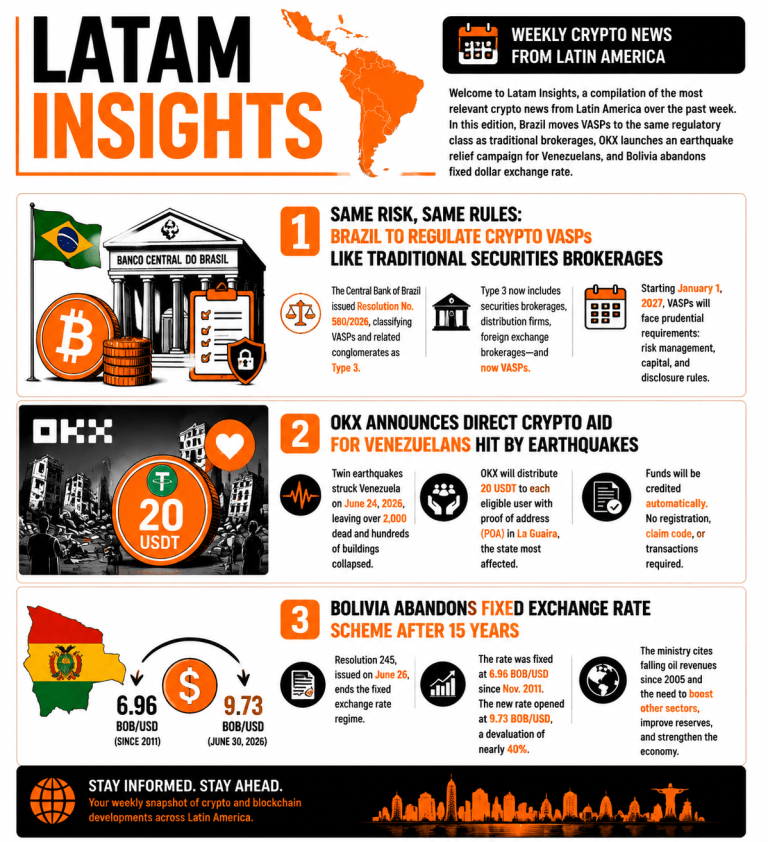
OKX, one of the largest cryptocurrency exchanges by volume, has taken action to help Venezuelan users affected by the twin earthquakes that left over 2,000 dead and hundreds of buildings collapsed.
On social media, using its Latam account, OKX referred to the twin earthquakes that hit Venezuela on June 24, 2026, and how the cryptocurrency community has responded to this event in one of the Latam countries with growing crypto adoption.
“We know that these days have been difficult. But we have also seen something extraordinary: the solidarity of Venezuela and the entire international community, which fills us with hope,” it declared.
To help Venezuelan users in regions hit by the natural disaster, OKX announced it will distribute 20 USDT to each user with proof of address (POA) verifying they reside in La Guaira, the state most affected by the twin earthquakes.
The Ministry of Economy has issued a new resolution that corrects a situation that had been hampering the Bolivian economy for years.
On June 26, the Ministry published Resolution 245, opening the Bolivian market to a system of free flotation on the dollar exchange rate. The exchange rate had been fixed at 6.96 Bolivian bolivianos per dollar since November 2011. The new exchange rate opened at 9.73 Bolivian bolivianos on Monday, an implied devaluation of nearly 40%.
In the resolution, the ministry acknowledges that this regime was established when oil exports had surged, but that since 2005, these revenues have been drying up, underscoring the need to incentivize other economic sectors to generate their own dollars and improve the balance of payments and foreign reserve accumulation.
免责声明:本文章仅代表作者个人观点,不代表本平台的立场和观点。本文章仅供信息分享,不构成对任何人的任何投资建议。用户与作者之间的任何争议,与本平台无关。如网页中刊载的文章或图片涉及侵权,请提供相关的权利证明和身份证明发送邮件到support@aicoin.com,本平台相关工作人员将会进行核查。


