Original | Odaily Planet Daily (@OdailyChina)
Author | Golem (@web 3_golem)
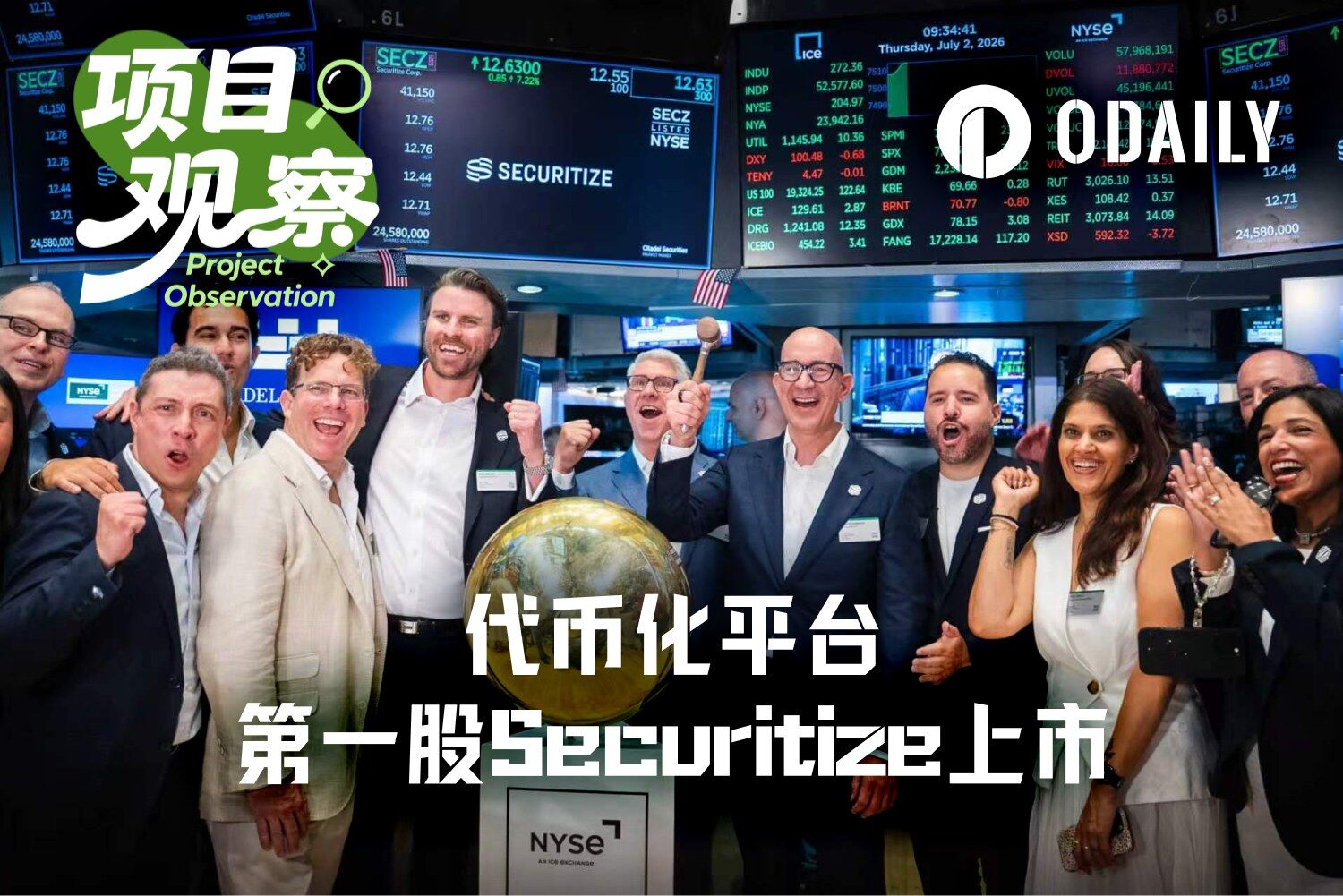
The first stock of a tokenized platform, Securitize, has gone public through a SPAC merger.
On July 2, Securitize officially started trading on the New York Stock Exchange after completing a business merger with SPAC Cantor Equity Partners II, under the ticker symbol "SECZ." SECZ opened at $12.45, reaching a high of $13.70 during the day, an increase of about 10%, and ultimately closing at $12.30, with a market value approaching $2 billion.
Securitize is the first company to be listed both on the NYSE and on-chain, and it tokenized its common stock at the time of listing. Qualified U.S. investors can purchase the tokenized SECZ on the Avalanche and Solana blockchains through Securitize’s regulated platform. According toRWA.xyz data, SECZ became the largest tokenized stock globally on its first day of issuance, with an on-chain value exceeding $295 million.
SECZ is also the first major tokenized stock launched on-chain by Securitize, signaling that this "behemoth" in the RWA space has begun to claim territory.
A tokenized platform committed to selling "real products"
Securitize is undoubtedly the leader in the RWA space. According to DeFiLlama data, the total on-chain market value of RWA issued by Securitize exceeds $4.4 billion, significantly surpassing platforms like Circle, Tether, and Ondo, making it the first (Odaily note: excluding stablecoins like USDT, USDC, etc.). However, retail investors may find Securitize unfamiliar compared to platforms like Ondo, xStocks, and Binance’s bStocks, with some users possibly having never heard of it.

Total market value ranking of tokenized platforms on RWA chain
Securitize is not deliberately trying to distance itself from the public; it's simply that its products are not closely related to most retail investors, mainly targeting institutions. The 24 on-chain tokenized products it has issued, totaling over $4 billion in assets, mainly consist of bonds, private credit, and money market funds, with only one tokenized stock CURR (which has virtually no trading volume).
The most representative on-chain product from Securitize is the tokenized BUIDL money market fund provided for BlackRock. As of now, the fund has exceeded $2.2 billion in size, making it the second-largest tokenized money market fund product in the current RWA market (Odaily note: the first is the USYC issued by Circle).
However, as Securitize has issued its own stock as the first major tokenized stock on-chain, everything might be changing.
The listing of Securitize can also be seen as the true starting point of its tokenized stock business, with the company's slogan on its official website succinctly summarizing the difference between Securitize and other tokenized stock platforms — "OWN THE REAL THING, NOT A SYNTHETIC VERSION."
Each tokenized stock on Securitize represents direct ownership of actual shares, granting the same legal and economic rights as any traditional shareholder, including dividends, voting rights, and all other rights. This is fundamentally different from many existing "tokenized stocks" on the market, which are often just "equity certificates," where investors can only enjoy the economic benefits behind the stock (like dividends), but do not transfer true ownership or regulatory protection; this includes tokenized stocks issued by Ondo, xStocks, Binance’s bStocks, and Bitget's Reality.
However, the price Securitize pays for pursuing "real" tokenized stocks is that ordinary people cannot buy them.
For example, to purchase SECZ now, investors must complete KYC, KYC/AML reviews, meet jurisdictional requirements, and comply with applicable securities laws to gain investment opportunities. If an investor does not have a U.S. identity, they cannot even pass KYC. Securitize adds the wallet addresses of qualified investors to a whitelist, and only whitelisted addresses can trade tokenized SECZ. Therefore, even on a decentralized DEX, ordinary people cannot buy Securitize's tokenized stocks.
When announcing the launch of tokenized SECZ, Securitize stated on the X platform, "This means that although the U.S. traditional stock market will be closed on Friday (July 3) in observance of Independence Day, SECZ will continue to trade." This may sound somewhat ironic, because the number of individuals eligible to trade SECZ globally is exceedingly small, while at the same time, retail investors worldwide can gain risk exposure through other tokenized stock platforms that do not sell "real products."
The high threshold for users does not hinder Securitize's determination to develop tokenized stocks; Securitize President Brett Redfearn stated after the IPO that the company is discussing the possibility of tokenizing other IPOs within the next year.
Is Securitize undervalued?
From an investment perspective, excluding the user aspect, is the recently listed Securitize currently undervalued? The closing price of SECZ is $12.30, but the official has not disclosed the current total number of shares, so we can only estimate its market value.
Securitize has valued itself at $1.25 billion in its S-4 filing with the SEC, with a SPAC and PIPE financing subscription price of $10 per share, corresponding to a stock capital of about 125 million shares. Adding approximately 30 million publicly traded common shares from the shell company Cantor Equity Partners II, Securitize's total stock post-merger listing is likely around 160 million shares. Therefore, Securitize’s market value on its first day of listing was approximately $1.96 billion, peaking at nearly $2.2 billion during trading.
In April this year, investment bank Benchmark set a target price of $16 for Securitize post-IPO, believing it is poised to significantly benefit from the wave of tokenized assets. Benchmark emphasized that Securitize is not just a tokenized platform but also possesses a "complete regulatory qualification system" covering broker-dealer, transfer agent, and trading functions, expected to generate diverse income throughout the full lifecycle of asset issuance, secondary trading, and custodial services.
According to Securitize's submitted S-4 document, revenue for the first nine months of 2025 is projected to be $55.6 million, but the full-year revenue for 2025 has not yet been disclosed, with management predicting annual revenue will be around $69 million; at the same time, Securitize expects Q1 2026 revenue to be $19.5 million, a 39% increase from Q1 2025, representing the company's highest quarterly revenue in history, predicting total revenue for 2026 to be around $110 million.
Based on the management's projected revenue for 2025, Securitize's static price-to-sales ratio for 2025 is about 28 times. A comparable company for Securitize's valuation is the RWA platform Figure, mainly focused on real estate and private credit, with Figure’s static price-to-sales ratio for 2025 estimated at around 15 times. Compared to this, Securitize’s price-to-sales ratio appears somewhat high. In terms of tokenized AUM, Securitize has $4.4 billion, while Figure has $19.4 billion; Securitize's market value to AUM ratio is about 0.45, whereas Figure's is 0.38, indicating Securitize is still above Figure.
Although Securitize is above Figure in both metrics, its valuation is not significantly undervalued. However, when considering the richness of Securitize's business and its leading position in the RWA space, such data does not seem excessively high, and the capital market still expects Securitize's future performance, especially in the tokenized stock domain.
Undoubtedly, the tokenized stock market is one where bad money drives out good; most investors merely seek exposure to stock trading risk and show little interest in the ownership and voting rights inherent in being a shareholder. Therefore, Securitize, which incurs the cost of higher trading thresholds and only sells "real product" stocks on-chain, may suffer a bit.
This may also be Securitize's strategic move, staying several steps ahead of its competitors. For instance, in the early days of China's Internet film copyright market, when piracy was rampant among Chinese video platforms and users did not care whether they were watching legal content, many film companies viewed spending money to buy legitimate film libraries as a "fool's errand." However, LeTV insisted on high-cost large-scale procurement of legitimate copyrights and became the biggest winner once relevant policies were implemented. Securitize might also be waiting for that decisive punch to land.
However, the most ironic thing now is that for most retail investors, even if we are optimistic about Securitize's future development and wish to invest in the value of SECZ, we can only wait for other tokenized stock platforms to launch "fakes."
免责声明:本文章仅代表作者个人观点,不代表本平台的立场和观点。本文章仅供信息分享,不构成对任何人的任何投资建议。用户与作者之间的任何争议,与本平台无关。如网页中刊载的文章或图片涉及侵权,请提供相关的权利证明和身份证明发送邮件到support@aicoin.com,本平台相关工作人员将会进行核查。


