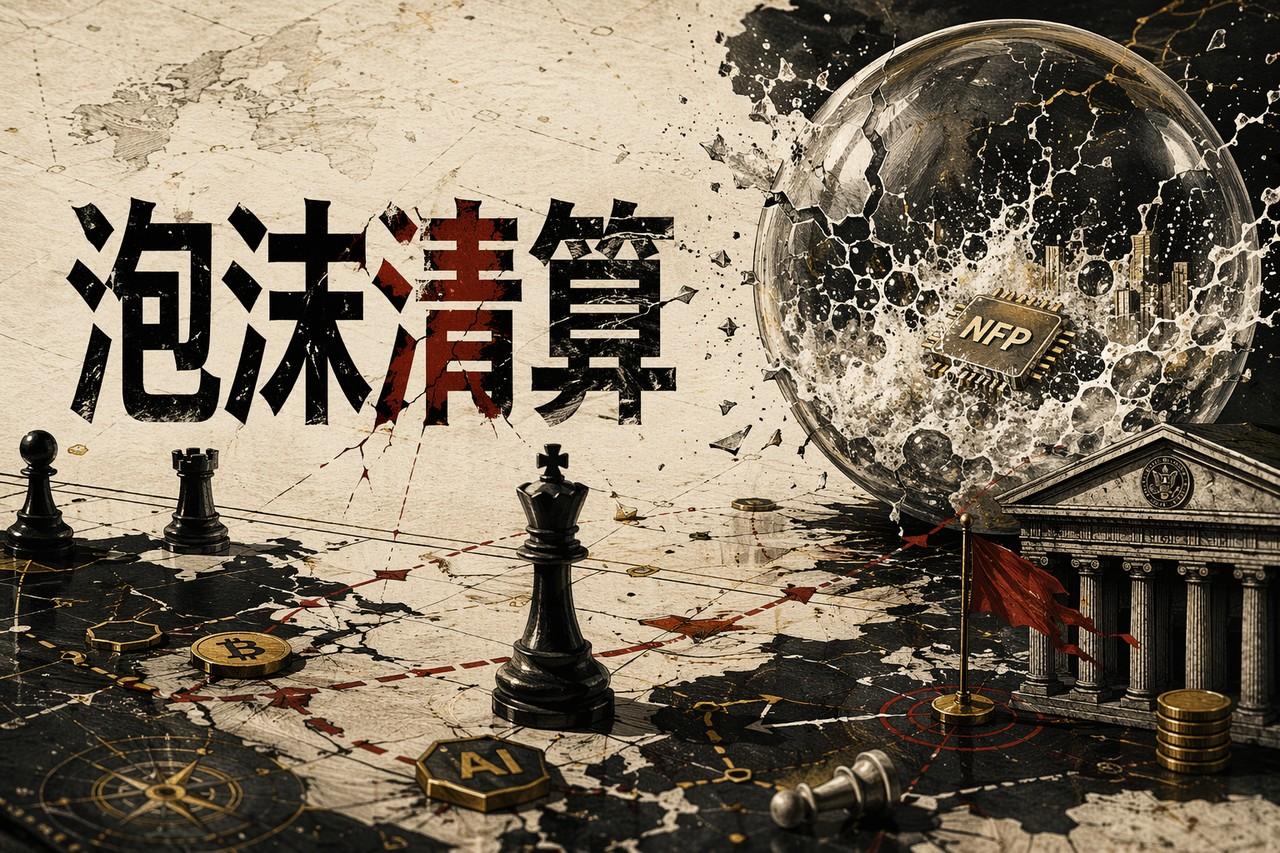
As of early July 2026, global tech stocks have entered the same downward channel as the crypto market: stocks of Micron, SK Hynix, and Samsung Electronics are under pressure, mainstream assets like Bitcoin have retreated synchronously, and the cryptocurrency fear and greed index has fallen to 19, marked as "extreme fear." Beyond prices, what is more striking is the crack in the narrative layer—on one side, Whitney Webb openly questions Polymarket's official story of "2020 bathroom grassroots entrepreneurship," pointing to earlier allegations of connections with TokenBnk and complex political capital; on the other side, ENS DAO co-founders have prevented the security committee from extending its term, triggering a chain reaction of governance system failure, with even Christoph Jentzsch, who once wrote the code for "The DAO," stepping forward to claim that "ENS DAO has collapsed," proposing to destroy key keys and allocate remaining funds, completely transforming ENS into public infrastructure. In the same window where the trust narrative of these native projects is shaken, Cloudflare announced the launch of the Monetization Gateway, supporting on-chain payments, embedding crypto payments into the internet's foundation due to its infrastructure that handles about one-fifth of global internet traffic, directly targeting a future dominated by AI agents. The divergence at the market level is more specific: around 7.055 million WLD were dumped on Binance within the past 7 hours, with prices crashing from $0.395 to $0.365, a decrease of about 8%, while on trade.xyz, Micron and SK Hynix's 24-hour trading volumes were approximately $516 million and $465 million, respectively, with SK Hynix's annualized funding rate reaching up to 314.4%, as a large number of highly leveraged bulls counter-cyclically bought into tech stocks and related narratives, intertwining panic selling and aggressive buying into a beginning of a rupture regarding trust and betting direction on the same chart.
Grassroots Myth Rupture: Polymarket Origin Reversal
At the moment when the fear index drops to 19, the very gambling itself begins to be questioned. Polymarket was once regarded as the most "grassroots" prediction market of this era: a platform built on crypto that allows users to bet on elections, wars, economic data, and even tech stock trends. The official story is simple yet captivating—founder Shayne Coplan typed the first line of code one night in 2020 while squatting alone in a bathroom, bringing the company from a narrow space to the global public opinion arena, reminiscent of the "garage startup" template that the crypto world loves to repeat: isolated and helpless, far from traditional capital, relying solely on technology and community to bring the product to the forefront.
Whitney Webb's investigation pulls this story back from myth to power narrative. She points out that the "2020 bathroom original" origin is not true; Polymarket existed beforehand in the form of TokenBnk, and the capital and interest network surrounding this prediction market directly points to ties with Israeli interests and Peter Thiel. The evidence chain has yet to be made public, but the allegations alone are sufficient to complete a narrative reversal: from the grassroots legend of the "lone hacker" to a strategically embedded platform within geopolitical and capital layouts. When a prediction market, primarily betting on political events, is questioned for intentionally fabricating a "decentralized personal hero story," users begin to doubt not just the company's origin but whether the platform is truly politically neutral—whether the setting of odds, presentation of data, and adjudication of results serve some position or asset in the unseen. The controversy surrounding Polymarket first tears apart a startup myth, but what is shaken, however, is the very neutrality that the prediction market relies upon and the foundation of community trust.
Security Committee Stalemate: ENS Declared Collapsed
If the neutrality dispute of prediction markets lingers at the narrative level, then the conflicts surrounding ENS DAO directly touch the "public infrastructure" at the very foundation of the crypto world. ENS DAO is responsible for the governance and fund management of Ethereum's domain service, with its security committee originally designed to be a critical security and check-and-balance institution: capable of rapid responses in extreme situations, and serving as the last brake on multi-sign and governance processes in daily operations. Now, the extension of this security committee has been directly blocked by the project co-founders, the reasons for which remain undisclosed, but the mechanism itself is effectively at a standstill—overnight, the community realizes that the infrastructure, said to be controlled by collective will, can still be paused by a few core individuals at key nodes.
What makes this governance crisis more glaring is who uttered the words "ENS DAO has collapsed." Christoph Jentzsch, the coder behind the legendary event "The DAO" in 2016, is nearly equivalent to a dual symbol of "original sin and enlightenment" in the entire DAO history. Years later, he in the ENS community no longer seeks to repair processes but instead proposes a radical plan that completely denies the existing model: destroy the keys of the ENSv2 Universal Router, severing the technical leverage that can be manipulated by a few; allocate the remaining funds without continuing to stack complex governance games; ultimately, formalize ENS as a public infrastructure not governed by DAO, allowing this name to serve the blockchain itself rather than a governance shell that claims to "represent the community."
This public statement of "has collapsed" strikes at what all DAOs are avoiding: when the security committee can be intercepted to stop its extension by co-founders, when the key reasons go unmentioned, governance participants grow weary over time, and voting and discussion gradually devolve into a professional game for a few, the so-called design of checks and balances becomes weak or even ineffective at the moment it is needed most. ENS's crisis reminds people that DAOs are not just technical architectures or institutional texts, but a social contract that requires ongoing investment of energy and trust; once this investment is exhausted, even the most sophisticated governance model will collapse into an empty shell that must be reset.
When DAOs Fail, Cloudflare Integrates Crypto Payments
While the ENS community is still arguing over the fate of the security committee and struggling to rewrite governance texts, the "power center" on the other end is not voting in the forums at all. Cloudflare, this traditional listed company, quietly reaches into the underlying pipeline of crypto payments—it processes about one-fifth of global internet traffic and is one of the backbones of content distribution, attack protection, and network acceleration, determining whether countless websites can be opened and whether they can withstand traffic surges, and also deciding who can charge smoothly on this network. In other words, when you type a domain name into your browser, there is a high probability that you are passing through Cloudflare's infrastructure rather than a voting contract of some governance token.
In this position, Cloudflare launched the Monetization Gateway, directly linking the payment capabilities of on-chain assets anchored to fiat currency to the internet's foundation, providing tools for developers, websites, and applications for "automatic charging": as long as they connect to the gateway, machines can settle and deduct fees in the background, especially targeting AI agents that are positioned to potentially dominate future traffic, allowing these automated entities to spontaneously purchase services, pay for bandwidth, and pay for computing power on the internet. Unlike crypto-native projects like Polymarket and ENS, Cloudflare is not advocating decentralized ideals but rather extending its commercial footprint as a giant of internet infrastructure; it has not yet disclosed the gateway's fee rates, initial customers, and technical details, but the market can already see a clear contrast: when the DAOs internally fall into collapse and participants exhaust their trust in programmatic governance, companies that truly control traffic and security entrances steadily embed on-chain payments into the existing order, this slow shift of "credibility" from community contracts to infrastructure giants is in itself the most structurally alarming change in the current crypto world.
Fear Index 19: WLD Crash and Micron SK Hynix Bottom Fishing
When the fear and greed index falls to 19, this scale simply labeled as "extreme fear" truly comes to life—on-chain data begins to show a collective flight losing patience. In the last 7 hours, approximately 7.055 million WLD were pushed onto Binance, valued at around $2.66 million, pouring into the same exit in such a short time, with prices being driven down from $0.395 to $0.365, a drop of about 8%. The large influx of tokens into the exchange coinciding with a rapid short-term drop, in the eyes of veteran traders, has only one simple name: dumping. It is not a sophisticated hedge of a single account, but rather resembles a moment when everyone tacitly chooses to throw their chips back to the market after a complete emotional reversal.
The lens shifts to another screen, where Micron and SK Hynix are playing an entirely opposite script on trade.xyz: within the same time window, Micron's 24-hour trading volume is about $516 million, and SK Hynix's about $465 million, with SK Hynix's annualized funding rate raised to approximately 314.4%, meaning that highly leveraged bulls are scrambling to enter at costs almost equivalent to "renting liquidation positions." On one side is the backdrop of synchronized weakening of tech stocks and crypto assets, while on the other side, there is greed betting on a rebound with nearly triple the market annual rent, operating parallelly on the same order book. Similar extreme bets are also seen in more macro directions: trader James Wynn shorted the SP500 index with a 50x leverage and faced 7 partial liquidations within a week, now still holding onto about 186.68 contracts, totaling around $1.4 million in short positions, with the liquidation price locked around $7536.42, this repeated reach for the edge but refusal to exit positions materializes "faith in a high-volatility environment" into a risk structure that could be forcibly liquidated at any time. With the fear index stalled at 19, the WLD crash, Micron and SK Hynix’s high-leverage bottom-fishing, and the stubborn shorts on the SP500 together depict not just the rise and fall of a single market, but a whole suite oscillating between mistrust and gambling in contemporary risk preference.
Betting Between Trust Gaps and Accelerated Adoption
From Whitney Webb's investigation tearing apart Polymarket's "bathroom grassroots entrepreneurship" story, to the ENS co-founders blocking the security committee's extension, to Christoph Jentzsch publicly declaring that "ENS DAO has collapsed," this round of synchronous retreat of global tech stocks and crypto assets concentrates and exposes the trust crisis of crypto-native projects: the origin narrative of the prediction market is deemed untrue, the safety mechanism of governance DAOs is personally overturned by the founders, and even "who gets to tell the story and who gets to enforce the rules" has lost consensus. Parallel to the collapse of this endogenous trust is the ramp-up of infrastructure and funding layers for crypto adoption—Cloudflare introduces a fee gateway for on-chain payment assets anchored to fiat currency at the entrance where it handles about one-fifth of global internet traffic, providing a direct ability to settle with crypto assets for websites and future AI agents; the fear index halts at 19, 7.05 million WLD dumped onto Binance in 7 hours, SK Hynix’s annual funding rate surpassing 300% on trade.xyz, and James Wynn stubbornly shorting the SP500 with 50x leverage all indicate that amidst the background noise of heightened geopolitical risks and volatility, the market is losing patience with native projects, while still betting on "crypto will still be used" with high leverage and underlying technology integration. The real issue has shifted from "will prices rebound" to "who can still be seen as a credible intermediary": for prediction markets to rebuild credibility, they must confront their relationship with real power structures, and for DAOs to regain authorization to manage public assets, they must ensure that safety and accountability mechanisms no longer rely on personal will, while the expanding real uses at the infrastructure layer are quietly rewriting the chip structure—over the next few years, the outcome in the crypto world is likely to be determined not by which narrative is most captivating, but by which layer can continuously deliver verifiable functions and power that cannot be easily taken away in the gaps of trust.
Join our community, let's discuss and grow stronger together!
Exclusive Hyperliquid benefits for AiCoin: https://app.hyperliquid.xyz/join/AICOIN88
Exclusive Aster benefits for AiCoin: https://www.asterdex.com/zh-CN/referral/9C50e2
On-chain Telegram community: https://t.me/AiCoinWhaleData
On-chain community: https://www.aicoin.com/link/chat?cid=N6OVMor5g
AiCoin on-chain Twitter: https://x.com/aicoinwhaledata
免责声明:本文章仅代表作者个人观点,不代表本平台的立场和观点。本文章仅供信息分享,不构成对任何人的任何投资建议。用户与作者之间的任何争议,与本平台无关。如网页中刊载的文章或图片涉及侵权,请提供相关的权利证明和身份证明发送邮件到support@aicoin.com,本平台相关工作人员将会进行核查。