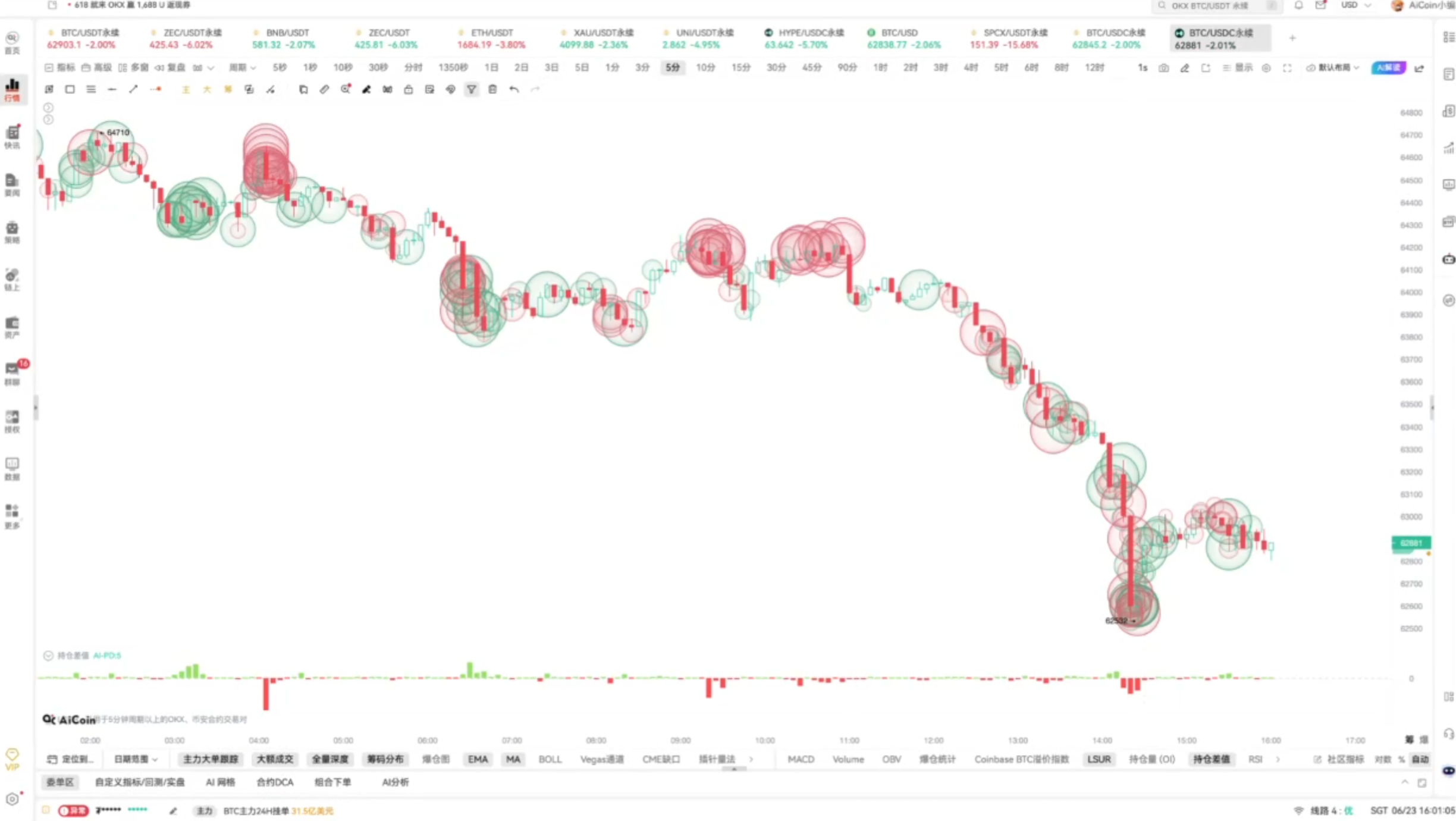
On June 23, 2026 (UTC), the on-chain data platform Onchain Lens detected two large ETH withdrawals: one was from a wallet labeled as “a16z affiliated” which withdrew 25,560 ETH from Binance, estimated to be worth approximately 42.3 million dollars based on the then value of about 1,660 dollars per coin; the other involved two newly created wallets suspected to be related to Bitmine, which collectively withdrew 35,138 ETH from BitGo and Kraken, estimated to be around 58.39 million dollars. The total of the three transactions amounted to 60,698 ETH, approaching the 100 million dollar mark, and was subsequently reported by several Chinese media outlets such as Deep Tide TechFlow, PANews, and Jinse Finance on June 24, using terms like “a16z affiliated wallet” and “suspected Bitmine.” However, as of June 24, neither a16z nor Bitmine had publicly explained the ownership of the wallets or the purpose of the withdrawals, and other on-chain analysis institutions had not provided independent verification, indicating that current interpretations heavily rely on a single data source and the judgment logic of “affiliated/suspected” labels. In the current heightened market focus on the ETH narrative, this undoubtedly represents an institutional-level on-chain movement that warrants tracking, but whether it should be regarded as a bullish signal, neutral, or even potentially bearish remains highly uncertain.
Over 60,000 ETH Withdrawn from Exchanges in Two Institutional Names
According to monitoring by Onchain Lens, on June 23, 2026 (UTC), a wallet labeled as a16z affiliated withdrew 25,560 ETH from Binance, valued at approximately 42.3 million dollars based on the then price of about 1,660 dollars per coin. On the same day, two newly created wallets suspected to be related to Bitmine withdrew a total of 35,138 ETH from BitGo and Kraken, representing about 58.39 million dollars. The three large withdrawals amounted to approximately 60,698 ETH, bringing the total value to around 100 million dollars, subsequently reported by several media outlets, including Deep Tide TechFlow, PANews, and Jinse Finance, using expressions like “a16z affiliated wallet” and “suspected Bitmine” in their titles or text.
From a synchronicity and directional perspective, all three transactions occurred on the same day and consisted of significant one-way withdrawals from custody or trading platforms to new wallets on-chain, lacking complex transit paths or multiple split structures; the overall characteristics are highly reminiscent of a typical “institutional-level” address operation pattern. During the window of heightened market attention to the ETH narrative, this scale and similarly concentrated outflow of funds are naturally categorized by the market as potential institutional actions that require separate observation.
How On-Chain Labels Turn Ordinary Withdrawals into “Institutional Actions”
The reason on-chain analysis platforms can “name” certain wallets among the vast sea of addresses typically relies on historical interactions and trading patterns: for example, long-term significant transactions only with a specific address at a certain custodian or trading platform, concentrated inflows and outflows within a specific time window, forming stable financial paths with known project party addresses, etc., leading to “affiliation” or “suspicion” labels. These labels are essentially inferences based on behavioral characteristics and public information, rather than legally recognized account authentication, which is why they are widely used in the industry, but they inherently hold a degree of misjudgment space. The expressions repeatedly cited by the media, such as “a16z affiliated wallet,” “suspected to belong to Bitmine,” and “may belong to Bitmine,” follow the labels assigned by Onchain Lens to the related addresses rather than being an official determination made by a16z or Bitmine about the wallet ownership.
According to public reports, as of June 24, 2026, both a16z and Bitmine have not explained the ownership of these wallets or the intention behind this withdrawal via any public channels, and other on-chain data institutions have not provided an independent attribution judgment or verified Onchain Lens's conclusions, leading to a highly concentrated information source on a single platform. In this context, treating the related addresses as “highly suspected” can help the market focus on risks and opportunities, but directly equating that with “confirmed institutional capital operations” exceeds the evidential boundary of the labels themselves; thus, a more cautious statement at this time is to consider this large withdrawal as a potential institutional behavior based on a single-source inference, rather than as a definitive institutional action confirmed by multiple parties.
How the Market Typically Interprets Large ETH Withdrawals from Exchanges
In industry practice, significant ETH withdrawals from exchanges to on-chain wallets are often interpreted as an action of “moving toward self-custody or on-chain participation”: funds are moved from an easily sellable on-premise environment to scenarios that are more geared toward long-term holding or participation in staking and lending applications, signifying a tendency not to rush to sell immediately. However, this is merely a common interpretation and does not equate to the true intentions of the actors; the market has seen cases where large withdrawals were soon followed by multiple partial returns to exchanges or even ultimately choosing to sell. Therefore, it is difficult to provide directional, definitive market judgments based solely on the act of “withdrawing.”
In the context of late June 2026, the large withdrawal labeled as potentially associated with institutions, coupled with macro narratives such as “ETH spot ETF” still under repeated market discussion, naturally draws more attention. Media reports often focus on descriptions like “massive amounts” or “possibly for long-term holding or on-chain use,” without providing “clear bullish” or “clear bearish” conclusions. More critically, existing public materials do not simultaneously provide data on ETH price performance, spot trading volume, derivatives positions, and funding rates; in the absence of these key signals, directly classifying a single large withdrawal as a confirmed bullish or bearish event may overestimate the explanatory power of this on-chain behavior itself.
Possible Subsequent On-Chain Paths and What We Can Discuss
Based on experience, large withdrawals marked as institutional affiliate addresses commonly have several potential uses: first is simple “warehouse moving,” transferring to self-custody wallets for long-term storage or internal fund restructuring; second is reserving for future staking chips, subsequently interacting in batches with Ethereum staking contracts or third-party staking services; third involves splitting into multiple addresses to participate in lending, market-making, and other DeFi protocols; fourth is serving as transfer funds for over-the-counter settlements, project distribution, or intermediary custodial pools. However, these are merely possible pathways listed based on common industry models and cannot be inferred that the withdrawals related to a16z or Bitmine have already or will inevitably follow such paths.
From the currently available public materials, the only “endpoint” that is supported by on-chain facts is this: approximately 60,000 ETH has been transferred from Binance, BitGo, and Kraken to three on-chain wallets. The reports do not provide any transaction records, staking actions, or liquidity addition operations following the wallets, nor do they show any new interactions with staking contract addresses or mainstream DeFi protocols, meaning the evidence chain only covers the segment of “withdrawing from custody/trading platforms to self-owned wallets.” For ordinary investors, the aforementioned “possible uses” are more meant to build an observational framework, such as whether there are ongoing small splits or whether there are initial interactions with staking contracts, rather than jumping to conclusions or directly converting this into trading decisions based solely on one large withdrawal in the absence of subsequent on-chain actions.
The Three Types of Signals Worth Monitoring Moving Forward
In summary, this withdrawal of about 60,000 ETH marked as a16z affiliated addresses and suspected Bitmine addresses is an on-chain movement that cannot be ignored under the current ETH narrative; however, as of June 24, existing information comes solely from a single data source, Onchain Lens, and neither a16z nor Bitmine has provided public explanations regarding wallet ownership or withdrawal intentions, making it far from sufficient to support “extremely bullish” or “extremely bearish” conclusions. The three types of signals truly worth monitoring moving forward are: first, whether more on-chain analysis institutions label the same batch of addresses with the same or opposite tags, as this will directly affect the credibility of the term “institutional withdrawal”; second, whether these wallets subsequently begin to interact with staking contracts or DeFi protocols, or whether there are continued splits and transfers, helping to determine whether this is a long-term allocation, internal migration, or a phase adjustment; third, whether similar large-scale withdrawal actions recur within a similar time frame, indicating if this is a one-time event or has evolved into a medium-term trend. For ordinary investors, what is truly needed is to establish a verification habit based on multiple data sources and official information, avoiding equating a single-point event and an unvalidated label with directional trading logic before there is cross-validation by multiple parties and when on-chain behaviors have yet to form a clear pattern.
Join our community to discuss and become stronger together!
AiCoin exclusive Hyperliquid benefits: https://app.hyperliquid.xyz/join/AICOIN88
AiCoin exclusive Aster benefits: https://www.asterdex.com/zh-CN/referral/9C50e2
On-chain Telegram community: https://t.me/AiCoinWhaleData
On-chain community: https://www.aicoin.com/link/chat?cid=N6OVMor5g
AiCoin on-chain Twitter: https://x.com/aicoinwhaledata
免责声明:本文章仅代表作者个人观点,不代表本平台的立场和观点。本文章仅供信息分享,不构成对任何人的任何投资建议。用户与作者之间的任何争议,与本平台无关。如网页中刊载的文章或图片涉及侵权,请提供相关的权利证明和身份证明发送邮件到support@aicoin.com,本平台相关工作人员将会进行核查。