Source: Epoch of the Jiazi
437 days.
This is the duration of Chen Hang's second tenure at DingTalk.
From March 31, 2025, when Alibaba announced its acquisition of Hydrogen and Oxygen, this founder returned to the helm after four years, until he stepped down as CEO on June 11 of this year. A total of 437 days.
In these 437 days, DingTalk held two important product launch events and launched the world's first enterprise-level AI-native work platform, "Wukong." There were also two extensively circulated farewell articles, where he faced rare and severe criticism from Alibaba partners in 27 years, welcoming the successor Chen Yusen, born in 1992.
Three questions tie up the entire story of 437 days:
What did Chen Hang do wrong? What price did Alibaba pay for this return? What was left on the chessboard of DingTalk when Chen Yusen, born in 1992, took over?
The story may begin from the old apartment called Hu Pan Garden in 2014.
1. Returning to Hu Pan Garden
In 2014, six Alibaba employees gathered around a table in an old apartment located at 176 Wenyu West Road, Xihu District, Hangzhou.
They had just experienced a failure. The previous product was called "Laiwang"—Alibaba once invested 1 billion, launched a mass recruitment strategy, requiring each employee to bring in 100 external users a month, with Jack Ma personally supporting it, and inviting Liu Chuanzhi, Shi Yuzhu, and Jet Li to join, but ultimately it did not shake WeChat in the slightest.
After that failure, Chen Hang (alias "Wuzhao") took a few people and "dove back" into this apartment—Hu Pan Garden. This is where Alibaba had previously incubated Alipay, Tmall, and Cainiao; it is the company's lucky place.
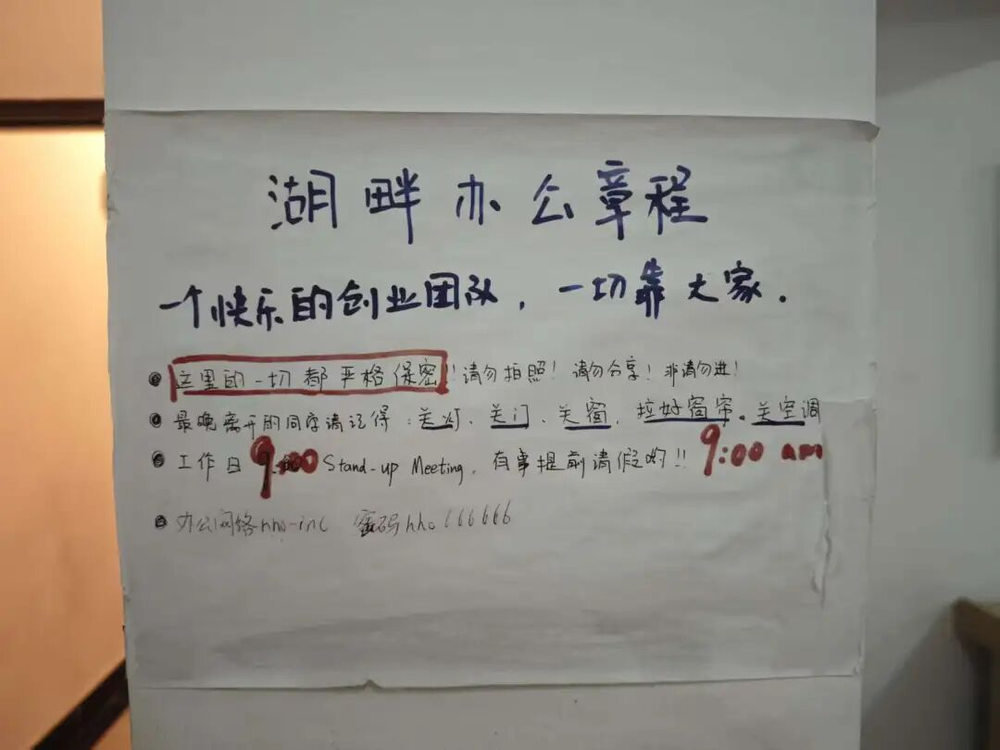
The internal situation of the Hu Pan Garden replicated in Alibaba's Xixi office area, image source: "Epoch of the Jiazi"
In January 2015, the first-generation DingTalk went online. Its core insight was: reverse-engineering functions from the needs of business owners. For example, "ding" reminders, read/unread messages, corporate address books, approvals—these features, which many later criticized as "strong management, strong control," directly addressed the most basic yet anxious question in Chinese enterprises: Did the other party see what I said? Did the tasks I assigned actually make progress?
This insight was evidently a sharp breakthrough. In its first year, DingTalk reached over 100 million users, and surpassed 300 million within three years.
In DingTalk's recruitment announcements, Chen Hang referred to the team as "the insane asylums," with T-shirts printed with "BE CRAZY." He himself worked over 15 hours a day, often from 8 AM until dawn.
In 2018, his remark at a mobilization meeting, "I don't know what you do at home before 10 PM," has since become a repeatedly quoted joke in the internet industry.
In 2020, things changed. Alibaba announced the "Cloud DingTalk Integration" strategy, with DingTalk upgraded into the "Greater DingTalk Division" under Alibaba Cloud Intelligence Group, managed directly by then Alibaba Cloud Intelligence President Zhang Jianfeng. DingTalk was required to deeply integrate with Alibaba Cloud's proprietary cloud architecture, and its previously independent standardized product route began to tear apart under the demands of major clients.
In 2021, Chen Hang was reassigned from DingTalk CEO to assistant to Alibaba Group CEO Zhang Yong, with Ye Jun taking over DingTalk. That same year, Chen Hang officially left to start the "Hydrogen and Oxygen" (HHO) company to do cross-border exports and launched some small intelligent hardware products.
During his years at HHO, external evaluations were not high. It was a startup lacking money but rich in stories, without delivering impressive results. He later told the media that during his time at HHO, "I learned to strictly control costs, stipulating that only one of three elevators could be used." These trivial matters are not concerns for executives at large companies.
However, in the years he left DingTalk, DingTalk's situation became increasingly awkward.
In 2024, it remained the largest enterprise office application in the country: 700 million users, 26 million corporate organizations, but its commercialization progress was overtaken by Feishu. Under Ye Jun's leadership, DingTalk allocated 60% of research and development resources to major client customizations, and the ISV ecosystem complained that "the platform has degenerated into a distributor."
In February 2025, Alibaba announced a 380 billion investment to start a three-year long AI march. In the same month, Group CEO Wu Yongming clearly positioned DingTalk as "Alibaba's most important B2B-oriented AI application" during a financial report conference call.
One detail is worth noting: Wu Yongming and Chen Hang's connection can be traced back to 1999. That year, when Chen Hang first entered Alibaba as an intern, his mentor was Wu Yongming. He left Alibaba twice and returned twice at Wu Yongming's invitation.
On the evening of March 31, 2025, news broke about Alibaba acquiring HHO's investor shares. After the deal was completed, Chen Hang became CEO of DingTalk.
The skilled recruiter and the galloping horse. This story has been told many times within Alibaba's system. But few question the real motivation: When a founder returns to the company he founded himself, is it to put out fires or to rewrite the script?
2. The "Tightening Curse" of April
In April last year, just a few days after Chen Hang's return, DingTalk's internal situation exploded.
A series of measures were consecutively leaked: clocking in at 9 AM, shortening lunch breaks, being required to enter work mode by 1:15 PM, evening summaries, banning WeChat, Weibo, Xiaohongshu, and other social media apps, and unifying external communication scripts to "I'm sorry, I only use DingTalk."
Even harsher measures included: the technical team being required to check code volume, with programmers having 0 code in the past three months to be eliminated; even all management positions needing to learn Python; to reduce purely management roles; product managers required to visit three enterprises each week for co-creation.
Chen Hang himself would tour the building every night at 10 PM, giving thumbs up to colleagues who worked overtime.
At that time, "DingTalk Refugees" became a new label on social platforms. Some employees changed their profiles to "DingTalk is getting intense," asking competitor firms if they were hiring. Someone humorously joked in an anonymous area: "Refused to connect on dating apps; they left after hearing I could only use DingTalk."
On June 4, a 75,000-word article titled "In DingTalk" went viral, written by Teng Yaxin (alias "Yousu"), the core product manager of the DingTalk ONE project, reflecting on their interview experience filled with "loyalty" style questioning.
Chen Hang repeatedly asked: "Why can't it be done? Is there anyone left in your father's family? Is there anyone left in your mother's family? Are your grandparents still living? Really can't find anyone? Can't gather six family members who can use DingTalk?"
Despite these questions seeming absurd, when Chen Hang incubated DingTalk in 2014, he used this logic to filter like-minded individuals; however, by 2025, candidates' first reactions to this interview culture were PUA.
The same action, with the target changed, takes on a different meaning.
At that time, Chen Hang also initiated a "Go Down Movement": requiring product, R&D, and operations team members to each serve as customer service for two hours daily.
This action was later confirmed as the key to Chen Hang discovering DingTalk's "data illusion." Previously, the customer service team reported "a transfer rate of only 15%, all five-star reviews." But Chen Hang discovered through on-site visits that many users complained about "irrelevant answers," "demands not responded to for over a year," "unable to find a human entry point."
Chen Hang quickly refreshed this data: DingTalk's actual customer satisfaction was only 30%.
3. AI DingTalk 1.0, DingTalk ONE's Birth
The iron-fisted Chen Hang quickly delivered results.
On August 25 last year, DingTalk's tenth anniversary event was also the AI DingTalk 1.0 launch event.
At the event, Chen Hang launched five products in one go:
DingTalk ONE: a new generation of interactive portals that can automatically identify "the most important thing at the moment."
DingTalk A1: a 3.8 mm thick AI recording card that magnetically adheres to the back of a phone, equipped with a Hengxuan 6nm chip.
AI Forms: allows enterprises to generate AI applications with zero code.
AI Note: supports translingual meeting minutes in 72 languages.
AI Search: a search engine that can search, ask, and work.
Chen Hang stated, "AI DingTalk must serve real work scenarios in the AI era." This was one of his most public appearances. However, the night before the launch event, he was spotted walking around the DingTalk campus at dawn, trending as the "most intense CEO."
On the day of the event, DingTalk simultaneously disclosed a set of key data:
The number of enterprise organizations on DingTalk exceeded 26 million. Among them, the number of paid organizations exceeded 190,000. Of the 5191 publicly listed companies in A-shares, 79% are using DingTalk. The number of AI applications on DingTalk has reached 1.41 million.
DingTalk's customer satisfaction, which had only been 30% unearthed by Chen Hang's "Go Down Movement" in April, was increased to 80% after he restructured the customer service team and established three core teams for data engineering/model training/effect evaluation. Costs fell by 90% in parallel.
In addition to these statistics, the most noteworthy aspect was DingTalk ONE.
DingTalk ONE was positioned as "the new portal for DingTalk in the AI era," seen as the core of AI DingTalk 1.0. At that time, DingTalk ONE was the flagship product that was heavily relied upon.
This was a project that Chen Hang began nurturing in April. From April to August, DingTalk ONE completed its journey from project inception to launch in less than half a year.
However, this highlight did not last long.
4. The Summer and Autumn of ONE
ONE was not a product that was gradually polished.
There is a segment in "In DingTalk" reflecting on the ONE lifecycle: the lifecycle of ONE began to take shape in April 2025, publicly launched for the first time at the August 25 event, stabilizing at around 3 million daily active users (DAU). It was the first major AI-native project promoted after Chen Hang's return.
However, ONE was also a project with high fluidity. The design leader in the second week left, and the senior who connected and recommended her to the project was reassigned to another department in the fourth week. There were only three people on the product for over three months, and Yousu was one of them.
ONE had a heavy design gene; its first lead was the head of the design center. However, during its transition to the operational phase, its initial "card" form gradually evolved into "a screen displaying all important content."
Clearly, this was a failed attempt.
After reaching 3 million DAU, the retention rate plummeted.
By early 2026, ONE was dismantled.
It is worth considering that the rise and fall of ONE is not a simple story of a product failing.
Its "summer" corresponds to Alibaba's urgency regarding the AI B2B strategy—Alibaba needed a new entry point to follow the narrative of the Agent era. However, its "autumn" also stemmed from this; from the moment of its inception, it was destined to bear double standards imposed by the group: to rapidly release proof of AI strategic determination while also having to accept the physical laws governing retention rates for AI native products.
When these two curves intersect, the product inevitably loses.
A statement from "In DingTalk" accurately describes the cost of such efficiency: it was eager to establish a new entry point, eager to prove that DingTalk was not outdated.
DingTalk is not outdated. With 800 million users, 26 million enterprises, 1.41 million AI applications, and 190,000 paid organizations... with these figures, it still ranks first in the domestic office collaboration sector.
However, what Chen Hang wanted was not just being first; he wanted to be "the first in the AI era."
5. The Day DingTalk Was Shattered
On March 16, 2026.
Wu Yongming sent an internal letter announcing the establishment of the Alibaba Token Hub (ATH) business group. This business group focuses on "creating Tokens, delivering Tokens, applying Tokens," led personally by Wu Yongming.
It integrates five major business units: Tongyi Laboratory (Qwen large model), MaaS business line (Bailian), Qianwen Division (C-end AI assistant), Wukong Division (B-end AI native work platform), and AI Innovation Division.
Among them, the "Wukong Division" made its first appearance.
24 hours later. On March 17 morning, the annual product launch for AI DingTalk 2.0.
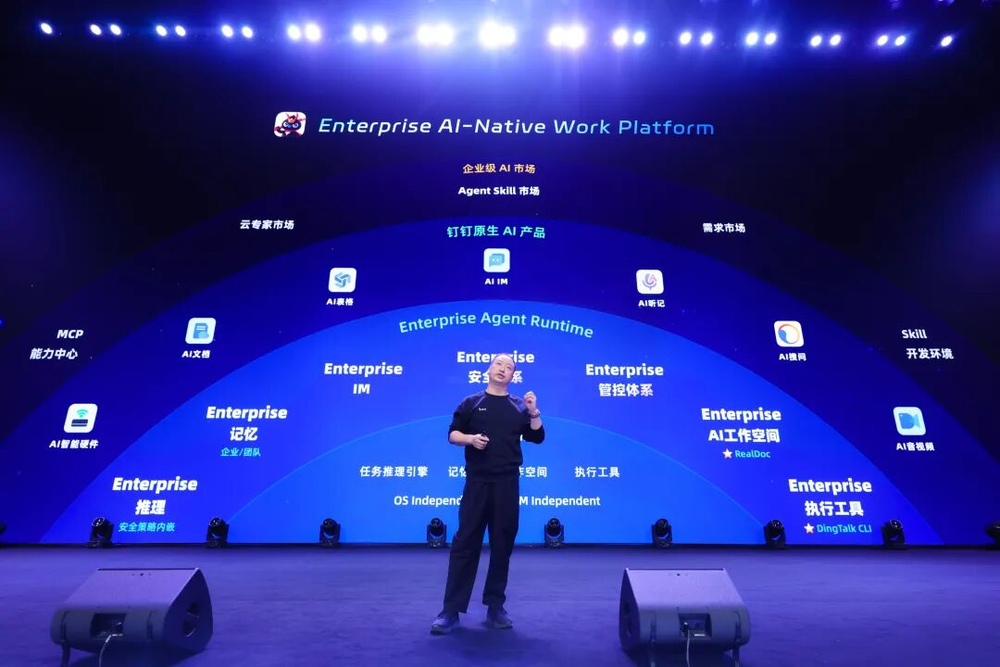
On this day, Chen Hang launched the world's first enterprise-level AI native work platform, "Wukong." Its promotional artwork featured a cartoon version of Wukong holding a staff, standing in the midst of a group of shrimp soldiers, filled with metaphor.
Chen Hang stated on stage: "Today, we shatter DingTalk and rebuild it with AI, forging 'Wukong.' In the past, people used DingTalk to work; in the future, AI will work with DingTalk."
"Shatter" is not a rhetorical flourish.
DingTalk rewrote its underlying code, fully integrating CLI (Command-line Interface), allowing all capabilities to be called and operated by AI, rather than simulated clicks;
"Communication is execution"—within a DingTalk group, a command like "generate last week's sales report and sync with management" allows Wukong to automatically pull approval flows, attendance, CRM data, generate reports, and push them out, with no manual operation required throughout.
Wukong simultaneously released the top ten industry solutions for OPT (One Person Team). This is the world's first plan to translate AI Skills from a technical concept into an industry-ready, plug-and-play product, covering ten scenarios including e-commerce, cross-border e-commerce, design, development, and retail.
A detail worth reflecting on: Alibaba named the AI DingTalk 1.0 released on August 25 of last year as "Fern," the 1.1 version released on December 23 as "Magnolia," and the 2.0 version as "Wukong."
"Fern" signifies breaking ground. "Magnolia" signifies being newly born. While "Wukong" signifies achieving refinement.
These three version names essentially represent Alibaba's three-stage judgment of AI DingTalk's maturity. From "breaking ground" to "refinement," DingTalk took less than seven months.
Thus, "Wukong" became the new entry point in Alibaba's AI toB strategy.
It is worth noting that the generational shift for Alibaba's toB entry point has never been smooth. Each iteration of an entry point has been accompanied by a repositioning or marginalization of existing businesses.
The C-end entry promoted in 2025 was Quark. The C-end entry in 2026 is the Qianwen App. The B-end entry promoted in 2026 is Wukong. DingTalk is no longer referred to as the "first entry point for toB" but has become the vessel for Wukong.
Chen Hang's role has shifted from "the one who reshaped DingTalk" to "the one who shattered DingTalk."
This is a highly dramatic transformation within the organization.
6. The Seven Days of June
On June 4 this year, an article titled "In DingTalk" went viral on Alibaba's internal network.
This was not an ordinary emotional rant. It had a complete structure and tight logic, acting as an organizational critique report. The article traces the entire process of the strategic AI project ONE from its inception to its rushed contraction, systematically exposing severe internal issues within DingTalk such as harmful internal competition, unilateral decision-making, meaningless overtime, and mechanical assessments.
Following that, on June 8, a second lengthy article appeared. Former DingTalk Vice President Maluila (Wang Jiamin) published "Outside DingTalk" on her personal public account.
In the article, she stated: "I hope Wuzhao can lead DingTalk to glory again, but the price shouldn't be that everyone exchanges their working hours for exhaustion. In this era, hard work and diligence are indeed important, but sudden flashes of creativity are equally important."
These two articles—one internal, one external—thoroughly revealed the issues within DingTalk and became a critical trigger for the posts from the Alibaba partner committee.
Then came June 10. The Alibaba Partner Committee published a post on the company's internal network titled "Having Feelings, Loyalty, and Growth is True Alibaba Culture." The post harshly criticized DingTalk's team management approach, directly stating that "this is not the way of Alibaba culture."
"Under any circumstances, no matter how urgent the task is, there should never be the type of management that the DingTalk team has adopted as mentioned in the post. This management style has never been the direction advocated by Alibaba culture. It is not what Alibaba culture should look like," wrote the Alibaba Partner Committee in the document.
This marked a rare public stance on internal management issues from the partner committee in the 27 years since Alibaba's founding.
24 hours after the post was published, on June 11, Alibaba announced a management adjustment at DingTalk: Chen Hang stepped down as CEO, and Chen Yusen, a tech geek born in 1992, took over.
It is noteworthy that when Chen Hang was an intern at Alibaba in 1999, the then 7-year-old Chen Yusen was born in 1992.
7. The Successor of '92
Chen Yusen was born in 1992.
A tech geek who achieved fame at a young age. He has won numerous championships in top domestic and international computer competitions. At the age of 22, his cybersecurity company, Changting Technology, was acquired by Alibaba Cloud.
In 2025, he undertook entrepreneurial endeavors within Alibaba Cloud, leading the development of the AI Agent product MuleRun.
His labels—born in '92, Forbes Asia "30 Under 30," Changting Technology was acquired by Alibaba Cloud, founder of MuleRun—depict a successor with a style starkly different from Chen Hang.
Chen Hang's labels are "director of the insane asylum," "Wuzhao," "BE CRAZY."
In contrast, Chen Yusen's label is "tech geek." Although his management style has yet to be defined, the products incubated simultaneously within the ATH group have already signaled: Happy Horse, Happy Oyster, MuleRun, Qoder—these names serve as new annotations of Alibaba's "small teams, young talents, respecting individuality" organizational paradigm.
The Alibaba Partner Committee emphasized in the previous day's post: "People are Alibaba's most valuable wealth; cultivating and inspiring individuals is the responsibility of every leader. In the AI era, when machines can replace many tasks that people can do, individuals have become our most valuable assets. In the AI era, we need to uphold feelings and loyalty even more and jointly foster an open, inclusive, and diverse work culture."
DingTalk's true position in Alibaba's AI toB strategy will not change due to Chen Hang stepping down. The strategic position of the Wukong Division remains unchanged. It is still one of the five core sectors within the ATH group and remains a segment of Alibaba's full-link application concerned with "creating Tokens, delivering Tokens, applying Tokens."
The complete matrix for Alibaba's AI toB—Qwen (foundation model) + Alibaba Cloud (computing infrastructure) + Wukong Division (B-end application entry) + Pingtouge (self-developed GPU)—has already taken shape.
Chen Hang's 437 days of effort were not in vain: the "Agent OS/CLI transformation/Wukong platform" he left behind is the true foundation of Alibaba's B-end A entry.
However, the price he paid for this upgrade was not only technical costs and commercialization costs but also organizational costs, human costs, and cultural costs.
Clearly, from here on, DingTalk's script will be written by someone else.
And the entrepreneurial spirit of Hu Pan Garden has never been the private property of any individual. It will return repeatedly under different names, different products, and different organizations—as long as the organization is willing to leave a door open for it.
In 2014, six people led by Chen Hang set out from Hu Pan Garden.
In 2026, DingTalk needs to rediscover its Hu Pan Garden.
免责声明:本文章仅代表作者个人观点,不代表本平台的立场和观点。本文章仅供信息分享,不构成对任何人的任何投资建议。用户与作者之间的任何争议,与本平台无关。如网页中刊载的文章或图片涉及侵权,请提供相关的权利证明和身份证明发送邮件到support@aicoin.com,本平台相关工作人员将会进行核查。


