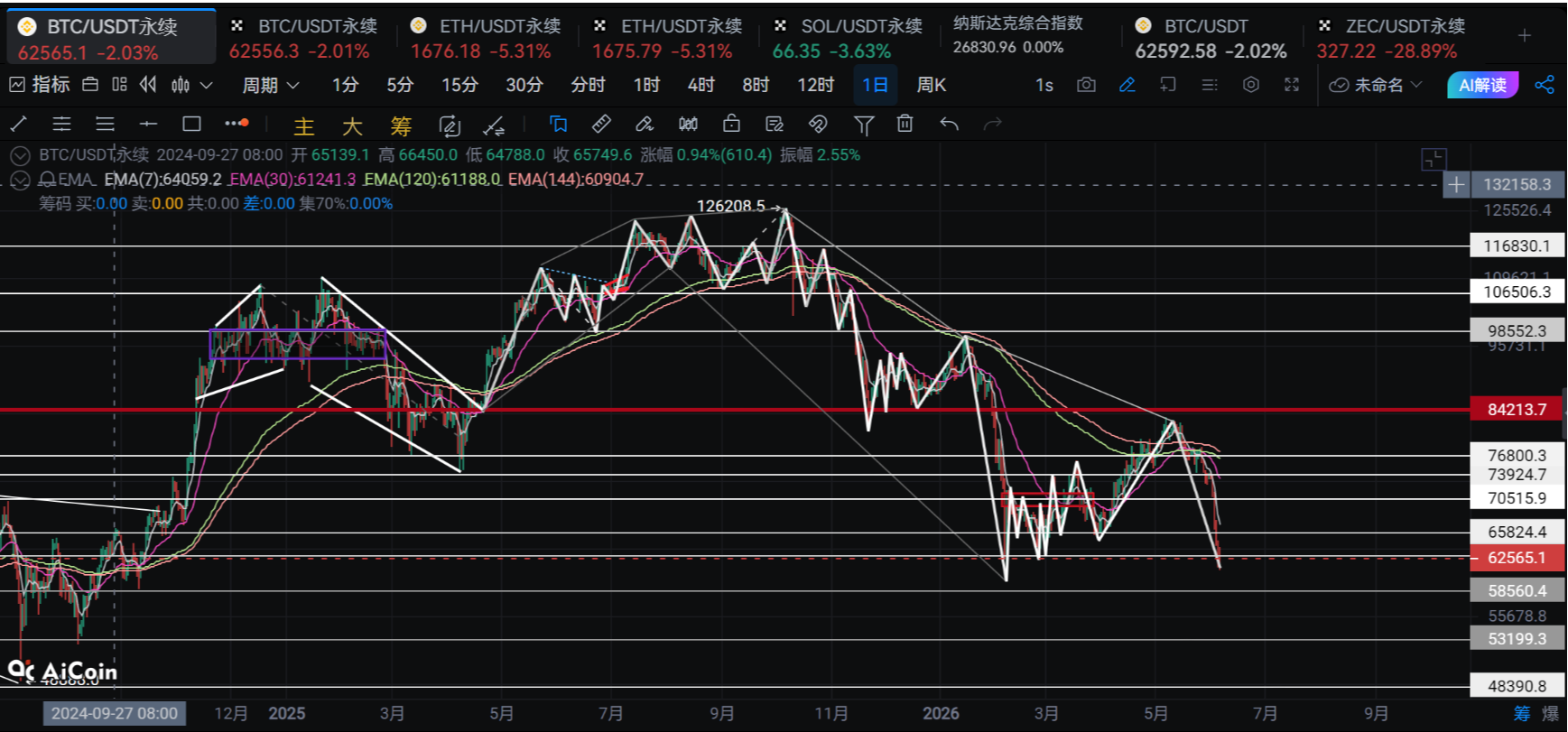
David Hoffman, the co-founder of Bankless, recently publicly shared his reasons for selling all his Ethereum online (details available in the reference link).
The viewpoint and content of his article may represent the source of inner confusion and anxiety for a considerable number of people.
His article mainly consists of two parts:
The first part states that he still sees potential in Ethereum, still believes in Ethereum, ......, and similar viewpoints.
The second part elaborates on his key motivation for liquidating: he believes that the current price of Ethereum reflects its intrinsic value, and its potential for the future is limited.
Regarding the viewpoints in the first part, I completely agree except for one detail where I differ from him.
What is that detail?
The two founders of Bankless generally consider Ethereum to be money.
But I do not think so; I believe that Ethereum's tokens have monetary properties but are more like commodities/oil, and the Ethereum network possesses platform characteristics and attributes. Therefore, Ethereum is a thing that encompasses multiple attributes, and it is not quite suitable to explain it purely as "money." Moreover, I believe that the attributes of a commodity outweigh those of money.
The second part is where I fundamentally disagree with him.
He believes that the current price of Ethereum reflects its value and that its potential for the future is limited.
This viewpoint involves a very fundamental and core question:
How should Ethereum be valued?
This question has been discussed many times in past content from Bankless. Based on the data I have collected, they have used various methods, such as:
- Viewing Ethereum as money, with a potential valuation of $250,000.
This method refers to Bitcoin and gold (money). I do not quite agree with this, as I have mentioned earlier. But I agree with their approach: they estimated it based on future development trends.
- Evaluating Ethereum's security features separately, with a potential price of $6,900.
I have also used this method, and the potential price I calculated was much higher than this. But later, I felt that the estimated algorithm had a high degree of randomness, and logically, it was lacking, making it not very suitable.
- Lastly, David Hoffman's valuation in that final article, which places the current price range at $2,000 to $2,100.
I agree with the model he used; he assessed it based on cash flow income. However, I cannot understand the logic of his calculation result. Additionally, I do not agree with his method – calculating based on current indicators.
The reason I do not agree: investment is about looking towards the future, not the present.
Therefore, I do not quite accept the various methods they have used for valuation in the past or the methods used in this article.
I have shared my method in previous articles.
On November 14, 2024, I shared an "Alternative Method for Valuing Ethereum Tokens."
On April 2, 2025, I shared "Ethereum's Business Model and Valuation."
On April 3, 2025, I shared "Ethereum's Investment Value Assessment."
On April 28, 2025, I shared "Ethereum's Moat and Investment Value."
On December 3, 2025, I shared "Methods for Valuing Ethereum."
Some of these articles contain calculation methods, while others discuss valuation logic.
This final article is my last sharing on Ethereum valuation as of now.
Why haven’t I written similar valuation articles since then?
It is not because I can now provide a very accurate valuation for Ethereum, but because I believe that even a relatively rough method can show Ethereum's future and potential.
Today, I will reiterate my rough valuation method.
First, I want to emphasize that there are no precedents for valuing Ethereum, nor can we refer to precedents. The attributes of Ethereum are complex, and no existing method can fully encompass its value system.
In my view, the properties of Ethereum mainly include: commodity attributes, monetary attributes, network attributes, and providing security value.
No single item in the world possesses all these attributes at once. I most recognize the commodity attributes and network attributes. These two attributes can be roughly estimated based on real data.
I partially agree with the monetary attributes, but I do not consider them a primary factor, and I am also unsure which data to select for valuing this attribute. Thus, I will not value this attribute.
I also strongly recognize the provision of security value but am uncertain about what kind of model can reflect the security value it provides. Therefore, I will not value this attribute either.
As a result, I simply choose to value the commodity attributes and network attributes using cash flow (income), and my conclusion is:
Once Ethereum's network activity reaches a certain critical value, its price is very likely to exceed $10,000.
However, it is important to note this premise: Ethereum's network activity must reach a certain critical value.
On this point, opinions may vary.
If one believes that the crypto ecosystem has no future, or has a future but not on Ethereum, then the subsequent deductions and conclusions need not be considered.
If one believes the crypto ecosystem has a future, and major activities will occur primarily on Ethereum (as well as layer two scaling), then the subsequent conclusions follow naturally as a logical deduction.
In my view, the crypto ecosystem has a future, and major activities will indeed take place on Ethereum (and layer two scaling).
Why?
Because of Ethereum's decentralization and resistance to censorship—this is the greatest common denominator achievable by all humanity and AI, enabling both angels and devils to willingly and fearlessly use it.
Therefore, my subsequent deductions and conclusions are derived naturally.
What is the critical value of this activity?
Refer to the article from April 2, 2025.
With this framework, when I look at any external opinions and comments, I can quickly filter out the distractions and noise to identify the key points of those opinions and comments.
Once I catch the key point, the question becomes clear at a glance.
David Hoffman’s article "Why I Sold My ETH" was just that.
Although my method is not comprehensive or complete, I believe the general direction is correct, so even though my conclusions are not precise, they are still reasonable and make sense logically.
Moreover, my method only selects two attributes for valuation, completely disregarding other attributes. If other attributes are considered in real scenarios, I believe the probability of this valuation becoming more accurate will increase.
However, this requires patience and waiting, and I believe that day will come soon.
David Hoffman’s piece has been reviewed.
"Some resign and return home, some rush to their exams overnight"—this is a common state in any ecosystem.
Everyone is responsible for their actions and pays for their understanding.
Reference link:
https://x.com/TrustlessState/status/2059371247163613489
免责声明:本文章仅代表作者个人观点,不代表本平台的立场和观点。本文章仅供信息分享,不构成对任何人的任何投资建议。用户与作者之间的任何争议,与本平台无关。如网页中刊载的文章或图片涉及侵权,请提供相关的权利证明和身份证明发送邮件到support@aicoin.com,本平台相关工作人员将会进行核查。