Key Takeaways:
- Babylon Labs filed a May 25 Temp Check asking Aave DAO to accept native BTC collateral via Trustless Bitcoin Vaults on Aave V4.
- The BTC Vault Swap Spoke targets Aave’s $5B WBTC supply, currently underused on the borrow side, to drive new demand.
- If the Temperature Check passes, Babylon Labs advances to ARFC review, with audits by Coinspect, Sherlock, and Zellic ongoing.
The proposal calls for deploying two new Aave V4 Spokes on Ethereum Mainnet. The first, the Babylon Core Lending Spoke, lets BTC holders borrow supported assets such as stablecoins and wrapped BTC against their native bitcoin collateral. The second, the BTC Vault Swap Spoke, handles post- liquidation settlement by converting seized BTC collateral into WBTC for permissionless liquidators.
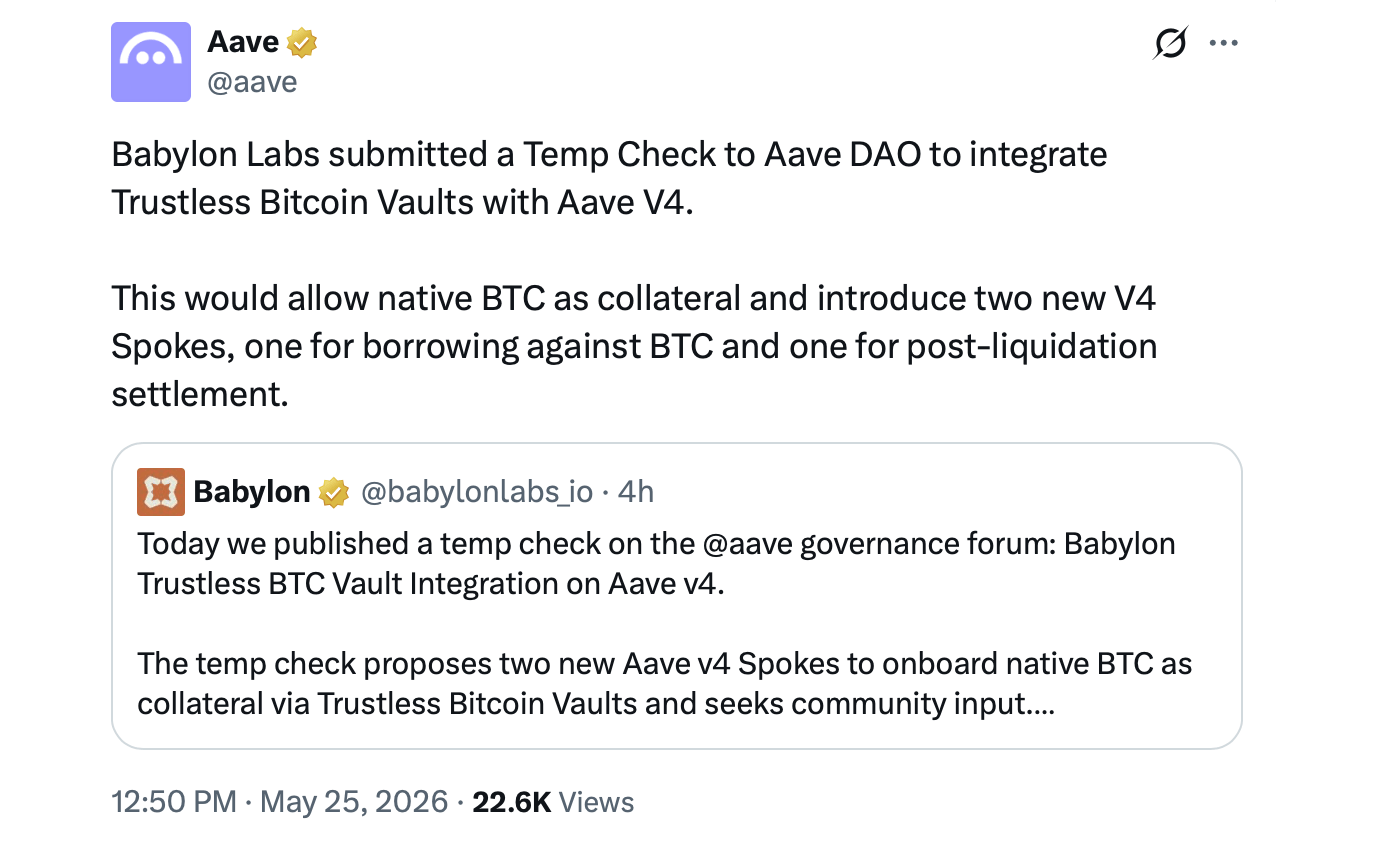
Aave posting about the Temp Check on X.
The mechanism works through Taproot scripts on Bitcoin. A depositor locks BTC onchain inside a Taproot unspent transaction output ( UTXO). That lock creates a corresponding vault record on Ethereum.
Because Aave V4 only accepts ERC-20 tokens as collateral, adapter contracts represent each vault record one-to-one as a transfer-restricted token called vaultBTC. The token can only move between the Aave V4 Hub, the Babylon Core Spoke, and the integration’s adapter contract. No other transfers are permitted.
Babylon Labs co-founded the project in 2022 with Professor David Tse of Stanford and Dr. Fisher Yu. Since its bitcoin ( BTC) staking protocol launched in August 2024, it has activated more than 100,000 BTC cumulatively and currently holds approximately 51,000 BTC, valued near $4 billion, in active stakes.
Investors backing the project include A16z, Paradigm, and Polychain, with total funding exceeding $100 million. The underlying cryptography driving Trustless Bitcoin Vaults comes from BaBe, a peer-reviewed paper co-developed by Babylon Labs and UC Berkeley, set to appear at CCS 2026, according to the Temp Check.
The research reduces the cost of SNARK proof verification on Bitcoin by roughly 1,000 times compared to prior approaches, making the fraud-proof challenge window economically viable at scale. When a user’s BTC position is liquidated, a permissionless liquidator swaps the seized vault for WBTC at a small premium. A separate set of permissioned arbitrageurs then purchase those escrowed vaults, repay the WBTC debt, and redeem the underlying BTC natively on Bitcoin.
The structure decouples liquidation timing from BTC redemption, allowing liquidators to settle immediately while the BTC-side process runs on its own timeline. The proposal also targets WBTC utilization on Aave. The platform currently holds roughly $5 billion in WBTC supply, which Babylon Labs described as underutilized on the borrow side.
Routing liquidation settlements through WBTC is designed to generate new borrowing demand for that asset. Aave DAO retains full control over all risk parameters, supply caps, borrow caps, and governance oversight across both Spokes. The Temperature Check focuses on integration architecture. Risk parameters, oracle configuration, and full trust-assumption details are expected in a follow-up Aave Request for Comment.
Security reviews are currently underway with Coinspect, Sherlock, Zellic, ABDK, and ZK Security across the protocol stack, as detailed by Babylon Labs. Formal verification is being conducted by Runtime Verification.
If the Temperature Check snapshot shows positive community sentiment, the proposal advances to the ARFC stage for further risk evaluation and audit review. A successful ARFC snapshot moves it to an onchain AIP vote for final governance approval.
Babylon Labs stated it was not compensated by any third party to publish the proposal.
The integration, if approved, would give BTC holders a direct path to decentralized finance ( DeFi) borrowing without handing custody to a bridge, signer consortium, or threshold-signature group. Other projects building BTC-collateralized products could also layer on top of the primitive, extending the reach of native BTC into broader DeFi activity.
Early community response to the governance thread has been broadly supportive. Aave Labs Technical Service Provider Simo noted the integration aligns with Aave V4’s Hub-and-Spoke design and that routing post- liquidation settlements through WBTC would generate meaningful borrow demand for an asset already heavily supplied on the platform.
Aave founder Stani Kulechov backed the Temperature Check directly, citing enthusiasm for the V4 Spoke ecosystem gaining real bitcoin collateral. Contributor Nicopei added an institutional angle, pointing out that keeping BTC native while offering predictable borrowing costs addresses the two requirements most commonly cited by institutional borrowers who currently rely on off-chain solutions.
免责声明:本文章仅代表作者个人观点,不代表本平台的立场和观点。本文章仅供信息分享,不构成对任何人的任何投资建议。用户与作者之间的任何争议,与本平台无关。如网页中刊载的文章或图片涉及侵权,请提供相关的权利证明和身份证明发送邮件到support@aicoin.com,本平台相关工作人员将会进行核查。


