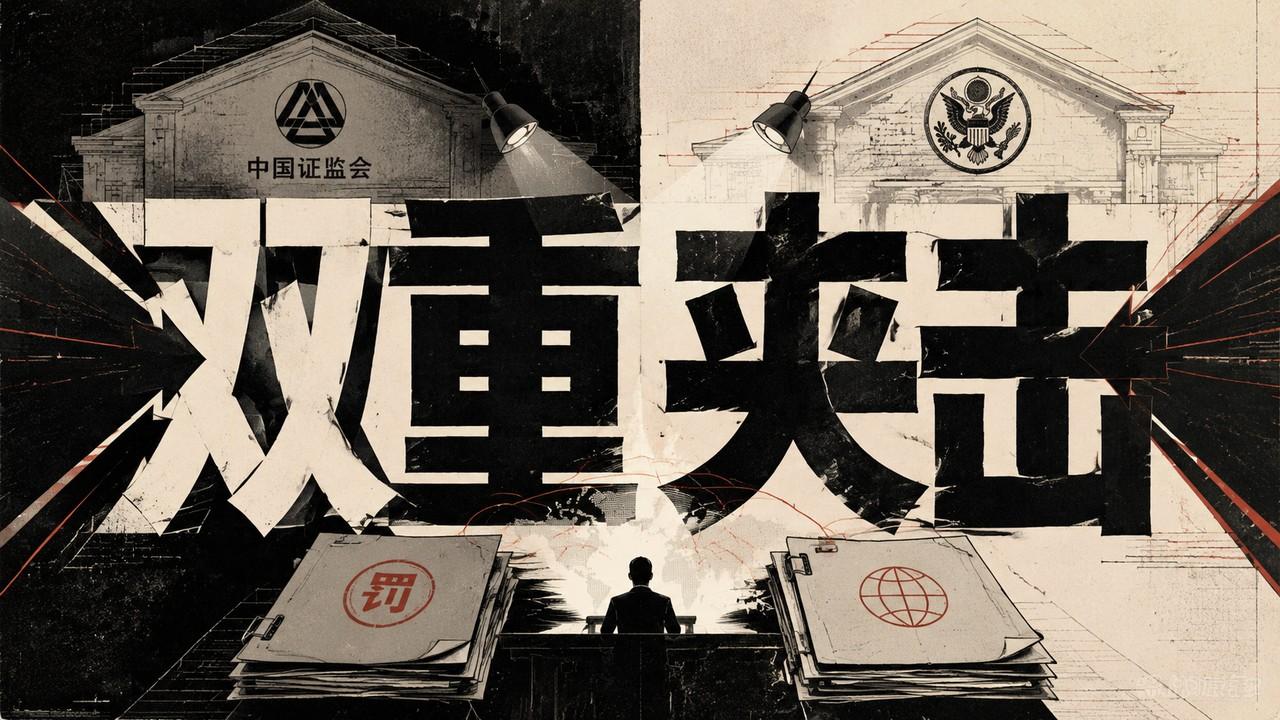
Around May 22, 2026, two originally unrelated pieces of news intertwined on the same timeline: on one side, the China Securities Regulatory Commission (CSRC) proposed to impose severe penalties on Futu Securities International (Hong Kong), Tiger Brokers (NZ), and ChangQiao Securities (Hong Kong) for illegal cross-border operations. The details have yet to be fully disclosed, but they are enough to make countless mainland investors focused on the US stock market tense — as of December 31, 2025, the total client assets on the Futu platform alone amount to approximately HKD 1.23 trillion (about USD 158.4 billion), with the Greater China region accounting for over 80% of client assets. Market analysts roughly estimate that, should mainland investors be unable to continue holding or trading US stocks through related platforms in the future, the potential scale of US stock assets involved could reach about USD 175 billion, though this is merely an estimate of potentially affected assets and does not equate to a guaranteed sell-off amount. On the other side, in the crypto market, the ONDO token suddenly surged within the same timeframe: around May 22, the price broke through USD 0.46, oscillating in the range of USD 0.465 to USD 0.4686, with a roughly 14% to 15% increase in 24 hours, leading several Chinese media outlets to repeatedly label it as a “US stock tokenization platform” and “RWA representative project.” On one hand, offline cross-border brokerage channels face uncertain regulatory rhythms; on the other hand, the on-chain “US stock concept” has been rapidly ignited emotionally. Multiple Chinese crypto media outlets even combined these two events into a single narrative — regulatory tightening, heightened interest in RWA and on-chain US stock concepts. However, with the CSRC’s final penalty decisions and rectification timelines not yet clarified, and the drivers behind ONDO's rise lacking clearer disclosure, an unavoidable question has just surfaced: when traditional cross-border paths may narrow at any time, will the funds revolving around US stocks remain passive observers, choose to transfer custody and migrate accounts, or will a portion attempt to tentatively shift their chips towards the narrative of on-chain tokenized assets.
Cross-border brokers under fire: Greater China funds forced to find an exit
In this round of regulatory storm, the targets named are not fringe players but several main routes for cross-border US stock allocation in Greater China. Futu Securities International (Hong Kong), Tiger Brokers (NZ) Limited, and ChangQiao Securities (Hong Kong) have long positioned “Greater China customers buying US stocks” as their core business logic, with familiar Chinese interfaces and local customer service at the front end, while connecting funds to the US stock market at the backend. CCB International mentioned in its report on March 16, 2025, that the Greater China region accounts for over 80% of client assets on the Futu platform, and as of December 31, 2025, the total client assets on the Futu platform amounted to approximately HKD 1.23 trillion (about USD 158.4 billion), signifying that the volume of cross-border funds just from Futu alone is substantial. Now, the CSRC intends to classify its “illegal cross-border operations” and impose severe penalties around May 22, 2026, with Tiger and ChangQiao also caught up in the wave. Before the specific penalty details have been fully disclosed, the ones being pushed to the brink are the investors relying on these platforms to allocate US stocks and the pools of funds behind them.
After the regulatory news broke, market analysts began to establish an upper limit concept for this fund: if mainland investors can no longer hold or trade US stocks through the aforementioned platforms, the potential scale of involved US stock assets could be around USD 175 billion. However, this merely represents the gauge of “potentially affected” assets and should not be simplistically interpreted as USD 175 billion that must be passively directed to the secondary market. Research briefs have repeatedly reminded that investors theoretically can still migrate existing US stock positions to other channels through asset custody transfer and account migration, rather than simply hitting the liquidation button to exit. Therefore, the real question left by this regulatory assault is not “will there be a passive sell-off of a hundred billion dollars,” but rather “how much cost is this originally highly dependent Greater China fund willing to bear to transfer custody, to migrate accounts, or will they passively choose to shrink their overseas exposure?”
Reality choices for mainland US stock investors after route tightening
For mainland US stock investors sitting in front of their screens, this round of regulatory storm first strikes at their instinctive judgment on “how secure is this position.” Once the cross-border channels are named, the order placement, transfer, and deposit-withdrawal logic that was once taken for granted is immediately overshadowed by compliance: how long will it take before normal trading? Will there be a point in the future where operations through the original platform cannot continue? If positions were to be migrated, will there be resistance in terms of procedures, time, and costs? The reason these questions remain unresolved is that, as of May 22, 2026, the CSRC has yet to publish the final penalty documents, with core clauses such as “whether to confiscate all illegal income,” “duration of the rectification period,” and “restrictions on new business” lacking official conclusions, making it impossible for investors to reverse engineer a definitive timetable and disposal path based on this.
In this state of incomplete information, reality choices are often dismantled into several intertwined routes. The first is “hold steady for now”: pause large sums of new capital from entering, maintain existing positions, and observe how regulatory details materialize; this is an instinctive reaction for many funds in a stage of high uncertainty. The second is “quietly moving house”: research briefs suggest that theoretically, they can migrate US stock positions to other compliant platforms or offshore accounts through asset custody transfers and account migrations, where some larger-scale or lower-risk preference clients may prioritize assessing this option. The third is “passively holding”: especially for accounts with limited capital and lower trading frequency, in the absence of a clear understanding of costs and risks across various scenarios, it is likely that they will choose to reduce trading frequency, accepting a decrease in liquidity and convenience for a period. The approximately USD 175 billion potential asset scale mentioned by market analysts, in this context, seems more like a “base of chips” on one end of a balance scale, rather than already loaded sell-off ammunition — research briefs have clarified that this figure cannot be equated to future net selling scale, nor can any definitive funding direction be extrapolated under the current lack of clarity on regulatory details; it can only be considered a key variable to be repeatedly tested in various hypothetical scenarios.
Regulatory news fermentation, ONDO rises against the trend
When the “USD 175 billion potential chips” was still in scenario modeling, the crypto circle quickly found a narrative projection for this uncertainty: ONDO, packaged by multiple Chinese media outlets as a “US stock tokenization platform.” As part of the RWA (Real World Assets) track, ONDO was repeatedly named within the same time window, linked with keywords such as “on-chain US stocks” and “on-chain alternative channels.” Around May 22, 2026, as the CSRC proposed severe penalties for Futu, Tiger Brokers, and ChangQiao, ONDO’s token price surpassed USD 0.46, trading in a range of about USD 0.465 to USD 0.4686 in a short time, with a 24-hour increase of about 14% to 15%. Against the backdrop of tightening regulatory news, such a rise against the trend naturally stands out.
Chinese crypto media immediately provided a simple yet attractive storyline: offline and traditional brokerage channels face regulatory tightening, and demand is forced to find an exit, hence “flowing towards” RWA and on-chain US stock concept assets, with ONDO seen as a representative project among them. This logic of “regulatory cuts traditional channels → on-chain alternative solutions benefit” has been highly condensed into the 14% to 15% price spike of ONDO in the reports. However, research briefs have clearly pointed out that, at present, there is no reliable source to prove a direct causal relationship between ONDO’s current rise and the cross-border broker regulation, nor does any data show that changes in TVL, rumors of overseas regulatory frameworks, or other isolated RWA favorable conditions have played a decisive role at the same time. Thus, interpreting this price fluctuation as “the regulatory favoring of ONDO” is more a narrative choice from a single source rather than a conclusion validated by data and evidence.
On-chain US stocks and RWA: imaginative space and ceiling
In the mood of “cross-border brokerage channels might be limited,” the market soon presented a seemingly smooth alternative narrative: if traditional paths like Futu, Tiger, and ChangQiao are subjected to regulatory tightening, projects tagged with “on-chain US stocks” and “RWA” might capture that part of pressured demand. Projects classified by media as RWA or even directly referred to as “US stock tokenization platforms,” such as ONDO, have been spotlighted as potential alternative paths beyond traditional brokers. For some participants, the allure of this imaginative chain lies in the notion that as long as asset forms migrate from account systems to on-chain tokens, it seems possible to continue allocating US stocks and other overseas assets within another set of technological and narrative frameworks.
However, research briefs repeatedly emphasize that this seems more like a scenario hypothesis constructed by some market participants rather than a validated direction for fund migration. Multiple Chinese crypto media outlets packaged “regulatory cuts traditional channels → favors on-chain alternative solutions” into a complete storyline, which essentially remains an interpretation of the market unendorsed by regulatory bodies or authoritative organizations; under this premise, one cannot simply extrapolate that “regulatory cuts traditional brokers’ channels, and demand must inevitably turn to on-chain RWA,” nor can it be directly concluded that “projects like ONDO will certainly benefit from RWA.” Whether or not this narrative can lead to large-scale migration depends on multiple variables such as regulatory boundaries, actual liquidity of on-chain products, and users' risk preferences, and research briefs have also clearly required that discussions on the liquidity, risk, and applicability of on-chain US stocks must remain neutral and descriptive. Therefore, the statement “on-chain US stocks and RWA taking over cross-border funds” is currently, at most, a sensationalized market story rather than an already proven inevitable path in reality.
From daily trading to medium-term game: what to watch next
Reflecting on this round of interaction, the main contradiction is actually quite clear: on one hand is the CSRC's expectation of “severe penalties” for illegal cross-border operations against Futu, Tiger Brokers (NZ), ChangQiao Securities, and others pressing down on approximately USD 175 billion worth of potentially affected US stock assets, with the final details, as of May 22, 2026, still not fully materialized, leaving cross-border funds facing enormous but uncertain pathways; on the other hand, within the same time window, ONDO has been repeatedly packaged by the media as a “US stock tokenization platform,” with the token price rapidly increasing about 14% to 15% from around USD 0.46 within 24 hours, frequent trading concentrated in the range of USD 0.465 to USD 0.4686, while the sentiments around RWA and on-chain US stocks surged dramatically. However, this feels more like a pressure test for a new narrative rather than corroborating that fund migration has already occurred — research briefs have already indicated that aside from regulatory news, whether ONDO is also driven by changes in TVL, rumors of overseas regulatory frameworks, and other independent favorable factors remains unverified by reliable sources; under the premise of clearly incomplete information, a single day's trading cannot support a conclusion of “trend reversal.” What is truly worth keeping an eye on moving forward are three medium-term variables: first, the CSRC's final punishment metrics and advancing pace will directly determine the accessibility of traditional cross-border channels; second, the actual flow of funds on-chain and offline will offer answers as affected investors choose between asset custody transfer, account migration, or partial selling and observing; third, whether RWA projects like ONDO can continuously make progress on fundamental aspects such as compliance framework, asset transparency, and product structure will determine whether they function as short-term sentiment carriers or qualify as long-term tools to accommodate part of cross-border funds, and the evolution of these three points will determine whether today’s “regulatory storm and RWA storyline” ultimately translates into an episode or a genuine migration path.
Join our community to discuss and become stronger together!
Official Telegram community: https://t.me/aicoincn
AiCoin Chinese Twitter: https://x.com/AiCoinzh
OKX welfare group: https://aicoin.com/link/chat?cid=l61eM4owQ
Binance welfare group: https://aicoin.com/link/chat?cid=ynr7d1P6Z
免责声明:本文章仅代表作者个人观点,不代表本平台的立场和观点。本文章仅供信息分享,不构成对任何人的任何投资建议。用户与作者之间的任何争议,与本平台无关。如网页中刊载的文章或图片涉及侵权,请提供相关的权利证明和身份证明发送邮件到support@aicoin.com,本平台相关工作人员将会进行核查。