Who benefits after the China Securities Regulatory Commission's supervision? Is it RWA or purely overseas brokers?? Where will the clients of Futu, Tiger Brokers, and Changqiao go!
Many friends ask me if this is a positive for RWA, positive for U.S. stocks on the blockchain, and whether brokers in places like Hong Kong will also withdraw users from mainland China, so where will these users go.
I will share my view. First of all, I think it is beneficial for RWA, but this benefit is very limited. Why do I say that?
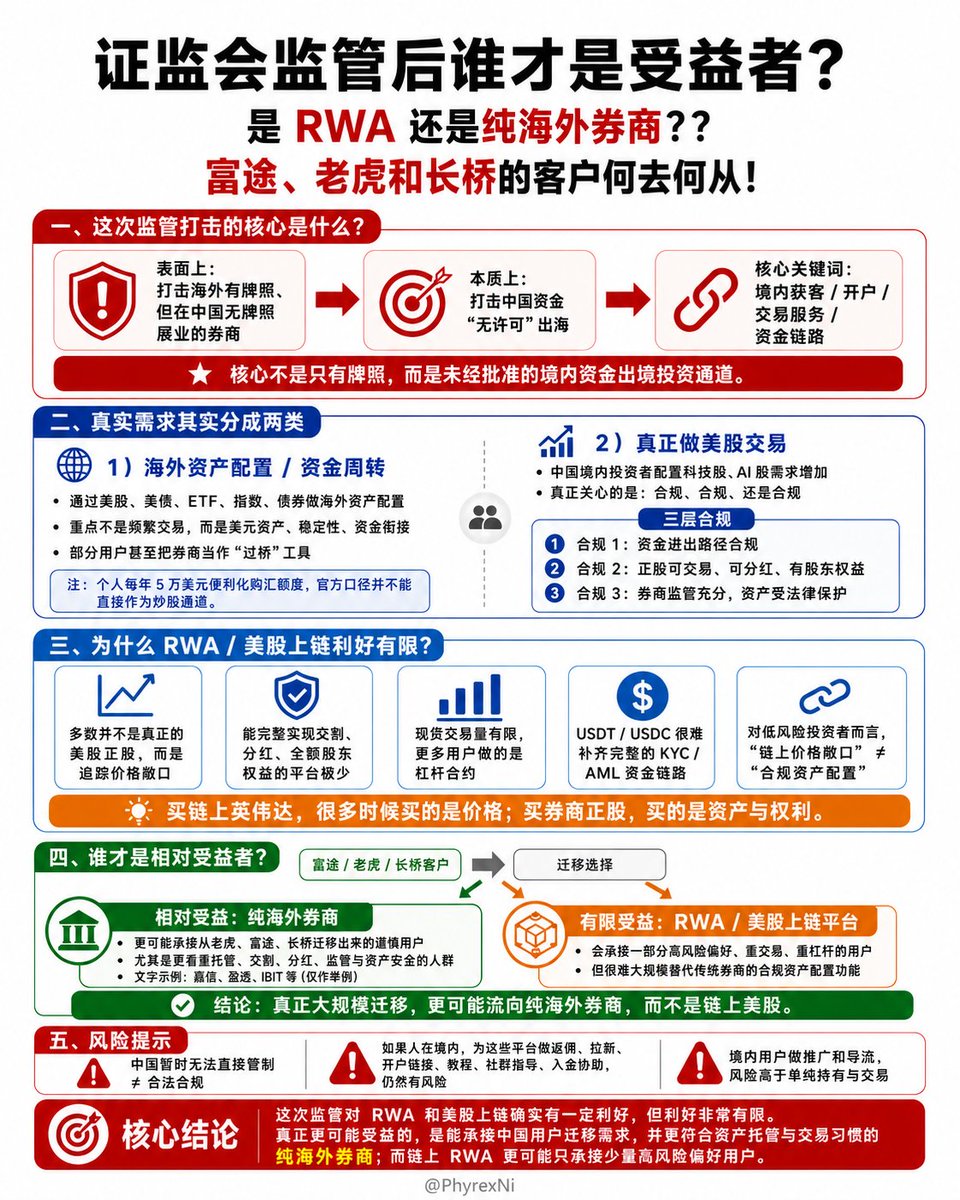
This time, it is targeting brokers that have legal licenses overseas but operate without a license in China. I have also mentioned this in previous analyses; essentially, it is aimed at curbing "unlicensed" outflows of Chinese capital, so there are two key points here.
The first: circulating funds with overseas brokers.
This aspect arises from overseas capital allocation, where users' needs are fulfilled through buying and selling U.S. stocks, U.S. Treasury bonds, or ETFs to achieve overseas capital allocation.
In other words, buying U.S. stocks and similar products is not very crucial for the first type of users; what is important is the availability of leveraged funds. These users actually buy more ETFs, indices, and bonds mainly for asset stability; when they need to use dollar-denominated assets, they can. Some users even use brokers as a "bridge."
The second: engaging in actual trading of U.S. stocks.
There are indeed users in this category, and there are quite a few, especially after the development of AI, where many investors in China have begun to allocate technology stocks and AI stocks. This portion of users is concerned about compliance, compliance, and compliance.
Compliance 1 refers to the legality of capital inflows and outflows. Although supervision in this area is relatively strict, there are indeed compliant channels.
Additionally, it should be noted that while individuals have a quota of $50,000 each year that can be used, it cannot be used for overseas property purchases, securities investments, life insurance purchases, and investment-linked insurance products that have not yet been opened to capital projects.
In other words, the $50,000 quota can be used for travel, studying abroad, medical treatment, visiting relatives, etc., but on the official level, it cannot be directly said to be used for stock trading.
Compliance 2 refers to the broker's own compliance, meaning that stocks need to be deliverable, can pay dividends, and enjoy all shareholders' rights, rather than just tracking stock prices.
Compliance 3 refers to the regulatory compliance of the broker itself, which proves that the funds held by the broker are safe, that the transactions themselves are legal, and that the assets are protected by local laws.
This is what most U.S. stock investors are concerned about; in other words, whether they are the first type of user or the second, the focus on U.S. stock allocation is due to the legality of capital flow, and the ability to provide KYC and AML in the capital flow chain, proving that their money can flow globally.
But currently, the RWA or U.S. stocks on the blockchain may not be targeting these users.
First of all, there are almost no underlying stocks available on the U.S. stocks blockchain; most platforms provide indices that track prices, and while some may have dividend rights, it is very difficult to enjoy all shareholder rights, and platforms capable of U.S. stock deliveries on-chain are almost non-existent.
Secondly, data from exchanges and various platforms show that the spot trading that tracks stock prices has very limited transaction volumes; more users are trading contracts that track prices, often using leverage.
In simple terms, there are very few investors genuinely purchasing Nvidia on-chain, but many investors are still opening long and short contracts on Nvidia, and the capital involved is significant. This is because exchanges and platforms are more lenient in regulation, allowing users to open high-leverage contracts directly, which can be very appealing to some friends.
However, for low-risk tolerant investors, it becomes quite challenging; thus, for on-chain U.S. stocks, the issue of capital allocation is difficult to resolve. USDT and USDC still cannot complete all the AML and KYC linkages. Next, for pure trading users, tracking prices and buying and selling underlying stocks is still different, and being sufficiently compliant and relatively lenient also makes a big difference.
A bigger distinction is that one can directly exchange RMB for U.S. dollars or Hong Kong dollars through a bank for trading, while the other must navigate the "illegal" label to convert into USDT and then trade again, making the latter's promotional path more complicated.
Returning to the initial question, other brokers in Hong Kong or brokers with entities in mainland China are likely to start withdrawing from Chinese users, mainly due to regulations from the Securities Regulatory Commission, unless they have no business in mainland China or do not have diplomatic relations with China.
Overall, I think this round of regulation most benefits platforms that can allow Chinese users to open accounts without being regulated by the China Securities Regulatory Commission.
For example, pure American brokers like Charles Schwab, Interactive Brokers, and BIT are relatively the safest because they do not face direct regulation from China, especially since it does not involve CRS. These platforms should be the ones that worried users may choose to migrate to after the cleaning of the three companies, and compliant brokers themselves can transfer their "tickets" to other brokers.
PS: It is essential to note that the inability of China to regulate directly does not mean that it is legal and compliant; it only indicates that China currently cannot impose control. However, if users in mainland China engage in transactions with commissions or new user promotions for these exchanges, there are still risks involved.
As for the portion of users, the flow into the RWA and U.S. stocks on-chain in the cryptocurrency space, I personally think there will be some, but it may be very limited.
免责声明:本文章仅代表作者个人观点,不代表本平台的立场和观点。本文章仅供信息分享,不构成对任何人的任何投资建议。用户与作者之间的任何争议,与本平台无关。如网页中刊载的文章或图片涉及侵权,请提供相关的权利证明和身份证明发送邮件到support@aicoin.com,本平台相关工作人员将会进行核查。


