Key Takeaways:
- BNB Smart Chain tested NIST-backed ML-DSA-44 to prepare for quantum threats.
- BNB throughput fell 40%-50% as post-quantum transactions grew to 2.5KB on-chain.
- BNB developers target long-term quantum resilience as blockchain security standards evolve.
BNB Smart Chain developers have completed a large-scale test of quantum-resistant cryptography, offering one of the clearest demonstrations yet that blockchain networks can migrate away from vulnerable encryption systems before quantum computing becomes a practical threat.
The research centers on replacing the cryptographic algorithms currently used to secure transactions and validator consensus with post-quantum alternatives standardized by the U.S. National Institute of Standards and Technology.
While experts widely agree that quantum computers capable of breaking modern blockchain encryption are still years away, the industry has begun preparing for a future in which current systems such as ECDSA and BLS signatures may no longer be secure. Shor’s algorithm, a quantum computing technique, is theoretically capable of compromising the elliptic-curve cryptography underpinning most major blockchain networks.
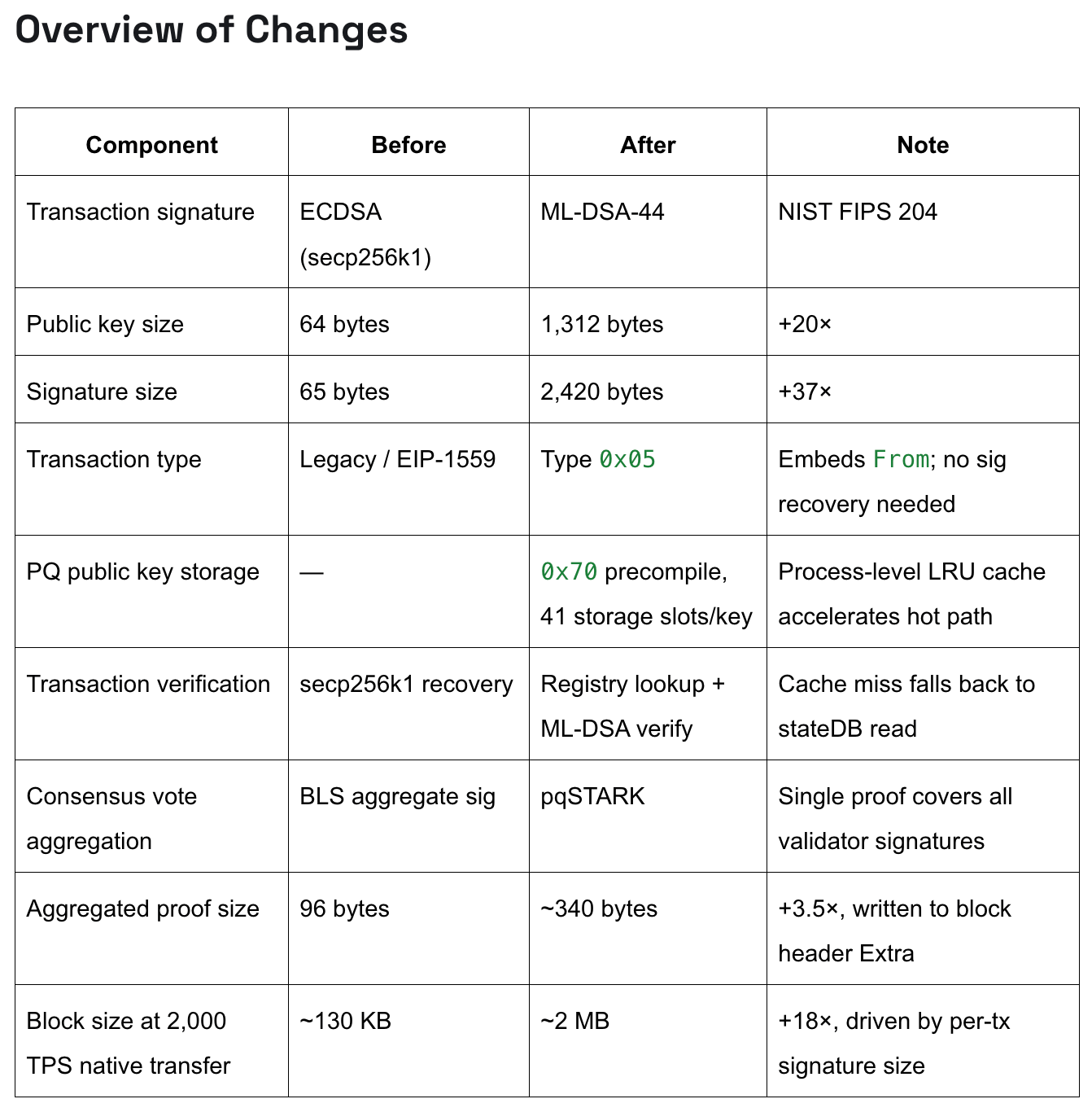
The BNB Smart Chain proposal replaces traditional transaction signatures with ML-DSA-44, a lattice-based signature algorithm standardized under NIST’s FIPS 204 framework. Consensus-layer vote aggregation is simultaneously upgraded using pqSTARK proofs.
The changes significantly improve theoretical resistance to quantum attacks, but they also expose the practical limitations of today’s blockchain infrastructure.
Under the new framework, average transaction size rises from roughly 110 bytes to about 2.5 kilobytes. At the network level, block sizes increase from around 130 kilobytes to nearly 2 megabytes under equivalent transaction loads.
In testing, throughput dropped between 40% and 50% depending on workload conditions. Cross-region performance saw the sharpest impact as larger blocks required more time to propagate across geographically distributed validator nodes.
Even so, developers said the results demonstrate that quantum-safe migration is technically feasible using current standards and infrastructure.
Quantum Test Retains Compatibility With Existing Blockchain Architecture
One of the key breakthroughs came at the consensus layer. Although individual post-quantum signatures are substantially larger than existing cryptographic signatures, aggregation through pqSTARK compression reduced validator communication overhead to manageable levels.
In one example, six validator signatures totaling 14.5 kilobytes were compressed into a proof of roughly 340 bytes, producing a compression ratio of approximately 43-to-1.
The proposal also preserves compatibility with existing blockchain tooling. Wallet addresses remain unchanged at 20 bytes and continue to rely on keccak-256 formatting, meaning most wallets, SDKs, and RPC infrastructure would not require significant redesign.
Developers selected ML-DSA-44 over larger security variants because of efficiency concerns. While stronger versions offer higher theoretical protection, they also produce substantially larger signatures that would further reduce throughput. Researchers concluded that ML-DSA-44 provides a sufficient security margin given estimates that cryptographically relevant quantum computers remain at least a decade away.
The work reflects a growing industry shift toward long-term cryptography, as blockchain networks evaluate how existing architectures would perform under quantum-resistant models.
免责声明:本文章仅代表作者个人观点,不代表本平台的立场和观点。本文章仅供信息分享,不构成对任何人的任何投资建议。用户与作者之间的任何争议,与本平台无关。如网页中刊载的文章或图片涉及侵权,请提供相关的权利证明和身份证明发送邮件到support@aicoin.com,本平台相关工作人员将会进行核查。


